

The right consulting model is the one that turns a digital transformation decision into work your team can deliver. For an SME, senior-led advice with a defined scope can be a practical fit when you need both strategic direction and implementation planning.
It’s reasonable to want experienced guidance without ending up with recommendations your lean team can’t put into practice. Firm size alone won’t tell you whether the support fits. What matters is whether the people shaping the roadmap stay involved in process redesign, system decisions and change management.
This article compares consulting models and sets out practical criteria for assessing expertise, senior involvement, scope and delivery approach. You’ll also find a step you can take before engaging a consultancy: define the business problem, the decisions you need to make and the internal capacity available to implement them. That gives you a clearer basis for choosing support that fits the work.
Key Takeaways
- Choose a consulting model based on the business problem, systems involved and your team’s capacity to deliver change.
- An alternative to McKinsey for SMEs can be a senior-led transformation consultancy that connects advice with implementation planning.
- Compare advisers on problem fit, senior involvement, scope, expected outputs and who owns each implementation task.
- Before engaging a consultancy, write down the problem, the decision you need to make, key constraints and an internal project owner.
- Match the support to the need: process reengineering, a digital roadmap and system integration address different parts of transformation.
Why SMEs look for an alternative to McKinsey
A stalled system decision, repeated manual work or a process that can’t keep pace with growth can create pressure to act. The question isn’t whether a large consulting model is universally better or worse. It’s whether the engagement fits the problem, the decisions you need to make and the people available to carry the work forward.
Broad strategic direction can help when a challenge spans the organisation and requires a wide-ranging response. A focused transformation assignment calls for advice tied to a defined decision, such as redesigning a process, selecting a system or planning how to implement a change. Judge the fit by the work and delivery needs, not by firm size alone.
A fit-for-purpose consulting alternative gives an SME the senior advice, defined outputs and implementation support needed to move a specific business problem into action.
What SME decision-makers need from a consulting engagement
Start with the decision or operational constraint prompting the search. Is a process slowing routine work? Are disconnected systems making information hard to use? Define the output you need, the decisions it must support and the internal owner who can coordinate the work.
A tight scope helps a lean team focus on relevant findings and clear next steps. It also makes responsibilities visible: what the adviser will deliver, what your team must decide and what needs to happen before implementation can begin.
When a global consulting model may not fit the assignment
A global model may suit a complex challenge spanning multiple functions or systems. For a focused transformation decision, test whether the proposed scope, access to senior expertise and delivery support match the work. This is a question of assignment fit, not consulting quality.
If the immediate need is to understand a process constraint and plan a practical improvement, broad direction alone may leave your team with unresolved decisions. A defined business process improvement approach can help connect diagnosis to action.
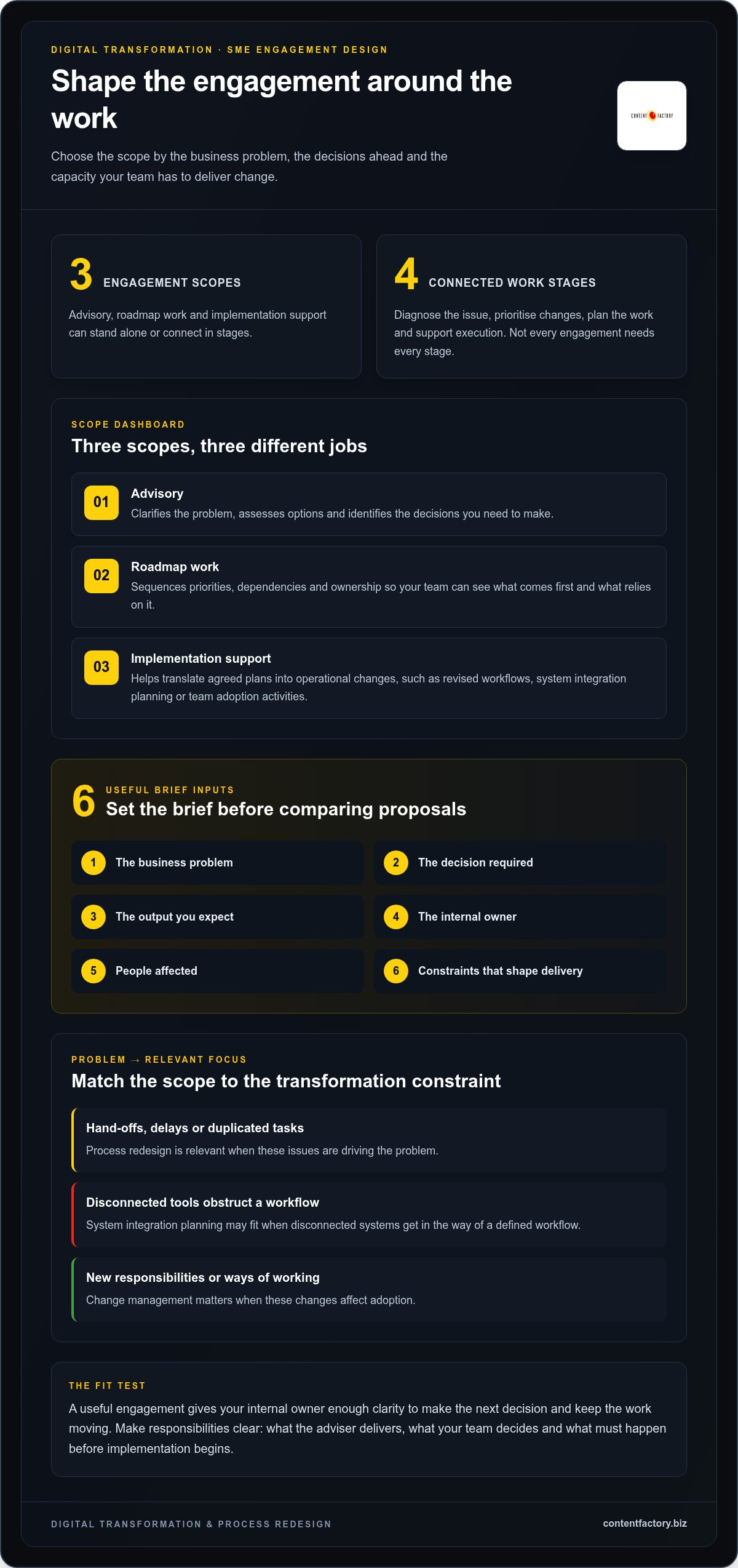
Before speaking with an adviser, write a short brief: name the problem, the decision required, the output you expect and the internal owner. Add the people affected and the constraints that could shape delivery. This gives you a concrete basis for comparing scope and implementation responsibilities, rather than relying on credentials or a polished proposal.
What kind of consulting alternative fits an SME’s digital transformation?
A focused transformation consultancy diagnoses the operational issue, prioritises the changes that matter, plans the work and supports execution. Not every engagement needs all four stages. The right scope depends on the business problem, the systems involved and how much ownership your team can take on.
For example, if information is entered repeatedly across disconnected systems, the issue may involve both process design and integration. If the tools are adequate but a new workflow isn’t being adopted, change management may be central. The scope should follow the cause of the problem, not a preset package.
Advisory, roadmap and implementation support are different scopes
Advisory clarifies the problem, assesses options and identifies the decisions you need to make. Roadmap work sequences priorities, dependencies and ownership so your team can see what comes first and what relies on it. Implementation support helps translate agreed plans into operational changes, such as revised workflows, system integration planning or team adoption activities.
Match the engagement to the transformation problem
Start by matching the work to the constraint. Process redesign is relevant when hand-offs, delays or duplicated tasks are driving the problem. System integration planning may fit when disconnected tools obstruct a defined workflow. Change management matters when new responsibilities or ways of working affect adoption.
A practical scope might begin with mapping one process, then identifying the system decisions and ownership needed to improve it. A broader roadmap may be warranted if several connected processes or systems need to change together. ContentFactory’s Digital Transformation & Process Redesign support connects process redesign, roadmapping and system integration to defined business needs.
Before deciding on scope, list the specific process or system constraint, the decision you need to make and the internal owner who can coordinate it. If you’re defining a digital transformation engagement for your business, discuss your transformation requirements.
How to compare consulting models beyond the brand name
A proposal should make clear how the adviser will address your business problem, who will lead the work and what your team will receive. Compare options against the same criteria. A recognised name or a small team, on its own, tells you little about whether the engagement fits your transformation needs.
Consulting fit depends on scope, ownership and delivery requirements, not brand size alone. This is especially relevant when your internal team has limited capacity: a sound recommendation still needs a clear owner, realistic dependencies and a workable route into day-to-day operations. Harvard Business Review has examined changes in consulting models in its discussion of disruption in management consulting.
Evaluate expertise, access and defined outputs
Look beyond general claims of transformation expertise. Does the proposed team understand the specific process, systems or implementation decision at the centre of your assignment? Ask who will shape the analysis and remain involved when key decisions are made. Senior involvement matters most when it is connected to the work, not just presented at the start.
Then test the proposed outputs against the business question. If you need to decide how to integrate systems, a useful deliverable should clarify the options, assumptions and dependencies relevant to that decision. Identify who in your organisation owns each action, and what information or approval they will need to proceed.
Assess execution and organisational fit
Clarify exactly which activities are included after recommendations are made. An engagement may cover diagnosis and planning without supporting operational changes. Another may include implementation planning or change support. Neither scope is automatically better; the important point is knowing where the adviser’s responsibility ends and your team’s begins.
Check whether the plan accounts for your existing systems and workflows, along with the people affected by the change. A proposal that skips these constraints may be difficult to put into practice, even if the analysis is sound. Avoid comparing advisers on unverified savings, promised timelines or guaranteed outcomes. Compare the quality and relevance of the work they propose instead.
- Problem fit: Does the approach address the operational issue you have defined?
- People and access: Who leads the work, and who will be involved in key decisions?
- Scope and outputs: What will be delivered, and what is explicitly outside the engagement?
- Assumptions and dependencies: What must your team provide, decide or complete?
- Implementation responsibility: Which activities belong to the adviser, and which need an internal owner?
Use this same checklist for every proposal. ContentFactory’s digital roadmap and implementation planning connects transformation priorities with sequencing, dependencies and ownership.
Build a practical brief before choosing a consulting partner
A short written brief helps you compare proposals against the work your business actually needs. Describe the operational problem, the decision you need to make and the constraints any adviser must account for. Keep the brief focused on what is happening now, rather than prescribing a solution before the issue is understood.
A shared brief also gives each adviser the same starting point. That makes it easier to see whether proposals differ in scope, outputs or assumptions, rather than in how each has interpreted the assignment.
Write a transformation brief that keeps proposals comparable
Describe the workflow or system issue in practical terms. Note where delays occur, information is re-entered or hand-offs break down. List the existing tools, teams involved and known dependencies, along with any limits on staff time or access. This gives advisers useful context without steering them towards a particular technology or approach.
Next, state the decisions the work must support and what outputs would be useful. Name an internal owner and identify the people whose roles or daily work may be affected. You can ask each adviser to set out:
- The proposed scope, activities and outputs
- Who will lead the work and take part in key decisions
- Your team’s responsibilities and required inputs
- Assumptions, dependencies and work outside the scope
- How recommendations connect to implementation planning
For guidance on sequencing technology decisions and delivery, read this digital roadmap and implementation planning guide.
Use a decision checklist before committing
Check that each proposed scope addresses the problem you described. Confirm who will be involved in decisions, what your internal owner must coordinate and where the adviser’s implementation responsibilities end. These details help you judge whether the proposed work is realistic for your team.
Record unresolved assumptions, such as access to system information, staff availability or input from another team. Ask for clear explanations before making a selection. If you’re ready to discuss a digital transformation scope, Contact Us.
How ContentFactory supports SME digital transformation
For an SME, a transformation plan only helps if it addresses the operational problem and gives your team a workable route to act. ContentFactory supports digital transformation by connecting process reengineering, roadmap planning and system integration to the needs of the business. The aim is practical alignment: identify what is getting in the way, decide what should change and plan how to put that change into operation.
This can make ContentFactory an alternative to McKinsey for SMEs whose requirement is focused digital transformation and process redesign. The right starting point isn’t a technology purchase. It’s a clear view of the process, systems and people involved.
From transformation diagnosis to an executable roadmap
Process reengineering helps examine how work moves through your organisation. It can surface unnecessary steps, delays, duplicated effort or unclear hand-offs. That diagnosis informs the roadmap: which improvements to prioritise, what decisions are needed and how the work can be sequenced around dependencies and internal ownership.
System adoption and integration planning then relate technology choices to the agreed operational need. If a workflow depends on information moving between systems, the plan should address that connection rather than treat each system as a separate decision. ContentFactory’s Digital Roadmap and Implementation Planning service links priorities to implementation planning, so recommendations can lead to defined next steps.
Keep delivery grounded in the SME’s operating reality
A practical scope must account for the team that will carry the change. That means clarifying who owns decisions, what your staff can support and which implementation activities sit within the engagement. Change management matters when revised workflows or systems alter people’s roles and day-to-day responsibilities. Without clear ownership and attention to adoption, a technically sound plan can still be difficult to put into practice.
Senior-led advice can help keep the work connected from diagnosis through planning and delivery. Mayuresh Godse is a Singapore Certified Management Consultant with 25+ years of consulting experience. That credential belongs to him, not to the firm as a whole. ContentFactory combines senior-led advisory with hands-on implementation support for SMEs.
Choose a scope that fits your actual constraint. You may need to redesign a process, establish a roadmap, plan system integration or support teams through change. The work should make clear what your business needs to decide and who will take each step forward.
To discuss digital transformation and process redesign for your SME, Contact Us.
Choose support that moves the work forward
The right alternative to McKinsey for SMEs is the consulting model that fits your transformation problem, your team’s capacity and the implementation support you need. Compare proposals on scope, senior involvement, outputs, ownership and assumptions. Before engaging anyone, write a brief that defines the decision and the operational constraints.
ContentFactory supports SMEs with digital roadmaps, process redesign, technology adoption and system integration. Mayuresh Godse is a Singapore Certified Management Consultant with 25+ years of consulting experience. The focus is practical: connect the diagnosis to clear priorities, responsibilities and delivery planning.
Ready to discuss the transformation challenge your business needs to solve? Contact Us to take a considered next step.
With a clear problem and the right support, your team can move from uncertainty to action. Book a Strategic Consultation.
Frequently Asked Questions
Is McKinsey the right consulting choice for an SME?
The right choice depends on the complexity and scope of your challenge, and the decisions the engagement must support, not company size alone. Before assessing any proposal, define the output you need, the senior adviser access that matters and the implementation responsibilities involved. Clarify what your team can own and what support you expect. Then compare equivalent scopes, deliverables and roles to make a grounded choice.
What is an alternative to McKinsey for SMEs?
An alternative to McKinsey for SMEs is a consulting model that fits a specific business problem and your team’s capacity to deliver change. Options may include focused strategic advice, digital transformation roadmapping or support putting agreed plans into practice. Compare the adviser’s relevant expertise, scope, outputs, internal ownership and implementation responsibilities. Neither a smaller nor a larger firm is automatically the better fit; the assignment requirements should guide your decision.
How can an SME compare consulting firms fairly?
Give each adviser the same brief and assess every proposal against the same criteria. Compare how well the approach fits your problem, who will lead the work, what deliverables you’ll receive, which assumptions apply and what your team must own. Check whether implementation support is included and where responsibilities end. Equivalent criteria make differences easier to understand. Don’t rely on brand recognition, unverified client outcomes or savings claims alone.
Can a smaller consultancy support digital transformation implementation?
It can, if the agreed scope and the adviser’s relevant capabilities include implementation support. Clarify whether the work covers process redesign, roadmap planning, system adoption, integration or change management. Separate advice and planning deliverables from the activities your team or adviser will carry out. A written scope should name responsibilities, dependencies and boundaries before work begins. This helps you assess whether the proposed support matches your operational needs without relying on promises about speed or results.
What should an SME include in a digital transformation consulting brief?
Include the operational problem, decisions you need to make, affected workflows, existing systems, known constraints and an internal owner. State what outputs would make the work useful, but avoid prescribing a solution before the issue is understood. Ask each adviser to explain the proposed scope, assumptions, roles, dependencies and implementation boundaries. A shared brief gives you a practical basis for comparing proposals and helps clarify expectations before an engagement begins.
How do I know whether my SME needs a roadmap or implementation support?
A roadmap helps when priorities, dependencies or the sequence of decisions remain unclear. Implementation support fits when you’ve agreed what needs to change and need help translating the plan into operational work. Some assignments need both, with distinct deliverables and responsibilities for each stage. Start by identifying the current gap: is your team unsure what to prioritise, or clear on the plan but unable to put it into practice?
What does a digital transformation consultancy do for an SME?
A digital transformation consultancy can review business processes, plan a digital roadmap, assess technology adoption and integration needs, and support change management. The specific scope should reflect your problem and the outputs you agree. The work should connect recommendations to actual workflows and systems, not stop at general strategic direction. Clear internal owners also matter, so decisions and follow-up actions have accountable people in your organisation.

Article by
Mayuresh Godse
Mayuresh Godse is a Singapore Certified Management Consultant and Business Strategist specializing in Sustainability, ESG, AI-driven Digital Transformation, and business growth. Based in Singapore, he writes about Sustainability, Digital Innovation, Business Strategy, and Content Marketing for global audiences.
Disclaimer
This article is provided by ContentFactory for general information only and is not legal, tax, accounting or financial advice. Regulations and government scheme criteria change; grant eligibility and quantum are set by the relevant Singapore agencies and assessed case by case, with no outcome guaranteed. Verify current requirements before acting.