

The biggest ASEAN expansion risk isn’t choosing the wrong country. It’s treating a promising market as a proven one. A regional adviser helps you test that assumption by assessing feasibility, competitor conditions, product positioning and potential local partners, then turning the evidence into clear decisions.
If you’re unsure which opportunity deserves investment, or don’t have the capacity to validate demand and assess partners on the ground, that uncertainty is understandable. Advice that stops at a report won’t resolve it. You need a practical view of what the evidence supports, what remains uncertain and what your business can realistically pursue.
This article explains what market-development advice should cover, how to assess whether an engagement fits your priorities, and what useful deliverables look like. You’ll see how feasibility, positioning and partner due diligence connect, and how to turn them into next steps aligned with your resources, rather than a theoretical expansion plan.
Key Takeaways
- Translate regional growth goals into specific market decisions before committing resources.
- Use TAM analysis to frame potential demand, then test assumptions against market evidence.
- Assess local partners for fit, capability, supporting evidence and potential risks.
- Choose an ASEAN business development consultant with relevant expertise, a defined scope and decision-useful outputs.
- Agree the decision, share business context and review findings so you can choose practical next steps.
What an ASEAN business development consultant does for a growing company
An ASEAN business development consultant helps you turn regional growth goals into assessable market decisions. Rather than assuming that a promising opportunity deserves investment, the adviser helps examine where to focus, how to position your offer and what route to market may be workable.
This support can matter when expansion planning competes with day-to-day responsibilities and your team has limited regional experience. The remit may include market feasibility, competitor assessment, product positioning, potential partner due diligence and cross-border considerations. The work should connect these questions, because a market opportunity is only useful if your business can reach customers and operate through a suitable route to market.
The role is advisory, not a sales representative acting on your behalf or an employee with an open-ended job description. It also doesn’t guarantee demand, partner performance or commercial results. The value lies in structuring the decision and making the available evidence easier to use.
When external ASEAN market-development advice is useful
Consider external advice when your market hypothesis is untested, your route to market is unclear or several opportunities are competing for limited resources. If your internal team lacks experience in the markets under consideration, an adviser can organise the questions, identify information gaps and help you compare options against your business objectives.
That doesn’t mean every business needs a consultant. If your team already has reliable market evidence and a clear decision process, you may be able to proceed internally. Start by writing down the decision you need to make, the assumptions behind it and the evidence that would change your view.
What a business should expect from the role
Expect questions that test the business case: who might buy, what alternatives exist, how your offer should be positioned and what evidence supports a potential partner’s stated capability. The scope should set out which markets and questions are in scope, what information will be reviewed and what recommendations you’ll receive. Outputs should reflect your objectives and the information available, with assumptions and evidence gaps made clear.
An ASEAN business development consultant turns market questions into evidence-led decisions, not promised commercial outcomes.
For an SME or mid-market company, decision-ready recommendations might clarify which opportunity to assess further, what partner evidence to seek or which assumptions need validation before committing resources. ContentFactory’s ASEAN and India market expansion support connects feasibility, positioning and partner due diligence to practical decisions.
How an ASEAN consultant assesses market opportunity and feasibility
A credible market assessment starts with a decision, not a market-size figure. An ASEAN business development consultant should connect your growth objective to evidence about demand, competition, routes to market and your organisation’s ability to act. The aim is to test whether an opportunity merits further commitment, not to present an estimate as a promise.
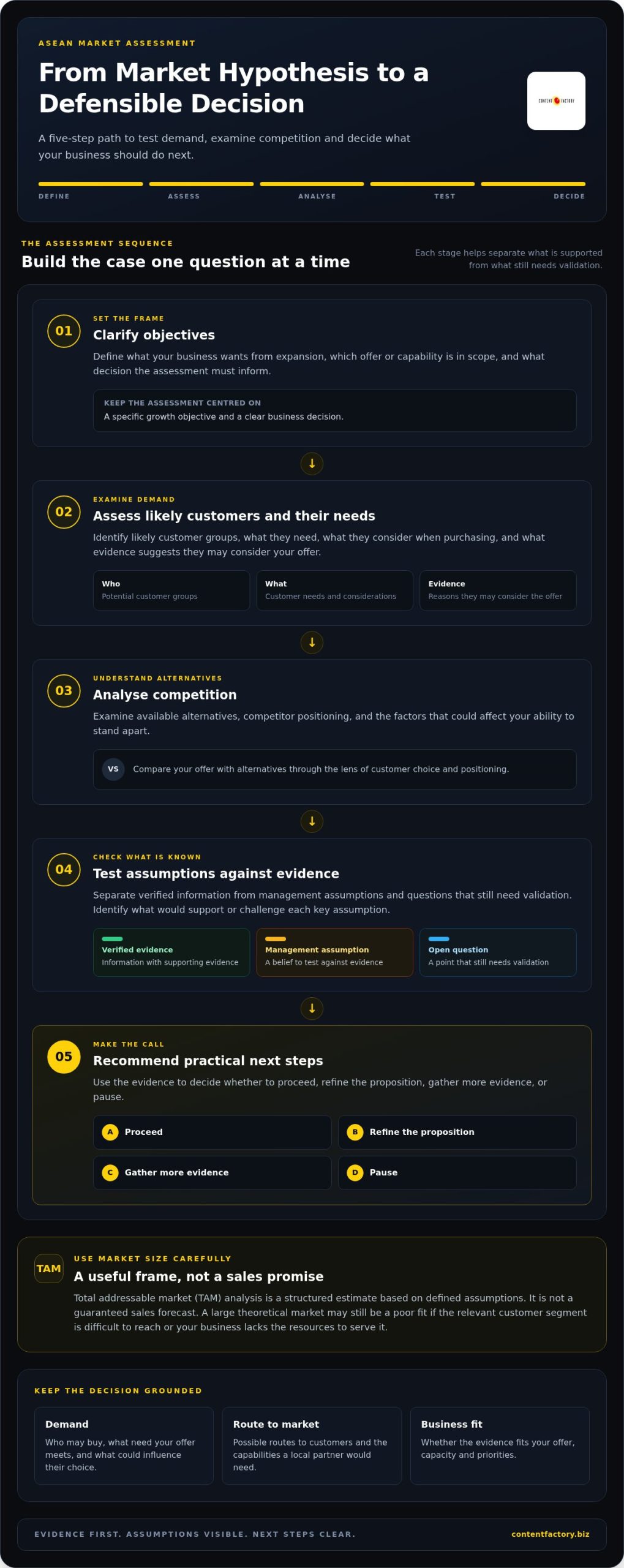
A practical assessment can follow five steps:
- Clarify objectives. Define what your business wants from expansion, which offer or capability is in scope, and what decision the assessment must inform.
- Assess demand. Identify likely customer groups, their needs, purchasing considerations and the evidence that suggests they may consider your offer.
- Analyse competition. Examine alternatives, competitor positioning and the factors that could affect your ability to stand apart.
- Test assumptions. Separate verified information from management assumptions and questions that still need validation.
- Recommend next steps. Set out whether to proceed, refine the proposition, gather more evidence or pause.
Total addressable market (TAM) analysis can help frame the potential demand for an offer. It is a structured estimate based on defined assumptions, not a guaranteed forecast of sales. A large theoretical market may still be a poor fit if the relevant customer segment is difficult to reach or your business lacks the resources to serve it.
Which evidence supports a credible market-entry decision?
Useful evidence should address the decision at hand. Ask who the potential customers are, what need your offer meets, how they currently address it and what could influence their choice. Then assess the alternatives available, possible routes to market and the capabilities a local partner would need to provide.
Feasibility depends on the fit between that evidence and your own offer, capacity and priorities. Record each point as verified evidence, a management assumption or an open question. Public resources such as the US International Trade Administration’s overview of business opportunities in Southeast Asia can provide regional context, but they don’t replace current, market-specific validation. ContentFactory’s market entry strategy and feasibility work brings these considerations into a decision-focused assessment.
How to turn a market hypothesis into a decision
Write down the assumptions that must hold true before you commit resources. These might concern customer demand, your proposition’s fit, competitor alternatives or a partner’s ability to reach the intended buyers. For each assumption, identify what evidence would support it and what would challenge it.
Use that evidence to set a clear decision gate: proceed if the case is supported, revise the proposition if the fit is weak, gather evidence if key questions remain open, or pause if the opportunity doesn’t align with your resources. Country-specific requirements should be checked against current, named official sources before decisions rely on them. If you need to structure that assessment, discuss your market-entry decision with ContentFactory.
How to assess consultant fit, scope, and partner-diligence capability
A good fit is more than regional familiarity. Your adviser should understand the commercial questions in your sector, explain how evidence will be gathered and analysed, and produce outputs that help you make a decision. An ASEAN business development consultant should also be clear about where the advisory remit ends: the engagement supports your team’s judgement, but doesn’t replace your ownership of the market decision.
Assess the proposed work against your actual expansion question. If you need to understand how your offer compares with local alternatives, competitor benchmarking and product positioning may be central. If your route to market depends on a local intermediary, partner diligence needs a defined place in the scope. The method should connect these workstreams rather than treat them as unrelated findings.
What a clear consultancy scope should specify
Before work begins, agree the objective, target market and decision the engagement must support. The scope should identify workstreams, responsibilities, information your business needs to provide, expected deliverables and review points. It should also make clear how findings will be shared and how open questions or changes in direction will be handled.
Scope should fit your decision timeline and available inputs, not a generic package. For example, an assessment based on existing company and market information will differ from one that needs additional validation. Look for transparent methods and recommendations that distinguish evidence from assumptions. A broad report without a defined decision purpose is difficult to act on.
How partner due diligence supports market-entry decisions
Partner due diligence should examine strategic fit, relevant capabilities, supporting evidence and potential risks. Consider whether the prospective partner’s stated reach and experience match your intended route to market, what evidence supports those claims, and whether proposed responsibilities and working arrangements are clear. Findings can inform comparison and selection, but they can’t guarantee future performance. For a closer look at what to verify, see this guide to distributor due diligence in ASEAN.
Partner due diligence turns claims about fit and capability into evidence you can weigh before making a market-entry decision. ContentFactory’s distributor and partner due diligence work can sit alongside competitor benchmarking and product positioning when both inform your route to market.
Use a simple fit test before agreeing an engagement: can the adviser explain the method, show how the scope maps to your decision, and specify what your team will be able to assess at the end? If you’re defining that scope, discuss your market-expansion priorities with ContentFactory.
How to govern an ASEAN market-development engagement
A useful engagement needs active input from your business, not just a final presentation. The owner or executive sponsor supplies context, clarifies priorities and makes decisions when evidence points in different directions. The adviser structures the work and analyses the findings; your team remains accountable for choosing what to do.
Set up the engagement as a sequence of decisions:
- Agree the decision. State the business question, target market and intended decision. For example, are you deciding whether to enter a market, refine your product positioning or assess a potential partner?
- Establish the scope. Confirm the workstreams, responsibilities, inputs, deliverables and review points. Make sure the scope reflects the question, not a generic list of activities.
- Share relevant inputs. Provide the business context, existing market knowledge, offer details and resource constraints needed to assess the opportunity.
- Review evidence together. Discuss findings, assumptions and unresolved questions at agreed points. Correct gaps in context before they shape the recommendations.
- Choose next steps. Decide whether to proceed, adjust the proposition, gather further evidence or pause, and assign an internal owner to each action.
What to agree before work begins
Write down what is in scope and what is not. Specify the target-market boundaries, the responsibilities of your team and the adviser, the information required, and the decision the work is meant to support. Agree how evidence gaps and assumptions will be recorded, raised and revisited.
Review points should give you a chance to check direction and address new questions without assuming a fixed project duration. If the business question changes, revisit the scope before treating the original deliverables as sufficient.
How to make recommendations usable
Ask for prioritised options, the rationale behind each one and practical next actions. Recommendations should show how evidence informs market-entry choices, product positioning or partner assessment, while making clear what remains uncertain. They should also reflect your organisation’s capacity: an action without an owner or available resources is not an executable next step.
Use the review to confirm who will own each action, what decision is needed next and which open questions still matter. This turns findings into a managed decision process rather than a report that sits apart from day-to-day business choices.
For broader context on connecting regional expansion choices, read ContentFactory’s ASEAN strategic advisory guide. If you’re shaping an engagement around a specific market decision, Contact Us.
Choosing an ASEAN business development consultant for execution-ready advice
The right adviser should help you move from a regional ambition to a decision your business can act on. Assess the fit against four practical criteria: relevant sector and market-expansion experience, a defined scope, transparent methods that distinguish evidence from assumptions, and clear accountability for agreed outputs. An ASEAN business development consultant should make it easier to evaluate your options, not leave your team with a report and no decision path.
- Relevant expertise: Look for experience that fits your sector and the questions your business needs to resolve.
- Defined work: The scope should identify the markets, workstreams, inputs and deliverables.
- Usable evidence: Findings should support decisions about feasibility, positioning or partner fit.
- Clear accountability: Agree who supplies information, reviews findings and makes the business decisions.
External advice is not an internal job description or a substitute for business ownership. The adviser brings structured analysis and regional perspective; your team provides company context, sets priorities and decides what to pursue. For SMEs and mid-market firms, senior-led guidance and access to regional expertise can be relevant when internal capacity or market experience is limited.
How ContentFactory supports ASEAN market expansion
ContentFactory’s ASEAN & India Market Expansion support brings together market feasibility and TAM analysis, competitor benchmarking, product positioning, distributor and partner due diligence, and cross-border compliance advisory. These workstreams can be shaped around the decision your business needs to make, so market evidence and partner considerations inform practical next steps. Cross-border compliance considerations are treated as general advisory matters, not legal or tax advice.
Explore the ASEAN and India market-expansion services to see how these areas fit within a regional growth engagement.
What to prepare for a first strategic discussion
Bring your growth objective, current assumptions about the target market and the constraints that affect your decision. Note what your business already knows, what remains uncertain and which decision is pending. It also helps to identify the resources your team could commit if the evidence supports moving forward.
This preparation keeps the discussion focused on the decision, not a generic overview of the region. ContentFactory provides senior-led market-expansion guidance for SMEs and mid-market companies across ASEAN and India, connecting feasibility, positioning and partner assessment to practical business choices. Book a Strategic Consultation.
Turn ASEAN expansion questions into clear next steps
Regional growth decisions need more than an attractive market hypothesis. They need evidence on feasibility, a clear view of how your offer could be positioned, and careful assessment of potential partners. A well-scoped engagement connects those findings to choices your business can resource and own.
The right adviser should make assumptions visible, explain the basis for recommendations and help you identify what to do next. That doesn’t mean promising a result. It means giving decision-makers a practical foundation for proceeding, refining the opportunity or pausing.
ContentFactory’s ASEAN & India Market Expansion support is led by Mayuresh Godse, a Singapore Certified Management Consultant with 25+ years of consulting experience. Its regional network of experts and experience across manufacturing, technology, logistics and retail support practical market-expansion guidance for SMEs and mid-market firms.
Bring your growth objective, key assumptions and pending decision into the discussion. Contact Us to book a 30-minute discovery call and discuss a focused next step for your business.
Frequently Asked Questions
What does an ASEAN business development consultant do?
An ASEAN business development consultant helps turn regional growth objectives into assessable market decisions. The work can include evaluating market feasibility, framing potential demand through TAM analysis, benchmarking competitors, refining product positioning and assessing potential distributors or partners. Recommendations should explain the evidence, assumptions and open questions behind them. The adviser supports your decision-making; they don’t guarantee demand, partner performance or commercial results.
When should a company engage an ASEAN business development consultant?
Consider engaging a consultant when your business has an untested market hypothesis, an unclear route to market or limited internal capacity to evaluate regional opportunities. External support can help structure the questions and compare options against your objectives and resources. It may be unnecessary if your team already has reliable evidence, relevant regional experience and a clear process for deciding where to focus.
How do I choose an ASEAN market development consultant?
Choose an ASEAN business development consultant whose experience fits your sector and the decision you need to make. Look for a clear scope, transparent methods and outputs that separate verified evidence from assumptions and unanswered questions. Ask how the work will address feasibility, competitor conditions, positioning or partner assessment as relevant. The engagement should clarify responsibilities and provide recommendations your business can evaluate and act on.
What should an ASEAN market-entry consultancy deliver?
A market-entry consultancy should deliver findings tied to your agreed objectives, not a generic regional overview. Depending on scope, outputs may include a feasibility assessment, TAM analysis, competitor benchmarking, positioning considerations, partner-diligence findings and prioritised next steps. The work should identify supporting evidence, management assumptions and information still requiring validation. Recommendations should inform decisions while making clear that market outcomes cannot be guaranteed.
How does a consultant assess whether an ASEAN market is viable?
A consultant assesses viability by connecting potential demand and customer needs with competitor alternatives, possible routes to market and your business’s ability to serve the opportunity. TAM analysis can frame potential demand, but it isn’t a sales forecast. The assessment should test assumptions, identify evidence gaps and consider relevant market-specific factors. Any country-specific requirements should be checked against current, named official sources before decisions rely on them.
What is the difference between a consultant and a business development manager?
A consultant is typically engaged to assess a defined business question, such as market feasibility, positioning or partner fit, and provide recommendations for a decision. A business development manager is generally an internal role with ongoing responsibilities set by the organisation. The distinction is the engagement’s purpose and accountability: advisory work informs business choices, while the company retains ownership of decisions and any continuing market-development activity.
Can an ASEAN consultant help assess distributors and local partners?
Yes. A consultant can assess a potential partner’s strategic fit, relevant capabilities, supporting evidence, proposed responsibilities and working arrangements. This helps your business compare potential partners against its route-to-market needs and identify questions that remain unresolved. Due diligence can inform selection, but it cannot guarantee a partner’s future performance. Findings should be considered alongside market feasibility and the resources your business can commit to the relationship.
What should I prepare before speaking with a market-expansion consultant?
Prepare your growth objective, the markets or opportunities under consideration and the decision you need to make. Note your current assumptions, what evidence supports them, what remains uncertain and any constraints on your team’s capacity or resources. You don’t need a complete market assessment before the discussion. A clear summary of what you know and what you need to decide gives the conversation a practical starting point.

Article by
Mayuresh Godse
Mayuresh Godse is a Singapore Certified Management Consultant and Business Strategist specializing in Sustainability, ESG, AI-driven Digital Transformation, and business growth. Based in Singapore, he writes about Sustainability, Digital Innovation, Business Strategy, and Content Marketing for global audiences.
Disclaimer
This article is provided by ContentFactory for general information only and is not legal, tax, accounting or financial advice. Regulations and government scheme criteria change; grant eligibility and quantum are set by the relevant Singapore agencies and assessed case by case, with no outcome guaranteed. Verify current requirements before acting.