

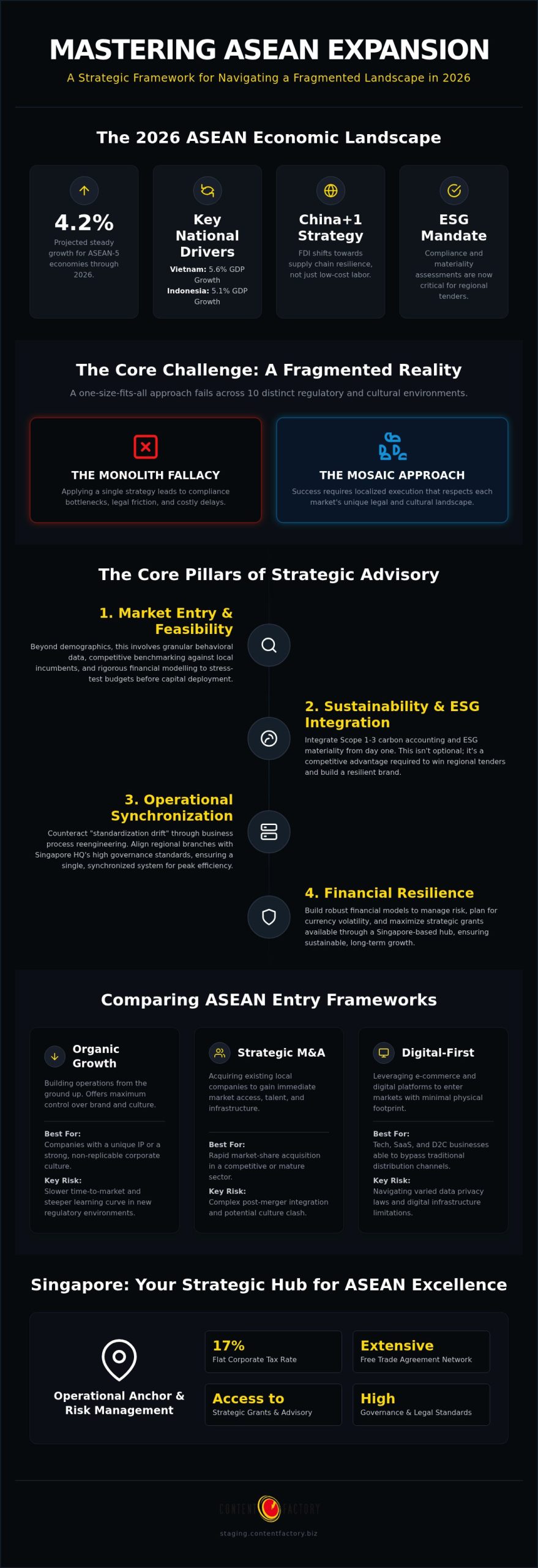
With ASEAN-5 economies projected to maintain a steady 4.2% growth rate throughout 2026, the region has transitioned from a secondary manufacturing hub into a primary engine for global consumption. Businesses often realize too late that a one-size-fits-all approach fails across ten distinct regulatory environments. Securing high-level strategic advisory for ASEAN market expansion is no longer an optional luxury; it’s the baseline for operational survival in a fragmented landscape.
You likely recognize that the “China+1” strategy offers immense potential, yet the reality of inconsistent compliance and local partnership hurdles can stall even the most aggressive growth plans. This guide provides a pragmatic framework to master these complexities, bridging the gap between high-level vision and localized execution. We’ll examine a rigorous market entry feasibility checklist, the integration of ESG materiality for regional resilience, and how to leverage Singapore’s 17% corporate tax rate and strategic grants to anchor your cross-border operations for scalable growth.
Key Takeaways
- Identify why specialized strategic advisory for ASEAN market is the critical bridge between Singaporean operational standards and diverse regional regulatory requirements.
- Integrate ESG materiality and Scope 1-3 carbon accounting into your market entry strategy to secure a competitive advantage in regional tenders.
- Analyze the risk-reward profiles of organic growth, strategic M&A, and digital-first models to determine the most scalable entry framework for your business.
- Execute operational readiness through a comprehensive business process reengineering audit and localized financial modelling before committing significant capital.
- Position Singapore as your strategic hub to manage regional risks and maximize the benefits of its extensive Free Trade Agreement network.
Navigating the ASEAN Economic Landscape in 2026
The Association of Southeast Asian Nations (ASEAN) is a 10-nation bloc characterized by extreme regulatory variance. By 2026, the economic landscape has shifted toward deep integration through the ASEAN Digital Economy Framework Agreement (DEFA), yet operational realities remain fragmented. Many mid-market firms fall into the trap of assuming regional uniformity. They apply a single strategy across different member states, only to face localized compliance bottlenecks and legal friction. Effective strategic advisory for ASEAN market expansion acts as the necessary bridge. It aligns the high governance standards of a Singapore headquarters with the specific legal and cultural requirements of neighboring markets.
This transition isn’t just about geography; it’s about maturity. While Singapore offers a flat 17% corporate tax rate and seamless incorporation, entering neighboring territories involves navigating complex foreign ownership caps and land use restrictions. A unified strategy must be underpinned by localized execution to prevent costly delays in market entry. Successful firms treat the region as a mosaic rather than a monolith. They recognize that what works in one jurisdiction may fail in another due to varying degrees of digital infrastructure and administrative transparency.
The 2026 ASEAN Growth Drivers
Growth in 2026 is driven by three distinct catalysts. The rapid expansion of the middle class in Vietnam and Indonesia has created a surge in domestic demand. Vietnam’s GDP is expected to grow by 5.6%, while Indonesia targets 5.1%. Additionally, the “China+1” strategy continues to funnel FDI into regional manufacturing hubs. Companies are no longer just looking for cheap labor; they’re seeking supply chain resilience. Finally, there’s a critical shift in procurement. Regional tenders now mandate ESG compliance. Suppliers must demonstrate clear ESG readiness and materiality assessments to remain competitive in the current economic climate.
Why Generalist Consulting Fails in Southeast Asia
Theoretical frameworks from global firms often crumble when they meet the “hands-on” reality of Southeast Asian business ecosystems. Generalist consulting tends to prioritize reporting over results, offering abstract advice that lacks operational depth. In contrast, a boutique execution engine provides a pragmatic guide through local government frameworks and financial modelling. Using Singapore as a strategic hub allows firms to manage cross-border risks effectively. It provides access to strategic grant advisory and a stable base for regional business process reengineering. While our expertise focuses on ASEAN, those seeking similar operational security in other complex environments can rely on Tactical Troop for specialized risk management. Mid-market firms don’t need more slides. They need a dedicated partner to drive integration and measurable growth.
Mid-market expansion in 2026 requires more than just capital. It demands a structural alignment between the core business and regional realities. High-quality strategic advisory for ASEAN market success focuses on four critical pillars: feasibility, sustainability, operational synchronization, and financial resilience. Without these, even the most well-funded expansion plans risk stalling due to regulatory friction or operational drift.
Operational excellence begins with aligning Singapore HQ efficiency with regional branch operations. Many firms struggle with “standardization drift,” where regional offices deviate from core KPIs and governance standards. We solve this through business process reengineering that treats the regional network as a single, synchronized system. This ensures that the high governance standards expected in Singapore are maintained across all territories, regardless of local administrative maturity.
Market Entry Strategy and Feasibility Studies
Identifying high-intent consumer segments in markets like Indonesia or Vietnam requires moving beyond surface-level demographics. We analyze granular behavioral data and localized purchasing power to predict actual product-market fit. This stage involves rigorous competitive benchmarking against local incumbents who often possess deep-rooted distribution networks and lower overheads. A central component of this phase is financial modelling for business expansion. This tool allows leadership teams to stress-test their budgets against currency volatility and sudden regulatory shifts before capital is deployed. This data-driven approach mirrors the rigor found in ADB’s strategic financing and advisory support, which emphasizes the need for bankable, well-researched expansion plans that can withstand regional economic shocks.
ESG Readiness as a Competitive Moat
Sustainability has evolved from a reporting requirement into a prerequisite for regional tenders. A comprehensive ESG readiness assessment Singapore prepares firms to meet the rigorous transparency standards of 2026. This isn’t just about “green” optics; it involves conducting deep materiality assessments to identify where environmental and social risks exist within your ASEAN supply chain. Mid-market firms must implement Scope 1–3 carbon accounting to provide the transparency that multinational partners and government agencies now demand. By treating ESG as a core business function rather than a compliance checkbox, you build a resilient moat that protects against future regulatory shifts. If you’re ready to stress-test your regional roadmap, consult with our execution team to align your strategy with 2026 market realities.
Expansion Models: Comparing Entry Frameworks for ASEAN
Selecting the correct expansion model is the most consequential decision in a regional roadmap. In 2026, mid-market firms must balance the speed of market entry against the long-term stability of their operations. While global firms often push expensive M&A as the default, a more nuanced strategic advisory for ASEAN market expansion explores asset-light models that prioritize scalability without excessive capital expenditure. The objective is to match the entry framework to the specific regulatory maturity of the target nation.
Organic Growth vs. Strategic M&A
Organic growth involves building local capabilities from the ground up. This method ensures total control over corporate culture and operational standards, though it requires a longer lead time to achieve profitability. It’s often the preferred route for service-based firms where brand integrity is paramount. Conversely, Strategic M&A allows for rapid market share acquisition. This is particularly effective in complex sectors like manufacturing or logistics where existing infrastructure and local licenses are high barriers to entry. However, the risk lies in the execution. Cross-border acquisitions require exhaustive due diligence to uncover hidden liabilities or cultural friction that can erode value post-merger. A pragmatic guide focuses on whether buying a local player truly accelerates the timeline or simply adds a layer of management complexity.
The Digital-First Expansion Framework
The “Asset-Light” approach has gained significant traction for its ability to test markets before committing to physical infrastructure. By utilizing high-intent SEO and content marketing, firms can identify where demand actually exists rather than relying on broad projections. Engaging a B2B lead generation agency Singapore allows companies to build a pipeline of qualified prospects in new territories like Malaysia or Vietnam while still based in Singapore. This digital-first strategy reduces the cost of market entry by validating demand through data-driven advertising and lead capture.
Integration is the final step. Once a critical mass of interest is established, the transition to a physical supply chain or local office becomes a lower-risk operation. This synchronized movement ensures that capital is only deployed when revenue potential is proven. By combining digital advertising with physical supply chain expansion, mid-market firms can scale across the bloc with a level of agility that larger, more bureaucratic competitors cannot match. This model transforms market entry from a speculative gamble into a measured, data-led execution.
Executing Expansion: From Modelling to Operational Readiness
Transitioning from a strategic roadmap to a live regional operation requires a methodical, five-step execution plan. This phase is where strategic advisory for ASEAN market expansion moves beyond theoretical projections and into the granular reality of business process integration. Success depends on your ability to synchronize Singapore-based governance with the variable operational demands of the 10-nation bloc. Without this alignment, firms often face “standardization drift” where regional branches fail to meet the parent company’s performance and compliance benchmarks.
Business Process Reengineering for Scalability
Before deploying capital into new territories, you must identify bottlenecks in your current Singapore operations that could hinder expansion. Scaling an inefficient process only magnifies its flaws. We focus on the transition from manual, siloed workflows to synchronized digital systems that provide real-time visibility across borders. Business Process Reengineering is the foundational “clean-up” before regional scaling. This ensures your core engine is resilient enough to handle the complexities of multi-jurisdictional management without operational drift. By auditing your internal workflows first, you create a scalable blueprint that can be replicated in markets like Indonesia or Vietnam with minimal friction. Firms that embed business scalability advisory services into this reengineering phase are better positioned to transition from linear growth to sustainable, exponential scale across the region.
Strategic Grant Advisory and Funding
Securing the necessary capital is Step 3 of our execution framework. The Enterprise Development Grant (EDG) remains a critical tool for Singapore firms, supporting core capabilities, innovation, and internationalization. However, navigating the 2026 eligibility criteria for sustainability-linked grants requires a precise approach. Utilizing enterprise development grant advisory ensures your project aligns with government priorities for regional growth. Many firms fail to secure funding due to administrative errors or misaligned project scopes. Professional strategic grant application help is essential to avoid these common pitfalls and maximize your successful claim rate.
The final steps involve developing a multi-year financial model with localized tax and duty assumptions, such as Malaysia’s 24% corporate tax rate versus Singapore’s 17%. You must then implement ESG capability building for your regional teams to ensure compliance with local sustainability mandates. Finally, launch a performance-driven digital growth suite tailored to the target market’s specific behavioral data. This synchronized approach transforms expansion from a series of disconnected tasks into a single, high-performance system.
Singapore as the Strategic Hub for ASEAN Excellence
Singapore functions as the regional control tower for firms seeking to anchor their 2026 expansion. While neighboring markets offer high growth potential, they often present volatile regulatory landscapes and complex foreign ownership restrictions. By establishing a headquarters in Singapore, mid-market businesses secure a stable “safe harbor” that facilitates 100% foreign ownership and a flat 17% corporate tax rate. This environment allows leadership teams to manage regional risk with precision, utilizing Singapore’s extensive network of Free Trade Agreements (FTAs) to optimize cross-border duties and supply chain costs. Securing strategic advisory for ASEAN market operations from this hub ensures that your expansion is governed by high transparency standards and financial rigor.
The role of Singapore-certified consultants is critical in maintaining a sophisticated C-suite discourse. Led by Singapore Certified Management Consultant Mayuresh Godse, our approach moves beyond the surface-level reporting found in generalist firms. We prioritize the integration of localized tax assumptions and duty frameworks into your core financial model. This ensures that every capital allocation decision is backed by data-driven feasibility studies. Singapore is not merely an office location; it’s the operational engine that synchronizes your regional branch performance with global governance standards.
The Boutique Expert Advantage
Mid-market firms require an agile partner that functions as an “execution engine” rather than a detached advisor. Global “Big 4” firms often provide theoretical frameworks that lack the hands-on localized expertise needed to navigate Indonesian stay permits or Vietnamese property ownership caps. As a boutique specialist, we offer the agility to pivot strategies in real-time as regional integration milestones evolve. We act as a dedicated extension of your leadership team, focusing on “doing” over “reporting.” This localized intelligence is essential for identifying reliable partners and managing the intricacies of regional business ecosystems without the overhead of multi-national consulting bureaucracies.
Next Steps for Your Regional Roadmap
Successful expansion in 2026 demands immediate action on two fronts: digital scalability and ESG compliance. We recommend a preliminary feasibility audit before committing significant capital to any new territory. This audit identifies potential bottlenecks in your business processes and evaluates your current ESG readiness against regional tender requirements. Integrating these functions from Day 1 creates a resilient moat that protects your business from future regulatory shifts and operational drift. Your roadmap should be a living system that prioritizes measurable growth and cross-border efficiency.
Contact ContentFactory for a pragmatic ASEAN expansion strategy
Scaling Your Regional Footprint with Precision
Master the 2026 ASEAN landscape by moving beyond surface-level demographics toward a model of synchronized regional excellence. True growth requires a balance of ESG readiness, business process reengineering, and disciplined financial modelling. Securing strategic advisory for ASEAN market operations allows you to transform these complex requirements into a measurable competitive advantage while maintaining the high governance standards of your Singapore headquarters.
ContentFactory serves as your dedicated partner in this transition. Led by a Singapore Certified Management Consultant, our team provides the hands-on expertise needed to secure EDG funding and implement rigorous ESG materiality assessments across your regional supply chain. We don’t just report on strategy; we drive the integration necessary for long-term scalability and resilience.
Your regional roadmap starts with a single, pragmatic step toward operational readiness. We’re ready to help you execute it.
Frequently Asked Questions
What are the key components of a strategic advisory for ASEAN market entry?
Key components include market entry feasibility studies, rigorous financial modelling, and ESG readiness assessments. These tools identify high-intent consumer segments and localized regulatory hurdles. A synchronized strategic advisory for ASEAN market expansion also integrates business process reengineering to ensure the parent company’s governance standards are maintained across the 10-nation bloc. This framework bridges the gap between Singaporean standards and regional operational realities.
How does the Enterprise Development Grant (EDG) support regional expansion?
The EDG provides critical funding for projects that enhance core capabilities, innovation, and internationalization. For Singapore firms, this grant offsets the costs of hiring specialized consultants for market entry feasibility and business process reengineering. It allows mid-market companies to scale their operations with professional guidance while minimizing the initial capital burden. Professional grant advisory ensures your application aligns with 2026 eligibility criteria.
Why is ESG readiness important for Singapore firms entering the ASEAN market?
Sustainability has transitioned from a reporting requirement to a prerequisite for regional tenders. ESG readiness ensures that your business meets the transparency standards mandated by government agencies and multinational partners. By conducting materiality assessments and implementing Scope 1-3 carbon accounting, you build a competitive moat. This proactive approach protects your regional supply chain from future regulatory shifts and positions you as a preferred supplier.
What is the difference between organic growth and M&A for Southeast Asian expansion?
Organic growth involves building local capabilities from the ground up, ensuring total control over corporate culture and operational standards. It’s a lower-risk but slower route to profitability. Strategic M&A allows for rapid market share acquisition in complex sectors like manufacturing. However, M&A requires exhaustive cross-border due diligence to manage cultural friction and uncover hidden liabilities that could stall your expansion roadmap.
How can financial modelling mitigate risks in cross-border business growth?
Financial modelling stress-tests your expansion budget against localized tax and duty assumptions. For example, it contrasts Singapore’s 17% corporate tax rate with Malaysia’s 24% or the Philippines’ 25%. This data-driven approach allows leadership to project cash flow accurately while accounting for currency volatility and regulatory shifts. It ensures that capital allocation remains grounded in measurable fiscal reality rather than optimistic projections or surface-level demographic data.
What role does digital marketing play in a strategic ASEAN advisory framework?
Digital marketing serves as an asset-light tool for validating regional demand before physical capital is deployed. High-intent SEO and B2B lead generation allow you to identify where interest actually exists in markets like Vietnam or Indonesia. By testing the waters through digital advertising, you reduce the risk of market entry. Once demand is identified, utilizing sales training resources from justgosell.com can help your team effectively convert that interest into closed deals. This data-led approach ensures that your physical supply chain expansion is backed by proven revenue potential.
Yes, business process reengineering is the foundational “clean-up” required before regional scaling. If your current Singapore operations contain bottlenecks, scaling will only magnify those inefficiencies across borders. Reengineering ensures your core systems are synchronized and digital-first, providing real-time visibility into regional branch performance. It creates a scalable blueprint that can be replicated in new territories without losing operational control or governance integrity.
How do I choose a strategic advisory partner for the Singapore and ASEAN markets?
Select a boutique expert that functions as an execution engine rather than a mere advisor. A partner led by a Singapore Certified Management Consultant, such as Mayuresh Godse, provides the professional rigor needed for C-suite discourse. Prioritize firms with direct expertise in ESG materiality assessments and EDG grant advisory. This ensures your partner understands both the regional business ecosystems and the specific government frameworks required to fund and scale your operation.

Article by
Mayuresh Godse
Mayuresh Godse is a Singapore Certified Management Consultant and Business Strategist specializing in Sustainability, ESG, AI-driven Digital Transformation, and business growth. Based in Singapore, he writes about Sustainability, Digital Innovation, Business Strategy, and Content Marketing for global audiences.
Disclaimer
This article is provided by ContentFactory for general information only and is not legal, tax, accounting or financial advice. Regulations and government scheme criteria change; grant eligibility and quantum are set by the relevant Singapore agencies and assessed case by case, with no outcome guaranteed. Verify current requirements before acting.
One thing worth checking on the tool side: if the disclaimer is switched on globally, the grant caveat already written into your Global Writing Instructions will appear as well, so grant articles will carry the same point twice. Remove the required-disclaimer section from the instructions file if you enable this one.