

The common EDG grant application mistakes often begin before you reach the supporting documents: an unclear project scope, outcomes without evidence, costs that are difficult to trace or work that begins before the application is submitted. Enterprise Singapore replaced the EDG with the EDGE Grant for new applications on 30 September 2026, while ongoing EDG projects continue to be processed.
If you’re preparing an application or reviewing an EDG project already in progress, a clear project rationale and consistent documentation still matter. A persuasive proposal connects the business need to the project plan, expected outcomes, costs and supporting evidence.
This checklist will help you identify weak points before submission or while managing an existing project. Use it to sharpen the scope, make costs and documents easier to follow, and review timing and post-approval responsibilities. The aim is to prepare a coherent, well-evidenced proposal and understand what needs attention at each stage.
Key Takeaways
- Explain the business need before setting out project activities and intended outcomes.
- Check that the scope, deliverables, milestones and cost explanations tell one consistent story.
- Review company details and supporting documents for gaps or conflicting information.
- Verify current EnterpriseSG guidance on project timing, contracts and submission requirements before proceeding.
- Review the application and supporting documents together to catch inconsistencies before submission.
Common EDG grant application mistakes begin with a weak project case
A project may sound worthwhile but still leave a basic question unanswered: what business need will it address? If the proposal presents ambition without a clear rationale, defined work or evidence, it is difficult to understand what the project involves and what it is intended to change. These are preparation gaps, not automatic reasons for rejection.
Enterprise Singapore’s Enterprise Development Grant (EDG) supported projects rather than general operating expenditure. As of 30 September 2026, EnterpriseSG has replaced EDG with the EDGE Grant for new applications; ongoing EDG projects continue to be processed. If you’re preparing an application or managing an existing EDG project, check the current EnterpriseSG guidance that applies to your situation. Describe a specific business need and the bounded work planned to address it, rather than simply listing routine expenses.
Mistake: describing an ambition instead of a business need
“We want to grow” describes an ambition, not a project case. State the current constraint, connect it to a project objective and explain the intended operational outcome. For example, identify a recurring delay in a defined business process, describe what the project will change and explain how you’ll assess the result. An intended outcome can clarify the rationale, but it does not guarantee grant support or approval.
Mistake: bundling unrelated work into one project
A proposal can lose focus when it combines separate activities without explaining how they fit together. Separate distinct workstreams and state what each will deliver, how it relates to the business need and where its scope ends. Describe the project as a defined set of related activities, with clear objectives, deliverables and intended outcomes, in line with the applicable EnterpriseSG guidance.
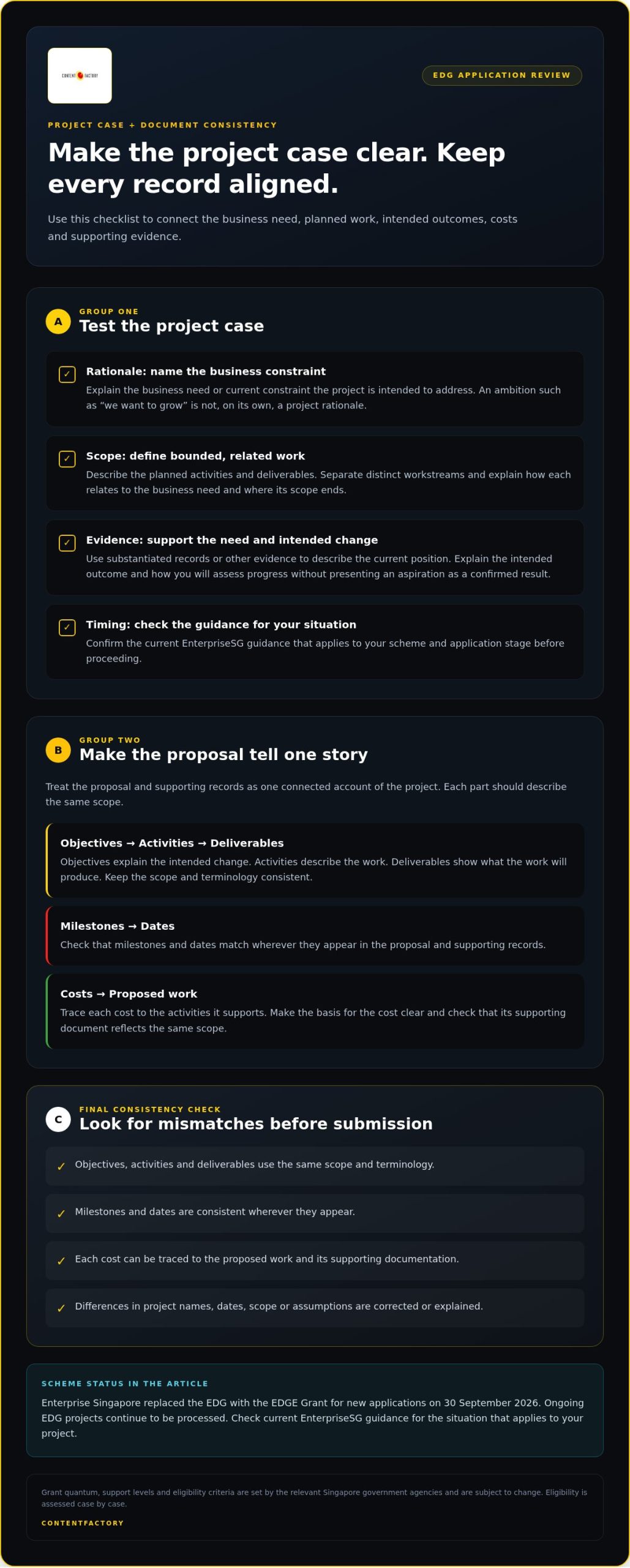
Before drafting further, test the project case against these four questions:
- Rationale: Can you state the business constraint clearly?
- Scope: Are the planned activities and deliverables bounded and connected?
- Evidence: Can you support the need and explain how you’ll assess the intended outcome?
- Timing: Have you checked the current rules that apply to your application or ongoing project?
Use this test to catch common EDG grant application mistakes before inconsistencies spread across the proposal and supporting documents. ContentFactory provides strategic grant advisory and financial modelling to help you connect the business rationale, project scope and documentation.
Check that EDG scope, outcomes and costs tell one consistent story
A clear business rationale is not enough if the proposal, cost details and supporting documents describe different versions of the project. Treat them as one connected record: objectives explain the intended change, activities describe the work, deliverables show what it will produce, and milestones indicate how it will progress. Check the current EnterpriseSG guidance for the scheme and application stage that applies to your project.
Keep outcomes distinct from deliverables. A deliverable is a project output, such as a documented process or completed assessment. A business outcome is the intended effect of that output. Describe the current position, the change you expect and the evidence you can use to observe progress. Don’t present an aspiration as a confirmed result or imply that a particular outcome guarantees support.
Mistake: vague objectives and unsupported outcomes
Replace broad claims such as “improve efficiency” with a clear account of what is happening now and what the project aims to change. Use records or other evidence you can substantiate to explain the baseline and intended outcome. A baseline makes the proposed change easier to understand because it shows what the project is meant to improve. Check EnterpriseSG’s Enterprise Development Grant guidance for current scheme information, rather than relying on old templates or assumptions.
Mistake: cost details that do not match the proposed work
Review each cost description against the activities and deliverables it is meant to support. If a quotation refers to a different scope, project name or workstream, resolve the mismatch and explain the basis for each cost in line with current application guidance. Don’t assume a figure is self-explanatory. Make its connection to the proposed work clear and ensure the supporting document reflects the same scope.
Before submission, compare the proposal and supporting records for consistency. Check that:
- Project objectives, activities and deliverables use the same scope and terminology.
- Milestones and dates are consistent wherever they appear.
- Each cost can be traced to the proposed work and its supporting documentation.
- Differences in project names, dates, scope or assumptions have been corrected or explained.
These checks help you describe intended outcomes without turning them into promises or assuming measurement rules that EnterpriseSG has not stated. ContentFactory’s strategic grant advisory and financial modelling can help you review how the project rationale, scope and costs fit together. You can also discuss your grant application preparation.
Avoid EDG application errors in eligibility checks and supporting documents
An eligibility check based on an old guide or a previous application may leave you working from outdated requirements. Enterprise Singapore replaced the EDG with the EDGE Grant for new applications on 30 September 2026; ongoing EDG projects continue to be processed. Before preparing or updating documents, establish which scheme and application stage applies, then use the relevant current EnterpriseSG guidance.
Mistake: relying on an outdated or incomplete eligibility check
Don’t decide that your business qualifies based on a summary, an old checklist or another company’s experience. Compare your circumstances with the current Enterprise Development Grant guidance if you’re managing an ongoing EDG project, or with the relevant EDGE guidance for a new application. Scheme status, eligibility conditions and application instructions can change, so verify them against official guidance before preparing or submitting documents. EnterpriseSG provides the current scheme requirements and application instructions.
Review documents in two stages. First, confirm what the applicable guidance currently calls for. Information available for the grant process identifies company information, audited financial statements and a project proposal with quotations among the application documents. Check EnterpriseSG’s latest instructions for your scheme and project before treating any item as required.
Then separate those items from records that may depend on the project or further agency guidance. Don’t assume every applicant needs the same supporting documents, or that an example checklist is exhaustive. Missing or unclear information may lead to follow-up or processing issues, but verify the specific requirements and consequences with EnterpriseSG.
Mistake: submitting documents that conflict or leave gaps
Check that your company name and identifiers match the relevant official business records. Then compare the proposal, quotations and supporting documents for the project name, scope, activities, dates and cost descriptions. A proposal that describes one set of activities while a quotation names another creates a gap, even if each document looks complete on its own.
Use this practical checklist before submission:
- Scheme: Confirm whether you’re preparing a new application or managing an ongoing EDG project.
- Company details: Match names and identifiers across the application and official business records.
- Documents: Separate items required by current guidance from project-specific supporting evidence.
- Consistency: Reconcile differences in project names, dates, scope, quotations or cost explanations.
This document-by-document review helps catch common application errors without assuming a generic list fits every project. For more context on preparing an application, read the EDG advisory guide for Singapore SMEs, or discuss your grant application documentation.
Use an EDG submission checklist to catch timing and record-keeping mistakes
Timing is not a detail to resolve from memory. The applicable rules may depend on whether you’re making a new application under the current scheme or managing an ongoing EDG project. Before signing a contract, making a payment or allowing work to begin, check the latest EnterpriseSG instructions for your application and any Letter of Offer. Don’t treat another applicant’s timeline as a rule for your project.
Mistake: assuming application timing rules
Use this ordered review before submitting or taking the next project step:
- Confirm the scheme and stage. Establish whether your matter concerns a new application or an ongoing EDG project.
- Check the latest instructions. Review current EnterpriseSG guidance on application timing, project commencement, contracts, payments and the Letter of Offer.
- Resolve uncertainties first. If the instructions don’t clearly address your proposed next step, seek clarification through the appropriate official channel before committing.
- Record the decision. Keep a copy of the guidance you reviewed and note when you checked it.
A grant adviser can help organise an application and its documents, but cannot predict agency processing times or an approval decision. Treat the stop-and-check point as a control for your own planning, not as a promise about timing or outcome.
Mistake: treating documentation as a one-time task
Submission is not the end of the record-keeping process. Keep a project file with the submitted application, supporting documents, correspondence, EnterpriseSG decisions and relevant project records. As work proceeds, organise records so they can be traced back to the approved scope and applicable instructions. Follow the conditions and record requirements that apply to your project rather than assuming a retention period.
This file helps you trace what was proposed, what was approved and what was documented during delivery. If the scope or circumstances change, preserve the relevant communications and check the applicable guidance instead of relying on informal notes alone.
To reduce timing and record-keeping errors, verify before committing, save the guidance you relied on and maintain a coherent project file. ContentFactory also provides post-approval grant audit and compliance support. For help with grant administration, see Contact Us.
Prepare a stronger EDG application with a clear review process
A final review is more useful than another round of broad claims. Check that the business need, project scope, evidence, costs, timing and records line up across the application. Since EnterpriseSG replaced the EDG with the EDGE Grant for new applications on 30 September 2026, first confirm which scheme and guidance apply to your situation. Ongoing EDG projects continue to be processed.
A final self-review before submission
Set aside your application and supporting documents together, then review them as one project file. Check each record against the same project description and objective, not just for spelling or completeness.
- Business need and scope: Does the project address a clearly stated business need, with defined activities and deliverables?
- Evidence and outcomes: Are claims supported by information you can substantiate, without presenting intended outcomes as guaranteed results?
- Costs and documents: Do cost explanations and supporting records match the proposed work and use consistent project details?
- Timing and records: Have you checked current EnterpriseSG instructions on application timing, project commencement, contracts and any Letter of Offer? Are relevant documents organised for future reference?
Mark uncertain scheme details for verification against current official guidance. Remove unsupported eligibility claims, outcome promises and cost assumptions. If a project name, date or scope differs between documents, resolve the inconsistency before proceeding.
When grant advisory can help with preparation
You can complete this consistency review yourself. If the project rationale, financial modelling or application documents need a more structured review, grant advisory can help connect those elements and identify gaps for you to address. ContentFactory provides strategic grant advisory and post-approval compliance support.
EnterpriseSG assesses applications. An adviser can support preparation, but cannot guarantee approval or influence the agency’s decision. Grant quantum, support levels and eligibility criteria are set by the relevant Singapore government agencies and are subject to change. Eligibility is assessed case by case.
Book a 30-minute discovery call: Book a Strategic Consultation
Article by
Mayuresh Godse
Mayuresh Godse is a Singapore Certified Management Consultant and Business Strategist specializing in Sustainability, ESG, AI-driven Digital Transformation, and business growth. Based in Singapore, he writes about Sustainability, Digital Innovation, Business Strategy, and Content Marketing for global audiences.
Disclaimer
This article is provided by ContentFactory for general information only and is not legal, tax, accounting or financial advice. Regulations and government scheme criteria change; grant eligibility and quantum are set by the relevant Singapore agencies and assessed case by case, with no outcome guaranteed. Verify current requirements before acting.