

Audit readiness is built project by project, not in a last-minute paperwork sprint. For Singapore SMEs, preparation means connecting the approved scope to the work delivered, costs claimed and payments made, using complete, traceable records. When evidence is spread across teams or systems, inconsistencies can be hard to spot before audit questions arrive.
It’s reasonable to be unsure which grant conditions and documents matter, especially when project and finance records are kept separately. The practical first step is to check the approval terms and relevant agency instructions, then organise evidence around the funded project rather than relying on a pile of files assembled at the last minute.
This Singapore-focused checklist shows you how to structure a clear evidence file, compare claims and payments with the work completed, and identify gaps before responding to a post-approval review. You’ll also see when specialist compliance support may be useful. The aim is not to predict an audit outcome, but to make your project records coherent, traceable and ready to explain.
Key Takeaways
- Start with the grant award documents so you can identify the approved scope, conditions and claims to check.
- Organise project evidence by activity and deliverable, making it easier to trace records back to the funded work.
- Use SME grant audit preparation to compare approved terms, delivered work, claims, payments and supporting records for inconsistencies.
- Set up an indexed evidence folder and assign a contact for each finance or project record before questions arrive.
- Consider post-approval compliance support if records are dispersed or gaps need structured follow-up. This preparation is distinct from an independent audit opinion.
What SME grant audit preparation means after funding is approved
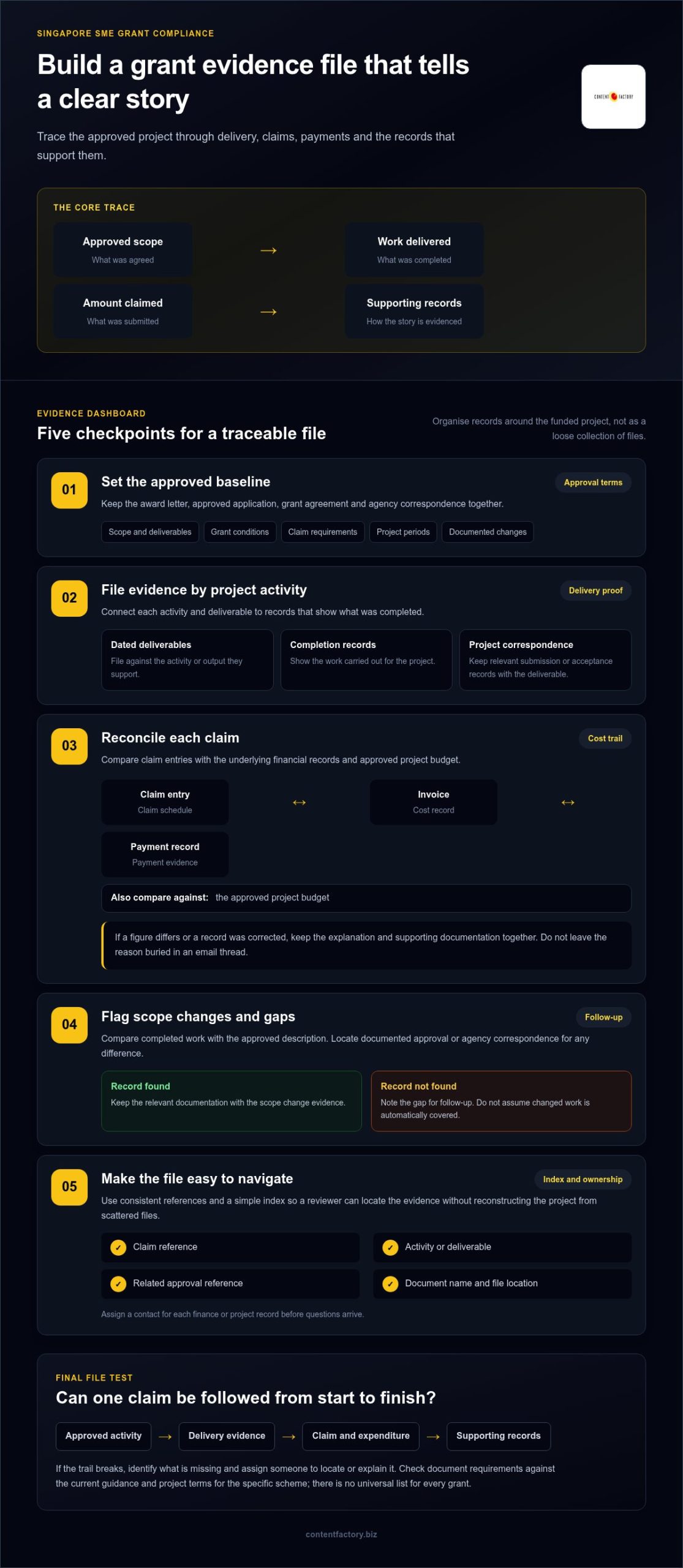
After funding is approved, start with the award documents, then trace each claim back to the project evidence that supports it. SME grant audit preparation is the process of organising those records and checking them against the approved project, its conditions and the claims made. It is not a generic audit checklist: the relevant scheme documents and project terms determine what applies.
A practical test is whether someone unfamiliar with the project can follow the file from the approved scope to the work delivered, the amount claimed and the records that support it. If the evidence does not connect clearly, identify the gap before responding to a review request.
Start with the award letter and grant conditions
Gather the award letter, approved application, grant agreement and subsequent agency correspondence in one working folder. These documents establish the reference point for your review. Avoid relying on an old application draft or informal team recollections where the approved documents provide the definitive project terms.
Extract the details that shape your obligations, including:
- Approved project scope and deliverables
- Conditions attached to the grant and any reporting duties
- Claim requirements and relevant project periods
- Changes or clarifications recorded in agency correspondence
Use these points as an index for the records you gather next. If instructions appear unclear or documents seem to conflict, flag the issue and verify it against current official guidance for the relevant scheme. Don’t assume that a condition from another grant or project applies to yours.
Separate preparation support from an audit opinion
Preparation means arranging available records and checking whether they tell a consistent story against the grant documents. It can help you identify missing evidence, mismatched descriptions or questions that need follow-up. It does not determine whether an auditor will accept a claim, or guarantee disbursement or any particular audit outcome.
ContentFactory provides post-approval grant audit and compliance preparation, not audit or assurance opinions. That distinction matters: preparation supports a clear, traceable file, while an independent audit opinion is outside this support. For details of the relevant service, see post-approval grant audit and compliance support.
For a useful first action, create a simple project index with one entry for each approved deliverable. Note the relevant condition, the claim it relates to and where its supporting records are stored. This gives your team a consistent starting point for the deeper evidence checks that follow.
Build an SME grant audit evidence file around the approved project
A useful evidence file lets you move from an approved activity to its deliverable, claim and supporting records without piecing the story together from scattered folders. Organise documents by project activity, deliverable, claim period and relevant grant condition. That structure keeps evidence connected to the work it supports, rather than turning the file into a collection of unrelated invoices and emails.
For each activity, gather the approved scope, relevant agency correspondence, invoices, payment evidence and records showing delivery, where applicable. Verify document types against the current guidance for your specific scheme and project. There is no universal list that should be assumed to apply to every Singapore grant.
Match expenditure records to claims
Reconcile each claim entry with its invoice, payment record and approved project budget. Use consistent project references across claim schedules and source documents where available. If a figure differs, a record was corrected or the plan changed, keep a clear explanation and the supporting documentation together. Don’t silently adjust a schedule and leave the reason buried in an email thread.
A simple index can make the trail easier to follow. Record the claim reference, activity or deliverable, related approval reference, document name and file location. Check the relevant Singapore agency guidance and project terms to confirm which records apply to your grant, rather than relying on a generic checklist.
Prove that approved work was delivered
Financial records show what was claimed and paid. Delivery evidence helps show how that expenditure relates to the approved project. File dated deliverables, completion records and relevant project correspondence against the activity or output they support. For example, label a completed project report with its activity reference and store it alongside correspondence documenting its submission or acceptance, where applicable.
Scope changes need particular care. Compare the work completed with the approved description, then flag any difference and locate the documented approval or agency correspondence relating to it. If you can’t find that record, note the gap for follow-up rather than treating the changed work as automatically covered.
During SME grant audit preparation, test the file with one claim: can you trace it from the approved activity through delivery evidence to the expenditure records? If not, identify what’s missing and assign someone to locate or explain it. Where you need structured help organising post-approval records, ContentFactory provides post-approval grant compliance support. Contact Us to discuss your preparation needs.
Check grant claims, project delivery and records for inconsistencies
A focused self-review can reveal where the project story stops matching the claim. Compare the approval documents with the work delivered, the claim submitted, the payment records and the evidence supporting each item. This is a preparation check, not a formal audit or assurance conclusion.
Keep the review anchored to the approved project. A cost or activity appearing in your records does not, by itself, show that it relates to the grant-funded scope. Check the relevant scheme guidance and project documents, then record discrepancies factually. Note what differs, the explanation, any correction made and the records supporting that explanation. Don’t alter source documents to make them appear consistent.
Trace each claim from approval to evidence
Take each claim item in sequence. First confirm that its activity appears in the approved project documents. Then compare the submitted details with source records and the evidence of delivery. If a claim description, amount, date or deliverable doesn’t align, record the precise point that needs follow-up rather than making assumptions about whether it is acceptable.
Use a short follow-up log to capture the claim reference, issue, evidence reviewed, next action and responsible owner. For example, if a submitted claim refers to a project output but the file contains no corresponding delivery record, mark the evidence gap and assign it to the person responsible for that project record. Industry guidance such as the National Grants Management Association’s Grant compliance best practices can offer general post-award context, but your Singapore grant’s own terms and current agency guidance take priority.
Assign ownership and preserve a clear record
Unclear ownership slows follow-up and can leave important questions unanswered. Assign an internal owner for each record category: grant terms and agency correspondence, finance records, project delivery evidence and the overall follow-up log. One person can hold more than one role in a small team, but each responsibility should be explicit.
Keep a dated record of file updates, explanations and actions taken. Preserve source records and limit edits to working copies, following the retention and submission instructions applicable to your scheme. This helps distinguish original evidence from later notes or corrections, without implying a universal retention period.
Use the completed review to sort issues into three groups: evidence found and matched, evidence requiring clarification, and evidence still missing. ContentFactory provides post-approval grant compliance support to help structure this preparation. For support with a project review, Contact Us.
Prepare your team to answer grant audit questions
A clear evidence folder is only useful if your team can retrieve the right records and explain them consistently. Before questions arrive, appoint one central contact to log requests and coordinate responses. That person should route each item to the colleague who owns the relevant finance record, project evidence or agency correspondence, rather than asking several teams to respond independently.
SME grant audit preparation should include a response process, not just document storage. Keep answers tied to the question asked, the approved project terms and the source records. Avoid adding unsupported explanations or estimates. Retain the request, the response and the exact evidence submitted in the project file so your organisation has a clear record of what was provided.
Use a practical response checklist
For every request, record the date received, the due date stated by the agency, the responsible owner and the documents needed. Before submission, check the draft response against the award documents and original records. Confirm that figures, dates and descriptions match the evidence, and that attachments support the point being answered.
After submission, save a copy of the response and its supporting documents alongside the original request. If the agency follows up, this record helps your team see what was already provided and keep later answers consistent.
Escalate gaps without guessing
If a requested document is unavailable, don’t recreate it or edit source records to make the file look complete. Record what is missing, where the team searched, who was asked to follow up and what remains unresolved. If an alternative record may help explain the issue, label it accurately and avoid presenting it as the missing original.
Unclear requirements should be checked against current official guidance or relevant agency correspondence. Keep a note of the clarification and any resulting action in the project record. This is more reliable than relying on assumptions or applying another scheme’s instructions to your grant.
A short internal response log can include the request, agency-stated due date, assigned owner, evidence location, reviewer and submission date. Set it up before you need it, then keep it with the indexed evidence folder. If you need support structuring post-approval grant compliance preparation, Contact Us.
When post-approval grant compliance support can help your SME
Not every funded project needs outside preparation support. If your team can locate the award documents, account for project records and explain how claims relate to approved work, a structured internal review may be enough. Support becomes more useful when records sit across different teams or systems, grant conditions are difficult to interpret, or unresolved gaps need clear ownership and follow-up.
The right level of help depends on the state of your project file. Start by assessing what your team can already verify, then identify where extra coordination or a second review would add structure. The purpose is to make the evidence easier to understand and follow, not to predict or influence an agency’s decision.
Choose the right level of preparation support
A self-review may suit a team with complete records, clear ownership and a straightforward link between the approved project and its claims. Your team can work through the relevant scheme documents and record any open questions for follow-up.
Structured advisory support may help if finance and project evidence are dispersed, conditions need careful review against the project documents, or several gaps remain open. ContentFactory’s post-approval grant audit and compliance support focuses on organising records and preparing for a post-approval review. It is not an audit or assurance opinion, and it does not guarantee acceptance, disbursement or any audit outcome.
Take the next step with a clear project file
Before a consultation, prepare a concise project snapshot. Include the approved scope, the records gathered so far, open questions and any agency requests or correspondence that need attention. This gives the discussion a practical starting point and helps distinguish an evidence gap from a question about the grant terms.
Whether you manage preparation internally or seek structured support, keep decisions grounded in the applicable project documents and current official guidance. ContentFactory supports Singapore SMEs with post-approval grant compliance preparation and broader Singapore grant consulting, without providing an independent audit opinion.
Grant quantum, support levels and eligibility criteria are set by the relevant Singapore government agencies and are subject to change. Eligibility is assessed case by case.
Contact Us to discuss your project file, or Book a Strategic Consultation for a 30-minute discovery call.
Keep your grant evidence clear and connected
Strong grant preparation starts with the approved project, not a last-minute search for files. Keep a traceable link between grant conditions, delivered work, claims, payments and supporting records. Then check for gaps, document explanations and assign clear owners so your team can respond consistently if questions arise.
A practical next step is to review one claim from start to finish. Confirm its link to the approved scope, locate the delivery and payment evidence, and note any unresolved questions. Repeat the process across the project, using the relevant scheme documents as your reference.
ContentFactory provides post-approval grant audit and compliance support to help SMEs organise records and prepare for review. Mayuresh Godse is a Singapore Certified Management Consultant with 25+ years of consulting experience. This support is preparation, not an independent audit opinion or a promise of any outcome. Contact Us to discuss your project file, or Book a Strategic Consultation for a 30-minute discovery call.
Grant quantum, support levels and eligibility criteria are set by the relevant Singapore government agencies and are subject to change. Eligibility is assessed case by case.
Frequently Asked Questions
What documents should an SME prepare for a grant audit in Singapore?
Start with the award letter, approved application, grant agreement and relevant agency correspondence. Then organise records that relate to the approved work, such as invoices, payment evidence, project deliverables and completion records, where applicable. Requirements vary by scheme and project, so check current official guidance rather than treating this as a universal document list. An index linking each claim to its approval reference and supporting evidence makes gaps easier to identify.
How can a business check that grant claims match the approved project?
Trace each claim from the approved activity to the work delivered and the records supporting the expenditure. Compare claim details with source documents and relevant delivery evidence, then note differences, corrections or missing information factually. SME grant audit preparation is a consistency check against your project documents, not a formal audit conclusion. Assign open questions to the person responsible for the relevant finance or project record, and retain supporting explanations.
Can an SME prepare for a grant audit before receiving a request?
Yes. You can organise the project file and review it against the award documents before any request arrives. Set up an indexed folder, identify owners for finance and delivery records, and check whether claims can be traced to approved activities and supporting evidence. Keep a central contact and a record of open questions. This preparation helps your team locate relevant information, but it does not predict or guarantee any audit outcome.
What happens if grant records are missing or inconsistent?
First, document exactly what is missing or inconsistent and identify the records checked. Assign follow-up to the relevant finance or project owner, and retain explanations and any supporting documents. Don’t alter source records or recreate evidence as if it were original. If the issue concerns a grant condition or required document, check current official guidance or relevant agency correspondence. The effect of a gap depends on the applicable scheme and project terms.
Does grant audit preparation mean the adviser conducts the audit?
No. Preparation support helps organise grant records and review consistency against available project documents. It is distinct from conducting an independent audit or providing an audit or assurance opinion. ContentFactory provides post-approval grant audit and compliance support to help SMEs prepare their records. This support does not guarantee that a claim will be accepted, that funds will be disbursed or that an audit will reach a particular outcome.
When should an SME seek post-approval grant compliance support?
Consider structured support if project and finance records are dispersed, grant conditions are difficult to interpret, or evidence gaps need coordinated follow-up. If your team can locate complete records, understands its responsibilities and can trace claims to approved work, an internal review may be sufficient. Before seeking help, assemble the approved scope, available records, open questions and any agency correspondence. This gives the review a clear, project-specific starting point.
Grant quantum, support levels and eligibility criteria are set by the relevant Singapore government agencies and are subject to change. Eligibility is assessed case by case.

Article by
Mayuresh Godse
Mayuresh Godse is a Singapore Certified Management Consultant and Business Strategist specializing in Sustainability, ESG, AI-driven Digital Transformation, and business growth. Based in Singapore, he writes about Sustainability, Digital Innovation, Business Strategy, and Content Marketing for global audiences.
Disclaimer
This article is provided by ContentFactory for general information only and is not legal, tax, accounting or financial advice. Regulations and government scheme criteria change; grant eligibility and quantum are set by the relevant Singapore agencies and assessed case by case, with no outcome guaranteed. Verify current requirements before acting.