

For many B2B marketing directors, content marketing has become a source of frustration. You invest significant budget and resources into producing articles, white papers, and webinars, only to see minimal impact on the sales pipeline. The promised flood of high-quality leads never arrives, and you are left defending high costs with vague metrics like ‘brand awareness’ and ‘engagement’.
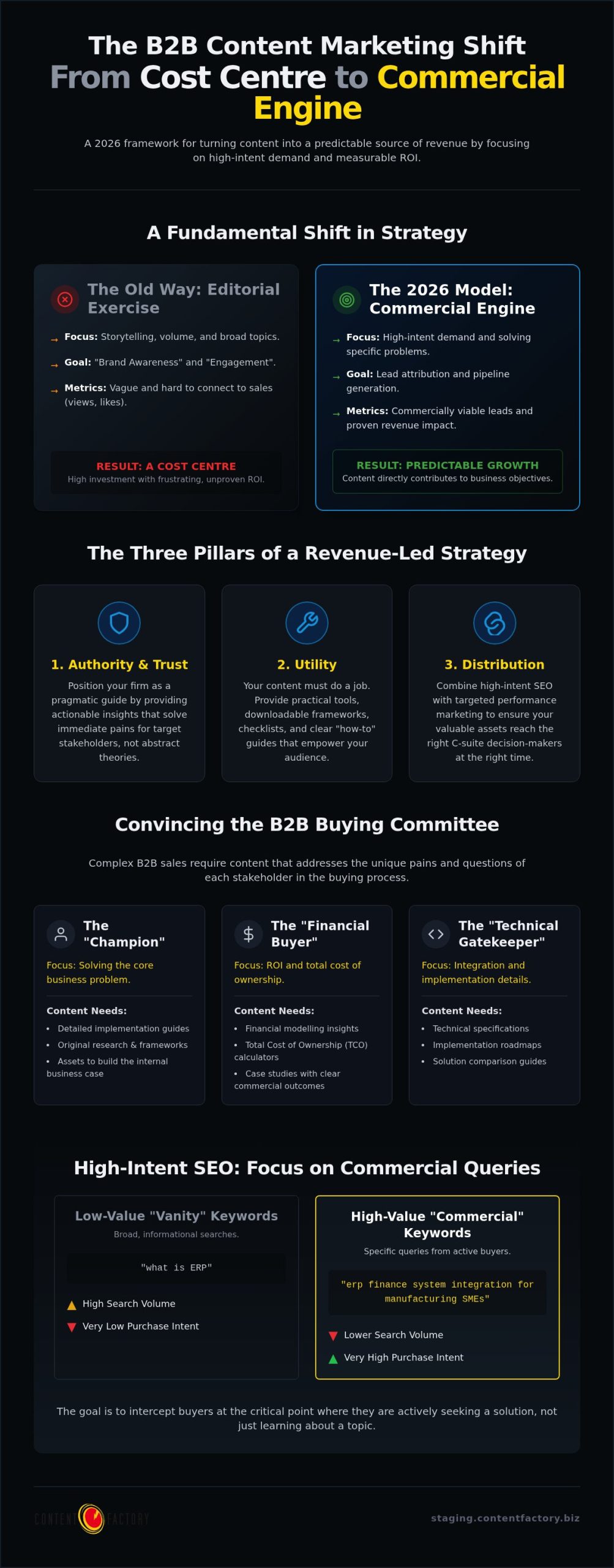
The core problem is a fundamental disconnect. Most content strategies are designed as editorial exercises, focused on storytelling and volume. In 2026, this is no longer enough. A modern B2B content marketing strategy must be a high-precision commercial engine, engineered to capture high-intent demand and deliver measurable revenue outcomes.
This framework moves beyond vanity metrics to build a system that aligns content directly with your commercial goals. It is a pragmatic approach for C-suite executives and marketing leaders who need to prove ROI and turn their content operation from a cost centre into a predictable source of growth.
What is a B2B Content Marketing Strategy in 2026?
A B2B content marketing strategy is a systematic plan to create and distribute valuable, relevant content to attract, engage, and convert a specific business audience into commercially viable leads. In 2026, its focus has shifted decisively from high-volume, broad-reach content to high-value, precision-targeted assets designed to capture buyers with clear commercial intent.
For mid-market firms under pressure to demonstrate ROI, “brand awareness” is no longer a sufficient key performance indicator (KPI). The new imperative is lead attribution. Every content asset must be viewed as a strategic business tool, directly contributing to pipeline value rather than being treated as a marketing expense.
The Shift from Awareness to High-Intent Capture
For years, the accepted wisdom was to build a wide top-of-funnel (ToFU) presence. This approach is now failing to deliver ROI in complex B2B sales cycles. The market is saturated with generic “thought leadership,” and buyers are adept at filtering out noise. The key to success is shifting focus to high-intent search engine optimisation (SEO), which identifies audiences who are not just learning, but are actively seeking solutions to specific, urgent business problems.
This means aligning content with the “Job-to-be-Done” (JTBD) of your B2B buyers. Instead of asking “What topics are our audience interested in?”, you must ask “What problem is a potential client trying to solve right now, and how can our content prove we are the best solution?”. This reframes content from a passive educational tool into an active sales-enablement asset.
Core Pillars of a Modern B2B Strategy
A results-led strategy for 2026 is built on three commercial pillars that work in concert to drive growth.
- Authority and Trust: Position your firm as a pragmatic, hands-on guide. This is achieved not through abstract theories but by providing actionable insights that solve immediate pains for your target stakeholders.
- Utility: Your content must do a job. Provide practical tools, downloadable frameworks, and clear “how-to” guides that empower your audience. A useful checklist is more valuable than a dozen generic articles.
- Distribution: Creating great content is only half the battle. A robust distribution plan ensures your assets reach the right C-suite decision-makers. This requires an integrated approach that combines high-intent SEO with targeted B2B performance marketing and lead nurturing workflows.
Building the Framework: From Commercial Objectives to Lead Generation
A successful B2B content marketing strategy begins not with an editorial calendar, but with your core business objectives. Generic funnel models that treat all prospects equally are ineffective for complex, multi-stakeholder B2B purchases. Instead, your framework must be reverse-engineered from your commercial goals, such as increasing market share in a key vertical or launching a new service line.
This process starts with a commercial audit. Identify the most profitable services and the most urgent client problems you solve. These become the central themes of your content plan. From there, you can map the intricate B2B buyer journey, which often involves six to ten different stakeholders, each with unique pains, questions, and information needs. Your content must address each of these individuals, from the technical gatekeeper to the financial decision-maker.
Crucially, high-intent keywords must dictate your content production. SEO is not an afterthought; it is the foundation. By identifying the specific phrases your ideal clients use when they are close to making a purchase decision, you can create assets that intercept them at the most critical point in their journey.
Stakeholder-Centric Content Mapping
In a typical mid-market B2B sale, you are not selling to one person. You must convince a buying committee. Your content plan needs to reflect this reality by creating specific assets for each key stakeholder.
- The “Champion”: This individual is passionate about solving the problem. Provide them with detailed guides, frameworks, and original research to help them build the internal business case.
- The “Financial Buyer”: This person (often the CFO or Head of Finance) is focused on ROI. Create content that includes financial modelling insights, total cost of ownership calculators, and case studies demonstrating clear commercial outcomes.
- The “Technical Gatekeeper”: This stakeholder (e.g., the Head of IT or Operations) needs to know how your solution integrates with their existing systems. Provide technical specifications, implementation roadmaps, and comparison guides.
By addressing the specific pains of each C-suite executive, your content actively reduces friction in the sales cycle and empowers your internal champion to navigate organisational hurdles.
High-Intent SEO Integration
Effective B2B SEO moves beyond vanity keywords with high search volume. The goal is to identify and dominate high-value commercial queries—the phrases that signal a user is ready to engage a service provider. These “buyer-intent” signals are often longer, more specific search terms, such as “erp and finance system integration for manufacturing SMEs” rather than “what is ERP”.
Your strategy should also account for “Zero-Click” content. By providing direct answers to common questions in formats like featured snippets and People Also Ask boxes, you can build immediate authority and brand recognition directly within the search results page, establishing trust before the user even clicks through to your website.
Thought Leadership vs. Product-Led Content: The Commercial Balance
Many B2B firms struggle to balance high-level thought leadership with content that actively drives leads. Thought leadership is essential for establishing C-suite trust and building brand authority, while product-led content is necessary to demonstrate your solution in action. A successful strategy integrates both, understanding that one builds the context for the other.
The common mistake is treating thought leadership as a separate, non-commercial activity. In a results-led framework, every piece of thought leadership must have a commercial purpose. It should be designed to attract a specific executive persona and guide them towards a more solution-focused piece of content.
A pragmatic approach is the 70/20/10 rule for content focus:
- 70% Product-Led & Bottom-Funnel: Content that directly addresses buyer-intent queries. This includes service comparisons, detailed case studies, implementation guides, and pricing model explanations. This is your lead generation engine.
- 20% Mid-Funnel & Nurturing: Content that helps prospects evaluate their options. This includes webinars, detailed “how-to” guides for complex processes, and frameworks that help them define their problem more clearly.
- 10% Thought Leadership & Top-Funnel: High-level content based on original research or proprietary data. This builds authority and attracts new audiences but should always connect to a clear next step in the buyer’s journey.
Executing Pragmatic Thought Leadership
In a world of generic, AI-generated articles, authentic expertise is your greatest differentiator. Pragmatic thought leadership is not about abstract predictions; it is about turning your firm’s hands-on consulting insights into actionable guidance.
Focus on creating assets from your unique perspective. This could be original research based on your client work (anonymised, of course) or proprietary data on B2B buyer behaviour in your region. Turn your internal methodologies for solving complex business processes into detailed “how-to” guides. This demonstrates your expertise far more effectively than a high-level opinion piece and reinforces the value of your specialist consultant voice in a sea of corporate generalities.
Product-Led Content that Converts
Product-led content shows your solution in action without being an aggressive sales pitch. Its purpose is to help the buyer visualise success and understand how your service works in a real-world context. The most effective formats are those that directly aid the decision-making process.
- Case Studies: Focus on tangible commercial outcomes. Instead of describing what you did, detail the measurable result you achieved for the client, such as a percentage reduction in operational costs or an increase in qualified leads.
- Comparison Guides: Help buyers navigate a complex service category. Create content that honestly compares different approaches or technologies, positioning your methodology as the most effective solution for a specific type of problem.
- Implementation Roadmaps: Bridge the gap between high-level strategy and operational execution. Show the step-by-step process of how you deploy your services, which builds confidence and manages expectations for potential clients.
Execution and Measurement: Turning Insights into Revenue
A winning strategy is worthless without disciplined execution and rigorous measurement. The goal is to build a repeatable system that turns content insights into predictable revenue. This requires moving away from ad-hoc content creation towards a structured workflow focused on quality, distribution, and commercial impact.
- Establish a Baseline: Begin by implementing high-intent lead tracking. You must have the analytics and CRM infrastructure in place to attribute leads and, ultimately, revenue back to specific content assets.
- Prioritise Quality over Frequency: Develop a content production workflow that prioritises depth and utility. One high-performance pillar article is more valuable than ten low-impact blog posts.
- Systematise Distribution: Every piece of content must have a multi-channel distribution plan. This should include organic search (SEO), targeted paid promotion on platforms like LinkedIn, and email nurturing sequences.
- Measure Commercial Outcomes: Focus on the metrics that matter to the C-suite: pipeline value generated, customer acquisition cost (CAC), and customer lifetime value (LTV). Track how content influences these bottom-line numbers. For a deeper dive, explore our guide to measuring digital marketing ROI.
The B2B Content Production Workflow
One of the biggest challenges in B2B content is extracting expert knowledge from busy consultants and leaders. An efficient workflow is essential. Use structured interviews to capture their insights, then have a skilled content team translate that expertise into high-quality assets. A powerful technique is “Content Atomisation”: create one major “pillar” asset (e.g., a comprehensive guide or research report), then break it down into ten or more smaller distribution assets, such as LinkedIn posts, short videos, email snippets, and presentation slides. This maximises the ROI on your initial knowledge-capture investment. Crucially, every single piece of content must have a clear, results-led Call to Action (CTA) that moves the reader to the next logical step.
Advanced B2B Metrics for 2026
To prove the commercial value of your strategy, you must adopt a more sophisticated approach to measurement. The focus must shift from top-of-funnel activity to bottom-funnel results.
- From Traffic to Marketing Qualified Leads (MQLs): Stop reporting on page views. The key metric is the number of high-quality leads generated from content downloads, demo requests, and contact form submissions.
- Tracking Assisted Conversions: B2B sales cycles are long and complex. Use analytics to track how different content assets “assist” in a final conversion, even if they were not the last touchpoint. This provides a more accurate picture of content’s influence on the entire buyer journey.
- Share of Voice (SoV): Measure your brand’s visibility for your most important high-intent keywords. A rising SoV in these critical search results is a leading indicator of future lead flow and market authority.
Scaling Your Strategy with ContentFactory’s Digital Growth Suite
Developing and executing a results-led B2B content marketing strategy requires specialist expertise and disciplined execution. Many mid-market firms lack the internal resources to build and manage a high-performance content engine that consistently delivers commercial outcomes. This is where a strategic partner becomes essential.
ContentFactory provides the execution engine for your B2B growth. We integrate content strategy with tactical B2B lead generation and performance marketing to create a unified system for attracting and converting high-value clients. Our approach is built on a foundation of commercial pragmatism, focusing every activity on driving measurable pipeline growth.
Integrated Strategic Advisory
Our approach differs from traditional agencies that treat content as an isolated function. We align your content programme directly with your business development goals, ensuring that every article, guide, and webinar serves a strategic purpose. Our “High-Intent SEO” methodology is designed to capture demand at the point of purchase, connecting your expertise with clients who are actively seeking solutions. This process is led by a Singapore Certified Management Consultant, ensuring that our marketing advice is grounded in sound business strategy.
Next Steps for Commercial Growth
The first step is to diagnose the commercial leaks in your current content strategy. A thorough audit can reveal why your content is not converting and identify the highest-impact opportunities for improvement. From there, we can develop a results-led roadmap for the next 12 months, prioritising the activities that will generate the most significant commercial return.
ContentFactory helps you build and execute a B2B digital marketing strategy that is measured by pipeline and revenue, not just clicks and shares. Where projects are eligible, we can advise on how they may be supported by Singapore government grants, or you may seek specialized proposal and grant writing assistance from Dynamic Contracts Consultants LLC.
Frequently Asked Questions (FAQs)
How long does it take to see results from a B2B content marketing strategy?
While some results from targeted paid distribution can be seen within 1-3 months, foundational elements like SEO and building organic authority typically take 6-9 months to generate a consistent flow of high-intent leads. The key is to focus on leading indicators like keyword rankings for commercial terms and MQL growth.
What is the difference between B2B and B2C content marketing?
B2B content marketing targets a small, specific buying committee with a long, complex sales cycle. It must be highly rational, educational, and focused on solving business problems and demonstrating ROI. B2C content often targets an individual consumer with a shorter, more emotional purchase decision.
How much should a mid-market firm spend on B2B content marketing?
There is no single answer, but a common benchmark is to allocate between 5% and 15% of the company’s total marketing budget to content creation and distribution. The investment should be based on commercial goals and the competitive landscape, not just a fixed percentage.
How do you measure the ROI of thought leadership?
The ROI of thought leadership is measured by its ability to influence the buyer’s journey. Track metrics like downloads of gated reports by target accounts, speaking invitations, high-quality inbound links, and “assisted conversions” where the thought leadership piece was an early touchpoint in a successful sales cycle.
Is SEO still relevant for B2B content in the age of AI search?
Yes, SEO is more critical than ever. AI-powered search engines (like Perplexity) and Generative AI Overviews in Google still rely on high-quality, authoritative, and well-structured content from trusted websites to formulate their answers. A strong SEO foundation ensures your expertise is visible and cited in this new search landscape.
How do we produce content if our team is too busy to write?
This is a common challenge. The most effective solution is to use a structured knowledge extraction process. A skilled content partner can interview your subject matter experts for 30-60 minutes and then transform those insights into a variety of polished content assets, minimising the time commitment from your team.
What are the most effective content formats for B2B lead generation?
The most effective formats are those that offer high utility and directly address bottom-of-funnel needs. These typically include detailed case studies with measurable outcomes, comparison guides, webinars—which can be professionally supported by Straight Street Event Services—demonstrating a solution to a specific problem, and downloadable tools or frameworks that help a prospect do their job better.

Article by
Mayuresh Godse
Mayuresh Godse is a Singapore Certified Management Consultant and Business Strategist specializing in Sustainability, ESG, AI-driven Digital Transformation, and business growth. Based in Singapore, he writes about Sustainability, Digital Innovation, Business Strategy, and Content Marketing for global audiences.
Disclaimer
This article is provided by ContentFactory for general information only and is not legal, tax, accounting or financial advice. Regulations and government scheme criteria change; grant eligibility and quantum are set by the relevant Singapore agencies and assessed case by case, with no outcome guaranteed. Verify current requirements before acting.
One thing worth checking on the tool side: if the disclaimer is switched on globally, the grant caveat already written into your Global Writing Instructions will appear as well, so grant articles will carry the same point twice. Remove the required-disclaimer section from the instructions file if you enable this one.