

More outreach doesn’t automatically create more pipeline. B2B lead generation strategies Singapore businesses can use should match the industry, buying committee and sales cycle, then combine channels such as email, LinkedIn, calls, WhatsApp, events and account-based marketing. The right mix depends on whether you need to reach a broad group of prospects or focus on a shortlist of high-fit organisations.
That distinction matters in Singapore, where technology buyers, logistics operators and professional services firms can have different priorities and decision-makers. A campaign built around suitable accounts and a relevant business problem is more useful than a large contact list with little connection to your offer. This article explains how to tailor lead generation to different industries, identify decision-makers, personalise outreach and follow up after events and trade shows. It also covers how account-based tactics can focus effort on organisations that fit your target market, and what to measure to improve lead quality and sales handovers.
Key Takeaways
- Choose outreach channels around the decision-makers, buying process and business problem in each target industry.
- Personalise email, LinkedIn and call outreach so each message gives a relevant reason to start a conversation.
- Plan event follow-up before a trade show, then continue conversations while the discussion is still fresh.
- Use account-based tactics to focus effort on organisations that fit your offer, rather than simply expanding your contact list.
- Share locally relevant business insights on social media to support targeted outreach and build familiarity with prospective buyers.
2. Targeting decision-makers through email, LinkedIn, calls, and WhatsApp
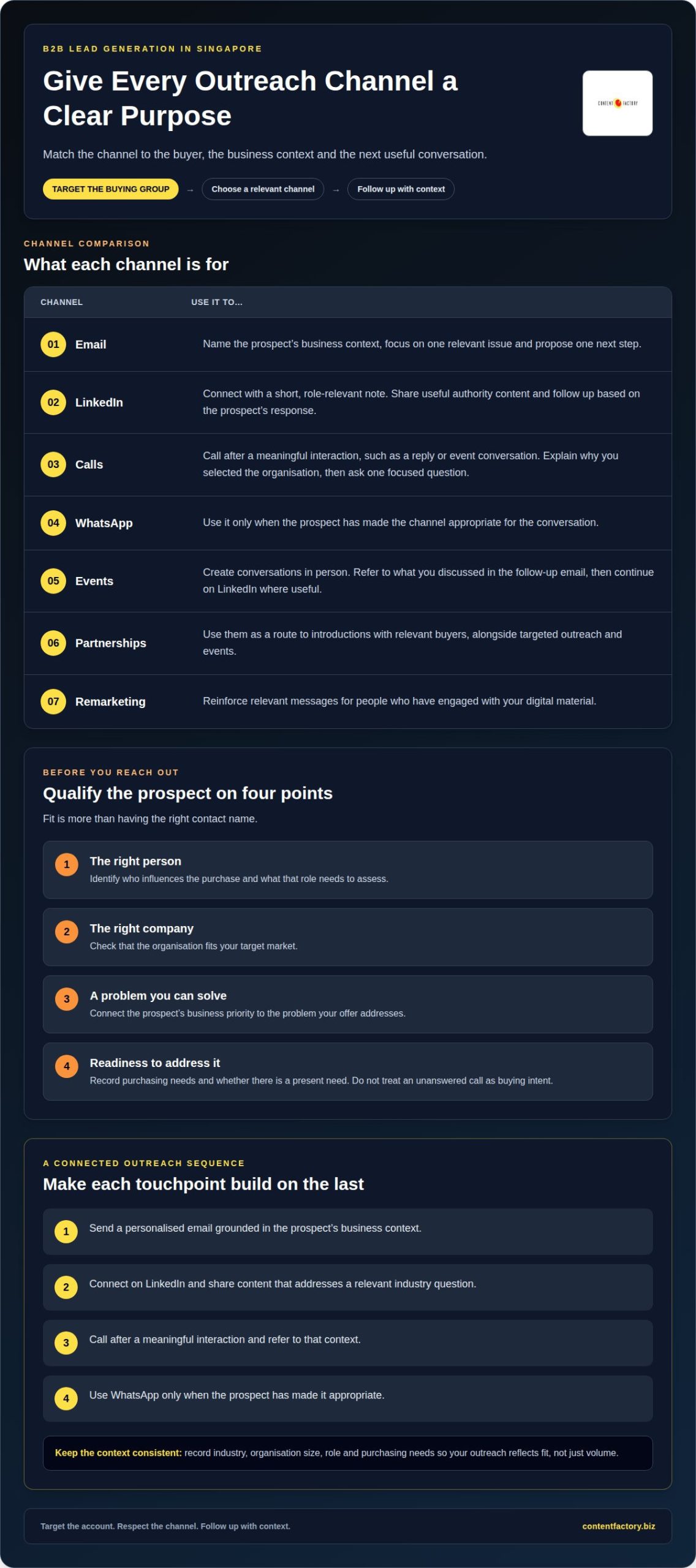
In Singapore, combine targeted outreach with events and partnerships instead of treating them as competing routes. Email, LinkedIn, calls and WhatsApp create direct contact. Events create conversations, while partnerships can introduce you to relevant buyers.
Start with the buying group, not a broad contact list. C-level buyers, procurement managers and technology directors may influence a B2B purchase, but the right contact depends on your offer. For a software solution, a technology director may assess its fit, while procurement evaluates commercial requirements. Map each role’s likely concerns before choosing a channel.
Qualify each prospect against four criteria: the right person, the right company, a problem you can solve and readiness to address it. A procurement manager at a company outside your target market may be the right person but the wrong account. Record industry, organisation size, role and purchasing needs so your outreach reflects fit, not just volume.
Personalise the first email around one relevant business issue. For example, you might address a logistics prospect’s need to coordinate operational information, then give a concise reason to discuss your solution. On LinkedIn, connect with a short note relevant to the recipient’s role. Follow up with a useful observation or question, not an immediate sales pitch.
Use a simple multi-channel sequence, with a clear purpose for each step:
- Send a personalised email that names the prospect’s business context and proposes one next step.
- Connect on LinkedIn, then share authority content that answers a relevant industry question.
- Call after a meaningful interaction, such as a reply or event conversation, and refer to that context.
- Use WhatsApp only when the prospect has made that channel appropriate for the conversation.
- Use remarketing to reinforce relevant messages for people who have engaged with your digital material.
For LinkedIn content that builds authority, share practical insights about Singapore business challenges or industry shifts. A short post on a common implementation consideration gives decision-makers a reason to engage before a sales conversation. Keep the topic relevant to your offer, then personalise follow-up based on the prospect’s response.
Coordinate outreach with events instead of sending disconnected messages. If you meet a prospect at an industry event, refer to the discussion in your follow-up email, then continue on LinkedIn where useful. B2B outreach and LinkedIn can generate conversations within weeks, but lead quality still depends on the account and its needs. For a joined-up campaign, digital advertising and B2B lead generation can connect targeted outreach with remarketing.
3. How do you handle cold calling and outreach for Singaporean prospects?
Replace generic outreach with a specific reason to contact each account. Before messaging or calling, connect the prospect’s industry, role and likely business priority to the problem your offer addresses. For example, an IT supplier could ask a finance leader about reporting needs instead of opening with a broad description of its services.
For account-based outreach, coordinate the conversation around the organisation, not just one contact. Identify the relevant functions, then tailor each message to what that person needs to assess. A technical contact may want to discuss implementation requirements; a business sponsor may focus on the operational case. Keep the core proposition consistent across both conversations.
Use calls to learn, not deliver a long pitch. Introduce yourself, explain why you selected the organisation and ask one focused question about its priorities. If the prospect describes a current challenge, ask what a useful next step would be. If there is no present need, record that clearly. Do not treat an unanswered call as buying intent.
Personalised outreach works best when marketing and sales share the same account context. If a prospect engages with an industry briefing, for example, a follow-up call can refer to its specific topic rather than start with an unrelated sales script. Agree internally on who follows up, what information they need and how to record the outcome.
What are Singapore’s PDPA rules for B2B email marketing, telemarketing and personal data? The Personal Data Protection Commission (PDPC) administers Singapore’s Personal Data Protection Act (PDPA). The Act concerns personal data handling, so assess what personal information your outreach uses, why it is used and how recipients can express contact preferences. Channel and data circumstances matter; use relevant PDPC guidance when shaping your process.
What steps should a Singapore company follow to build a B2B lead generation funnel? Define the target account and buyer, select a relevant message and channel, capture responses, qualify business need, then agree a sales handover and follow-up. For example, a reply requesting a product discussion calls for a different next action from someone who only viewed an industry post.
Review outcomes with sales and marketing together. Note where conversations pause, whether the stated problem matches your offer and what information prospects request next. This gives you practical evidence for improving targeting and follow-up without assuming that more calls alone will strengthen the pipeline. If you want to discuss a focused outreach approach, Contact Us.
4. Event and trade-show lead generation
A trade-show stand is not a lead-generation plan by itself. Before booking, define the business challenge you want to discuss, the roles you need to meet and the next action you can offer. For example, a technology supplier at an industry exhibition could focus on how operations teams evaluate a particular solution, rather than handing brochures to every visitor.
Pre-event outreach gives the event a commercial purpose. Review the attendee or exhibitor information available to your team, identify relevant organisations and invite selected contacts to meet. Explain briefly why the conversation may matter to their business. If an event agency provides meeting tools, use them to schedule targeted discussions, not to fill every available slot.
Prepare a concise conversation guide for the stand team. Include an opening question, prompts about current challenges and a clear way to capture responses. Ask visitors what is delaying a project, who else is involved in the decision and what information would help them assess options. Their answers help distinguish qualified leads from casual interest.
Keep lead capture practical. Record the person’s role, organisation, stated need, relevant solution and agreed follow-up. Add context, such as “requested a product discussion after the panel”, rather than relying on a badge scan alone. A scan records attendance, not buying intent. Before the event, make sure the team knows who owns each follow-up.
After the show, sort contacts by their stated interest and agreed next step. Send a timely, relevant follow-up that refers to the actual conversation. A visitor who asked for a technical discussion should receive that next step, not a generic thank-you. If they are not ready, share a useful resource and set a suitable nurture action instead of treating silence as a sales signal.
- Connect the event topic to a specific customer challenge and business outcome.
- Use a short qualification prompt to capture needs, roles and next steps.
- Assign each contact to a named team member before leaving the venue.
- Use marketing automation to organise follow-up tasks and record engagement.
- Review meetings, qualified leads and later revenue influence after the event.
Measure the event beyond badge scans. Track which conversations progress to meetings, proposals or revenue, and compare those outcomes with the event’s objectives. If a session attracts the right decision-makers, use that audience to shape future outreach. If follow-up stalls, review message relevance, timing and ownership before increasing activity at the stand.
Trade shows work best as one stage in a coordinated campaign. Email can secure meetings beforehand, in-person discussions can reveal challenges, and follow-up can continue the relationship afterwards. Give each channel a clear action, then review lead quality to decide whether the event belongs in your next campaign.
5. Account-based lead generation
Account-based lead generation concentrates effort on organisations that fit your offer, rather than expanding a contact list indiscriminately. Singapore’s concentrated B2B market may make it possible to name 50 ideal clients. One well-qualified lead can be worth more than 50 irrelevant contacts, particularly when an enterprise sale involves several decision-makers.
Build your account list around fit and a credible business need. For each organisation, note its industry, relevant challenge, likely buying roles and evidence of interest. A logistics company may suit a solution designed for logistics operations, while an unrelated business with more contacts may not. Choose accounts based on your actual offer, not a convenient list size.
Map the people who shape the purchase. A technology lead may assess technical fit, procurement may consider purchasing requirements, and a senior sponsor may weigh business priorities. Tailor the message to each role while keeping the central value proposition consistent. This coordinates outreach without sending identical copy to every contact.
Use a channel sequence that builds context around each account. A LinkedIn post can introduce an industry insight; a personalised email can connect that insight to the organisation’s situation. A webinar can give several stakeholders a shared way to explore a relevant topic. Make follow-up specific to the account’s engagement instead of repeating the original pitch.
Keep the account’s progress through the pipeline visible to marketing and sales. Track meaningful signals, such as a reply, webinar registration or request to discuss a specific challenge. Separate engagement from purchase readiness: a contact can show interest without representing an active opportunity. Agree on what qualifies an account for sales follow-up and record the next action.
An illustrative Singapore SaaS campaign targeting logistics firms focused on companies with 200-500 employees. After 90 days, its marketing-qualified leads had a 78% fit score. Treat this as an example of how account selection and fit can be assessed, not a forecast for another campaign.
Measure progress at account level, not just individual lead volume. Review whether target organisations engage, whether relevant roles join conversations and whether opportunities advance towards conversion. If engagement comes from the wrong roles, refine the account map. If the right stakeholders respond but the pipeline stalls, revisit the problem addressed and the next step offered.
The practical takeaway: select ideal accounts first, map buying roles, then coordinate relevant content and outreach around each organisation. This ties the channel mix to account fit and gives sales a clearer basis for prioritising follow-up.
5. How can Singapore businesses generate B2B leads through LinkedIn and other social media?
B2B lead generation strategies Singapore businesses can use on social media
Use LinkedIn to turn industry insight into relevant business conversations, not simply collect reactions. A Singapore software firm serving logistics companies could post about shipment visibility challenges, then engage with operations leaders who respond. Keep each post focused on a buyer concern your organisation can address, with a clear next step for interested readers.
Effective B2B lead generation strategies in Singapore begin with content grounded in local business needs. A post might explain how a manufacturer can assess production delays, while a short video could outline questions to consider before selecting a solution. Use industry developments and relevant policy changes as context, then explain their practical business implications accurately.
Make engagement useful. If someone comments on a post about logistics operations, respond to their point before inviting a discussion. A tailored LinkedIn message can refer to the issue they raised and offer a relevant next step, such as sharing a practical resource. Give the recipient a clear reason to continue the conversation.
Other social platforms can support the same goal when your target buyers use them professionally. For example, a company serving Singapore’s technology sector could share an industry briefing on LinkedIn and adapt its main insight for another suitable business platform. Keep the message consistent, while adjusting its format and detail for each channel.
Treat social activity as a signal, not proof of purchase intent. A profile visit or post interaction can help prioritise follow-up, but qualify the person and organisation before treating them as a sales lead. Connect social engagement with email campaigns, event conversations and website interactions in your lead records, so sales can see the context.
- Choose a target industry and publish content about a specific local business challenge.
- Use LinkedIn interactions to identify relevant people and organisations.
- Personalise follow-up around the issue or content that prompted engagement.
- Offer a clear next step, such as a conversation or relevant resource.
- Assess which social interactions lead to qualified sales discussions.
Social media supports lead generation when content, targeting and follow-up work together. Contact Us to discuss a focused approach for your target market.
ContentFactory: Digital advertising and B2B lead generation
ContentFactory helps businesses plan and execute digital advertising and B2B lead generation when outreach lacks focus, qualified conversations are inconsistent, or campaigns aren’t connected to clear pipeline goals. The work centres on aligning audience, message and channel, then using campaign performance to guide practical adjustments.
If your team has defined its target industries and buyer roles but needs a structured way to reach them, explore digital advertising and B2B lead generation. It can complement the outreach, events and account-based tactics covered in this guide without treating lead volume as the only measure of progress.
Contact Us
Build a lead generation process you can improve
Turn your current activity into a repeatable decision process. Choose a priority industry, identify where suitable prospects stop engaging and decide what evidence would indicate progress. That might be more conversations with relevant decision-makers, clearer sales handovers or better alignment between campaign responses and business needs.
Set a shared definition of a qualified lead before adjusting channels. Then review the message, audience and follow-up together, rather than changing several elements at once. This gives your team a clearer basis for deciding what to refine next. B2B lead generation strategies in Singapore work best when they reflect your buyers’ context and are assessed against useful pipeline signals, not activity alone.
ContentFactory helps businesses plan and execute digital advertising and B2B lead generation. If you want to discuss how that work could fit your priorities, Contact Us.
A focused next step can help your team build momentum with purpose.
Frequently Asked Questions
Do you provide lead generation specific to Singapore’s industries?
Yes. ContentFactory provides digital advertising and B2B lead generation that can be aligned with your industry, audience and commercial priorities. Singapore businesses in manufacturing, technology, logistics and retail may need different messages and buyer pathways. For example, a campaign aimed at a manufacturing operations lead should address a different business need from one targeting a retail technology decision-maker. The campaign focus should follow your offer and intended buyers.
So, why is lead generation crucial for B2B businesses?
Lead generation gives your sales team a structured way to find organisations with a relevant need, rather than relying only on existing relationships or occasional enquiries. It also shows which messages and channels prompt useful business conversations. If a campaign attracts interest but few requests for follow-up, for example, that signal can guide changes to targeting or the offer. The aim is a more dependable flow of relevant sales opportunities.
How do you handle cold calling and outreach for Singaporean prospects?
Effective outreach starts with a reason to contact a specific prospect. Before a call, identify the organisation’s likely business context and the role of the person you are speaking with. Introduce yourself briefly, explain why the conversation may be relevant, then ask a focused question. If the prospect identifies a current need, agree on a suitable next step. If there is no fit, record the outcome rather than treating repeated calls as progress.
Why are my leads not converting to sales?
Leads may fail to convert because the contact lacks influence, the organisation does not fit your target market or the offer does not address an active problem. A delayed or unclear sales handover can also leave interested prospects without a relevant next step. Review recent opportunities individually: note why each stalled, who was involved and what information they needed. Patterns can reveal whether targeting, messaging or follow-up needs attention.
What B2B lead generation strategies work best in Singapore?
Which Singapore industries and buyer segments are best for B2B lead generation?
No industry is automatically the best target. The strongest fit is where your solution addresses a clear business need. ContentFactory works with businesses across manufacturing, technology, logistics and retail. Buyer roles vary within each sector: a technology lead may assess a solution’s fit, while a business leader considers its wider operational relevance. Start with the sectors your offer serves, then define the organisation types and roles most likely to value it.
How can businesses qualify, score and nurture B2B leads in Singapore?
Use a consistent scoring approach based on evidence, not seniority alone. Record how closely the organisation fits your market, whether the person has described a relevant need and what action they have taken. Assign a clear follow-up: a sales conversation for an active requirement, or useful information for someone still evaluating options. Review responses with sales regularly so scoring reflects actual conversations and nurture messages stay relevant.
What are typical B2B lead generation agency prices and cost per lead in Singapore?

Article by
Mayuresh Godse
Mayuresh Godse is a Singapore Certified Management Consultant and Business Strategist specializing in Sustainability, ESG, AI-driven Digital Transformation, and business growth. Based in Singapore, he writes about Sustainability, Digital Innovation, Business Strategy, and Content Marketing for global audiences.
Disclaimer
This article is provided by ContentFactory for general information only and is not legal, tax, accounting or financial advice. Regulations and government scheme criteria change; grant eligibility and quantum are set by the relevant Singapore agencies and assessed case by case, with no outcome guaranteed. Verify current requirements before acting.