

For Singaporean SMEs and mid-market firms, the pressure to demonstrate a clear return on marketing investment has never been greater. Many businesses find themselves trapped in a cycle of spending on digital campaigns that generate vanity metrics—clicks, impressions, and traffic—but fail to deliver high-intent leads that convert into commercial growth. The disconnect between marketing activity and tangible business outcomes leads to wasted budgets and strategic uncertainty. This is where a shift in perspective is required, moving from conventional digital marketing to a results-led framework. This guide outlines how to engineer a B2B performance marketing Singapore strategy for 2026, one that is built on measurable outcomes and directly supports your commercial objectives.
What is B2B Performance Marketing in the Singapore Context?
B2B performance marketing is a data-driven approach where marketing efforts, and often payment, are directly tied to measurable actions and commercial results. In the competitive Singaporean B2B landscape of 2026, this represents a critical shift from ambiguous “brand awareness” goals to a clear focus on driving commercial growth. It is no longer enough to attract an audience; the objective is to convert that audience into qualified leads and, ultimately, revenue.
For Singaporean SMEs, this means moving beyond surface-level metrics. Instead of celebrating high click-through rates, the emphasis is on high-intent conversions: demo requests, consultation bookings, and qualified sales opportunities. Performance marketing is not an isolated tactic; it is an integral component of a wider business process reengineering journey, ensuring that every marketing dollar is accountable and contributes to the bottom line.
The Core Pillars of a Performance-Driven Strategy
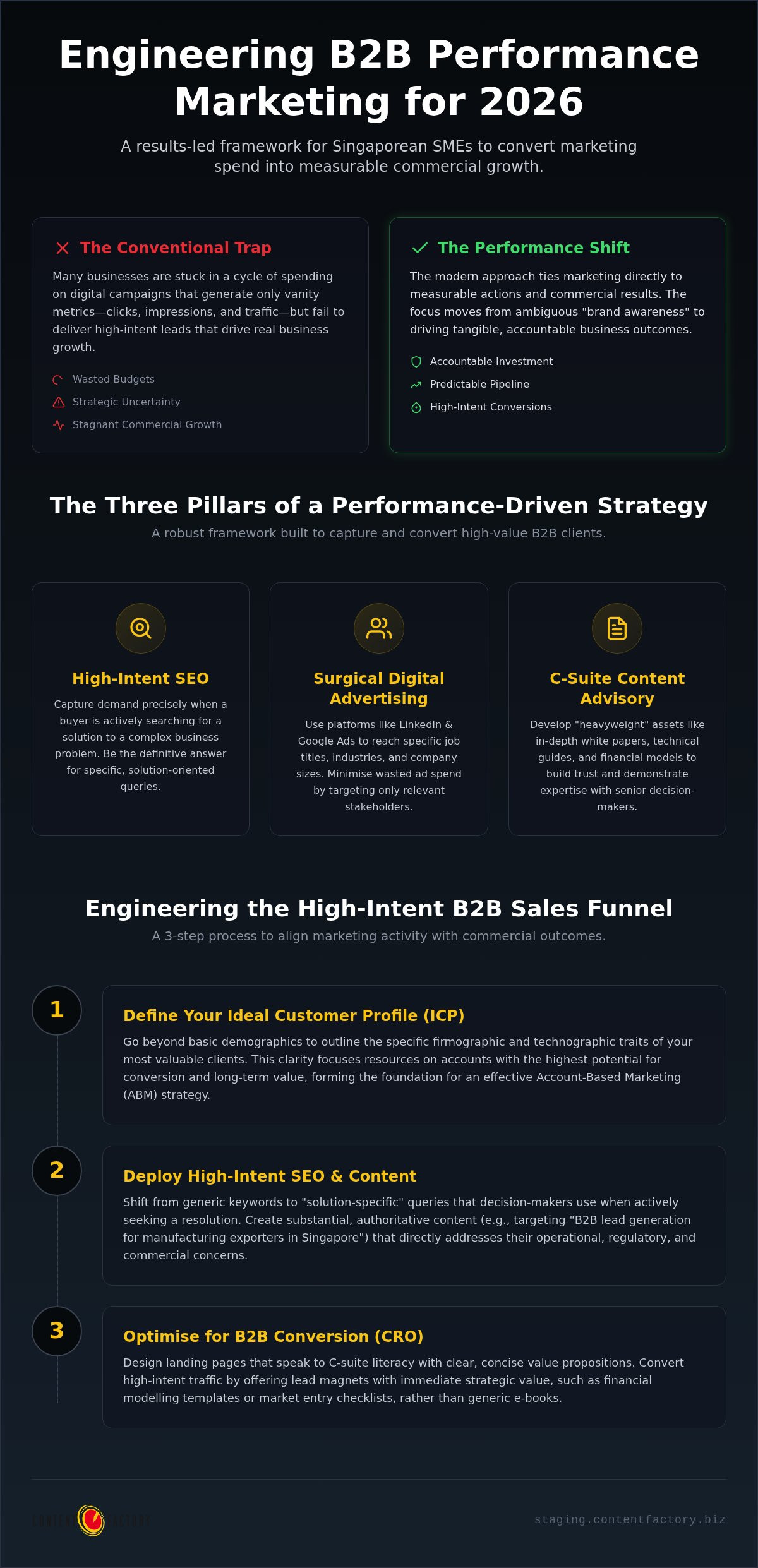
A robust B2B performance marketing framework is built on three interconnected pillars designed to capture and convert high-value clients.
- High-Intent SEO: This goes beyond ranking for generic keywords. It focuses on capturing demand at the precise moment a buyer is actively looking for a solution to a complex business problem. The goal is to be the definitive answer when decision-makers search for specific, solution-oriented queries.
- Digital Advertising: Utilising platforms like LinkedIn and Google Ads for surgical B2B targeting allows you to reach specific job titles, industries, and company sizes. This precision minimises wasted ad spend and places your message directly in front of the stakeholders who matter.
- Content Advisory: C-suite executives and senior decision-makers require more than a simple blog post. Performance marketing relies on creating “heavyweight” assets—in-depth white papers, technical guides, and financial models—that build trust and demonstrate genuine expertise, addressing the complex challenges they face.
Performance vs. Traditional B2B Marketing
Traditional “spray and pray” marketing methods, such as generic advertisements and untargeted content, are increasingly ineffective in the high-stakes ASEAN market. They lack the precision and accountability needed to justify expenditure. Performance marketing is the direct antidote, prioritising measurement and optimisation at every stage.
This precision is particularly crucial in the legal industry, where firms explore High-Intent MVA Case Acquisition to move beyond untargeted outreach and focus on high-value, specific case types.
The difference is most evident in the use of attribution models. In professional services and other complex B2B sectors, a sale may result from multiple touchpoints over several months. Sophisticated attribution allows you to understand which channels and content are most influential in the buyer’s journey, enabling you to double down on what works. This disciplined, results-oriented approach is fundamental to building a predictable pipeline and is a core component of how a modern B2B lead generation agency in Singapore drives commercial growth.
Engineering the High-Intent B2B Sales Funnel
A successful performance marketing strategy depends on a meticulously engineered sales funnel that mirrors the complex, multi-stakeholder B2B buyer journey. This is not a simple, linear path but a series of stages designed to educate, validate, and build trust before any attempt at a hard sell. Aligning marketing activity with clear sales-qualified lead (SQL) definitions is crucial to ensure a seamless handover from the marketing function to the sales team.
The middle of the funnel (MOFU) is particularly critical. This is where potential clients are evaluating solutions and require substantial, credible information to move forward. Integrating marketing automation at this stage is essential for nurturing leads through long sales cycles, delivering the right content at the right time to maintain engagement and build authority.
Step 1: Defining Your Ideal Customer Profile (ICP) and High-Value Accounts
Before launching any campaign, you must define precisely who you are targeting. This goes deeper than basic demographics. An Ideal Customer Profile (ICP) outlines the specific firmographic and technographic characteristics of your most valuable potential clients. It involves identifying the industries, company sizes, revenue levels, and existing technology stacks that signal a perfect fit for your services. This clarity allows you to focus resources on accounts with the highest potential for conversion and long-term value, forming the foundation for an effective Account-Based Marketing (ABM) strategy.
Step 2: Deploying High-Intent SEO and Content
With a clear ICP, your SEO and content strategy can shift from generic keywords to “solution-specific” queries. These are the long-tail search terms that decision-makers use when they have a defined problem and are actively seeking a resolution. Your content must directly address their operational, regulatory, and commercial concerns. For example, instead of targeting “digital marketing,” a more effective strategy would target “B2B lead generation for manufacturing exporters in Singapore.” The content created for these queries should be substantial, authoritative, and designed to reduce the friction of complex business decisions, such as regional expansion or technology adoption.
Step 3: Conversion Rate Optimisation (CRO) for B2B
Driving high-intent traffic to your website is only half the battle. The next step is to convert that traffic into qualified leads. B2B CRO requires a different approach than B2C. Landing pages must be designed to speak to C-suite literacy, with clear, concise messaging that gets straight to the value proposition. Lead magnets should offer immediate strategic value—think financial modelling templates, market entry checklists, or digital transformation readiness guides. Finally, implementing automated lead nurturing sequences ensures that every new lead is managed efficiently, maintaining engagement throughout what can often be a long and complex sales cycle.
Advanced Targeting and Automation in B2B Campaigns
To gain a competitive edge in 2026, B2B performance marketing must leverage technology for superior efficiency and precision. The next evolution of performance marketing moves beyond manual campaign management to a system where data, AI, and automation work in concert to deliver highly personalised experiences at scale. This allows you to identify and engage high-value prospects with a level of accuracy that was previously impossible.
This technology-led approach ensures that your marketing budget is deployed with maximum impact, focusing efforts on accounts that are most likely to convert and delivering messaging that resonates deeply with their specific business challenges.
Account-Based Marketing (ABM) for High-Value Targets
Account-Based Marketing (ABM) flips the traditional marketing funnel on its head. Instead of casting a wide net, ABM focuses marketing and sales resources on a predefined set of high-value target accounts. Performance marketing techniques are then used to execute highly personalised campaigns designed to resonate with the specific needs and stakeholders within those organisations. This could involve creating custom content, running targeted LinkedIn ad campaigns aimed at specific job titles within a single company, and coordinating outreach between marketing and sales for a unified, high-touch experience.
The Role of AI in Predictive Analytics and Ad Optimisation
Applied AI is transforming B2B performance marketing in Singapore by enabling predictive analytics. AI algorithms can analyse vast datasets—including website behaviour, CRM data, and third-party firmographics—to identify companies that are showing early signs of buying intent. This allows you to engage potential clients before they even begin their active search. In digital advertising, AI optimises ad spend in real-time, allocating budget to the campaigns, audiences, and creative assets that are driving the most qualified leads, thereby maximising your return on investment.
Implementing Marketing Automation for Lead Nurturing
The B2B sales cycle is often long and involves multiple decision-makers. Marketing automation is the engine that keeps potential leads engaged throughout this journey. By setting up automated nurturing workflows, you can deliver a sequence of relevant content—such as case studies, webinars, and technical guides—based on a lead’s behaviour and engagement level. This process systematically builds trust and educates the prospect, ensuring that by the time they are passed to the sales team, they are well-informed and highly qualified.
Measuring ROI: Metrics that Drive Singaporean Commercial Growth
The ultimate goal of performance marketing is to demonstrate a clear and compelling return on investment. For the Singaporean C-suite, this requires moving away from ambiguous, top-of-funnel metrics and focusing on data that directly impacts the company’s financial health. The conversation must shift from “Cost Per Click” to “Cost Per Qualified Lead” and, most importantly, “Customer Acquisition Cost (CAC).”
Effective measurement requires robust financial modelling to forecast marketing-driven growth and attribute revenue back to specific campaigns. When you can present a dashboard that clearly links marketing expenditure to pipeline growth and closed deals, you can confidently justify your budget and position the marketing function as a core driver of commercial success.
The B2B Performance Dashboard
A modern B2B performance dashboard provides a single source of truth by integrating marketing data with your CRM system. It should track metrics that reflect true business momentum.
- Pipeline Velocity: Measures how quickly leads are moving through the sales funnel, indicating the efficiency of your marketing and sales process.
- Customer Lifetime Value (LTV): Analyses the total revenue a client generates over their entire relationship with your business, allowing you to understand the true value of leads from different channels.
- Lead-to-SQL Conversion Rate: Tracks the percentage of leads that meet the criteria to be passed to the sales team, providing a critical measure of lead quality.
Leveraging Grants for Digital Growth
For eligible Singaporean companies, government grants can be a powerful multiplier for your marketing budget. The Enterprise Development Grant (EDG), for example, can be used to co-fund the costs of engaging digital marketing consultancy services to develop and execute a performance-driven strategy. By aligning your grant application with measurable business optimisation outcomes—such as generating a certain volume of qualified leads or achieving a target CAC—you can build a powerful business case for support. This strategic approach transforms a grant from a simple subsidy into a catalyst for building a scalable, high-performance digital growth engine.
Grant quantum, support levels and eligibility criteria are set by the relevant Singapore government agencies and are subject to change. Eligibility is assessed case by case.
The ContentFactory Approach: Pragmatic Execution Engines
Many businesses find that traditional agencies focus on reports and presentations, leaving the client with the burden of implementation. ContentFactory operates as a hands-on execution engine, bridging the gap between high-level strategy and the practical work required to achieve it. We integrate digital marketing with broader business process reengineering, ensuring that your growth is not only measurable but also efficient and scalable.
Our focus is on the specific challenges and opportunities within the Singaporean SME and mid-market ecosystem. We ground every digital growth initiative in tangible outcomes, translating strategic vision into a high-performance marketing system that delivers predictable results.
Expert Execution vs. Multinational Agencies
Mid-market firms need an agile, senior-led partner who understands the nuances of the Singaporean market and its regulatory landscape. Unlike large, layered multinational agencies, our model provides you with direct access to strategic advisors like Mayuresh Godse, a Singapore Certified Management Consultant. Our commitment is to “doing” over “reporting”—we build and manage the systems that drive your growth, functioning as a dedicated extension of your leadership team.
Next Steps for Your B2B Growth
Building a high-intent lead generation pipeline is a systematic process. It begins with a thorough audit of your current digital presence and a clear roadmap for the future. The goal is to align every aspect of your digital marketing—from SEO and content to paid advertising and automation—with your core commercial objectives. By doing so, you can secure a durable competitive advantage in the dynamic ASEAN market of 2026.
ContentFactory provides the strategic advisory and hands-on execution needed to transform your digital marketing from a cost centre into a predictable commercial growth engine. Our work may be co-funded by the Enterprise Development Grant (EDG), subject to eligibility. To understand how we can engineer a high-intent performance marketing framework for your business, book a 30-minute, no-obligation discovery call.

Article by
Mayuresh Godse
Mayuresh Godse is a Singapore Certified Management Consultant and Business Strategist specializing in Sustainability, ESG, AI-driven Digital Transformation, and business growth. Based in Singapore, he writes about Sustainability, Digital Innovation, Business Strategy, and Content Marketing for global audiences.
Disclaimer
This article is provided by ContentFactory for general information only and is not legal, tax, accounting or financial advice. Regulations and government scheme criteria change; grant eligibility and quantum are set by the relevant Singapore agencies and assessed case by case, with no outcome guaranteed. Verify current requirements before acting.
One thing worth checking on the tool side: if the disclaimer is switched on globally, the grant caveat already written into your Global Writing Instructions will appear as well, so grant articles will carry the same point twice. Remove the required-disclaimer section from the instructions file if you enable this one.