

Marketing automation isn’t about adding more software to your business. It’s about making the marketing work you already do more consistent. The benefits of marketing automation for SMEs include more personalised customer experiences, structured lead nurturing and less time spent on repetitive tasks.
For a small team, marketing automation can send relevant follow-ups based on a prospect’s interests, rather than relying on someone to remember every next step. It works best when customer data is useful, messaging is clear and workflows fit how the business sells.
This article explains what marketing automation does, how it helps SMEs personalise communications and nurture leads, and which routine tasks it can take off your team’s plate. It also covers practical ways to keep automation focused on customer needs, rather than simply sending more messages.
Key Takeaways
- Use customer behaviour and preferences to make automated messages more relevant across touchpoints.
- Build segmented email journeys that follow up with prospects according to their interests and readiness to buy.
- Use lead scoring to help prioritise prospects, while keeping the criteria aligned with your sales process.
- Automate repeatable marketing tasks, then review workflows to keep messages timely and useful.
- Start with a clear business need and assess whether automation fits your team, customer journey and marketing goals.
How Does AI Enable Better Personalization and Customer Experiences?
AI can help SMEs use customer data and tracked behaviour to tailor marketing messages. For example, a prospect who reads a service comparison can receive a follow-up about that offer. A customer who has already purchased can receive guidance suited to their next stage. These interactions are more relevant than sending the same campaign to every contact.
Segmentation gives this approach structure. Group contacts by relevant attributes, such as their interests, previous interactions or place in the buying journey, then match each group with a useful message. A consultancy, for instance, could send separate updates to prospects exploring a service and customers seeking practical advice after purchase. Clear segments make engagement more efficient without treating every contact identically.
AI can also analyse patterns in campaign responses and website activity to help anticipate what a person may need next. Use those signals to identify likely interests, then choose a relevant message and channel. A prospect who repeatedly views a service page might receive a relevant explanation, while a returning customer could receive a related resource. The benefit is a more connected journey, not simply more automated messages.
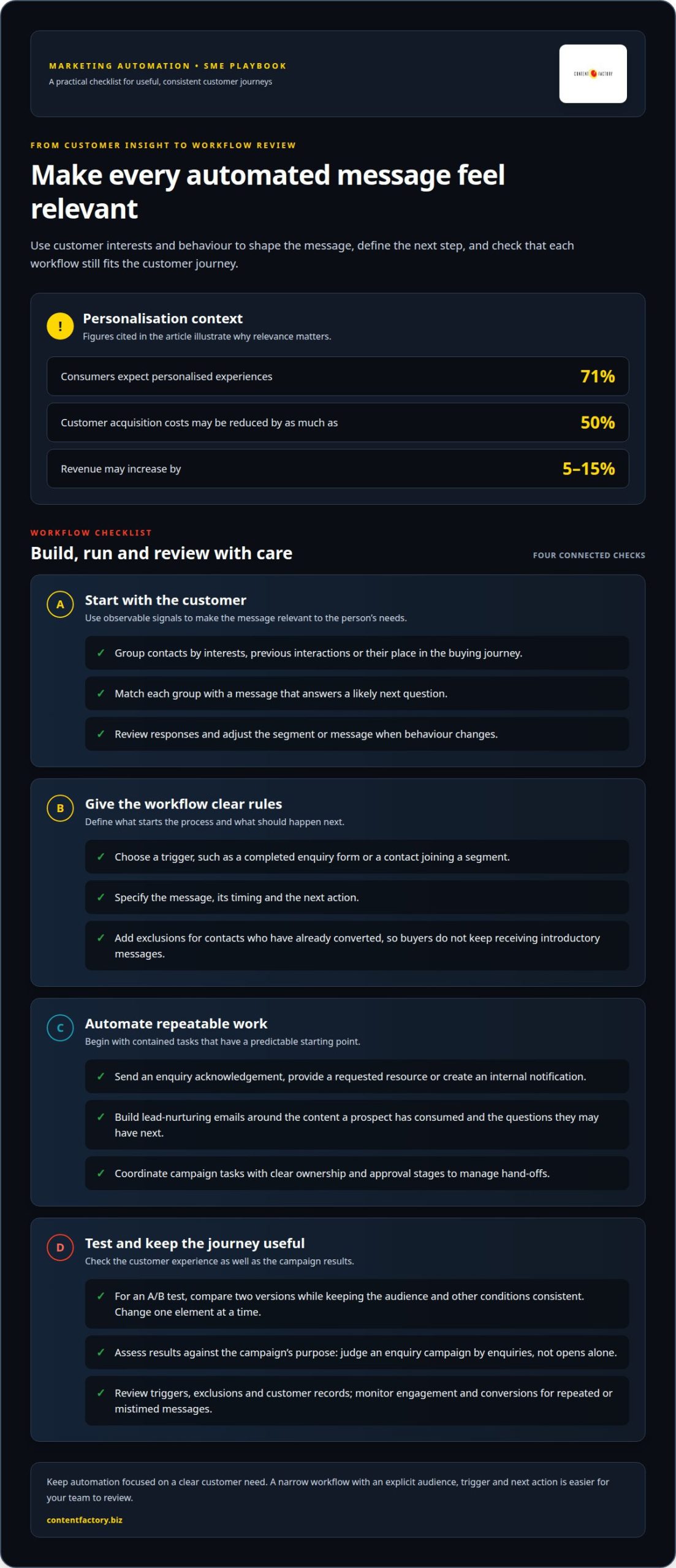
- Group contacts by an observable interest or interaction.
- Choose a message that answers that group’s next likely question.
- Review responses and adjust the segment or message when behaviour changes.
Personalised communication can support customer acquisition by making follow-ups more relevant to each prospect’s needs. It can also support retention: useful guidance after a purchase gives customers a reason to stay engaged. For sales teams, interaction records show which topics matter, helping conversations focus on customer priorities instead of repeating discovery.
Automation can reduce avoidable mistakes when teams define each journey carefully. Set a trigger, such as a completed enquiry form, then specify the message, timing and next action. Exclude contacts who have already converted. For example, a buyer should not keep receiving introductory emails for new prospects. These rules protect the customer experience and keep communications consistent.
The risks are generic messaging, excessive emails and inaccurate segmentation. An outdated or incomplete customer record can send a relevant message to the wrong person; a poorly designed workflow can repeat the same follow-up. Review each journey from the customer’s perspective, test its triggers and exclusions, and monitor engagement and conversions. Applied AI in digital marketing and automation can support this kind of targeted execution when the workflow is built around a clear customer need.
Marketing automation software can use customer data and tracked behaviour to create and deliver personalised marketing campaigns. Systems can track customers across channels and deliver personalized messages in real time across multiple touchpoints. These tools can help teams respond consistently as people move between channels, while keeping messages relevant to their activity and interests.
The case for this approach is also reflected in consumer expectations: 71% of consumers expect personalized experiences. Personalization marketing can reduce customer acquisition costs by as much as 50% and increase revenues by 5-15%. Predictive analytics can enable forecasts of future user behaviour, helping teams prepare relevant communications.
What Is Marketing Automation?
Marketing automation uses software to run planned marketing tasks when a contact takes a defined action. For an SME, it can connect email campaigns, audience segments and performance reporting in repeatable workflows.
Start with a task that repeats and has a clear trigger, such as acknowledging an enquiry or sharing a relevant resource. Automate that activity before adding complex branches. A workflow is easier to manage when its audience, trigger and intended next action are explicit.
In Singapore, the first tasks to automate are usually predictable activities with an observable starting point. An enquiry acknowledgement, a requested resource or an internal notification can each provide a contained test. Choose one, define what should happen next, and keep the process narrow enough for your team to review.
Automated Lead Nurturing and Email Campaigns
Lead nurturing uses a sequence of relevant messages to help prospects move towards a decision. For example, a contact who downloads an eBook can receive a follow-up email after an appropriate interval. Segment the audience by the content they consume, then make each message answer a likely next question. This helps your team plan communications around interest instead of sending every subscriber the same sequence.
Campaign and Content Workflows
Campaign workflows coordinate recurring activities, such as preparing an email, assigning a review and scheduling delivery. A simple process might begin when a contact joins a segment, then send an approved resource and record the response. Content workflows can also organise planned messages around a campaign theme. Clear ownership and approval stages help teams manage hand-offs and avoid missed steps.
A/B Testing and Campaign Optimisation
A/B testing compares two versions of a marketing asset, such as an email subject line or landing page. Keep the audience and other conditions consistent, then compare clicks or conversions to see which version performs better. Change one element at a time. This gives your team a practical basis for refining campaigns instead of relying on preference alone.
Automation dashboards can bring measures such as open rates, click rates and conversions together. Assess each result against the campaign’s purpose: a message designed to generate enquiries should be judged by enquiries, not opens alone. Historical and real-time reporting can help show where contacts disengage. For a more structured view, digital marketing ROI measurement connects campaign activity with business outcomes.
To keep the first workflow manageable, document its trigger, audience, message, exclusions and success measure. Review whether each step still serves the campaign purpose before expanding the process. If you need support shaping a practical automation approach, discuss your marketing workflow.
Automated lead generation, nurturing, and scoring
Automation can capture prospect activity, organise customer data and help sales teams prioritise follow-up. Its value depends on identifying relevant prospects, not simply increasing contact volume.
Audience Targeting and Lead Data
Audience targeting groups prospects by relevant attributes and interactions, so each lead receives suitable next steps. For example, a Singapore SME can distinguish people who downloaded a product guide from those who requested a consultation. A form can collect essential details, while automated rules can flag duplicate records or missing fields. Cleaner customer data makes targeting more useful and reduces manual sorting.
Lead Scoring and Follow-Up Management
Lead scoring assigns relative priority to prospects using documented actions and fit criteria. A team might give a consultation request more weight than a general newsletter sign-up, then route that lead for timely follow-up. Scores should reflect the business’s actual sales process, not arbitrary activity totals. Review whether high-priority leads progress, and revise the criteria if the score does not support useful decisions.
Lead Qualification and Nurturing
Lead qualification assesses whether a prospect’s needs and readiness fit the offer, while nurturing provides relevant information before a buying decision. Gleanster Research reports that 50% of leads businesses generate are qualified but not ready to buy immediately. An SME can place those contacts in a suitable nurture path, then adjust follow-up when their interactions indicate stronger intent.
Gated content can generate leads by offering a useful resource in exchange for contact details. For instance, a downloadable planning checklist can ask for a business email and an area of interest. Request only information relevant to the resource. A long form may deter prospects, while too little context can leave the sales team unable to tailor its response.
Define the hand-off between marketing and sales before activating lead scoring. Specify which actions trigger follow-up, who owns the response and what outcome should be recorded. If a prospect requests a consultation, the workflow should stop general nurture messages and alert the appropriate sales contact. This avoids competing messages and makes lead activity easier to assess.
Lead records also need ongoing maintenance. Set rules to identify duplicate contacts, correct incomplete fields and remove people from workflows when they no longer fit. Review scoring and response patterns together, since a rising score means little if sales conversations do not progress. A focused B2B lead generation approach connects targeting, qualification and follow-up into one operating process.
If your team needs to map that process to its sales priorities, discuss your lead generation needs.
Marketing automation can identify inbound leads, prioritize them using a scoring system and create tailored messages to influence them. Marketing automation tools can document contact history and evaluate sales potential through lead scores. Companies using marketing automation to nurture prospects saw a 451% increase in qualified leads.
Relevant content remains important throughout the process: 77% of buyers want unique, targeted content at each stage of their research. Nurtured leads made purchases 47% larger than purchases by non-nurtured leads.
Employee productivity and reduced repetitive work
Automation handles repeatable actions, while people retain control over decisions, tone and customer context. Compared with manual marketing, it applies the same approved rules consistently instead of relying on staff to remember every follow-up.
Marketing Productivity and Time Savings
Marketing automation supports productivity by completing recurring tasks from defined triggers, such as sending an acknowledgement after an enquiry. Staff can spend less time scheduling routine messages and more time interpreting responses or improving relevant content. McKinsey predicted generative AI could increase marketing productivity by up to 15% of total marketing expenditure. That is a potential productivity effect, not a guaranteed saving for each SME.
Reducing Repetitive Employee Work
Automation reduces repetitive work by applying set rules to routine marketing actions. For example, a workflow can send a welcome email, record a response and stop the sequence after a purchase. This removes manual copying and repeated reminders. Employees still need to review the message, trigger and exclusions, because an automated workflow can repeat mistakes as efficiently as correct actions.
Automation Compared With Manual Marketing
Manual marketing gives staff direct control over each message, but every send, update and follow-up requires attention. Automation applies a defined process consistently, while people handle exceptions and judgement calls. For an SME, the practical choice is not full automation or full manual control. Automate predictable tasks, but retain human review for sensitive messages, unusual responses and campaign decisions.
Start with a task that happens repeatedly and has a clear completion point. An enquiry confirmation is a practical example: define the trigger, approve the message, exclude duplicate enquiries and assign someone to handle replies needing personal attention. Record the current process, including missed follow-ups or repeated data entry. This gives your team a baseline for assessing whether automation makes the process more efficient.
Next, separate execution from judgement. A system can schedule an approved email or update a contact record, but a person should decide whether an offer remains relevant. If a customer replies with a specific concern, for example, pause the automated sequence and route the conversation for a tailored response. This safeguard prevents a routine workflow from overriding a real customer interaction.
Review workflow performance using practical indicators: time spent on the task, errors corrected, delayed responses and customer replies requiring intervention. Compare the same activity before and after implementation, and note what changed. If automation creates extra checking or irrelevant messages, revise its triggers. Productivity comes from removing unnecessary effort, not adding a constant stream of automated actions.
Marketing automation for small businesses
An SME can implement marketing automation by choosing one repeatable task, mapping its trigger and audience, then building and reviewing a simple workflow. Start with a clear customer need, not a complex tool or a long list of features.
For a small Singapore business, the right starting point might be acknowledging enquiries or sending a relevant resource after a prospect requests information. A focused workflow is easier to manage, and it lets your team see whether automation supports the customer relationship and business goal.
- Choose a recurring task. Identify work that follows a consistent pattern, such as confirming an enquiry or sharing information after a sign-up. Record the current steps and the point where staff need to take over.
- Set a specific outcome. Decide what the workflow should achieve. For an enquiry sequence, the outcome might be a response, a booked conversation or a clear point for personal follow-up.
- Define the audience and trigger. Specify which contacts enter the workflow and what action starts it. For example, a request for a product guide can trigger a follow-up related to that guide.
- Build the message and safeguards. Prepare useful content, check the timing and add rules to exclude people who have already replied or converted. Keep a human hand-off for questions that need context.
- Review and optimise. Track a relevant measure, such as replies or completed enquiries. If contacts disengage or staff need to correct the workflow often, revise its audience, content or trigger before expanding it.
Choose automation tools that fit your team’s operating capacity, rather than creating another system it cannot maintain. A small business can begin with one workflow and a named owner responsible for its messages, exceptions and performance. Documenting these responsibilities keeps the process from depending on one person’s memory.
Next, consider how the workflow fits your revenue process. A local service provider may want to respond promptly to enquiries, while a business with a longer consideration period may need to share useful information over time. In either case, align the automated action with what the customer has requested. Automation should make follow-up more consistent, not replace a conversation when personal judgement matters.
Keep the first workflow narrow. Avoid automating several customer journeys at once, particularly if contact records or message approvals are inconsistent. Review the process with the employees who handle enquiries, then adjust any step that causes duplicate contact or irrelevant follow-up. This helps an SME build capability gradually and improve the process based on actual customer responses.
If you want to plan an automation approach around your marketing priorities, Contact Us.
ContentFactory
ContentFactory helps SMEs connect marketing automation with audience needs and business priorities. If your automated messages are consistent but do not generate relevant engagement, the next step may be to improve your marketing automation strategy and execution. Its Digital Marketing Strategy & Execution services can help focus your messages and resources on the customer journey.
Turn to ContentFactory when you need to clarify what your marketing automation should communicate, which audiences it should serve and how activity supports lead generation. Automation works best as part of that wider direction, not as a substitute for it. Contact ContentFactory to discuss your marketing priorities.
Make your next marketing decision deliberate
The benefits of marketing automation for SMEs depend on how well it supports your priorities. Decide what your business wants to improve and who will guide the work as those priorities evolve.
ContentFactory helps you shape a practical digital marketing approach, including how applied AI and automation can support it. The focus is purposeful execution, not adding tools without a clear reason.
To discuss your priorities and next steps, book a 30-minute discovery call. A focused conversation can help you identify where to begin.
Frequently Asked Questions
What are the main benefits of marketing automation for SMEs?
A key strategic benefit is making marketing processes repeatable as a business grows. A small team can apply consistent criteria across customer journeys without relying on individual memory for every decision. Automation also creates a clearer record of how contacts move between stages. This visibility can help managers identify unclear responsibilities or slow manual hand-offs, then adjust the process.
How does marketing automation improve lead generation and conversion rates for small businesses?
Automation can improve conversion by helping marketing and sales agree on when a prospect is ready for a sales conversation. For example, both teams might define which business needs, decision roles or stated timelines indicate a suitable opportunity. Shared criteria reduce disagreement about lead quality and help sales teams focus their attention. Review rejected leads too, as the reasons can reveal gaps in targeting or qualification.
How much time and money can SMEs save with marketing automation?
There is no single saving that applies to every SME. The result depends on how often a task occurs, how much staff input it needs, and the platform and maintenance costs involved. A workflow for a frequent, standard process may free more capacity than one handling rare exceptions. Include staff review and correction time in the calculation, not just the task the software performs.
How can SMEs measure the ROI of marketing automation?
Assess ROI by separating revenue influenced by automation from revenue that would likely have occurred anyway. Use consistent campaign attribution and account for other relevant sales activity before assigning value to a workflow. Then compare its contribution with all associated costs, including staff oversight and implementation. This gives a more grounded view than crediting every sale after an automated message to the system.

Article by
Mayuresh Godse
Mayuresh Godse is a Singapore Certified Management Consultant and Business Strategist specializing in Sustainability, ESG, AI-driven Digital Transformation, and business growth. Based in Singapore, he writes about Sustainability, Digital Innovation, Business Strategy, and Content Marketing for global audiences.
Disclaimer
This article is provided by ContentFactory for general information only and is not legal, tax, accounting or financial advice. Regulations and government scheme criteria change; grant eligibility and quantum are set by the relevant Singapore agencies and assessed case by case, with no outcome guaranteed. Verify current requirements before acting.