

A sustainability proposal is easier to assess when it answers a business question, not just an environmental one. Building a business case for sustainability means connecting a specific initiative to a priority your organisation needs to address, then testing its value against evidence, assumptions and clear measures.
The challenge is that upfront costs are visible, while benefits may take longer to emerge or sit across teams. When sustainability data is incomplete, don’t fill the gaps with optimistic forecasts. Show what you know, what remains uncertain and how you will track progress.
This article explains how to define the business need, compare an initiative with competing priorities and assess its financial and operational value without overstating returns. It covers how materiality, ESG readiness and gap analysis, clear ownership and proportionate measures can turn scattered evidence into a decision-ready case.
Key Takeaways
- Start with a specific business decision so the sustainability proposal has a clear purpose and scope.
- Separate measurable operational effects from wider strategic value, and support claims with available records and stated assumptions.
- Compare initiatives using consistent criteria, including strategic fit, evidence quality, feasibility, dependencies and material risks.
- Build the case step by step, with a defined output at each stage.
- Turn approval into an ESG action plan with named owners, measures and review points, informed by readiness gaps and evidence needs.
Why building a business case for sustainability starts with a business decision
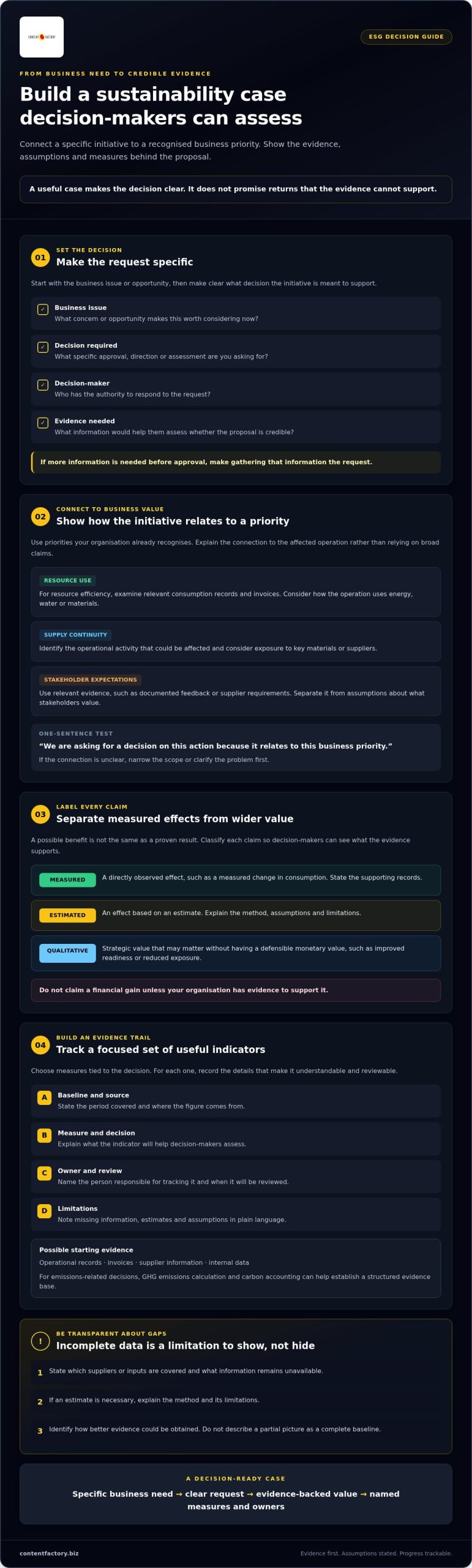
A sustainability proposal competes for the same time, people and resources as other business priorities. Without a clear reason to act, it can remain a broad statement of intent rather than something decision-makers can assess. Start with a business issue or opportunity, then define the decision the initiative is meant to support.
A business case is an evidence-based rationale for a specific decision. It links a recognised priority to a proposed action, explains the effects the organisation will assess and identifies the information behind the recommendation. It is not a promise that every initiative will deliver financial returns, or a list of sustainability activities without a clear request.
Consider a business reviewing its use of materials in a production process. A useful proposal would define the process and ask for a specific decision, such as whether to assess a change in material use. A general commitment to “reduce waste” does not tell decision-makers what they are being asked to approve or how the issue relates to operations.
What should a sustainability business case answer?
Make the decision easy to identify. State the business issue or opportunity, name the person or group expected to decide, and specify the evidence they need to assess the proposal. This might include operational records or input from the teams closest to the issue. If the decision-maker needs more information before approving action, make that the request rather than presenting the case as complete.
- Business issue: What concern or opportunity makes this worth considering now?
- Decision required: What specific approval, direction or assessment are you asking for?
- Decision-maker: Who has the authority to respond to that request?
- Evidence needed: What information would help them assess whether the proposal is credible?
How do you connect sustainability to business priorities?
Use priorities your organisation already recognises, such as resource use or supply continuity. Explain how the proposal relates to the affected operation instead of relying on broad claims about sustainability. If continuity is the priority, identify the operational activity that could be affected and explain why the initiative is relevant. Don’t claim a financial gain unless your organisation has evidence to support it.
Before drafting, test the proposal in one sentence: “We are asking for a decision on this action because it relates to this business priority.” If the connection is unclear, narrow the scope or clarify the problem first. A focused request gives decision-makers a sound basis for discussion and shows what the organisation still needs to learn before committing further resources.
Which business value can sustainability initiatives create, and how can you evidence it?
A sustainability initiative can create value in more than one way, but each claim needs relevant evidence. Separate effects you can measure directly from strategic benefits that are harder to quantify. This keeps the case useful without turning a possibility into a promised result.
Start with the business priority you have identified. If it is resource efficiency, examine relevant consumption records and invoices. If the concern is supply continuity, consider exposure to key materials or suppliers and the internal information that helps describe it. Stakeholder expectations may also matter, but distinguish documented feedback or requests from assumptions about what stakeholders value.
Which forms of value belong in the case?
Include a value pathway only when you can explain how it connects to the business priority. Resource efficiency may relate to how an operation uses energy, water or materials. Resilience may concern the organisation’s ability to manage an identified operational exposure. Stakeholder expectations may affect a decision if you have relevant evidence, such as supplier requirements or feedback.
Keep quantified effects separate from qualitative benefits. A measured change in consumption is not the same as a forecast financial return. Improved readiness or reduced exposure may be strategically relevant without having a defensible monetary value. In building a business case for sustainability, label each claim as measured, estimated or qualitative, and explain the basis for that label.
What evidence makes the case more credible?
Use a focused set of indicators tied to the decision rather than launching a broad data collection exercise. For each indicator, record its baseline, source, responsible owner and review point. Operational records, invoices, supplier information and internal data may provide a useful starting point. For emissions-related decisions, GHG emissions calculation and carbon accounting can help establish a structured evidence base.
- Baseline and source: State the period covered and where the figure comes from.
- Measure and decision: Explain what the indicator will help decision-makers assess.
- Owner and review: Name the person responsible for tracking it and when it will be reviewed.
- Limitations: Note missing information, estimates and assumptions in plain language.
For example, if supplier information is incomplete, state which suppliers or inputs are covered and what remains unavailable. Don’t describe a partial picture as a complete baseline. If an estimate is necessary, explain the method and its limitations, then identify how better evidence could be obtained. The measure should still help answer the decision at hand.
This discipline makes a case more credible, even when the data is imperfect. If you need help defining evidence needs for an ESG decision, discuss your sustainability case with ContentFactory.
How should you compare sustainability initiatives before committing resources?
Two proposals can sound equally persuasive but differ in what they require, what evidence supports them and how they fit current priorities. Compare them using the same criteria. This makes trade-offs visible and reduces the risk of choosing the initiative with the strongest pitch rather than the clearest fit.
For each option, record its expected contribution, supporting evidence, resource and operational requirements, dependencies and material risks. Keep qualitative benefits visible, but don’t force them into a monetary estimate. A useful comparison clarifies what is known, what remains uncertain and what decision follows.
Which criteria help distinguish one initiative from another?
First, check whether each option addresses an issue that matters to your organisation. Then assess whether the required data, people and operating conditions are available. A proposal that fits a priority but depends on unavailable information or capacity may need further scoping before you commit. Record dependencies and uncertainties alongside the benefits, not in a footnote.
- Strategic fit: Does the initiative address a recognised business or material sustainability issue?
- Evidence quality: Are the supporting facts traceable, current and relevant to the decision?
- Feasibility: Can the organisation carry out and review the work with its available capability?
- Dependencies and risk: What other decisions, information or conditions could affect delivery?
Apply the same prompts to every option. You could compare an operational resource-use initiative with a supplier-data improvement, for example, without assuming either is automatically more valuable. The first may have more accessible internal records; the second may depend on information from outside the organisation. Those differences affect feasibility and evidence strength, even before you consider longer-term effects.
How can you compare uncertain or longer-term benefits?
Separate confirmed evidence from assumptions and possible future effects. If delaying a proposal may leave an identified exposure unaddressed, describe the exposure and the basis for concern. Don’t present a potential loss as certain. Scenarios can help decision-makers consider different outcomes, provided each one states its assumptions and limitations.
For instance, a scenario might compare proceeding with a planned operational change against deferring it. Make clear which inputs come from records and which are estimates. If key evidence is missing, explain how that weakens the comparison and whether a limited information-gathering step should come before a larger commitment.
Conclude with a short written rationale: why the preferred option best fits the current priority, what evidence supports it, what uncertainties remain and what would trigger a review. This is the practical discipline behind building a business case for sustainability: a clear recommendation, not false certainty. If you need help assessing priorities and evidence gaps, discuss your ESG case with ContentFactory.
How to build a business case for sustainability step by step
A useful case doesn’t need a large research exercise. It needs a clear decision, a defined scope and enough evidence to support a proportionate recommendation. Keep each stage focused on producing something the next stage can use. This helps your team make progress when some information is incomplete.
What should you prepare before drafting the case?
Before writing, name the business issue, the decision-maker and the operation affected. Set boundaries so the proposal doesn’t expand into a general sustainability programme. Then list the available evidence, missing information, assumptions and people responsible for each item. This gives the case a clear starting point and makes gaps visible early.
- Define the decision. Write down what approval or direction you need, who will decide and when the decision is relevant. Keep the request specific, such as agreeing to assess an operational change, rather than asking for general support for sustainability. Output: a one-sentence decision statement.
- Set the scope. Identify the site, process, activity or stakeholder group involved. Note what falls outside the proposal, too. Output: a short scope description with clear boundaries.
- Connect the issue to a business priority. Explain why the sustainability issue matters to an existing organisational priority. Describe the link plainly, without assuming it creates savings or another financial return. Output: a concise problem statement and rationale.
- Assemble the evidence. Gather relevant records, identify their source and period, and note where coverage is partial. Separate observed information from estimates and assumptions. Assign an owner to each important data gap. Output: an evidence register showing sources, limitations and accountable owners.
- Describe the proposed action and its implications. Set out what the initiative involves, which teams or operations it affects, and any dependencies or delivery constraints. State expected effects as measured, estimated or qualitative, based on the evidence available. Output: a concise option summary with assumptions and uncertainties.
- Choose measures and review points. Select a focused set of indicators that will help assess the decision or track implementation. For each one, name the owner, baseline or starting point, data source and review point. Output: a simple monitoring plan.
How should you present the recommendation?
Bring the outputs together in a short recommendation: the proposed action, business rationale, supporting evidence, main uncertainties and how progress will be reviewed. End with the next decision required. Ask for a defined step, such as approval to proceed with a scoped assessment, rather than endorsement of an unsupported forecast.
Before sharing the case, check that every material claim has a source or is clearly labelled as an assumption. If you want support structuring an evidence-led sustainability proposal, Contact Us.
Turn a sustainability business case into an ESG action plan
Approval is a starting point, not the finish line. The next task is to translate the decision into work people can own, track and review. A scoped ESG action plan turns the recommendation into defined activities, responsibilities, measures and review points, so implementation does not stall after the initial decision.
Keep the plan proportionate to the approved scope. If the decision was to assess a specific operational issue, don’t expand it into an organisation-wide programme without a further decision. Set out what will happen, who is responsible, what information is needed and how the team will assess progress.
What should happen after the decision?
Convert the approved initiative into activities with a clear sequence and accountable owners. Each measure should have a source, a responsible person and a review point. Identify capability gaps early, such as where teams need guidance on collecting, interpreting or maintaining information. Make follow-through part of the plan rather than leaving it as an assumption.
- Activities: Define the work included in the approved scope and its immediate outputs.
- Owners: Assign responsibility for delivery, data collection and review.
- Measures: Choose indicators that show whether agreed work is progressing.
- Review points: Set when the team will check evidence, discuss issues and adjust the plan.
For an emissions-related initiative, specify which activities or parts of the organisation the data should cover, who can provide the source information and how the figures will be reviewed. Carbon accounting can help structure emissions measurement, but the plan should still name internal owners for providing and checking relevant data. If evidence is incomplete, record that as a work item rather than implying the baseline is complete.
When can ESG readiness support help?
Readiness work is useful when priorities, evidence or responsibilities are unclear. An ESG readiness gap analysis can help identify priority issues, define the scope of work and clarify what evidence teams need to build an actionable plan. It can also show where roles or data processes need attention before the organisation commits to broader activity.
Capability building is relevant when teams need support to understand their responsibilities and carry out agreed work consistently. Practical guidance can help staff understand what information to collect, how to maintain it and when to escalate gaps. The aim is to make ownership workable within your organisation, not to promise a particular financial or sustainability outcome.
Building a business case for sustainability only creates lasting value when approval leads to accountable action. ContentFactory supports organisations with ESG readiness, evidence-led planning, carbon accounting and capability building, with advice shaped around practical priorities and follow-through.
Put your next sustainability decision into motion
Your next step doesn’t need to settle every question. Choose one decision your business can make with the information available, then define what you need to learn before committing further resources. If evidence is incomplete, make that uncertainty part of the decision rather than hiding it in a forecast.
Building a business case for sustainability is most useful when it helps your organisation move from discussion to a clear, proportionate action. Set a review point, learn from what the work shows and use that evidence to guide the next decision.
ContentFactory helps organisations assess ESG readiness, identify evidence gaps and turn sustainability priorities into practical plans. Book a Strategic Consultation (30-minute discovery call).
Frequently Asked Questions
Is a sustainability business case only about reducing operating costs?
No. Cost reduction is one possible consideration, but a case can also address operational continuity, resource constraints, material ESG priorities or information needed to meet customer expectations. The relevant value depends on the decision. For example, a proposal to improve supplier information may support better oversight even if its immediate financial effect can’t be quantified. State that benefit plainly rather than presenting it as a saving.
Can you build a sustainability business case without complete data?
Yes. You can make a bounded recommendation using the evidence available, provided you identify what it covers and what remains unknown. If the gaps are too large to support a wider commitment, propose a defined information-gathering step first. For example, your initial decision might be to map available energy records across one operation, then use the findings to decide whether a larger initiative is justified.
How do you make a business case when sustainability benefits are difficult to quantify?
Describe the benefit in operational or strategic terms, then define how you will assess whether the initiative is progressing. A team capability improvement, for instance, may be tracked by whether staff can provide consistent information at agreed review points, rather than assigning it an unsupported monetary value. Keep qualitative outcomes distinct from measured effects and explain what evidence could strengthen the case later.
What should a sustainability business case include?
Include the decision requested, the business issue it addresses, and the proposed action and its scope. Add the supporting evidence, key assumptions, material uncertainties and alternatives considered. State who will own delivery and which measures will be reviewed. A short decision brief can make these elements easier to assess, provided it gives enough context for someone who wasn’t involved in developing the proposal.
Who should be involved in building a sustainability business case?
Involve the people who understand the operation, the information behind the case and the decision process. An operations lead can clarify practical constraints; staff responsible for relevant records can explain data limitations; and a finance lead can review financial assumptions. Include the decision-maker early enough to confirm what they need to evaluate. Assign one person to coordinate inputs so responsibilities don’t disappear between teams.

Article by
Mayuresh Godse
Mayuresh Godse is a Singapore Certified Management Consultant and Business Strategist specializing in Sustainability, ESG, AI-driven Digital Transformation, and business growth. Based in Singapore, he writes about Sustainability, Digital Innovation, Business Strategy, and Content Marketing for global audiences.
Disclaimer
This article is provided by ContentFactory for general information only and is not legal, tax, accounting or financial advice. Regulations and government scheme criteria change; grant eligibility and quantum are set by the relevant Singapore agencies and assessed case by case, with no outcome guaranteed. Verify current requirements before acting.