

By 2026, sustainability has transitioned from a voluntary initiative to a non-negotiable license to operate within global supply chains. You’re likely facing immense pressure to provide audit-ready carbon data, but building a business case for sustainability investment often feels like a financial burden due to high upfront costs. It’s difficult to justify these expenses to your board when the returns seem intangible or deferred.
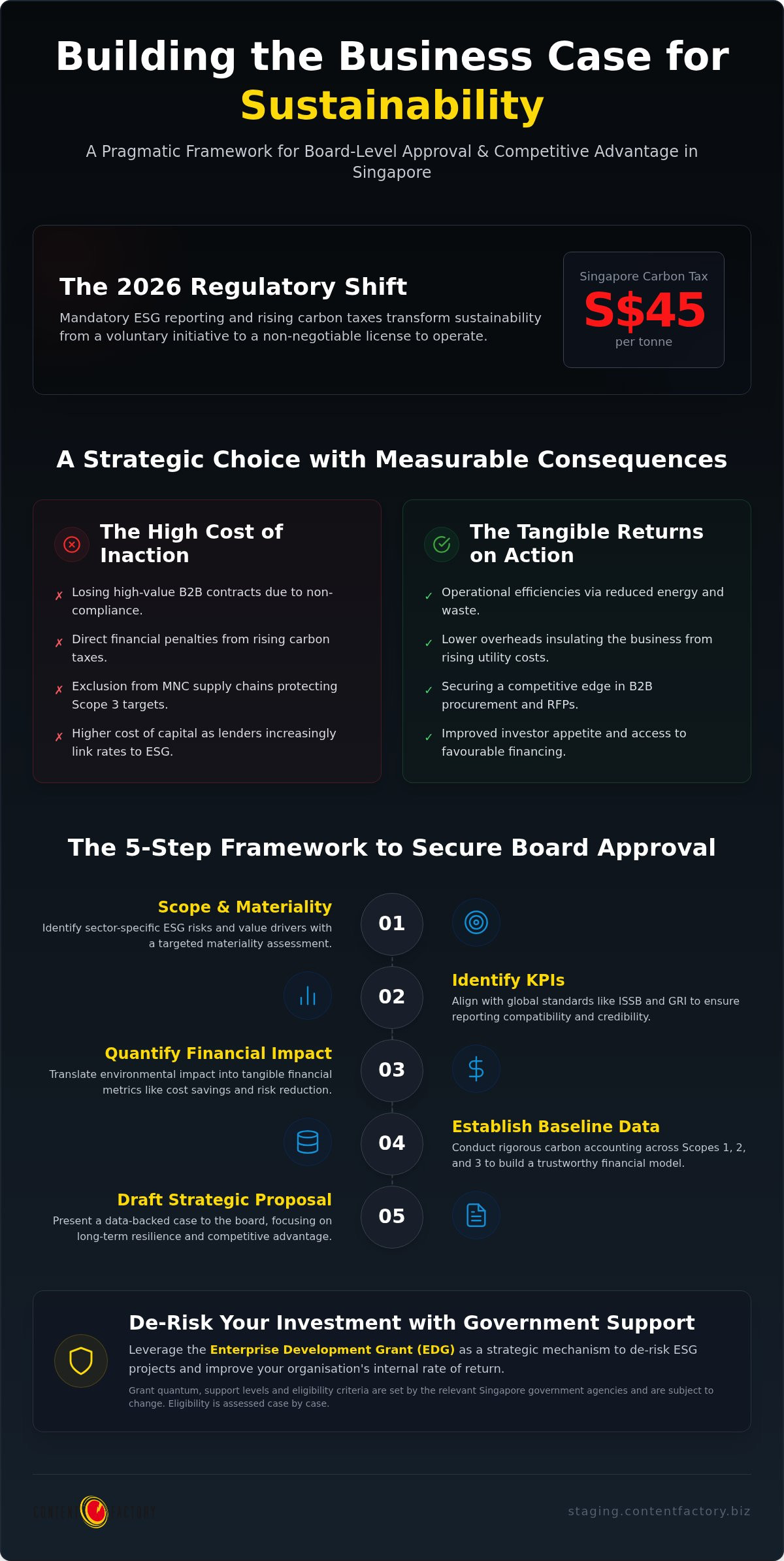
With the Singapore carbon tax reaching S$45 per tonne in 2026, the financial risk of inaction is no longer theoretical. You need a pragmatic approach that translates carbon metrics into the language of the balance sheet. This article provides the precise framework required to quantify the financial and strategic value of sustainability initiatives for board-level approval.
This guide details the financial modelling techniques needed to quantify ESG value, ensures your organisation aligns with mandatory 2026 Singapore reporting standards, and demonstrates how to transform compliance into a competitive edge for B2B procurement. You’ll gain the tools to move from reporting as a cost centre to sustainability as a driver of operational efficiency.
Key Takeaways
- Shift your perspective from viewing sustainability as an operational cost to a strategic roadmap for resilience in Singapore’s 2026 mandatory reporting environment.
- Execute a pragmatic framework for building a business case for sustainability investment that quantifies financial value through targeted materiality assessments and ISSB-aligned KPIs.
- Leverage the Enterprise Development Grant (EDG) as a strategic mechanism to de-risk ESG projects and improve your organisation’s internal rate of return.
- Secure a competitive edge in B2B procurement by transforming audit-ready carbon data and sustainability reports into high-value assets for RFPs and MNC supply chains.
- Transition from board-level approval to operational reality by establishing internal governance structures for ongoing emissions monitoring and ESG readiness.
Beyond ROI: Redefining the Business Case for Sustainability
A sustainability business case is no longer a peripheral corporate social responsibility exercise; it’s a strategic roadmap for operational resilience. For Singaporean enterprises, 2026 marks a definitive shift from voluntary initiatives to mandatory ESG compliance. SGX-listed issuers must now report Scope 1 and Scope 2 emissions, with Straits Times Index (STI) companies required to disclose Scope 3 greenhouse gas emissions starting from this financial year. This regulatory pressure filters down to every SME within the supply chain, making the ability to quantify impact a prerequisite for commercial survival.
Traditional 12-month ROI models fail to capture the structural value of ESG because they prioritise immediate cash flow over long-term risk mitigation. Building a business case for sustainability investment requires a broader lens that accounts for avoided costs and market access. A robust investment case begins with double materiality. This framework identifies how sustainability issues impact your financial performance and how your operations affect the environment and society. Without this foundation, your investment remains reactive rather than strategic.
The Cost of Inaction vs. The Cost of Investment
Inaction is a strategic choice with measurable consequences. Multinational corporations (MNCs) are increasingly excluding non-compliant vendors to protect their own Scope 3 targets. If your business cannot provide audit-ready carbon data, you risk losing high-value B2B contracts. Singapore’s regulatory environment is also tightening; the carbon tax has risen to S$45 per tonne for 2026, directly impacting the bottom line of carbon-intensive operations. The inaction premium is a hidden financial liability that grows every year you delay your transition.
Direct and Indirect Financial Drivers
Pragmatic sustainability investment delivers tangible returns through several channels. Direct gains often manifest as operational optimisations, including reduced energy consumption and minimised waste through process redesign. These efficiencies lower overheads and insulate the business against rising utility costs. Indirect gains are equally critical, as financial institutions increasingly link interest rates to ESG performance. Firms with strong ESG profiles often enjoy a lower cost of capital and improved investor appetite.
To quantify these drivers effectively, you must implement rigorous carbon accounting services SG. Accurate data allows you to move beyond estimates and present a financial model that boards can trust. By integrating these metrics into your core financial reporting, you transform sustainability from a compliance burden into an engine for scalable growth.
The 5-Step Framework for Building Your Sustainability Case
Executing a transition to sustainable operations requires a structured methodology that bridges the gap between environmental stewardship and financial performance. Building a business case for sustainability investment is a five-step process designed to secure executive buy-in while ensuring regulatory alignment. This framework transforms abstract ESG goals into a logical, sequence-driven roadmap that your board can evaluate with the same rigour as any other capital expenditure.
- Step 1: Scoping the initiative through a targeted materiality assessment to identify sector-specific risks.
- Step 2: Identifying KPIs aligned with ISSB and GRI standards to ensure reporting compatibility.
- Step 3: Translating environmental impact into tangible financial metrics such as cost savings and risk reduction.
- Step 4: Establishing baseline data through carbon accounting across Scopes 1, 2, and 3.
- Step 5: Drafting the proposal for board-level strategic approval with a focus on long-term resilience.
Scoping and Materiality: Defining What Matters
You must prioritise the ESG factors that directly influence your sector’s specific value drivers. A comprehensive materiality assessment for SMEs prevents the common trap of addressing low-impact metrics that dilute the business case. By focusing on material risks, you ensure that every dollar invested contributes to operational efficiency and regulatory compliance. This targeted approach demonstrates to leadership that sustainability is a tool for value creation rather than a generic compliance exercise.
Data Requirements and Carbon Accounting
Transitioning from estimated data to audit-ready emissions tracking is essential for the 2026 business case. With STI-listed companies now mandated to report Scope 3 emissions, SMEs within these supply chains must provide granular, verifiable data to remain viable partners. Establishing a measurable baseline allows you to track year-on-year improvements and demonstrate the benefits of a sustainable business strategy to your stakeholders. This data-driven foundation is what separates a speculative proposal from a robust investment case.
Translating these metrics into a financial language requires a deep understanding of how carbon footprints impact the balance sheet. If you need assistance in structuring these complex financial models, contact our consultants to start your readiness assessment. Securing board approval depends on your ability to present a clear, data-backed vision that aligns with Singapore’s evolving regulatory landscape.
De-risking the Case: Leveraging Singapore Government Support
Building a business case for sustainability investment often stalls at the capital expenditure phase. You’re likely facing high upfront costs for carbon accounting and process redesign that can deter even the most forward-thinking boards. In Singapore, the Enterprise Development Grant (EDG) acts as a critical de-risking mechanism by co-funding qualifying project costs. This support allows you to accelerate ESG transformations that would otherwise be financially prohibitive.
The EDG sustainability pillar specifically targets projects that drive resource efficiency and emissions reduction. Until 31 March 2026, eligible SMEs can access an enhanced support level of up to 70%. After this date, the standard co-funding rate of up to 50% is expected to apply for qualifying SMEs. By leveraging these funds, you shift the financial burden away from your internal reserves, allowing for a more aggressive implementation timeline that meets 2026 regulatory demands.
Maximising ROI through Strategic Grant Advisory
Aligning your corporate goals with Singapore’s national green priorities increases the likelihood of project success. Engaging a Singapore Certified Management Consultant ensures that your proposal meets the rigorous standards set by EnterpriseSG. This expertise is vital for navigating the Singapore grant consulting landscape and securing the necessary co-funding for your ESG roadmap.
Professional advisory helps you structure projects that demonstrate clear economic value alongside environmental impact. This dual focus is essential for making the business case for sustainability to stakeholders who prioritise financial stability. A well-constructed grant application serves as a proof of concept for your board, showing that the government is a strategic partner in your sustainability journey.
Financial Modelling for ESG Investments
Your business case must include detailed cash flow projections that integrate grant disbursements. This transparency allows the board to see the direct impact on the Internal Rate of Return (IRR) and the total payback period. Comparing a self-funded project against a grant-supported one often reveals a significant reduction in the time required to reach break-even. Don’t overlook how this liquidity improves your overall project viability.
Grants transform what looks like a prohibitive cost into a manageable strategic investment by providing immediate capital during the implementation phase. You should model the impact of the S$45 per tonne carbon tax alongside grant support to show the true net cost of inaction. This level of financial granularity is what secures final approval for large-scale ESG initiatives in a competitive market.
Grant quantum, support levels and eligibility criteria are set by the relevant Singapore government agencies and are subject to change. Eligibility is assessed case by case.
Commercial Upside: ESG as a Competitive Differentiator
Securing board approval for building a business case for sustainability investment becomes significantly easier when you frame ESG as a commercial offensive rather than a defensive compliance measure. In 2026, your sustainability report is no longer a static document; it’s a high-value asset that signals operational maturity to potential partners. Large-scale procurement teams now view audit-ready carbon data as a proxy for management quality and long-term viability. It’s a shift that turns transparency into a tangible revenue driver.
MNCs operating in Singapore and the wider ASEAN region are aggressively scrubbing their supply chains to meet global Scope 3 disclosure requirements. If your organisation can provide verified emissions data, you aren’t just another vendor; you’re a strategic partner that de-risks their own reporting. This positioning allows you to command a premium or secure long-term contracts that are closed to less transparent competitors. Building a business case for sustainability investment that emphasises market share capture ensures your proposal resonates with revenue-focused stakeholders.
The ESG-Procurement Synergy
By 2026, procurement professionals have moved past generic green claims. They prioritise suppliers who can demonstrate concrete progress through ISSB and GRI-aligned metrics. Integrating your Scope 1, 2, and 3 data directly into your commercial value proposition changes the conversation from price to resilience. This data-backed transparency is a core component of successful regional go-to-market execution, especially when targeting high-value B2B accounts that mandate strict environmental criteria.
Market Entry and Regional Expansion
Sustainability standards now act as a commercial passport for growth across the ASEAN region. As markets like Malaysia and Vietnam tighten their own environmental regulations, Singapore-based firms with established ESG frameworks possess a first-mover advantage. You can enter these markets not just as a service provider, but as a leader in sustainable operations. Competitor benchmarking based on ESG performance often reveals significant gaps that your business can exploit to gain regional traction and secure your place in global supply chains.
Transforming your compliance-led costs into commercial market leadership requires a shift in how you deploy your sustainability data. It’s about using your ESG credentials to navigate complex regional landscapes and secure your place in the global economy. When your business case aligns with the commercial realities of your buyers, investment becomes an obvious choice for growth-oriented leadership. This strategic alignment is the fastest route to turning mandatory reporting into a competitive edge.
Executing the Case: From Board Approval to Implementation
Approval is the starting gun, not the finish line. Once you’ve succeeded in building a business case for sustainability investment, the focus shifts to operationalising those commitments through a comprehensive ESG Readiness Assessment. This phase identifies the specific technical gaps between your current state and your 2026 compliance targets. You must move beyond theoretical projections to establish internal governance structures that ensure emissions monitoring becomes a standard monthly finance function. Selecting the right partners for business process reengineering is critical at this stage; they must possess the ability to integrate sustainability metrics into your existing ERP and finance systems without disrupting daily operations.
Reporting is a critical component of this execution. By 2026, relying on a single framework is insufficient for firms with regional ambitions. You should adopt a multi-framework approach that integrates GRI for impact reporting and ISSB for financial materiality. This dual-track strategy ensures your data satisfies both the procurement teams of MNCs and the rigorous requirements of Singapore’s regulatory bodies like SGX RegCo and ACRA. Establishing these reporting protocols early prevents the last-minute scramble for data that often leads to compliance errors. It’s about building a robust, audit-ready trail that stands up to third-party scrutiny and reinforces your commercial credibility. This credibility is further enhanced when supported by a culture of integrity, such as that fostered by Unashamedly Ethical NPC through their ethics-focused consultancy.
Operational success depends on your ability to embed ESG into your corporate DNA. You must train leadership teams to view sustainability as a core business function rather than a peripheral compliance task. Overcoming internal resistance requires a transparent change management strategy that highlights the efficiency gains of restructured processes. Establishing a culture of data-driven sustainability ensures that every department takes ownership of its carbon footprint. Investing in ESG capability building and training provides your staff with the technical literacy required to maintain audit-ready records.
Continuous Optimisation and Reporting
A static business case will become obsolete as regional regulations shift and global standards evolve. You must update your investment model annually to account for changes in Singapore’s carbon tax or new disclosure requirements. Leveraging digital tools for real-time carbon accounting and process automation reduces the administrative burden of manual data entry. This continuous optimisation ensures your sustainability strategy remains a live, high-performing engine for growth. By 2026, the most resilient firms will be those that treat building a business case for sustainability investment as an iterative process of refinement rather than a one-time project.
Securing Your Commercial Future Through ESG Operationalisation
By 2026, the distinction between sustainability and core business strategy has vanished. You’ve seen that building a business case for sustainability investment requires a definitive shift from short-term ROI to long-term resilience and market access. Integrating audit-ready carbon data and leveraging de-risking mechanisms like the Enterprise Development Grant are essential steps for any Singaporean SME looking to maintain its position in high-value global supply chains.
ContentFactory acts as your execution engine for this transformation. Led by Singapore Certified Management Consultant Mayuresh Godse, we specialise in pragmatic ESG readiness assessments and strategic grant advisory. We don’t just provide theoretical reports; we operationalise your sustainability goals to drive measurable growth and ensure compliance with evolving ACRA and SGX RegCo standards.
Your transition to a sustainable business model is a significant undertaking, but with the right framework, it’s your most powerful tool for regional expansion. Take the first step toward future-proofing your organisation today. We look forward to helping you navigate this transition with confidence.
Grant quantum, support levels and eligibility criteria are set by the relevant Singapore government agencies and are subject to change. Eligibility is assessed case by case.
Frequently Asked Questions
How do I start building a business case for sustainability with no data?
You begin by conducting a materiality assessment to identify the ESG factors most critical to your sector’s value drivers. This prioritisation allows you to focus on qualitative risks, such as potential supply chain exclusion, before you have granular data. Building a business case for sustainability investment without historical data involves using industry benchmarks to project potential efficiency gains and risk mitigation costs. It’s about establishing a baseline from which you can measure future performance.
What is the typical ROI for a sustainability investment in Singapore?
ROI for sustainability initiatives is often achieved through a combination of direct operational savings and indirect strategic value. Direct returns typically stem from energy efficiency and waste reduction, which lower overheads and insulate the business against rising utility costs. Strategic returns include access to green financing with lower interest rates and the retention of high-value B2B contracts. While specific figures depend on your sector’s energy intensity, most firms see a significant improvement in long-term resilience.
Can SMEs apply for the EDG for carbon accounting projects?
Yes, Singaporean SMEs can apply for the Enterprise Development Grant (EDG) to co-fund qualifying sustainability projects, including carbon accounting and ESG strategy development. Eligible SMEs can access up to 70% co-funding for sustainability-related initiatives until 31 March 2026. This support is designed to help businesses build internal capabilities and meet international reporting standards. Grant quantum, support levels and eligibility criteria are set by the relevant Singapore government agencies and are subject to change. Eligibility is assessed case by case.
What are the most important ESG KPIs for mid-market firms in 2026?
In 2026, the most critical KPIs for mid-market firms include Scope 1 and Scope 2 greenhouse gas emissions, energy intensity per unit of revenue, and waste diversion rates. Many firms are also prioritising Scope 3 data to satisfy the requirements of their multinational partners. These metrics should align with ISSB and GRI standards to ensure your reporting is compatible with global benchmarks. Focusing on these KPIs ensures your sustainability disclosures are both audit-ready and commercially relevant.
How does sustainability investment affect a company’s valuation?
Sustainability investment enhances company valuation by reducing a firm’s risk profile regarding carbon taxes and regulatory non-compliance. In the Singapore context, where the carbon tax is S$45 per tonne in 2026, businesses that have successfully decoupled growth from emissions are seen as more resilient. This lower risk often translates to higher multiples during valuation exercises. Investors and financial institutions increasingly prioritise firms that can demonstrate a clear, data-backed sustainability roadmap and measurable impact.
Is Scope 3 emissions reporting mandatory for Singapore private companies?
Mandatory Scope 3 reporting currently applies primarily to firms listed on the Straits Times Index (STI) starting from financial year 2026. However, private companies within the supply chains of these listed entities are often required to provide this data to remain preferred vendors. While it may not be a direct legal mandate for all private SMEs yet, it’s a commercial necessity for those engaging in B2B procurement with larger organisations or international MNCs.
What is the difference between a materiality assessment and a business case?
A materiality assessment identifies the environmental, social, and governance issues that significantly impact your business and stakeholders. It defines what you should report on. In contrast, building a business case for sustainability investment uses those material findings to justify the financial and strategic allocation of capital. The assessment provides the necessary data points, while the business case translates them into the language of ROI, risk mitigation, and commercial growth for board approval.
How long does it take to see financial returns from ESG initiatives?
The timeline for financial returns depends on the nature of the initiative. Operational efficiency projects, such as upgrading to energy-efficient equipment, often see a payback period within 18 to 36 months. Strategic returns, including market expansion and improved brand equity, are typically realised over a three-to-five-year horizon. It’s important to view these investments as a means of future-proofing your operations against rising carbon costs and tightening regulatory standards in the ASEAN region.
Article by
Mayuresh Godse
Mayuresh Godse is a Singapore Certified Management Consultant and Business Strategist specializing in Sustainability, ESG, AI-driven Digital Transformation, and business growth. Based in Singapore, he writes about Sustainability, Digital Innovation, Business Strategy, and Content Marketing for global audiences.
Disclaimer
This article is provided by ContentFactory for general information only and is not legal, tax, accounting or financial advice. Regulations and government scheme criteria change; grant eligibility and quantum are set by the relevant Singapore agencies and assessed case by case, with no outcome guaranteed. Verify current requirements before acting.
One thing worth checking on the tool side: if the disclaimer is switched on globally, the grant caveat already written into your Global Writing Instructions will appear as well, so grant articles will carry the same point twice. Remove the required-disclaimer section from the instructions file if you enable this one.