

A persuasive pitch can make an ASEAN partnership look straightforward. The harder question is whether the distributor has the financial capacity, operational resources and market experience to deliver the role your business needs. This guide to distributor due diligence ASEAN focuses on evidence, not presentation alone.
For Singapore SMEs, a copied checklist may miss the conditions that matter in a specific target market. Define the distributor’s responsibilities first, then assess its capabilities against those requirements. Claims should be checked in context, not accepted automatically or dismissed without review.
You’ll learn what to verify, how to identify gaps and how to document a proportionate decision to proceed, pause or decline. The aim is not to eliminate risk, but to make your ASEAN expansion decision with clearer evidence and fewer assumptions.
Key Takeaways
- Define the distributor’s responsibilities first so you can assess the capabilities your market-entry plan actually requires.
- Use distributor due diligence ASEAN to test claims about financial capacity, operating resources, market experience and strategic fit against evidence.
- Don’t treat size or an established appearance as proof of suitability; assess whether the partner can fulfil the specific role you assign.
- Document what you verify, what remains uncertain and whether the evidence supports proceeding, pausing or declining.
- Start with a practical action: list the prospective distributor’s critical claims and the evidence that would validate each one.
ASEAN distributor due diligence: why a persuasive pitch is not proof
Your SME is deciding whether to entrust a local distributor with market execution. That decision calls for more than choosing the partner with the most convincing growth plan. You need to assess whether the prospective distributor has the financial capacity, people, operating resources and relevant market experience to carry out the responsibilities you have in mind.
Distributor due diligence is the structured checking of a prospective partner’s claims and capabilities before you make a commercial commitment. A presentation sets out what a distributor says it can do. Due diligence compares those claims with relevant evidence and your business requirements. It can reduce uncertainty, but it cannot guarantee performance or eliminate risk.
Myth: a strong presentation proves a distributor can deliver
A polished proposal can show preparation and commercial interest. It does not, by itself, establish that the distributor has the resources or experience to execute. If it promises broad market coverage, for example, ask what supports that claim: relevant customer relationships, a capable team or operating reach that fits the market.
Don’t accept claims automatically, but don’t dismiss them either. Treat each as a question to test. Hypothetical example: a distributor says it can manage product demonstrations and after-sales support. You could ask who would perform those tasks, what relevant experience they have and how the support would work in practice. The point is not to assume the claim is false. It is to seek corroboration before relying on it.
Why ASEAN requires market-specific questions
ASEAN is not one uniform commercial or regulatory environment. The distributor’s role, route to customers and information relevant to assessing capability can differ by target market and product. A checklist prepared for one country may miss practical questions that matter in another.
Start with the requirements for your chosen market, then tailor your checks to the distributor’s responsibilities. Consider what it must deliver, which capabilities those tasks require and what evidence could demonstrate them. Avoid assuming that a partner’s presence in one ASEAN market proves it can operate effectively across the region.
To connect partner assessment with the wider market context, explore the market-entry strategy and feasibility guide. The purpose of distributor due diligence ASEAN is to assess evidence against the role to be performed, not the confidence of the pitch.
Four myths that can weaken ASEAN distributor due diligence
Weak screening often starts with a shortcut: treating visible signs of credibility as proof of operational fit. These four myths can distort distributor due diligence ASEAN decisions. The correction is straightforward: test each claim against the distributor’s assigned role, the target market and evidence that answers a specific question.
Myth 1: A larger business is automatically more capable
Size may indicate resources, but it doesn’t show whether the right people, coverage or attention will be available for your business. A large distributor may prioritise other products or markets. Assess the team and resources proposed for your account, and whether they match the work you expect the partner to perform.
Myth 2: A strong reputation or a folder of documents proves capability
References, credentials and company documents are useful starting points, not conclusions. Check whether each item is relevant to the proposed role, current enough for your decision and consistent with other information. An available document is not necessarily useful evidence: ask what decision it supports, then seek corroboration where the answer matters. The International Trade Administration’s guidance to evaluate potential representatives offers general vetting considerations, not ASEAN-specific rules.
Myth 3: Success in one market proves fit in another
A distributor may have delivered well in one country or product category without having the same reach, relationships or operating capability elsewhere. Treat experience as relevant context, not a transferable guarantee. Ask what the partner has done in the target market, for comparable products and for responsibilities similar to yours. Then test those claims against evidence suited to that market.
Myth 4: Trust and exclusivity make extensive checks unnecessary
Personal rapport can support a strong working relationship, but it can’t replace verification. Exclusivity is a commercial choice, not a default measure of trust. Consider whether it has a clear strategic rationale for your business and how the arrangement would affect your options if the distributor’s performance or priorities changed. The right approach depends on the relationship and market; no single structure fits every partnership.
Keep a simple record: claim, supporting evidence, gaps and relevance to the distributor’s role. That makes it easier to distinguish an unresolved question from a verified capability. If you need structured support assessing partner fit and capacity, explore distributor and partner due diligence, or Contact Us to discuss your assessment.
What to verify before appointing an ASEAN distributor
Build your assessment around the work the distributor will actually perform. The right evidence depends on whether it will manage customer relationships, hold stock, coordinate delivery or provide after-sales support. Evidence matters only when it is relevant to the distributor’s proposed role.
For distributor due diligence ASEAN businesses should compare claims with records and practical details, then document what each item does and does not establish. Use this prose checklist as a starting point, adapting it to the target market and the partner’s responsibilities.
Financial capacity and operational readiness
Assess whether the distributor appears able to sustain the proposed activities. Depending on what is available and appropriate to request, financial statements, management accounts or other financial records may help you understand its position. Consider them in context and over time where comparable information is available. Don’t impose a universal threshold without considering the scale and demands of the role.
- Financial capacity: Compare relevant financial records with the resources the distributor says it can commit. Record missing periods, inconsistent figures or unanswered questions for follow-up. A gap is a prompt to investigate, not proof of misconduct.
- People and facilities: Ask for details of the team, facilities and capacity assigned to your work. Compare these with the activities, locations and service levels you expect the partner to support.
- Logistics and service: Clarify how the distributor would handle delivery, stock or customer support where these fall within its proposed responsibilities. Seek evidence that relates to those specific tasks, rather than accepting a general claim of capability.
Market fit, reputation and reference checks
Assess whether the distributor’s customer access and sector experience match your intended market. Relevant evidence could include examples of comparable products or customers, an account of how it reaches those customers, and references relating to similar responsibilities. For highly technical sectors—such as the specialty chemical solutions developed by JAS Global Industries—evaluating whether a distributor understands sector-specific handling and market requirements is essential. A reference is more useful when you understand the work involved and how closely it resembles your planned arrangement.
Compare the partner’s stated strengths with your target customers, competing offers and product position. ContentFactory’s competitor benchmarking and product positioning service can help frame that market context. For a separate perspective, National Defense Magazine describes partner vetting as a key compliance element in its own context. Treat that as a prompt to consider relevant compliance questions, not as a statement of requirements across ASEAN.
For each area, record the claim, the evidence reviewed, its relevance, and any unresolved question. That creates a clearer basis for deciding whether the distributor’s capabilities fit the responsibilities you plan to assign.
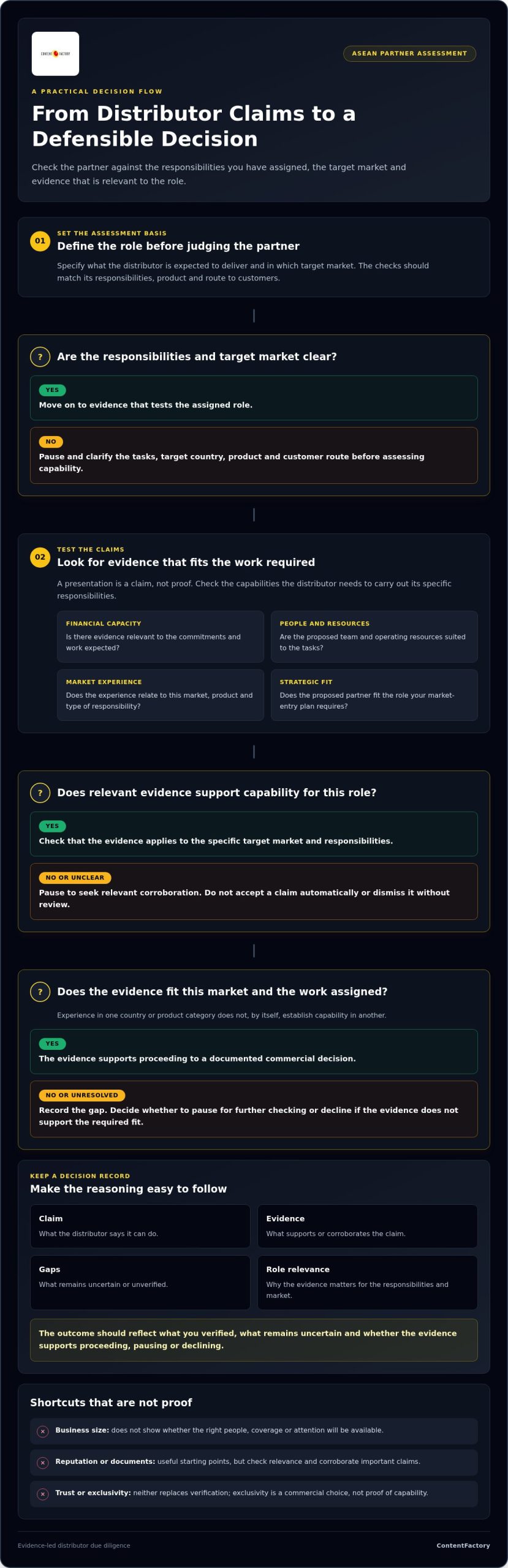
A practical process for assessing a prospective ASEAN distributor
A useful assessment is built around the distributor’s assigned role, not a generic scorecard. For distributor due diligence ASEAN, set the decision criteria before reviewing the partner, then gather and test evidence against those criteria. Prioritise checks according to the responsibilities involved and the conditions in the target market.
Set criteria before reviewing the distributor
Start by writing down what the distributor is expected to do, which customers it will serve and what contribution you need it to make in the market. Be specific about responsibilities such as customer coverage, product handling or after-sales support, where relevant. This gives your team a clear basis for assessing capability.
For each important claim, agree what evidence would support or challenge it. If the distributor says it can reach a particular customer group, define what would substantiate that claim, such as relevant customer examples or references for comparable work. Keep the criteria tied to your market-entry plan. Generic rankings can obscure whether the partner can deliver the activities your business actually needs.
Gather, verify and document evidence
Request information that relates to the criteria you set. Compare the material with the distributor’s statements and follow up on inconsistencies or missing details. The depth of verification should reflect the importance of each responsibility and the market context. A capability central to execution deserves closer scrutiny than a claim with little bearing on the partner’s role.
Keep a working record that distinguishes:
- Verified strengths: capabilities supported by relevant, consistent evidence.
- Open questions: points that need clarification or further evidence.
- Material gaps: requirements that current evidence does not show the distributor can meet.
- Possible mitigations: practical steps your business could consider, with an owner responsible for assessing or carrying them out.
Assign a decision owner for each follow-up and record the response or outcome. This makes unresolved issues visible rather than allowing them to disappear into meeting notes. Avoid reducing the assessment to a single pass-or-fail score: a strong result in one area may not offset a serious gap in a capability essential to the role.
Turn findings into a documented decision
Summarise the evidence, remaining uncertainty and business implications in a short decision record. A go may be appropriate when critical capabilities are supported; a pause may be warranted while important questions remain; a decline may follow when material gaps conflict with your requirements. These are possible outcomes, not automatic recommendations. Record who made the decision and why.
ContentFactory provides distributor and partner due diligence to help assess partner fit and financial and operational capability. To discuss your assessment, Contact Us.
Make distributor due diligence part of a stronger ASEAN entry decision
A distributor’s pitch describes potential. Your decision should rest on whether the partner can execute the role your business actually needs, in the market you plan to enter. Distributor due diligence ASEAN should therefore feed into the wider entry decision, not sit apart from it as a paperwork exercise.
Before your next partner discussion, take a practical step: write down the distributor’s most important claims, then specify what evidence would support or challenge each one. Include the capabilities essential to your plan, the questions that remain open and who in your organisation will assess the answers. This short record helps keep the decision grounded in evidence rather than presentation quality or personal confidence.
When an independent assessment can add value
An independent assessment can be useful when your team has limited local knowledge, the distributor makes complex capability claims, or the commitment would materially shape your expansion. A fresh review can organise evidence around the role, identify gaps that need follow-up and make assumptions visible. It supports a better-informed decision, not certainty about future performance.
Partner checks are strongest when the market context is clear. ContentFactory supports SMEs with distributor and partner due diligence across ASEAN and India, alongside ASEAN market-entry strategy and feasibility. Linking the two helps keep partner criteria connected to the target market and your intended route into it.
The next step for your distributor review
Before you seek an assessment, clarify three points: the target market, the distributor’s proposed responsibilities and the questions that will determine your decision. For example, identify which claimed capabilities are essential, what evidence would address them and which gaps would require a pause or further action. This gives the review a defined purpose.
ContentFactory’s distributor and partner due diligence examines partner fit and financial and operational capability. The work is led by Mayuresh Godse, a Singapore Certified Management Consultant with more than 25 years of consulting experience. The goal is a documented, proportionate decision to proceed, pause or decline, based on what the evidence shows and what remains unresolved.
To discuss your target market and partner review, Contact Us.
Make your next partnership decision evidence-led
A persuasive pitch can open the conversation, but evidence should shape your decision. Effective distributor due diligence ASEAN checks a prospective partner’s financial and operational capability against the role you need them to perform. It also recognises that market conditions differ, so a copied checklist may miss important questions.
Start by listing the distributor’s critical claims and the evidence that would test each one. Then document verified strengths, unresolved questions and any gaps that could affect execution. This gives your business a clearer basis to proceed, pause or decline without mistaking polished paperwork for proven capability.
ContentFactory supports SMEs with distributor and partner due diligence across ASEAN and India. The work is led by Mayuresh Godse, a Singapore Certified Management Consultant with 25+ years of consulting experience, and draws on a regional network of experts serving Singapore, ASEAN and India. Its experience spans manufacturing, technology, logistics and retail.
Bring your target market, proposed partner role and key decision questions into the review. With a structured assessment, you can move forward with greater clarity and a decision grounded in evidence. Contact Us to discuss your distributor review.
Frequently Asked Questions
What is distributor due diligence in ASEAN?
Distributor due diligence is the structured assessment of a prospective partner before you commit to working together. It tests relevant claims about financial capacity, operational resources, market experience and fit against the responsibilities you plan to assign. In ASEAN, the questions should reflect the specific target market rather than assume the region operates as one uniform commercial environment. The process helps you make a documented decision, but cannot guarantee performance.
Why is distributor due diligence important when expanding into ASEAN?
It helps you identify whether a prospective distributor can carry out the work your expansion depends on. A polished proposal or personal introduction may not show who will serve your customers, what resources will support the relationship or whether the partner has relevant local experience. A structured review helps separate verifiable evidence from assumptions, identify unanswered questions and make a more informed decision before committing to the partnership.
What should I check before appointing an ASEAN distributor?
Focus on the capabilities required for the distributor’s proposed role. Review available financial information, the people and resources assigned to your business, relevant operating capability, target-market experience and strategic fit. Ask for evidence that relates to specific claims, such as comparable customer references or details of how the partner would handle assigned responsibilities. Record what is verified, what remains unclear and how each finding affects your requirements.
Are company documents enough to verify a distributor?
No. Company documents can help establish context, but their existence alone doesn’t prove that a distributor can perform the role. Check whether the information is relevant to your decision, consistent with the partner’s claims and supported by other appropriate evidence. For example, a company profile may describe market coverage, but you may need further detail to understand whether the distributor has the people and resources to serve your intended customers.
How can I assess an ASEAN distributor’s operational capability?
Start with the activities you expect the distributor to perform, then check the resources behind each claim. If the partner is expected to manage customer support, clarify who would provide it and what relevant experience they have. If it will coordinate deliveries, ask how that responsibility would be handled. Compare the answers with your operating requirements, and record gaps or inconsistencies as questions for follow-up, not automatic proof of failure.
Does distributor due diligence guarantee a successful partnership?
No assessment can guarantee that a partnership will succeed or remove every risk. Conditions can change, and a distributor’s future performance depends on factors beyond what you can verify before committing. A structured distributor due diligence ASEAN review can reduce uncertainty by testing important claims, identifying open questions and documenting the basis for your decision. Use the findings to decide whether to proceed, pause for further evidence or decline.
When should a business conduct distributor due diligence?
Conduct it before making a commercial commitment or relying on a distributor to execute important parts of your market-entry plan. Begin once you understand the target market and the partner’s proposed responsibilities, so the checks can focus on relevant capabilities. An assessment is especially useful when local knowledge is limited, claims are complex or the partnership would materially shape your expansion. Revisit the review if the proposed role or market changes.

Article by
Mayuresh Godse
Mayuresh Godse is a Singapore Certified Management Consultant and Business Strategist specializing in Sustainability, ESG, AI-driven Digital Transformation, and business growth. Based in Singapore, he writes about Sustainability, Digital Innovation, Business Strategy, and Content Marketing for global audiences.
Disclaimer
This article is provided by ContentFactory for general information only and is not legal, tax, accounting or financial advice. Regulations and government scheme criteria change; grant eligibility and quantum are set by the relevant Singapore agencies and assessed case by case, with no outcome guaranteed. Verify current requirements before acting.