

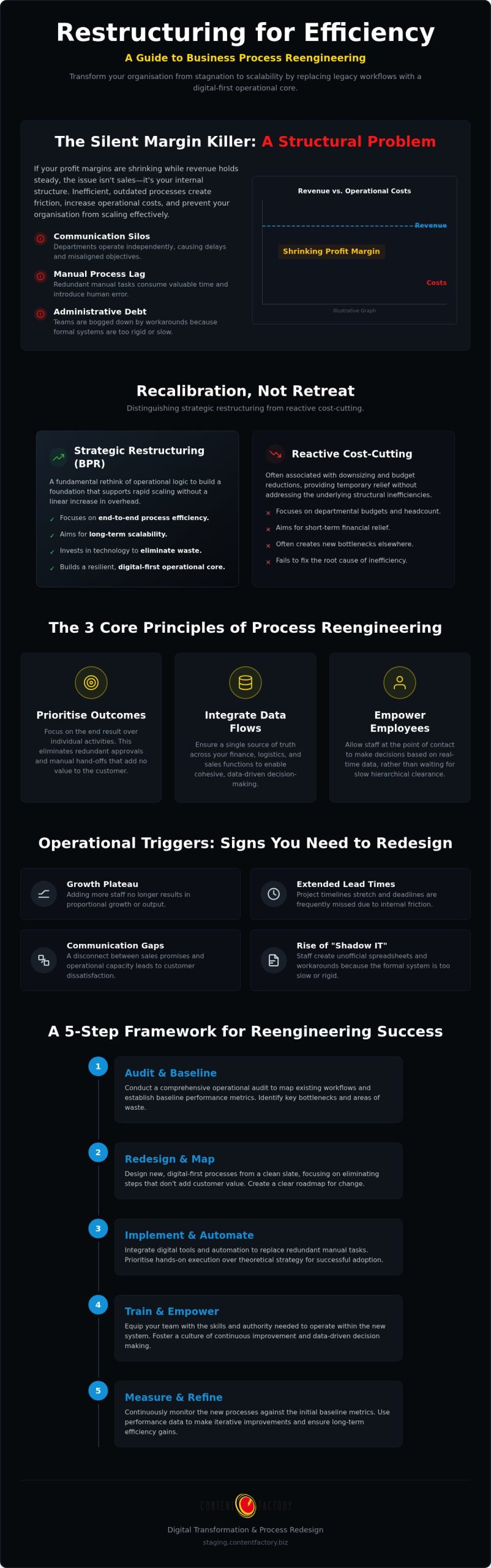
If your profit margins are shrinking while revenue holds steady, your organisation isn’t suffering from a sales problem; it’s suffering from a structural one. In the 2026 economy, sticking to legacy workflows is a recipe for stagnation. You’ve likely noticed that siloed departments and manual processes are creating a communication lag that prevents you from scaling at pace. To restructure for efficiency without disrupting current operations, you must implement business process reengineering services that prioritise a phased, digital-first realignment of your core functions. This approach eliminates waste by replacing redundant manual tasks with automated, high-output systems.
It’s frustrating to watch operational costs climb when you’ve invested in growth. You know that manual tasks should have been automated years ago, yet your team remains bogged down by administrative debt. This guide provides a strategic roadmap to replace those inefficient habits with streamlined workflows and clear accountability. You’ll learn how to identify operational triggers for redesign and apply a practical framework to integrate digital tools. We’ll explore how to move from fragmented systems to a synchronised digital core that lowers costs and builds long-term resilience.
Key Takeaways
- Distinguish between reactive cost-cutting and strategic restructuring to ensure your organisation is built for long-term scalability rather than temporary survival.
- Identify the specific operational triggers, such as communication silos and manual lag, that necessitate professional business process reengineering services to protect your profit margins.
- Determine whether your business requires incremental process improvements or a radical, clean-slate redesign based on your current digital maturity.
- Apply a rigorous five-step framework that begins with a comprehensive operational audit to establish baseline performance metrics before committing to structural changes.
- Prioritise hands-on execution over theoretical strategy to ensure new digital workflows are successfully integrated into your core business functions.
Business Restructuring for Efficiency: Defining the Strategic Shift
Restructuring is not a retreat; it’s a recalibration. While many executives associate the term with downsizing or headcount reduction, business process reengineering services focus on the opposite: expansion through efficiency. It’s a fundamental rethink of your operational logic. By 2026, this shift requires a digital-first operational model where technology isn’t just an add-on but the core engine of your workflow. You aren’t just cutting costs; you’re building a foundation that can support rapid scaling without a linear increase in overhead.
To better understand this concept, watch this helpful video:
The core objective is to realign your resources to maximise customer value. Every task that doesn’t contribute directly to a better client outcome or a faster delivery cycle is waste. In a competitive market, your ability to redirect capital and talent toward high-impact activities determines your profit margins. This isn’t about working harder; it’s about designing a system where the path of least resistance is also the most productive.
The Core Principles of Process Reengineering
Successful Business Process Reengineering (BPR) moves away from departmental silos. You must focus on end-to-end processes, such as the journey from a customer order to final delivery, rather than individual tasks within a single team. This holistic view ensures that optimising one department doesn’t create a bottleneck in another.
- Prioritise outcomes over activities to eliminate redundant approvals and manual hand-offs that add no value.
- Integrate data flows to ensure a single version of truth across your finance, logistics, and sales functions.
- Empower employees at the point of contact to make decisions based on real-time data rather than waiting for hierarchical clearance.
Why Efficiency Requires Structural Change
Incremental changes often fail because they don’t address the underlying architecture of the organisation. If your hierarchy is designed for a pre-digital era, it will naturally create process friction. Legacy workflows act as a barrier to the adoption of emerging technologies like AI and automated ERP systems. You can’t simply layer new software over an inefficient structure and expect a transformation.
True efficiency requires you to dismantle the bottlenecks that prevent your team from making rapid, data-driven decisions. Structural change ensures that your digital tools have a clear, logical path to follow. Without it, your automation efforts will only serve to speed up the production of errors and communication gaps.
Identifying the Operational Triggers for Process Redesign
You’ve likely reached a point where adding more staff no longer results in proportional growth. This plateau is a primary trigger for engaging business process reengineering services. When project lead times stretch and communication silos cause missed deadlines, the structure itself has become the bottleneck. This communication lag often results in a disconnect between sales promises and operational capacity, leading to customer dissatisfaction. You must evaluate the gap between what your market demands and what your current processes can actually deliver.
Signs Your Current Workflows are Stagnating
Inefficiency often hides in plain sight through “shadow IT.” These are the unofficial spreadsheets and manual workarounds created by staff because the formal system is too rigid or slow. These efficiency leaks indicate that you aren’t truly streamlining workflows, but merely working around a broken core. According to Microsoft data from June 2026, 66% of AI users in Singapore report producing work they couldn’t have created a year ago; if your workflows are still manual, you’re missing this productivity surge.
- High error rates: Frequent discrepancies in manual data entry across your ERP and finance systems indicate a lack of synchronisation.
- Reporting fatigue: Your leadership team spends more time compiling internal reports than they do on strategic execution.
- Scalability limits: You find it impossible to scale operations without a linear, and often unsustainable, increase in headcount.
The Friction of Legacy Technology Systems
By 2026, the cost of maintaining disconnected legacy platforms has become a significant financial drain. These systems act as technical debt, preventing the integration of AI or automated forecasting tools that your competitors are already using. When your software platforms don’t communicate, you lose the “single version of truth” required for rapid, confident decision-making. Without a unified data stream, your finance and logistics teams will always be at odds over inventory levels and cash flow projections.
Transitioning away from these friction points requires a clear digital roadmap. Without a structured plan, you’ll continue to pay the hidden tax of manual intervention and data silos. If you’re unsure where your specific process leaks are occurring, you can get an expert assessment to identify the highest-impact areas for your next structural redesign. This proactive approach ensures that your technology supports your growth rather than acting as a barrier to it.
Restructuring vs. Optimisation: Choosing the Right Path
Choosing between incremental business process improvement (BPI) and radical business process reengineering (BPR) is a decision that dictates your capital allocation for the next three years. BPI focuses on the “Kaizen” philosophy of continuous, small-scale refinements to existing workflows. It’s a low-risk strategy suitable when your core systems are functional but need polishing. In contrast, business process reengineering services advocate for a “clean-slate” approach. You don’t try to fix a broken process; you discard it entirely and design a new one from the ground up to meet current market realities.
Mid-market firms often hesitate at radical change due to the perceived risk of operational downtime. However, the ROI of BPR often outweighs incremental gains when your current architecture is fundamentally flawed. While BPI might yield a 5% to 10% efficiency gain, BPR aims for dramatic improvements in productivity that can redefine your cost structure. The risk profile is undeniably higher, requiring strong leadership and precise change management, but the alternative is death by a thousand small inefficiencies.
When to Prioritise Radical Redesign
You should prioritise a clean-slate redesign when your industry is facing rapid digital disruption that makes your current model obsolete. If your existing processes are fundamentally incompatible with new market entries or if the cost of “patching” old systems exceeds the investment required for a fresh start, restructuring is the only logical path. This is especially true when your legacy workflows prevent you from meeting the speed and transparency expectations of 2026 customers. Sticking to a failing system because of the “sunk cost” of your initial setup is a strategy for stagnation.
The Role of Data-Driven Decision Making
KPIs are the most objective tool for determining whether you need a minor adjustment or a total overhaul. If your data shows a persistent failure to meet service level agreements despite multiple BPI attempts, the problem is structural. You should also analyse customer feedback to identify where your current organisation fails to deliver value. Integrating data driven business process improvement into your decision-making ensures that you aren’t restructuring based on gut feeling, but on measurable performance gaps. This rigorous analysis allows you to pinpoint the exact workflows that are draining your resources without contributing to growth.
A Practical Framework for Business Process Reengineering
Successful execution requires moving beyond high-level strategy into the mechanics of daily operations. While a vision provides the ‘why’, business process reengineering services provide the ‘how’ through a structured, repeatable framework. This 5-step cycle ensures that your redesign isn’t a temporary fix but a permanent elevation of your operational capacity. By following this sequence, you ensure that every structural change is backed by data and supported by the right technology stack.
- Step 1: Operational Audit. You must establish a clear performance baseline by measuring lead times, error rates, and the true cost of current resource allocation.
- Step 2: Mapping the ‘As-Is’ State. Documenting every touchpoint in your current workflow reveals hidden redundancies, such as data being manually re-entered across three different departments.
- Step 3: Designing the ‘To-Be’ State. Architect a new process from a clean slate, asking how you’d design the workflow today if you were starting with 2026 technology.
- Step 4: Technology Adoption. Integrate system-wide tools, including AI-driven forecasting and unified ERP platforms, to automate the new ‘To-Be’ logic.
- Step 5: Change Management. Implement continuous monitoring and rigorous training to ensure the new workflows become the standard organisation-wide habit.
Mapping and Designing for Efficiency
Cross-functional mapping allows you to see how information moves across your organisation rather than just within individual teams. This bird’s-eye view makes it easy to identify ‘non-value-add’ steps, such as unnecessary approvals or redundant data verification, for immediate elimination. When you design workflows that prioritise automated data capture at the source, you remove the friction that typically slows down project delivery. This focus on outcome-oriented design ensures every step in the new process adds direct value to the end customer.
Bridging the Gap with Technology Integration
A restructure only succeeds if your digital tools are fully synchronised with your new operational logic. You must align your process redesign with a robust technology adoption strategy to avoid creating new bottlenecks. It’s essential that your ERP and finance systems support the new workflows rather than forcing your team back into manual workarounds. To maintain these efficiency gains, prioritise change management and training, as the human element is often the most significant barrier to structural change.
Operationalising Change with ContentFactory
Strategy only generates value when it is successfully operationalised. Many consulting engagements fail because they stop at the report stage, leaving you with a theoretical roadmap but no practical means of implementation. ContentFactory bridges this gap by integrating business process reengineering services with hands-on execution. We don’t just identify where your processes are broken; we work as a dedicated extension of your leadership team to rebuild them. This results-oriented approach ensures that every structural shift is grounded in efficiency and tangible outcomes.
Our methodology focuses on the seamless integration of digital tools with your redesigned workflows. By aligning your digital roadmap with your physical operations, you eliminate the friction that typically derails transformation projects. This senior-led expertise is essential for managing the complexities of structural change without disrupting your daily revenue generation. We prioritise “doing” over “reporting,” ensuring your new systems are fully functional and adopted by your team from day one.
From Strategy to Funded Execution
A structured approach to restructuring ensures a measurable ROI for mid-market firms. Working with a Singapore Certified Management Consultant provides you with the assurance that your project follows international best practices and rigorous professional standards. We move beyond the initial audit to handle the technical complexities of ERP and finance system integration. This ensures that your financial data flows perfectly through your new operational architecture, providing the transparency needed for rapid decision-making.
- Expert Leadership: Access 25+ years of consulting expertise focused on manufacturing, technology, and logistics.
- Execution Focus: Transition from high-level vision to full system integration and staff training.
- Measurable Growth: Focus on reducing operational costs while building the capacity to scale.
Building Long-Term Operational Resilience
Restructuring is a prerequisite for successful regional expansion. If your core processes are inefficient in Singapore, those flaws will only be magnified as you move into ASEAN markets. By creating a culture of continuous process improvement, you ensure your organisation remains agile enough to adapt to future market shifts. This resilience is built on a foundation of synchronised systems and clear accountability across every level of your organisation.
Practical Takeaway: Conduct a 15-minute ‘process waste’ audit today. Choose your most frequent workflow, such as order processing or vendor onboarding, and count every manual data entry point or redundant approval step. If you find more than three manual interventions, your process is a candidate for a radical redesign.
ContentFactory supports your Digital Transformation & Process Redesign journey through expert business process reengineering and technology adoption. We help you secure funding for these initiatives via the Edge grant of up to S$100,000 for eligible companies. Grant quantum, support levels and eligibility criteria are set by the relevant Singapore government agencies and are subject to change. Eligibility is assessed case by case. Book a 30-minute discovery call.
Future-Proofing Your Organisation Through Structural Redesign
Transitioning from fragmented, manual workflows to a synchronised digital-first structure is a strategic necessity for mid-market growth. By identifying operational triggers early and applying a rigorous reengineering framework, you secure your profit margins against rising costs. Success depends on moving beyond theoretical audits into the practical integration of ERP and AI systems to build a resilient organisation.
ContentFactory helps you operationalise efficiency through our Digital Transformation & Process Redesign pillar, including business process reengineering services. Led by Singapore Certified Management Consultant Mayuresh Godse with over 25 years of strategic expertise, we’ve built a proven track record in manufacturing and logistics. We move your business from theoretical strategy to funded execution, ensuring your systems and people are aligned for growth. To see if your project qualifies for the Enterprise Development Grant (EDG) which offers up to 50% funding for core capabilities, book a session via the link below.
Grant quantum, support levels and eligibility criteria are set by the relevant Singapore government agencies and are subject to change. Eligibility is assessed case by case. You have the tools and the framework to begin your transformation; now is the time to execute.
Frequently Asked Questions
What is the difference between business restructuring and downsizing?
Restructuring is about operational realignment for growth; downsizing is purely about cost-cutting via headcount reduction. Restructuring focuses on how work is done rather than just who does it. It aims to build a scalable foundation where resources are redirected to higher-value activities. Downsizing is often a reactive measure, whereas restructuring is a proactive strategic shift designed to improve your long-term profit margins and efficiency.
How long does a typical business process reengineering project take?
A typical project spans three to nine months depending on the complexity of your organisation and the depth of the redesign. The initial audit and mapping phase usually takes four to six weeks. Implementation of new systems and training follows, with the final phase focused on monitoring and refining the new workflows. Larger mid-market firms with multiple departments may require a longer phased rollout to ensure minimal disruption.
Can restructuring for efficiency be done without replacing all legacy software?
You don’t always need to replace every legacy system if they can be integrated with modern middleware or API-led architectures. The goal is to eliminate manual data entry and silos, which can sometimes be achieved through system integration rather than full replacement. However, if a legacy platform prevents you from adopting automation or AI, it becomes a barrier to efficiency that your organisation must eventually address.
How do I manage employee resistance during a business restructure?
Manage resistance by involving key staff in the mapping phase and communicating the benefits of streamlined workflows. Resistance usually stems from a fear of obsolescence or increased workload. By showing how business process reengineering services remove the frustration of manual, repetitive tasks, you gain buy-in. Clear training and change management programmes are essential to transition your team to the new operational logic without friction.
What are the common pitfalls in business process reengineering?
Common pitfalls include focusing only on technology without changing the underlying process and a lack of senior leadership commitment. Another major error is failing to establish baseline performance metrics before starting the project. Without a clear “as-is” map, you cannot measure the actual ROI of your restructuring efforts. Over-complicating the new “to-be” state can also lead to team burnout and project implementation failure.
How do I measure the success of a restructuring initiative?
Success is measured through specific KPIs such as reduced project lead times, lower error rates, and improved profit margins. You should see a measurable reduction in operational costs and an increase in output per employee. Success also manifests in the elimination of “shadow IT” and manual workarounds. Tracking these metrics over a six-month period post-implementation provides a clear picture of the restructure’s impact on your scalability.
Is business restructuring suitable for small businesses or only mid-market firms?
Restructuring is essential for both, though the scale and complexity differ. Small businesses benefit from early process design that prevents silos from forming as they grow. Mid-market firms often face more deep-seated bottlenecks that require formal business process reengineering services to resolve. For any company looking to scale without a linear increase in headcount, structural efficiency is a non-negotiable requirement for sustainable commercial growth.
What role does AI play in modern business restructuring for efficiency?
AI acts as an execution engine that automates data-heavy tasks and provides predictive insights for decision-making. In modern restructuring, AI is integrated into core workflows like ERP and finance systems to handle forecasting and anomaly detection. This allows your human talent to focus on high-level strategic tasks. AI adoption is most effective when the underlying business structure is already streamlined to support automated, clean data flows across the organisation.

Article by
Mayuresh Godse
Mayuresh Godse is a Singapore Certified Management Consultant and Business Strategist specializing in Sustainability, ESG, AI-driven Digital Transformation, and business growth. Based in Singapore, he writes about Sustainability, Digital Innovation, Business Strategy, and Content Marketing for global audiences.
Disclaimer
This article is provided by ContentFactory for general information only and is not legal, tax, accounting or financial advice. Regulations and government scheme criteria change; grant eligibility and quantum are set by the relevant Singapore agencies and assessed case by case, with no outcome guaranteed. Verify current requirements before acting.
One thing worth checking on the tool side: if the disclaimer is switched on globally, the grant caveat already written into your Global Writing Instructions will appear as well, so grant articles will carry the same point twice. Remove the required-disclaimer section from the instructions file if you enable this one.