

A climate risk assessment is a decision tool, not a box-ticking exercise. For Singapore businesses, a climate risk assessment for business operations examines exposure to physical hazards, such as flooding or heat, and transition risks linked to policy, technology and changing markets. Climate scenarios can help test how these risks may affect assets, operations and plans.
That distinction matters. A site may face direct disruption from physical hazards, while the business also faces costs or pressure as markets and regulations change. A useful assessment considers both categories, rather than focusing on one and leaving blind spots elsewhere.
This guide explains how to assess climate risks, compare physical and transition risks, and select a practical framework for your organisation. It also outlines how disclosure expectations may apply, including the role of ISSB Standards, and how to turn findings into priorities and action plans. Use it as a starting point for connecting climate analysis with business decisions.
Key Takeaways
- Separate physical hazards from transition pressures so you can see how each could affect your operations and plans.
- Map key sites, activities and supply-chain dependencies to identify where climate exposure could matter most.
- Use scenarios and suitable time horizons to test how different climate conditions may affect business decisions.
- Choose frameworks and disclosures based on your organisation’s reporting drivers, then connect findings to clear priorities.
- Review climate risks regularly and integrate practical responses into business planning.
How do physical and transition risks differ in the context of climate risk management?
Singapore businesses should assess physical hazards such as flooding and extreme heat at relevant sites, alongside transition risks from policy, technology, markets and reputation. Distinguishing between them helps you understand how weather can disrupt operations and how changing expectations can affect business decisions.
Physical Climate Hazards
Physical climate hazards are events or longer-term changes that can affect assets, people and operations. For a Singapore site, assess exposure to flooding, extreme heat and coastal impacts, then identify which locations, equipment or activities could be affected. A warehouse, for example, may face different exposure from an office or supplier site.
Physical risk depends on the hazard, the assets exposed and their vulnerability. Map each site and key operational dependency, then assess how disruption could affect access, production, storage or delivery. Some climate impacts are already relevant over operational time frames of 1-5 years, so near-term planning should sit alongside longer-term analysis.
Transition Risks and Opportunities
Transition risks arise as policy, technology, markets and expectations shift towards lower emissions. A low-emissions scenario can represent stronger climate policy and wider clean-energy adoption, broadly aligned with the Paris Agreement. Review how carbon-related requirements, changing customer preferences and new technologies could affect your costs, products and supplier choices.
The same shifts can create opportunities. Assess whether energy efficiency, lower resource use or a change in product design could improve resilience or meet changing demand. Identify relevant standards and market signals, then record the assumptions behind each opportunity. This makes them useful for planning rather than leaving them as general aspirations.
Physical and transition risks can interact. Flooding may interrupt a supplier’s operations, while new purchasing standards may affect your ability to keep supplying a customer. Map both direct operations and important supply-chain dependencies to understand these connections, rather than treating each risk in isolation.
Institutional factors, including regulations, reporting expectations and insurance availability, can shape how physical or transition risks affect the business. Identify the requirements relevant to your organisation and markets, then consider how they could influence access to cover, customer relationships or financing. These factors do not replace hazard analysis; they change the business consequences.
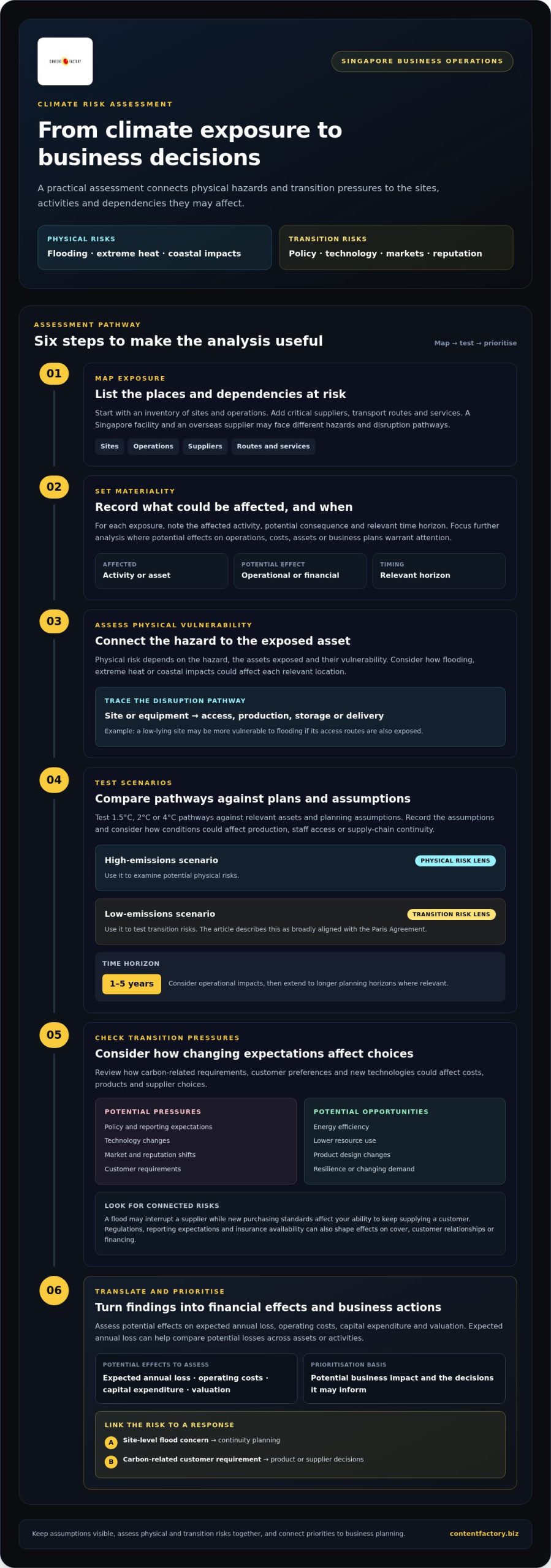
To identify risks and opportunities, compare your locations, activities and dependencies against plausible climate conditions. A high-emissions scenario can help examine physical risks, while a low-emissions scenario can test transition risks. For each issue, record the potential effect, affected business area and time horizon. This makes assumptions visible and helps decision-makers prioritise further analysis.
Keep the assessment tied to business choices. A site-level flood concern may inform continuity planning; a carbon-related customer requirement may affect product or supplier decisions. Reviewing both categories together gives leaders a clearer basis for prioritising action, updating plans and tracking how changes in weather, policy or markets alter exposure.
How do you conduct a climate risk assessment for a business step by step?
Start by mapping sites, operations and supply-chain dependencies. Then assess hazards, vulnerability and financial effects. Prioritise findings by potential business impact and connect them to practical resilience and adaptation decisions.
In Singapore, assessment costs depend on scope, site coverage, supply-chain depth, available data and scenario analysis. The fee is provided after a quote request, based on those project factors.
Exposure Mapping and Materiality
Exposure mapping records where climate hazards could affect your assets, activities and dependencies. Materiality assessment identifies which exposures matter most to business decisions. Begin with an inventory of sites and operations, then add critical suppliers, transport routes and services. A Singapore facility and an overseas supplier may face different hazards and disruption pathways.
For each exposure, note the affected activity, potential consequence and relevant time horizon. A risk is material when its potential effect on operations, costs, assets or business plans warrants attention. This directs further analysis towards important issues instead of treating every mapped hazard equally.
Sensitivity and Risk Scenarios
Sensitivity analysis examines how strongly an exposed asset or activity could be affected, while scenarios test how conditions may change. For example, a low-lying site may be more vulnerable to flooding if its access routes are also exposed. Compare hazards, exposure and vulnerability before setting priorities.
Test a 1.5°C, 2°C or 4°C pathway against relevant assets and planning assumptions. Consider operational impacts over 1-5 years, then extend the view to longer planning horizons where relevant. Record the assumptions and explain how extreme weather could affect production, staff access or supply-chain continuity.
Financial Exposure and Expected Annual Loss
Financial exposure translates identified risks into potential effects on expected annual loss, operating costs, capital expenditure and valuation. Expected annual loss helps compare potential losses across assets or activities. Cost and valuation impacts show how disruption could affect business decisions.
For a site exposed to flooding, estimate potential repair, interruption and recovery effects using available asset and operational data. Make assumptions visible, including the hazard considered and the asset’s vulnerability. Where precise estimates are impractical, qualitative ratings can still help rank exposures and show where better data would improve the analysis.
Once priorities are clear, connect each material risk to an owner, a response and a review point. For example, a supply-chain exposure may call for contingency planning, while an asset vulnerability may inform adaptation measures. Revisit the assessment when operations, dependencies or climate assumptions change. A structured discussion about your assessment scope can help clarify which sites, scenarios and financial effects to examine.
Climate-related financial disclosure requirements
For a Singapore business, first identify which applicable regulations, investor expectations or market requirements drive climate disclosure. Coverage can vary by organisation, so disclosure requirements are not the same for every business.
Climate-related financial disclosures explain how climate change may affect an organisation’s business, strategy and financial planning. They also describe how the organisation identifies, evaluates and manages those risks and opportunities.
Identify the disclosure driver before selecting a framework
Start by recording why you need to disclose: a regulation, an investor request or a market expectation. Then establish which entities and activities the requirement covers and note the relevant reporting period. This avoids a common mismatch: preparing information for a framework before confirming what the intended audience needs.
For Singapore operations, map the organisation’s regulatory scope and any investor or customer requests. If your business operates regionally, also consider whether requirements in another market apply to its activities. Do not assume a rule covering one entity automatically applies to every company in the group.
Match the framework to the disclosure purpose
The International Sustainability Standards Board (ISSB) Standards provide a global baseline for climate-related disclosures designed for integration into financial reporting. IFRS S2 expects companies to assess climate-related risks and opportunities across short-, medium- and long-term horizons. This helps connect climate information with the organisation’s financial outlook.
The Task Force on Climate-related Financial Disclosures (TCFD) framework organises disclosure around governance, strategy, risk management, and metrics and targets. Use these areas to structure how the board oversees climate issues, how they inform business planning, and how the organisation evaluates progress. TCFD focuses on climate impacts on the organisation.
Make disclosure useful and repeatable
Build disclosure from evidence already used in risk management and financial planning. For each material issue, record the relevant scenario, time horizon, business effect, response and accountable owner. For example, connect a flood exposure to affected operations and explain how management addresses it.
Keep a traceable record of assumptions, data sources and decisions. Separate measured information from estimates and explain the basis for each. This makes disclosures easier to update when operating conditions, exposures or reporting expectations change.
Monitor changes and review the process
Set a regular review process to check whether the organisation’s climate risks, opportunities and assumptions have changed. Integrate the review into existing business-as-usual risk management rather than treating disclosure as a one-off document. A new site, supplier dependency or planning assumption can change what needs to be assessed.
Finally, compare the draft disclosure with the selected framework and the original reason for reporting. If using TCFD, confirm that governance, strategy, risk management and metrics are addressed. For ISSB Standards, check that relevant financial information is aligned. Clear ownership and repeatable reviews make sustainability disclosure a practical input to decisions.
Transition risks, including policy, technology, market, reputation, and litigation
Transition risks arise as policy, technology, markets and expectations shift towards lower emissions. Businesses can build resilience by strengthening supply chains, integrating climate risks into financial planning and linking assessment findings to practical action.
Types of Transition Risk
Policy risk stems from changing climate rules or reporting expectations. Technology risk arises when existing processes or equipment become less competitive. Market risk can follow changing customer demand, while reputation risk may arise when public claims conflict with business actions. Litigation risk concerns disputes or claims connected with climate-related decisions or disclosures.
For a Singapore business, identify whether climate-related reporting expectations come from investors, customers or the organisation’s reporting scope. If your business operates across ASEAN, map the entities and markets to which those expectations relate. This helps distinguish relevant external demands from the assumption that one reporting approach applies across the whole business.
Identify the policy, technology and market drivers relevant to your sector. Then assess which products, processes, suppliers or reporting practices they could affect. For example, a business reliant on carbon-intensive equipment can evaluate how changing customer preferences or clean-energy adoption might affect its operating plans.
Estimating Financial Impacts
Financial impact analysis translates transition and physical climate risks into potential effects on operating costs, capital expenditure and business valuation. Compare each risk with the affected assets, processes and planning assumptions. Then record the expected direction of impact and the evidence supporting it.
For example, a business can model how a shift to cleaner technology might change equipment investment and operating costs. It can also examine how extreme weather could affect site operations and recovery needs. Keep assumptions distinct across scenarios so decision-makers can see which outcomes depend on policy, technology or hazard conditions.
Sector context shapes the analysis. An electricity business should assess how climate conditions could affect generation assets, network operations and continuity. Consider physical hazards alongside transition pressures, including technology changes and market shifts. The same issues may affect other sectors differently: a manufacturer may focus on equipment and inputs, while a service business may prioritise premises and operational continuity.
Integrate priority findings into business strategy rather than keeping them in a separate risk register. Assign owners to material risks, connect them to financial planning, and assess whether supply-chain dependencies need strengthening. A climate assessment can also inform a decarbonisation roadmap or transition plan, linking intended changes to operational processes and investment decisions.
Review impacts as assumptions, markets and reporting expectations change. For each priority, record the review trigger, responsible decision-maker and available response. If a supplier disruption could stop production, identify an alternative supply route or contingency process. If new technology could affect competitiveness, assess its relevance to planned investment.
Match practical measures to the exposure: strengthen critical supply-chain links, incorporate climate scenarios into financial planning, and connect identified risks to adaptation or transition actions. This turns climate analysis into decisions that support operational resilience, rather than a one-off exercise.
Climate change risk assessment frameworks
Frameworks give climate analysis a structure, but they serve different purposes. For a Singapore business, choose an approach that fits the decision: adaptation planning, asset-level risk analysis or climate-related disclosure.
Match the framework to the question
ISO 14090 provides a strategic framework for climate change adaptation, while ISO 14091 supports the practical implementation of climate risk analysis. Use ISO 14090 when connecting climate impacts to adaptation planning. Use ISO 14091 when organising the analysis of hazards, exposure and vulnerability across your operations.
AS 5334 addresses climate change adaptation for settlements and infrastructure. It may help structure analysis where a business depends on buildings, transport links or other infrastructure. These frameworks differ in emphasis, so identify the decision you need to inform before selecting one. A site adaptation plan calls for a different focus from a disclosure exercise.
Start with a rapid assessment, then deepen the analysis
The ESCI framework recommends starting with a simple, rapid, qualitative assessment. Use it to identify climate drivers and prioritise areas needing more detailed assessment. For example, screen each important site for relevant hazards, exposed assets and vulnerability before commissioning complex modelling.
Physical climate risk combines hazards, exposure and vulnerability. A hazard alone does not establish business risk: assess whether your assets or activities are exposed, then consider their ability to withstand or recover from impacts. This sequence distinguishes a general climate concern from an issue that could affect a specific operation.
Choose qualitative or quantitative methods based on the decision and available evidence. A qualitative rating can help prioritise sites for closer review. Quantitative analysis can examine financial effects or compare scenario outcomes when suitable data is available. Keep the rationale and assumptions consistent so decision-makers can interpret results across business units.
Set time horizons and scenarios deliberately
Define the assessment horizon before comparing scenarios. A practical structure might use a 5-year operational view, a 2035 planning view and a 2050+ view. These horizons distinguish near-term operating concerns from longer-term strategic choices.
Climate scenario analysis can examine 1.5°C, 2°C and 4°C pathways. Compare what each pathway could mean for relevant assets, suppliers and business plans, rather than treating a scenario as a forecast. For example, a Singapore organisation can test whether a long-term site decision remains sound under differing climate conditions.
Keep the framework useful after the initial analysis. Assign responsibility for reviewing assumptions, update the assessment when operations or dependencies change, and connect priority findings to adaptation plans or disclosure processes. For structured support applying these approaches, Contact Us.
ContentFactory: ESG Readiness & Materiality Assessments
ContentFactory connects climate-risk findings with ESG priorities through ESG Readiness & Materiality Assessments. This is a practical next step when you have identified exposures but need to determine which issues matter most to your organisation and stakeholders.
Where emissions data is part of the work, GHG Emissions Calculation and Carbon Accounting can help establish a clearer emissions baseline. Multi-Framework Sustainability Reporting can then organise relevant information for disclosure across applicable frameworks. These services support assessment and reporting; they do not replace an independent audit or assurance opinion.
If you want to discuss how these offerings fit your organisation’s priorities, contact ContentFactory.
Turn your assessment into an operating priority
Give climate findings a clear place in business decisions. Assign responsibility for reviewing key assumptions and connect priority actions to existing planning and reporting cycles. This keeps a climate risk assessment for your business relevant as operations, suppliers and expectations change.
ContentFactory supports this work through ESG Readiness & Materiality Assessments, GHG Emissions Calculation and Carbon Accounting, and Multi-Framework Sustainability Reporting. These services help organise priorities, emissions information and disclosures around your organisation’s needs.
Start with the decision your assessment needs to inform, such as prioritising a site or preparing information for a reporting framework. A focused next step makes the work easier to put into practice.
Contact Us to book a 30-minute discovery call and discuss your organisation’s priorities. Clear ownership and a practical review process can keep climate considerations connected to sound business decisions.
Frequently Asked Questions
What are the primary benefits of implementing climate risk management in businesses?
Climate risk management helps you make better-informed decisions about assets, operations and business priorities. It can reveal dependencies that routine planning misses, such as a critical supplier relying on a single flood-prone route. That insight can guide contingency planning, investment choices and resource allocation. It can also help your organisation explain its approach to investors and customers with consistent evidence rather than broad assurances.
How can companies integrate climate risk assessments into their operational practices?
Build climate considerations into existing routines instead of creating a separate exercise. Include site hazards in facilities reviews, supplier dependencies in procurement discussions, and extreme-weather scenarios in continuity exercises. Give an operational owner responsibility for tracking each priority and define what change triggers a reassessment. If a supplier changes location or a facility is refurbished, review whether existing assumptions still reflect actual exposure.
How do companies integrate climate change risk analysis into business strategy?
Connect analysis to decisions about investment, products, suppliers and business continuity. Before approving a long-term facility commitment, for example, compare its expected use with relevant climate scenarios and the organisation’s planning horizon. Senior leaders can weigh resilience measures alongside other strategic priorities. Assign an owner to each material issue and record how it affects the decision, so the analysis informs strategy rather than sitting apart from it.
What is the difference between climate risk analysis and climate risk assessment?
Climate risk analysis examines particular hazards, scenarios or potential impacts. A climate risk assessment brings those findings together to judge their relevance to the business. Analysis might test how extreme heat affects a production process. The wider assessment considers that result alongside exposed sites, supplier dependencies, financial consequences and business priorities. In practice, organisations often use analysis as one part of an assessment, not as a competing method.
How do you perform a climate vulnerability and capacity analysis?
Compare the hazards a location or activity faces with its sensitivity and ability to respond. For a Singapore facility, consider whether heat could affect equipment, staff conditions or operating schedules. Then assess capacity by reviewing contingency procedures, alternative suppliers, maintenance arrangements and decision-making responsibilities. Record gaps between exposure and the current response to show where adaptation planning may need stronger resources, procedures or operational flexibility.
What are the critical steps for developing a comprehensive climate risk management strategy?
Use a clear sequence: establish scope and decision-makers, identify relevant hazards and transition drivers, map exposed activities, assess potential effects, prioritise material issues, and assign responses. Then set review triggers and integrate them into existing planning. For example, review a supplier exposure after a sourcing change. Keep the strategy tied to accountable owners and business decisions, rather than treating it as a standalone policy document.
What does the framework cover?
A climate risk framework sets out how an organisation identifies, evaluates and manages climate-related risks and opportunities. Its practical coverage can include responsibilities, assessment scope, scenarios, time horizons, decision criteria, response planning and review. A useful framework also clarifies how findings are recorded and communicated. For instance, it can specify who reviews site-level information and how priority findings reach decision-makers responsible for operations or investment.
What is a climate risk assessment for a business?
A climate risk assessment for a business is a structured review of how climate-related hazards and economic changes could affect its activities, assets and plans. It helps decision-makers understand where exposure lies and which issues warrant attention. For example, a business with one essential distribution site may examine the consequences of disruption, then compare those effects with alternative operating arrangements and supplier options.

Article by
Mayuresh Godse
Mayuresh Godse is a Singapore Certified Management Consultant and Business Strategist specializing in Sustainability, ESG, AI-driven Digital Transformation, and business growth. Based in Singapore, he writes about Sustainability, Digital Innovation, Business Strategy, and Content Marketing for global audiences.
Disclaimer
This article is provided by ContentFactory for general information only and is not legal, tax, accounting or financial advice. Regulations and government scheme criteria change; grant eligibility and quantum are set by the relevant Singapore agencies and assessed case by case, with no outcome guaranteed. Verify current requirements before acting.