

What if the climate risk most likely to disrupt your business sits with a supplier, site or process you haven’t assessed? A climate risk assessment for businesses connects hazards to specific operational and value-chain exposures, then helps you decide which ones need attention first. It doesn’t have to predict the future with certainty to support better decisions.
It can be difficult to know where to start. Physical risks, such as heat or flooding, may affect assets, people and continuity. Transition risks, such as policy changes or shifting customer requirements, may affect costs and commercial relationships. For businesses in Singapore, exposures can be direct or embedded in supplier dependencies, and the available information may be incomplete.
This guide explains how to identify physical and transition risks, assess how they could affect your business and prioritise them using a transparent, repeatable method. You’ll also learn how to record assumptions, flag information gaps and assign practical next steps. The aim is to build a clear basis for action and follow-up, not to present estimates as certainty.
Key Takeaways
- A climate risk assessment for businesses connects climate hazards and transition drivers to your organisation’s exposures and potential consequences.
- Trace each risk from its cause through operational effects to the business impact, rather than treating hazards as risks on their own.
- Use a repeatable prioritisation process and record assumptions so decisions remain transparent when information is incomplete.
- Separate immediate evidence gaps from longer-term resilience decisions, then assign practical follow-up actions.
- Connect assessment findings with ESG priorities, governance and evidence to support measurable follow-up.
What a climate risk assessment for businesses reveals
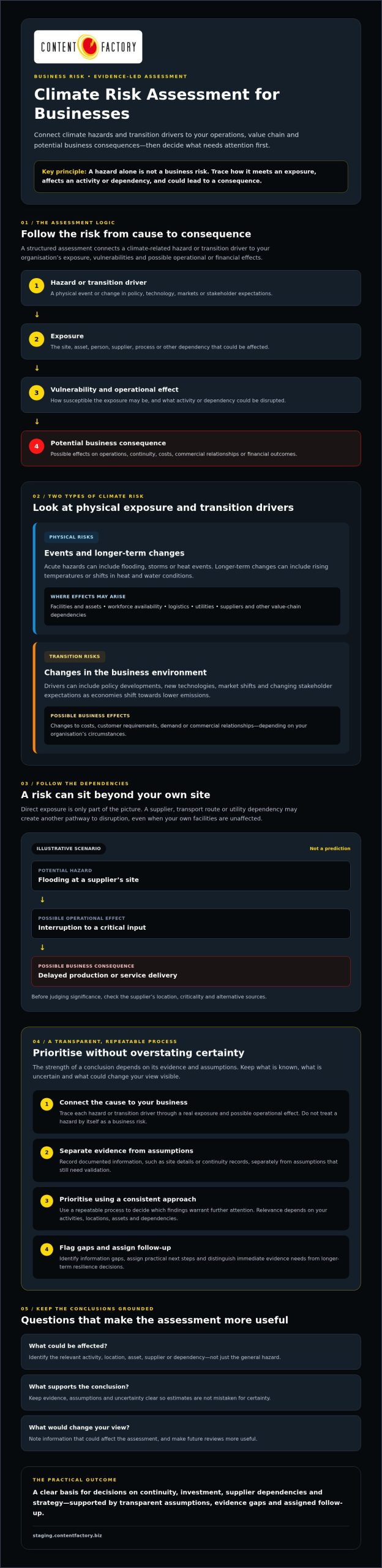
A climate risk assessment for businesses is a structured process that links climate-related hazards and transition drivers to your organisation’s exposure, vulnerabilities and potential operational or financial consequences. It helps you identify what could affect your activities, where the effects may arise and which findings warrant further attention.
A hazard alone is not a business risk. Heavy rainfall, for example, is a hazard. A site or supplier exposed to flooding has an exposure. Vulnerability describes how susceptible that site or supplier is, while the resulting effects could include disrupted operations or delayed inputs. The connection between these factors shapes the potential business consequence.
This video offers a practical perspective on assessing climate risk across commercial buildings and portfolios:
What counts as climate risk for a business?
Physical risks arise from acute events, such as flooding, and longer-term changes, such as rising temperatures. Transition risks stem from changes in policy, technology, markets and stakeholder expectations as economies shift towards lower emissions. For a broader overview of what climate risk is, see the foundational concepts. Neither category affects every organisation equally. Relevance depends on your activities, locations, assets and dependencies.
For example, assess whether heat could affect a particular site or whether a supplier’s location could create a continuity concern. These are questions to investigate, not proof that disruption will occur. An identified risk is not automatically material to your organisation.
Why assess climate risk before setting priorities?
An assessment gives you a reasoned basis for decisions about continuity, investment, supplier dependencies and strategy. Without linking a potential risk to your actual operations, you may prioritise a visible hazard while overlooking a less obvious dependency.
The strength of your conclusions depends on the evidence and assumptions behind them. Record what you know, what remains uncertain and what information could change your view. This helps prevent estimates from being treated as certainty and makes future reviews more useful. For broader context on organising ESG priorities and readiness, see the ESG readiness, gap analysis and strategy guide.
How physical and transition climate risks affect business operations
A climate risk affects a business through a chain: a hazard or transition driver meets an exposure, disrupts an activity or dependency, and may lead to an operational or financial consequence. Mapping each link helps distinguish a plausible business effect from a general climate concern.
For example, flooding at a supplier’s site could interrupt a critical input. Your own facilities may be unaffected, yet production or service delivery could still be delayed. Treat this as an illustrative scenario, not a prediction. Check the supplier’s location, criticality and alternative sources before judging how significant the exposure may be.
Physical climate risks can affect sites and dependencies
Acute hazards such as flooding, storms or heat events matter when they intersect with your operations or value chain. Potential effects could include disruption to facilities, workforce availability, logistics or utilities. Chronic changes, such as sustained shifts in heat or water conditions, may also be relevant when credible evidence connects them to a specific site, process or supplier.
Consider both direct and indirect exposure. A facility may face a physical hazard, while a supplier, transport route or utility dependency may create another pathway to disruption. Record documented information, such as site details or continuity records, separately from assumptions that still need validation.
Transition risks can change costs, access or demand
Transition-risk drivers include policy developments, new technologies, market shifts and changing stakeholder expectations. Their effects depend on your organisation’s circumstances. For instance, a customer could request additional climate-related information, requiring you to gather evidence or review supplier data. This is an illustrative possibility, not a claim that a particular requirement applies to every business.
Policy changes may affect operating conditions, while new technology or customer preferences could influence costs, business relationships or demand. Don’t assume a rule applies to your organisation without checking its scope and current official guidance. Separate confirmed requirements from possible future changes.
For each scenario, note the driver, the exposed activity or dependency, the plausible operational effect and the potential business consequence. Label the evidence and assumptions behind each point. This makes uncertainty visible and gives decision-makers a clear basis for checking the exposure. The Brookings Institution climate risk framework provides further context on connecting climate-risk analysis with business decisions.
If you’re organising climate findings within broader ESG priorities, discuss an ESG readiness assessment with ContentFactory.
How to prioritise climate risks without overstating certainty
A useful climate risk assessment for businesses turns a broad list of concerns into a reasoned set of priorities. Use the same sequence for each risk: define the scope, identify relevant risks, assess exposure, evaluate significance and document the decision. A consistent method makes it easier to explain why one exposure needs follow-up while another does not yet warrant action.
Prioritisation should reflect the strength of evidence, the uncertainty that remains and your business context, rather than relying on a single score presented as fact.
- Define scope: Set out the activities, assets, locations and dependencies being considered.
- Identify risks: Include relevant physical hazards and transition drivers.
- Assess exposure: Establish which operations or dependencies could be affected and how.
- Evaluate significance: Consider potential business consequences alongside evidence quality.
- Document decisions: Record the rationale, assumptions, information gaps and review needs.
Keep likelihood, magnitude, time horizon and business sensitivity distinct. Likelihood describes how plausible an event or change appears based on available evidence. Magnitude concerns the scale of its potential effect. Time horizon indicates when the effect could matter. Sensitivity captures how strongly your business might be affected because of its operating model or dependencies. Qualitative ratings can help compare risks, but explain the basis for each judgement instead of implying false precision.
Which evidence should a business gather?
Start with information you already hold about relevant sites, activities, suppliers and dependencies. For each important data point, record its source, date, coverage and limitations. Distinguish confirmed information from estimates or assumptions, and note what would help validate an uncertain finding.
Emissions data can inform the wider ESG evidence picture when it relates to the risks or decisions under review. For background on gathering that data, see the guide to GHG emissions calculation and carbon accounting.
How can scenarios inform decisions?
Scenarios help test whether a strategy remains workable under different plausible conditions. They are not precise forecasts. State the assumptions, time horizons and limitations clearly, and focus on what the analysis reveals about resilience rather than presenting one outcome as certain.
The IPCC Sixth Assessment Synthesis Report provides climate-science context, while the IFRS Foundation’s IFRS S2 Climate-related Disclosures sets out disclosure requirements for entities within its applicable scope. Use these sources to inform your approach, then check whether a source or requirement applies to your organisation before relying on it. Keep a short decision record so future reviews can update priorities when evidence or business conditions change.
Turn climate risk assessment findings into practical business action
An assessment creates value through decisions and follow-up, not scoring alone. For each material finding, identify the decision it informs, the person responsible and the next step. This turns climate risk assessment for businesses into a management process rather than a list of risks.
Separate actions into two tracks. First, close immediate information gaps, such as confirming which operations depend on a particular supplier or checking whether an asset is exposed. Second, consider longer-term resilience decisions, such as whether existing plans or operating arrangements need review. Don’t treat an uncertain finding as a confirmed impact. Assign someone to validate it and record the evidence needed.
Build a proportionate climate action plan
For each priority, document the exposure, the decision required and its accountable owner. Then assess feasible controls or resilience measures in the context of your business. A supplier dependency, for example, may call for checking continuity arrangements before considering broader changes. Record the resources, approvals and other dependencies required, but avoid promising benefits or assigning unsupported cost estimates.
- Finding: State the exposure and the evidence supporting it.
- Decision: Specify what needs to be agreed, assessed or changed.
- Owner: Name the role accountable for progressing the decision.
- Follow-up: Record the next step, required information and review point.
This format keeps actions proportionate. It also helps leadership distinguish between a decision to act now and a decision to gather more evidence first.
Review risks as evidence and business conditions change
Set a review cadence that suits your activities and exposure. Revisit findings when an asset or supplier changes, new evidence is verified, or operating conditions make a previous assumption less reliable. The aim is not to update scores for their own sake. It is to check whether the original decision still fits the business context.
Keep a decision record with the owner, rationale, assumptions, evidence source and review trigger. This creates traceability, so someone reviewing the finding later can see what was known and why the action was chosen. Where climate findings feed into reporting processes, mandatory sustainability assurance readiness can help frame the importance of evidence quality and traceability. It does not mean that an assessment or record is an assurance opinion.
To get started, select one material finding and record its owner, decision, evidence gap and next review trigger. This gives your team a clear basis for follow-up without overstating certainty.
How ContentFactory supports an evidence-led climate risk assessment
A climate risk assessment for businesses is more useful when its findings connect to evidence, clear priorities and decisions your organisation can revisit. ContentFactory’s ESG Readiness & Materiality Assessments can help organise climate-related issues within a wider ESG readiness process, clarify scope and information gaps, and identify areas for follow-up.
This work can help your team distinguish documented evidence from assumptions, identify where responsibilities sit and determine which questions need further analysis. It won’t remove uncertainty or guarantee a particular result. It gives you a structured basis for deciding what to validate and which priorities are relevant to your organisation.
What an expert-led assessment can help clarify
Led by Mayuresh Godse, a Singapore Certified Management Consultant with 25+ years of consulting experience, ContentFactory supports SMEs and mid-market organisations with practical ESG assessment and implementation. An ESG readiness, gap analysis and strategy engagement can help organise priorities and evidence while keeping the assessment grounded in your activities and business context.
ContentFactory also provides carbon accounting across Scopes 1-3 and sustainability assurance readiness. These are related ESG capabilities, not automatic outcomes of a climate risk assessment. Assurance readiness concerns preparation and evidence quality. It does not mean ContentFactory provides an audit or assurance opinion or guarantees compliance.
Prepare for a focused first discussion
You don’t need a complete dataset to begin. Bring a concise overview of your business activities, key assets and dependencies, known climate concerns and any information already gathered. Flag what is uncertain rather than presenting estimates as confirmed facts.
It also helps to identify the decisions you want the assessment to inform. You might want to know whether a particular dependency needs closer review, which evidence gap to address first, or how climate priorities fit within wider ESG readiness. This gives the discussion a practical starting point and keeps the work focused on decisions that matter to your organisation.
To discuss how ESG readiness and materiality assessment can help structure your priorities and evidence, explore ESG readiness, gap analysis and strategy.
Turn climate insight into a stronger basis for action
A practical climate risk assessment for businesses connects potential hazards and transition drivers to your organisation’s actual exposures. Its value comes from tracing those connections, prioritising findings in the context of your business and recording what remains uncertain. Clear owners and review triggers help turn findings into decisions you can revisit as evidence changes.
Start by identifying one important exposure, the evidence behind it and the decision it may affect. Separate confirmed information from assumptions, then assign someone to address the most relevant information gap. This creates a useful foundation without presenting estimates as certainty.
A clear process helps your business move from climate concerns to considered, evidence-led next steps.
ContentFactory supports organisations through ESG Readiness, Gap Analysis and Strategy, alongside related capabilities in carbon accounting and mandatory sustainability assurance readiness. Led by Mayuresh Godse, a Singapore Certified Management Consultant with 25+ years of consulting experience, ContentFactory can help structure ESG priorities and evidence without promising compliance outcomes or assurance opinions.
Frequently Asked Questions
What is a climate risk assessment for businesses?
A climate risk assessment for businesses is a structured way to identify how physical climate hazards and transition changes could affect your organisation. It links each potential driver to exposed activities, assets or dependencies, then considers possible operational or financial consequences. The assessment also records evidence, assumptions and uncertainties. Its purpose is to inform business decisions, not to predict climate impacts with certainty or treat every identified risk as material.
What are examples of climate risks for a business?
Examples include flooding that could affect a facility or supplier, heat that could disrupt a work activity, or changing water conditions that may matter to a particular operation. Transition risks could include new technology affecting existing processes, policy changes influencing operating conditions, or customer expectations prompting requests for climate information. These are possibilities to assess, not universal exposures. Relevance depends on your business activities, locations, assets and supply-chain dependencies.
How do you conduct a climate risk assessment?
Start by defining which activities, assets, locations and dependencies are in scope. Identify relevant physical hazards and transition drivers, then assess which parts of the business may be exposed and how they could be affected. Evaluate significance using evidence, potential consequences, time horizon and business sensitivity. Document assumptions, information gaps and decisions, assign owners to follow-up actions, and review findings when evidence or business conditions change.
Is climate risk assessment mandatory for every business in Singapore?
No. Singapore’s mandatory climate-disclosure requirements are phased and do not apply uniformly to every business. ACRA and SGX RegCo requirements cover SGX-listed companies on a phased basis, with broader disclosures for Straits Times Index constituents. Most SMEs are not directly covered by listed-company requirements, but larger customers may request climate or emissions information from suppliers. Check current official guidance to confirm requirements that apply to your organisation.
How often should a business review its climate risk assessment?
There isn’t one review frequency that suits every business. Set a cadence that reflects your activities, exposures and the pace at which relevant evidence changes. Review findings sooner if a key asset or supplier changes, new information is verified, or an assumption behind a priority no longer holds. Keep the review record clear: note what changed, whether it affects previous decisions and who owns any follow-up.
Can small and medium-sized businesses benefit from climate risk assessment?
Yes. An assessment can help an SME identify vulnerabilities in its own operations and dependencies on suppliers, facilities, logistics or utilities. It can also show which information gaps deserve attention first and help prepare the business to respond to relevant data requests from larger customers. Start with existing records and the decisions you need to make. You don’t need complete data to document known exposures and uncertainties.
What is the difference between climate risk assessment and carbon accounting?
Climate risk assessment examines how physical hazards and transition changes could affect a business, including its operations and dependencies. Carbon accounting measures and organises greenhouse gas emissions, commonly across Scope 1, Scope 2 and Scope 3 categories. The work can inform a wider ESG evidence picture, but it answers a different question: risk assessment considers potential business effects, while carbon accounting quantifies emissions. One does not replace the other.

Article by
Mayuresh Godse
Mayuresh Godse is a Singapore Certified Management Consultant and Business Strategist specializing in Sustainability, ESG, AI-driven Digital Transformation, and business growth. Based in Singapore, he writes about Sustainability, Digital Innovation, Business Strategy, and Content Marketing for global audiences.
Disclaimer
This article is provided by ContentFactory for general information only and is not legal, tax, accounting or financial advice. Regulations and government scheme criteria change; grant eligibility and quantum are set by the relevant Singapore agencies and assessed case by case, with no outcome guaranteed. Verify current requirements before acting.
One thing worth checking on the tool side: if the disclaimer is switched on globally, the grant caveat already written into your Global Writing Instructions will appear as well, so grant articles will carry the same point twice. Remove the required-disclaimer section from the instructions file if you enable this one.