

The biggest ESG reporting risk may not be a missing disclosure. It may be a figure no one can trace to its source. The common ESG reporting mistakes to avoid often begin with unclear data ownership, inconsistent measurement boundaries or evidence that can’t support a reported claim.
It’s understandable to focus on completing the report and choosing a framework. But if teams use different definitions, overlook value-chain information or can’t explain how a figure was calculated, the final disclosure may be difficult to verify and compare. In Singapore, reporting expectations are being phased in, while SMEs may also receive ESG data requests from customers and other business partners.
This checklist will help you spot weak points before information is finalised. You’ll review who owns each data point, whether figures are consistent and supported by evidence, and whether the selected framework and disclosures fit your organisation. It also highlights when a gap needs internal action or specialist support, so you can strengthen reporting processes before publication rather than rush to fix problems at the end.
Key Takeaways
- The common ESG reporting mistakes to avoid include unclear boundaries, inconsistent figures and claims that lack supporting evidence.
- Build a source register that records each metric’s owner, evidence, calculation method and reporting period.
- Check that your chosen framework and disclosures fit your organisation, rather than copying metrics without confirming their relevance.
- Before publication, mark each disclosure as pass, needs evidence or needs correction, then resolve gaps with the relevant owner.
- Use lessons from each reporting cycle to strengthen data methods and approvals, while keeping internal checks distinct from independent assurance.
Common ESG Reporting Mistakes That Weaken a Disclosure
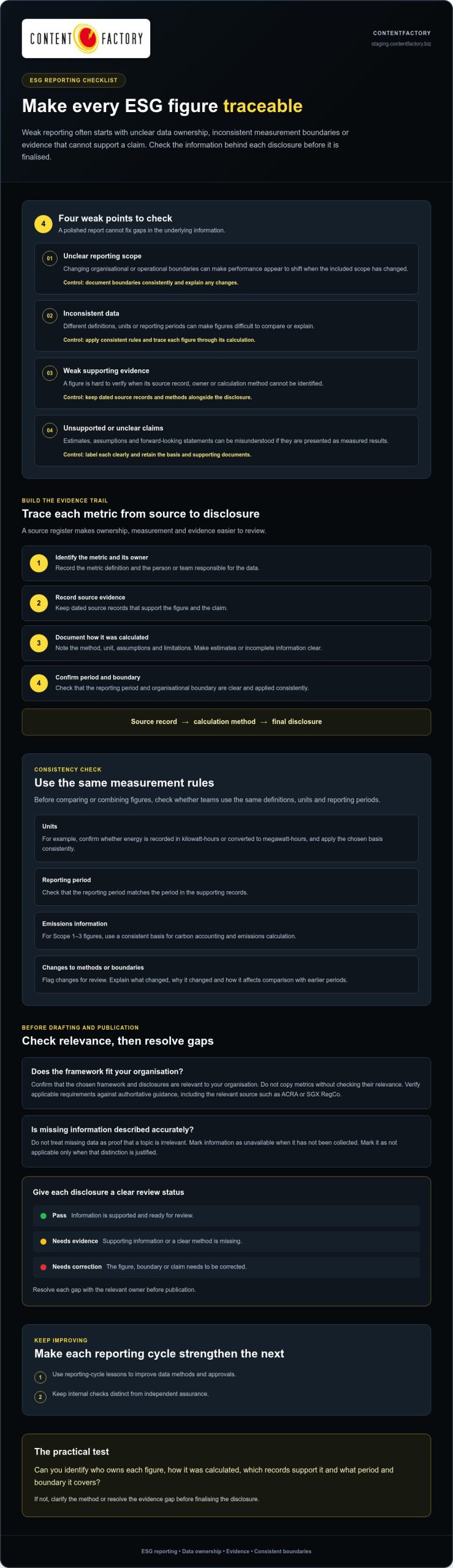
The common ESG reporting mistakes to avoid usually come down to four weaknesses: unclear reporting scope, inconsistent data, weak evidence and unsupported claims. Each can make a disclosure harder to compare with earlier reporting or assess with confidence. A polished report won’t resolve a gap in the underlying information. You need to know what sits behind each statement and figure.
The right framework and reporting obligations depend on your organisation and circumstances. Check the relevant requirements with the appropriate source, such as ACRA or SGX RegCo, rather than assuming a framework or disclosure applies. For a neutral overview of Environmental, social, and governance (ESG), see Wikipedia. For Singapore-specific ESG support, review ContentFactory’s ESG services.
This video offers another perspective on reporting blindspots:
Use a simple review lens for each disclosure: identify the potential error, look for its warning sign, then name the control that would prevent or correct it. This shifts review from general proofreading to checking whether information is complete, traceable and fit for purpose.
How incomplete scope creates misleading ESG disclosures
A reporting boundary that changes between periods can make performance appear to shift when the underlying change is actually in what the organisation included. Document organisational and operational boundaries consistently, and record any changes with a clear explanation. Don’t treat missing data as proof that a topic is irrelevant. Label information as unavailable when it hasn’t been collected, and as not applicable only when that distinction is justified.
Why unsupported statements damage reporting credibility
A claim is difficult to substantiate if no one can identify its owner, date or source record. Separate measured results from estimates, assumptions and forward-looking statements, and label each clearly. For example, an estimate should not be presented as a measured result. Keep the method and supporting documents alongside the disclosure so reviewers can trace how it was prepared.
An evidence-backed ESG disclosure is a statement linked to a clear method, an accountable owner and records that support what it says.
- Check that scope and reporting boundaries are documented and consistent.
- Trace figures and claims to dated source records and named owners.
- Label estimates, assumptions and forward-looking statements clearly.
- Verify framework choice and applicable disclosures against relevant authoritative guidance.
Prevent ESG Reporting Mistakes by Controlling Data and Boundaries
Even accurate source figures can become unreliable in a report if teams use different definitions, units or reporting periods. One function might record energy use in kilowatt-hours while another converts it to megawatt-hours; a reporting period might also differ from the period used in supporting records. Without consistent rules, reviewers can’t tell whether a change reflects actual performance or a change in measurement.
A practical control is a source register for each material metric. Record the metric definition, data owner, source evidence, calculation method and reporting period. Add the unit, organisational boundary and any assumptions or limitations. When information is estimated or incomplete, document the basis and the gap rather than presenting the figure as fully measured.
Catch inconsistent emissions and operational data
For each figure, trace the source record through the calculation to the final disclosure. Confirm that teams use the same unit, method and period wherever the metric appears. For Scope 1-3 figures, carbon accounting and emissions calculation can help establish a consistent basis for reporting.
Flag any change in method, estimate or organisational boundary for review. Keep a short explanation of what changed, why it changed and how it affects comparison with earlier periods. Don’t silently replace a calculation approach or combine figures prepared on different bases.
Assign owners and preserve an evidence trail
Give each material data point a responsible business function or named role. That owner should know where the information comes from, how it is calculated and who can clarify the supporting records. This makes follow-up more direct when a figure is missing or needs review.
Keep calculation files, source records, assumptions and review notes together, with enough information to identify who prepared and reviewed each figure. The organisation can decide the approval steps that fit its reporting process; the key is to record the steps it uses consistently.
- Is the metric definition consistent across teams and disclosures?
- Do the unit, reporting period and boundary match the source records?
- Can you trace the reported figure to evidence and a documented method?
- Are estimates, limitations and changes clearly recorded?
A consistent reporting boundary gives you a sound basis for comparing performance year on year, because you’re measuring the same activities on the same basis. If you need to strengthen data ownership or evidence controls, discuss your ESG reporting requirements with ContentFactory.
Check Materiality and Framework Fit Before Drafting ESG Disclosures
Framework selection and materiality assessment answer different questions. A framework provides reporting requirements or guidance; materiality helps determine which ESG topics matter to your organisation and should shape its disclosures. Choosing a framework doesn’t automatically make every topic relevant, and identifying a material topic doesn’t by itself confirm which disclosures you must provide.
This distinction is central to the common ESG reporting mistakes to avoid. Copying another organisation’s metrics can introduce irrelevant disclosures, mismatched definitions or claims that don’t reflect your business. Before drafting, verify the framework’s current version and your organisation’s applicable requirements against primary sources. In Singapore, check relevant guidance from ACRA or SGX RegCo where applicable.
Avoid treating every ESG topic as equally material
Assess topics in the context of your organisation’s impacts, risks and business activities. A topic that is central to one organisation may have a different level of relevance to another. Document the basis for your decisions, including how stakeholder input was considered where relevant. This gives readers a clearer view of why a topic is included or excluded. A materiality and ESG readiness assessment can help structure this review.
Avoid mixing frameworks or applying requirements loosely
GRI, ISSB, SASB, ESRS and BRSR serve different reporting contexts. Don’t combine selected disclosures from several frameworks and present them as if they form one consistent standard. For every chosen disclosure, confirm its definition, boundary and reporting expectations against the applicable framework’s primary materials. If more than one framework is relevant, document which requirements each disclosure addresses.
Use this short fit check before drafting:
- Purpose: What reporting need or audience is the framework intended to address?
- Applicability: Does a requirement apply to your organisation? Verify rather than assume.
- Materiality: Is the topic supported by your assessment and business context?
- Consistency: Do the metric definition, boundary and method match the selected framework?
Keep a record of the framework version reviewed, the source consulted and the reason for including each material disclosure. Where a topic is excluded, note the basis for that decision. A structured ESG readiness and gap review can help identify inconsistencies before the report is finalised.
Use This ESG Reporting Checklist to Fix Gaps Before Publication
A final review works best when you check disclosures in a set order. Start with scope, then trace information to its sources, test definitions and claims, and confirm that internal review responsibilities are documented. The common ESG reporting mistakes to avoid are easier to correct while the evidence and data owners are still accessible.
Apply one status to each disclosure: pass if it is supported and consistent, needs evidence if information is missing or cannot be traced, or needs correction if the disclosure is inaccurate, inconsistent or unclear. Resolve material gaps before polishing the narrative or design. Better presentation cannot make a weak figure reliable.
Run a source-to-disclosure review
Take each significant figure and claim in the draft and trace it back to its source record. Check that the supporting evidence relates to the correct reporting period and organisational boundary. Confirm that calculation notes and units match the figure as presented. If a claim has no support, obtain evidence, qualify it accurately or remove it.
- Scope: Does the disclosure use the stated reporting boundary?
- Source: Can you locate the underlying record and identify its owner?
- Method: Are units, calculation notes and reporting period consistent?
- Claim: Does the evidence support the wording and level of certainty?
Review consistency, caveats and sign-off
Read across the full report, not just one disclosure at a time. Compare repeated figures, definitions and boundary statements. A metric that changes between sections can confuse readers even if each instance came from a valid source.
Make estimates, assumptions, limitations and restatements clear. Check that caveats appear alongside the relevant disclosure rather than being buried elsewhere. Then confirm that the organisation’s documented review responsibilities have been completed and that the record shows who prepared and reviewed each item.
Use the status labels to drive action. Assign an owner and next step to every item marked “needs evidence” or “needs correction”. Keep unresolved material issues visible until they are addressed. This creates a practical record of what is ready, what still needs support and what should not be published in its current form.
For a final self-check, ask: Can a reviewer trace the disclosure, understand its basis and see any important limitation? If not, pause publication and close the gap first.
Make ESG Reporting Improvements Part of an Ongoing Process
Publishing the report shouldn’t close the loop. After each reporting cycle, review where information was delayed, difficult to verify or prepared using unclear methods. Turn those findings into updates to data ownership, calculation methods and evidence controls before the next cycle begins. This makes reporting more repeatable and helps prevent the common ESG reporting mistakes to avoid from returning year after year.
Start by separating issues that affect the substance of a disclosure from editorial fixes. A missing source record or unclear reporting boundary needs attention before publication. A formatting inconsistency may be less material, but still needs correction. Give each substantive action an owner, specify the evidence or change required, and set a point to check whether it has been completed.
Prioritise gaps by reporting impact and evidence readiness
Rank gaps by how they affect the completeness, accuracy or traceability of material disclosures. For each one, record its impact, evidence needed, accountable role and review point. Use a readiness and gap analysis to identify and prioritise improvements, not as a guarantee that a report meets every applicable requirement.
Internal checks help your team identify issues and improve its reporting process. Independent assurance is a separate activity. Advisory or readiness support can help you prepare data and controls, but it doesn’t provide an assurance opinion. If you’re preparing for assurance, review mandatory sustainability assurance readiness support.
Build repeatable reporting capability inside the organisation
Clear responsibilities reduce reliance on last-minute follow-up. ESG capability building and training can help teams understand who supplies each data point, how to record it and how to escalate missing or uncertain information. Capture these responsibilities in working guidance that staff can use in future reporting cycles.
Consider digital ESG integration and automation when your specific need is to support data workflows. The aim is to make information easier to track and review, not to replace clear definitions, accountable owners or evidence checks.
ContentFactory supports ESG readiness and gap analysis, carbon accounting, multi-framework reporting, assurance readiness, digital ESG integration and capability building. Use each reporting cycle to make targeted improvements, then check that owners have completed them before the next disclosure is prepared.
Strengthen Your ESG Reporting Before the Next Cycle
The common ESG reporting mistakes to avoid often start with unclear boundaries, inconsistent data or claims that lack supporting evidence. A clear source trail, documented responsibilities and a framework that fits your organisation give you a stronger basis for disclosures. Use each reporting cycle to identify gaps, assign corrective actions and improve the process for next time.
ContentFactory supports organisations with ESG readiness and gap analysis, carbon accounting and assurance readiness. Its ESG work is led by Mayuresh Godse, a Singapore Certified Management Consultant with more than 25 years of consulting experience. A readiness review can help you prioritise reporting improvements, while assurance readiness support helps prepare your information and processes. It does not provide an independent assurance opinion or guarantee compliance.
Frequently Asked Questions
What are the most common ESG reporting mistakes to avoid?
The most common ESG reporting mistakes to avoid are unclear reporting boundaries, inconsistent data, weak evidence and claims that the organisation can’t substantiate. Other risks include copying disclosures without checking their relevance and choosing a framework without confirming its fit or applicability. These issues can make disclosures harder to compare and assess. Use a consistent review process to check each figure and claim against its source, definition, reporting period and owner.
How can a business check whether its ESG data is reliable?
Check whether each reported figure can be traced to a source record, a documented method and a responsible owner. Confirm that units, reporting periods and organisational boundaries are consistent. Record estimates, assumptions and data limitations rather than presenting them as measured facts. A practical source register can capture the metric, owner, evidence, method and period, giving reviewers a clear route from the disclosure back to its underlying information.
Can a company report ESG information without choosing a framework?
A company can publish ESG information without claiming alignment to a particular framework, but it should not assume that this satisfies any applicable reporting obligations. Requirements depend on the organisation and its circumstances. Before drafting, check relevant primary guidance, including ACRA or SGX RegCo information where applicable. If you choose a framework, state which one you use and verify its current version, definitions and disclosure requirements before describing your report as aligned.
What happens if ESG figures change between reporting periods?
A change in an ESG figure may reflect changed performance, a revised method, a different boundary or better data. Explain the reason and document its effect on comparison with earlier periods. Check whether the figures remain comparable and whether a restatement or qualification is appropriate under the framework you use. Don’t leave readers to infer the cause. Keep records of the previous and current methods, assumptions and reporting boundaries.
How do you avoid unsupported environmental or social claims in a report?
Link each claim to dated records, a traceable source and an accountable owner. Check that the evidence supports the wording and distinguish measured results from estimates, assumptions and forward-looking statements. If evidence is incomplete, qualify the claim clearly or leave it out until it can be substantiated. Avoid broad statements that imply more than the records show. Keep supporting material with the relevant disclosure so an internal reviewer can follow the basis.
Is ESG reporting the same as ESG assurance?
No. ESG reporting is the organisation’s preparation and communication of information about relevant environmental, social and governance matters. ESG assurance is a separate process in which an independent assurance provider evaluates specified information against defined criteria and provides an assurance conclusion. Internal checks and advisory support can help improve data and prepare processes, but they aren’t independent assurance and shouldn’t be presented as an assurance opinion.
When should a business seek an ESG readiness or gap assessment?
Consider an ESG readiness or gap assessment when you’re unsure which disclosures apply, can’t trace key data, lack clear ownership, or need to prepare for a reporting or assurance process. The assessment can help identify weaknesses and prioritise practical improvements to data, governance and reporting processes. It doesn’t guarantee compliance. ContentFactory provides ESG readiness and gap analysis, carbon accounting and assurance readiness for SMEs and mid-market organisations.

Article by
Mayuresh Godse
Mayuresh Godse is a Singapore Certified Management Consultant and Business Strategist specializing in Sustainability, ESG, AI-driven Digital Transformation, and business growth. Based in Singapore, he writes about Sustainability, Digital Innovation, Business Strategy, and Content Marketing for global audiences.
Disclaimer
This article is provided by ContentFactory for general information only and is not legal, tax, accounting or financial advice. Regulations and government scheme criteria change; grant eligibility and quantum are set by the relevant Singapore agencies and assessed case by case, with no outcome guaranteed. Verify current requirements before acting.
One thing worth checking on the tool side: if the disclaimer is switched on globally, the grant caveat already written into your Global Writing Instructions will appear as well, so grant articles will carry the same point twice. Remove the required-disclaimer section from the instructions file if you enable this one.