

A technology rollout can be technically complete while teams still work around the new system. Change management for technology implementation is the structured work of preparing people, adapting processes and supporting adoption from planning through day-to-day use. It connects the technology decision to the behaviours and operational changes that make the system useful.
A new platform affects more than the screens employees see. It can change responsibilities, handovers, decision-making and confidence in familiar tasks. Treating communication or training as a last-minute add-on overlooks these shifts. Effective support starts by identifying who is affected and what they need to do differently.
This guide explains what change management means, how visible leadership and the ADKAR model support individual transitions, and what practical people and process support looks like during implementation. It also covers how stakeholder input, targeted communication, training, coaching and feedback can align with a rollout, helping you assess whether the change is taking hold and where further support is needed.
Key Takeaways
- Separate technical service changes from the wider shifts in roles, workflows and habits that shape organisational adoption.
- Translate broad change goals into specific employee behaviours and connect them to the outcomes the implementation is meant to support.
- Bring affected teams into decisions early, and make leadership visible throughout the transition.
- Use ADKAR to identify what individuals need to understand, commit to, learn, practise and sustain the change.
- Align communication, training, coaching and process support with the rollout, then use feedback to spot where adoption needs attention.
What is change management?
Change management guides organisational change from preparation through implementation and resolution. Change management for technology implementation connects system, process and role changes with how employees adopt new ways of working.
There is no single typical cost. Scope, system complexity, affected roles, training needs and support duration shape professional fees, which depend on the project and are provided after a quote request.
Effective change management for technology implementation starts with assessing impacts, defining employee behaviours, engaging stakeholders, preparing role-based training and planning a staged rollout. Professionals monitor adoption and use feedback to adjust support.
Employee Behaviours and Role Preparation
Professionals translate broad change goals into specific, observable employee behaviours and link those behaviours to the initiative’s intended outcomes. Prosci recommends making these connections explicit.
For a new finance system, that could mean specifying how staff submit invoices, approve exceptions or resolve incomplete records. Role-based preparation links each behaviour to a task, decision or handover. Employees learn what changes in their own work, rather than receiving one generic explanation. Managers can then identify where employees need guidance, practice or clearer responsibilities before the new process becomes routine.
Training and Staged Implementation
Staged implementation introduces technology in phases, with training aligned to the work employees will perform at each stage. A small group of end users can test the system before deployment at scale.
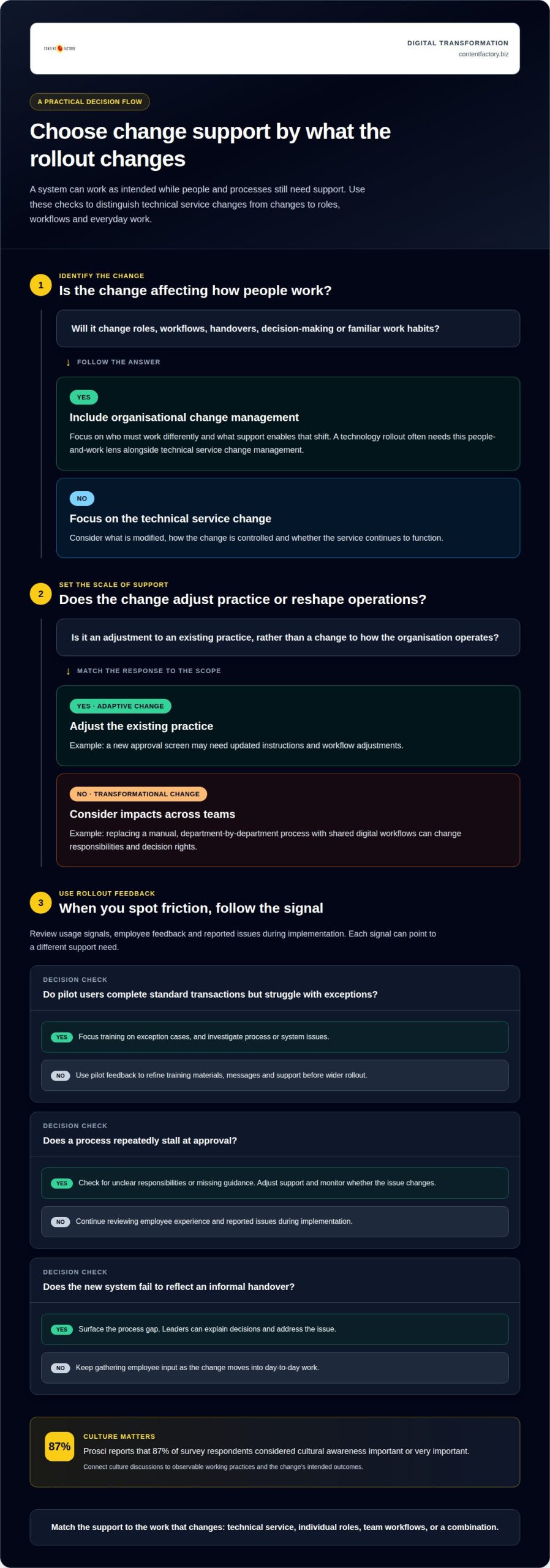
Professionals use pilot feedback to refine training materials, messages and support before a wider rollout. For example, pilot users may complete standard transactions but struggle with exceptions. Training can then focus on those cases, while the project team investigates process or system issues. Aligning preparation with implementation milestones makes support relevant when employees need to apply new skills.
Adoption Monitoring and Employee Input
Adoption monitoring combines usage signals, employee feedback and reported issues to show how the change works in practice. Teams can review these inputs during implementation and address emerging problems.
Professionals compare intended behaviours with employees’ experiences in actual workflows. If a process repeatedly stalls at approval, feedback may reveal unclear responsibilities or missing guidance. The team can adjust the support and monitor whether the issue changes. This makes engagement an ongoing source of operational insight, rather than a one-off consultation at the start of a project.
Cultural Readiness and Employee Resistance
Cultural readiness considers whether established habits, expectations and workflows support the proposed change. Resistance can signal practical concerns, competing priorities or uncertainty about new responsibilities.
Professionals examine current workflows and ask employees where the change creates friction. For example, a team may rely on an informal handover that the new system does not reflect. Open communication helps surface the issue; leaders can then explain decisions and address the process gap. This treats resistance as information to investigate, rather than assuming another announcement or generic training will resolve it.
IT service change management versus organisational change management
IT service change management controls how a technical service is modified; organisational change management addresses how people and work adapt. A technology rollout often needs both, because a stable system can still disrupt established practices.
Culture and Change Impacts
Organisational culture shapes how employees interpret and respond to new systems, roles and routines. It matters because a process that works technically may conflict with established decision-making or team expectations.
IT service change management typically focuses on the service itself: what changes, how the change is controlled, and whether the service continues to function. Organisational change management considers who must work differently and what support enables that shift. Both perspectives matter when, for example, a new system changes approval routes across departments. Prosci reports that 87% of survey respondents considered cultural awareness important or very important. The LEASH Model can be used as a culture-shaping lens, but its specific components should not be assumed without a defined model. Connect any culture discussion to observable working practices and the change’s intended outcomes.
Adaptive and Transformational Change
Adaptive change adjusts existing practices to meet a new need, while transformational change reshapes how an organisation operates. Distinguishing between them helps you choose a proportionate approach instead of treating every technology update as a full organisational redesign.
For example, introducing a new approval screen may require updated instructions and workflow adjustments. Replacing a manual, department-by-department process with shared digital workflows can change responsibilities and decision rights more broadly. In the second case, leaders need to consider impacts across teams, not only the technical release. The late-1970s framework introduced by Thomas J. Peters and Robert H. Waterman mapped factors influencing an organisation’s ability to change. Its central practical lesson is to examine connected organisational factors, rather than assuming technology alone will shift established practices.
Organisational Change for AI Adoption
AI adoption requires organisational change when it alters how employees produce, review or act on work. Clear accountability and suitable working practices matter because employees need to understand how the technology fits their roles.
Leaders can define which tasks AI supports, which decisions remain with employees, and how teams handle exceptions. They should also explain the rationale, invite questions and make room for feedback as work changes. Prosci found that 16% of surveyed enterprise IT and services executives identified a lack of leadership buy-in and support as an obstacle during change initiatives. That finding reinforces a practical point: leadership participation must extend beyond approving a technology purchase. If your implementation spans technical controls and changes to daily work, discuss the organisational impact with a change specialist.
Stakeholder engagement and leadership support
Stakeholder engagement identifies who is affected, what decisions they influence and when their input is needed. Leaders turn that insight into action by involving users before workflow decisions are finalised.
Identifying and Engaging Stakeholders
Stakeholder identification maps affected groups to the processes and decisions a technology change will alter. It matters because people who operate current workflows often see impacts that project teams miss.
Professionals first define the change’s scope, then identify employees who consistently use or support affected processes. A finance system, for example, may involve approvers, finance staff and employees submitting expenses. Engagement should begin while design choices remain open, not after the system is configured. Prosci’s survey of enterprise IT and services executives found that 23% identified insufficient stakeholder engagement and management as an obstacle during change initiatives.
Engagement gives each group a useful role. Frontline users can describe workarounds, handovers and exceptions; managers can explain operational priorities; technical teams can assess system constraints. The project team uses these insights to develop workflows that fit business needs. Stakeholder involvement can evolve as impacts become clearer, bringing additional groups into decisions when their processes are affected.
Communicating Technology Changes
Effective communication explains why a change is happening, how it affects each group and where employees can raise questions. A general announcement rarely gives every team enough detail to act.
Professionals tailor messages to employees’ roles and the decisions they face. For example, a manager may need to understand changed approval responsibilities, while an end user needs to know how a new task fits into daily work. Leaders should explain the rationale, describe practical impacts and provide a clear channel for questions and feedback.
Communication should continue through design, piloting and rollout. At each stage, leaders can share what has changed, what remains unresolved and what action employees need to take. Prosci reports that 37% of employees expect to hear about changes from leadership. Direct managers can reinforce those messages in team discussions and surface concerns that need a response.
Leadership support must be visible in decisions, not limited to launch announcements. A Prosci survey found that 16% of enterprise IT and services executives identified lack of leadership buy-in and support as an obstacle. Sponsors can demonstrate commitment by making timely decisions, explaining trade-offs and using the new workflow themselves. That example helps employees see how the change applies in practice.
ADKAR model and individual transitions
For technology initiatives, Prosci’s ADKAR Model provides a practical framework for individual transitions. For broader organisational change, leaders can pair it with a framework such as Kotter’s eight-step process, choosing an approach that suits the scale of the transformation.
ADKAR stands for Awareness, Desire, Knowledge, Ability and Reinforcement. It helps teams identify what an employee needs at each stage, rather than assuming one announcement or training session will lead to adoption.
- Awareness: explain why the change is happening and why now.
- Desire: address how the change affects an employee’s role and priorities.
- Knowledge: provide the instructions and learning needed for new tasks.
- Ability: give employees practice and support to apply that knowledge.
- Reinforcement: sustain the new behaviours through feedback and ongoing enablement.
Consider an employee moving from a spreadsheet process to a shared digital workflow. Awareness explains the reason for the change; Knowledge covers the new steps. If the employee understands the process but cannot complete it independently, the gap is in Ability. Targeting support to that gap is more useful than repeating general messages.
ADKAR is particularly useful when a change programme needs to diagnose individual barriers. It does not replace decisions about system design, responsibilities or organisational direction. Instead, it helps change leaders connect those decisions to what employees must understand, learn and do. This makes resistance a signal to investigate, not a reason to label an employee as unwilling.
Digital transformation also requires leaders to connect individual transitions with organisational action. The Centers for Disease Control and Prevention describes Kotter’s framework through these elements:
- Create urgency and form a guiding coalition.
- Develop a vision and strategy, then communicate the vision.
- Empower employees and generate short-term wins.
- Consolidate gains and anchor change in the culture.
These elements help leaders coordinate initiatives across teams, while ADKAR focuses on the employee’s transition. Neither framework works as a script detached from day-to-day work. Leaders need to use feedback to adjust support as implementation develops.
A people-centred approach treats employees as participants in transformation, not just recipients of change. Pilot users, for example, can identify where a new workflow clashes with real tasks. Leaders can address that friction, clarify responsibilities and reinforce the intended practice. Pairing ADKAR’s individual focus with organisational leadership action gives resistance a practical response and keeps technology change connected to daily work.
People and process support during technology implementation
Successful implementation depends on more than a working system. Employees need support to perform changed tasks, while processes must define how work moves through the technology and across teams.
For Singapore projects, regulatory considerations depend on the data handled, the system’s purpose and the organisation’s sector. The project team should identify relevant obligations early, then involve legal or compliance specialists to interpret them. Practical planning should also address data access, security controls, retention, vendor connections and employee responsibilities.
People support starts by mapping each affected role to the work it must complete. For a new finance platform, that may include submitting claims, approving exceptions and resolving incomplete records. The project team can then align training, job aids and coaching with those tasks. General demonstrations alone rarely prepare employees for the decisions and handovers their role requires.
Process support makes the new way of working explicit. Teams document who initiates each task, who reviews it, what happens when information is missing and where unresolved issues go. For example, a new customer management system needs clear rules for updating records and assigning follow-up. Without these agreements, employees may use the new platform while retaining inconsistent local practices.
Training works best when it follows the implementation sequence. Pilot users can practise realistic tasks, report where instructions fall short and identify process gaps before wider deployment. The project team can use those findings to revise training and prioritise fixes. After launch, managers need routes to escalate recurring problems, while ongoing support helps new employees learn the established process.
Measurement should connect system activity to operational outcomes. Teams can review usage patterns, employee feedback, unresolved issues and process completion to see where additional support is needed. Login counts alone cannot show whether employees complete work correctly. Combining usage signals with workflow evidence and user input gives leaders a clearer basis for action.
Prosci reports that 58% of employees prefer to receive communication about changes affecting them personally from their direct managers. Managers can reinforce training by discussing changed tasks in team settings and listening for points of confusion. That feedback helps the project team distinguish a training gap from a process defect or system issue.
For a practical takeaway, connect each rollout milestone to a named owner, a changed task, suitable training and a way to capture feedback. This makes support part of project delivery, not an activity left until go-live. To align people and process support with your implementation, Contact Us.
ContentFactory: Digital Roadmap and Implementation Planning
ContentFactory helps you turn a technology initiative into a coordinated implementation plan. Its Digital Roadmap and Implementation Planning aligns priorities, process changes and delivery decisions. If adoption depends on new responsibilities or working practices, change management and training can support employees through the transition.
Turn to this support when system decisions affect workflows, teams or implementation priorities, or when a rollout needs better coordination between technology and people. The work connects the intended business outcome with practical delivery and adoption needs.
Contact ContentFactory to discuss your implementation needs.
Make the next implementation decision deliberate
The next step is to connect the technology decision to the work your teams must do differently. Before confirming a rollout plan, identify the operational outcome, the affected roles and the decisions that still need an owner. This gives your organisation a clear basis for sequencing implementation and allocating support.
Effective change management for technology implementation is built into delivery, not added after technical decisions are settled. Treat employee readiness and process impact as active planning inputs. If priorities shift or feedback exposes friction, adjust the rollout rather than expecting employees to absorb the gap. A clear plan helps leaders make these trade-offs purposefully.
ContentFactory can help shape a digital roadmap and implementation plan that connects technology priorities with delivery and adoption needs. To discuss your next step, Contact Us. Your organisation can move forward with a plan grounded in how work actually gets done.
Frequently Asked Questions
Which factors can organisational change affect?
Organisational change can alter decision rights, resource allocation, performance expectations and how teams coordinate. For example, introducing a shared service may shift responsibility for approving requests from local managers to a central team. That affects who can make exceptions and how work is prioritised. Mapping these effects helps leaders identify where governance, accountability or team objectives need adjustment alongside operational changes.
What is change management in technology implementation?
It is the coordinated work of addressing the organisational consequences of introducing technology alongside its technical deployment. Its scope depends on what changes for the business: a software update may require limited coordination, while replacing a core platform can affect decision authority, service continuity and accountability. A useful distinction is between technical release tasks and decisions about who owns new processes, exceptions and outcomes.
How does a professional assess organisational readiness for a new technology?
Beyond employee capability, a readiness assessment examines whether essential prerequisites are in place. A professional may review data access, system dependencies, ownership of cutover decisions and arrangements for maintaining service if the transition encounters a problem. For a finance platform, the assessment might test whether opening balances can be reconciled and who authorises a return to the previous process. These findings inform release criteria and contingency planning.
What training and support do employees need during a technology rollout?
Employees need practical access to the learning environment, suitable time to prepare and a clear route to help after launch. Training plans should account for shift patterns and ensure users can access the system before scheduled sessions. A support team can review recurring questions and errors, then issue focused guidance. This helps distinguish a knowledge gap from a permissions problem or system defect.
How does a professional measure adoption and the success of a technology implementation?
A professional separates delivery outputs from business outcomes. System availability confirms a technical milestone, while reduced duplicate entry or fewer unresolved exceptions may indicate operational change. The team establishes a baseline, assigns an owner to each measure and agrees how evidence will be collected. Reviewing measures against the intended business case helps establish whether implementation is delivering useful value, not merely generating system activity.
What are common risks and causes of resistance during technology change?
Data migration errors, unsuitable access permissions and unclear fallback arrangements can disrupt a rollout even when employees understand the new system. Resistance may also reflect concerns about reduced autonomy, increased monitoring or incentives that still reward the old process. For example, employees may avoid a shared platform if performance reviews continue to favour individual case volumes. These risks call for operational controls and aligned management practices.
How can a professional manage stakeholder resistance to new technology?
A professional can record each concern, assign an accountable owner and document the response or decision. This creates a traceable route from stakeholder input to action, rather than leaving objections unresolved across meetings. Concerns can be grouped by decision, operational dependency or individual impact, then escalated to the person with authority to address them. Closing the loop means explaining what changed, what did not and why.

Article by
Mayuresh Godse
Mayuresh Godse is a Singapore Certified Management Consultant and Business Strategist specializing in Sustainability, ESG, AI-driven Digital Transformation, and business growth. Based in Singapore, he writes about Sustainability, Digital Innovation, Business Strategy, and Content Marketing for global audiences.
Disclaimer
This article is provided by ContentFactory for general information only and is not legal, tax, accounting or financial advice. Regulations and government scheme criteria change; grant eligibility and quantum are set by the relevant Singapore agencies and assessed case by case, with no outcome guaranteed. Verify current requirements before acting.