

Digital transformation fails when organisations invest in technology before defining the business problem. Common digital transformation failures often start with unclear outcomes, disconnected initiatives, weak ownership, or processes and people left out of the change. Companies need more than software: they need a clear roadmap that connects process redesign, system integration, adoption and measurable results.
It is reasonable to expect a transformation initiative to improve how work gets done. But activity, such as launching systems or running multiple projects, does not prove the business is better off. Results depend on whether the work addresses real operational problems and whether teams can adopt the changes.
This guide explains what transformation services should deliver, why initiatives stall, and how failures affect costs and day-to-day operations. You’ll also learn how to reset a struggling programme, sequence work more effectively and measure business outcomes. The focus is practical: how to make transformation relevant to your Singapore business, rather than adding another project that competes for attention.
Key Takeaways
- Prioritise initiatives by the operational problems they solve, then sequence the work instead of spreading teams across too many projects.
- Recover adoption by listening to frontline teams, addressing practical barriers and giving managers a clear role in supporting change.
- Assess how a failed rollout affects both costs and daily operations, including delays, workarounds and disrupted workflows.
- Separate delivery activity from adoption and business outcomes so progress reflects measurable improvements, not simply completed tasks.
- Use clear ownership, realistic goals and alignment between technology choices and business needs to address common causes of failure.
What Are Companies Actually Buying (when they hire someone to “design and kick off digital transformation”)?
They’re buying a way to connect business priorities, processes, systems and people, not simply a technology launch. McKinsey’s often-cited 70% figure concerns complex, large-scale change programmes failing to achieve stated goals; it is not a digital-transformation-specific failure rate. For a digital initiative, define failure against its agreed outcomes: missed goals, unrealised business value or a system that people cannot use effectively.
A Singapore organisation should also consider cybersecurity, privacy and regulatory exposure before rollout. Weak access controls, insecure system integrations, excessive collection of personal data or unclear data handling can create risk. Sector requirements may also affect system design. These risks can derail an initiative if teams address them only after implementation begins.
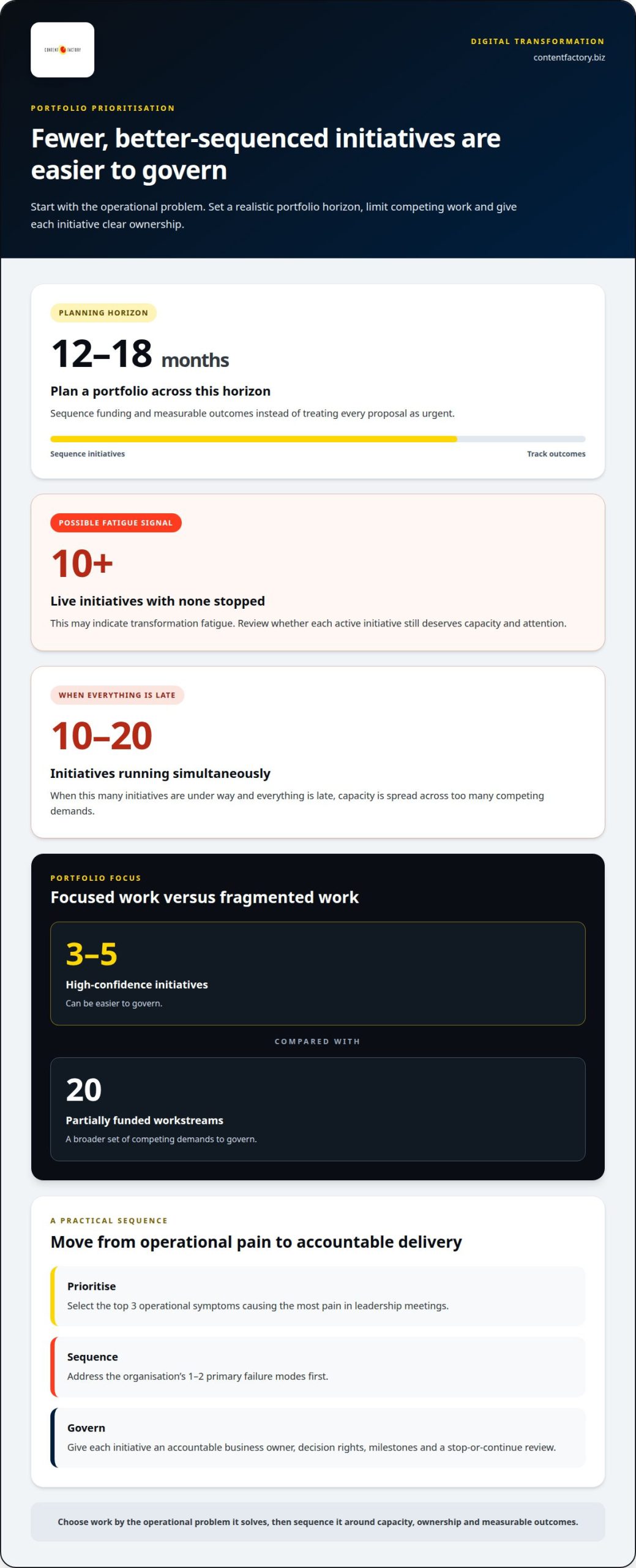
Focused prioritisation starts with the operational problem, then tests whether an initiative can solve it. If leaders cite slow approvals, map the approval process before selecting software. A portfolio covering 12 to 18 months can sequence funding and measurable outcomes, rather than treating every proposal as urgent.
Set work-in-progress limits. An organisation with 10 or more live initiatives and none stopped may be showing transformation fatigue. When 10-20 initiatives run simultaneously and everything is late, capacity is spread across too many competing demands. Three to five high-confidence initiatives can be easier to govern than 20 partially funded workstreams.
- Prioritise: Select the top 3 operational symptoms causing the most pain in leadership meetings.
- Sequence: Address the organisation’s 1-2 primary failure modes first.
- Govern: Assign an accountable business owner, decision rights, milestones and a stop-or-continue review to each initiative.
Digital media initiatives need the same governance as system programmes. The BBC’s Digital Media Initiative was cancelled in May 2013, illustrating why a named sponsor, usable deliverables and progress reviews matter. Governance should connect funding decisions to outcomes, not reward activity simply because a project remains open.
An IT-only approach is another trap. Technology teams can configure a platform, but they cannot define operational success alone. A finance-system change, for example, needs finance owners to define the workflow and frontline users to test it. Technology should support a redesigned process, not replace one.
Singapore examples should distinguish documented cases from illustrations. The facts here do not establish named local success or failure cases, so these are illustrative: a distributor could pilot digital order approvals, then scale after confirming users adopt the workflow. By contrast, replacing a core system before testing integrations could interrupt order processing. A Singapore-focused digital transformation roadmap should connect initiative selection, process ownership and implementation sequencing.
How do you recover a failed digital transformation?
Recovery starts by identifying where execution breaks down for employees, then correcting the change plan. Leaders need honest feedback, clear expectations and practical support to help people adopt the changes.
Addressing Frontline Resistance
Frontline resistance can mean employees are reluctant or struggling to use new software because it disrupts established work. It matters because a system delivers little value if employees avoid it, enter incomplete information or create workarounds. Listen to affected teams and identify specific friction, such as duplicate data entry or unclear steps. Frontline supervisors help sustain engagement during change, so equip them to surface issues and explain decisions consistently.
Engaging Employees in Digital Adoption
Employee engagement means involving the people who use a system in shaping how it fits their work. Adoption means they use it effectively in routine tasks. Leaders should explain why the change is happening, what will change in each role and where employees can raise concerns. During a digital engineering initiative, executives began hearing frontline concerns in August 2019. That feedback gave leaders a chance to address the gap between the programme’s intent and employees’ experience.
Managing Change and Adoption
Change management coordinates communication, training, manager support and feedback so new ways of working take hold. It matters because software deployment alone doesn’t prepare people for changed responsibilities. One reported finding says organisations with a change management strategy are 7 times more likely to meet digital transformation goals. Treat that as a reason to plan for adoption, not as a guarantee of results. Include role changes, practice and follow-up in the implementation plan.
Executive storytelling sets expectations through a consistent account of the problem, the intended outcome and what employees should expect next. Avoid presenting transformation as a finished success before daily workflows improve. In December 2018, executives repositioned Digital Engineering as a more strategic initiative and required frontline employees to perform daily in-app operations. The example underlines a practical point: explain the purpose, but also make the new work and its support visible.
Employee research can reveal obstacles before they become entrenched. In one anonymised enterprise case, teams mapped about 2,000 people through four-day interview waves, moving from discovery to implementation planning in under three weeks. The useful lesson is to organise listening around affected roles and concrete work. Ask where tasks break, what workarounds appear and which manager actions would help. Then turn those findings into owners, training needs and changes to the rollout.
For a recovery plan, pair supervisor check-ins with regular employee feedback, then use that evidence to adjust workflows and training. If your initiative needs a clearer adoption plan, discuss the implementation challenges with the team.
Financial and operational impacts of transformation failures
A failed transformation can affect finances and daily operations at the same time. A rollout may create rework, delay orders, interrupt service or leave employees maintaining old and new systems side by side. The impact depends on the process affected: disruption to order fulfilment, for example, can reach customers before project leaders see the full cost.
Several cases show how operational disruption develops. Hershey’s enterprise systems rollout experienced order-processing and distribution problems in 1999. HP faced major order-processing disruption while migrating a server product line in 2004. These examples show why a system change needs operational readiness, not just a technical completion date.
In 2018, Revlon estimated that disruption from its ERP rollout prevented fulfilment of shipments and generated incremental costs. Lamb Weston reported lower net sales and net income following ERP disruption in fiscal Q3 2024. These cases show the financial mechanisms: missed or delayed fulfilment can affect revenue, while recovery work adds pressure to operating costs.
These are examples, not a forecast for any particular country. They show how transformation can fail when a new system disrupts a process before the organisation is ready for the change. Map affected workflows, customer commitments, system dependencies and fallback procedures before rollout. This makes operational exposure visible while teams can still adjust the sequence of work.
Automation can reduce manual hand-offs, but digitising a flawed process simply moves the bottleneck into software. Converting a spreadsheet workflow into an app, for example, helps only if the app clarifies responsibilities, captures usable information and supports the decisions employees need to make. Start by mapping the process. Identify duplicate entry or unnecessary approvals, then test the redesigned workflow with its users.
An operating-model mismatch occurs when technology assumes decisions or responsibilities the organisation has not assigned. Repeated approvals and slow decisions can signal unclear ownership, even if the platform works as designed. Before implementation, define who approves each step, who resolves exceptions and which team owns the end-to-end result. Otherwise, the system may encode delays rather than remove them.
A practical review links each initiative to the operational process it changes. Track service interruptions, backlogs, order accuracy, rework and employee workarounds alongside project progress. If performance deteriorates after launch, pause expansion, isolate the affected workflow and correct the process or integration before scaling. A focused business process reengineering approach can help distinguish a technology issue from a process-design problem—an operational turnaround method emphasised by specialists like nexa-transform.com when realigning bespoke software systems with day-to-day execution.
Measuring business outcomes instead of activity
A rollout is not successful simply because software launches or milestones close. Measure whether the change improves a defined business outcome, who owns that result and how the organisation will track it. BCG’s study of more than 850 companies found that only 35% of digital transformations meet their value targets globally. That finding makes the baseline and target essential, not optional reporting details.
Set the intended outcome before delivery starts. For an order-processing change, the goal might be fewer errors or faster fulfilment; for a finance workflow, it might be less rework. Record the starting position, define the target and name the data source. Without these steps, teams can report activity but cannot tell whether the transformation created measurable value.
Separate three kinds of measures so leaders can see where progress is stuck:
- Delivery: Track whether agreed components are ready for use, not only whether tasks are marked complete.
- Adoption: Monitor whether affected employees use the new workflow in routine work, and where workarounds remain.
- Business outcomes: Connect the change to measures such as processing time, error rates, service levels or operating effort.
Keep the scorecard focused. Choose 3-5 key performance indicators for the portfolio, then assign an accountable owner and review cadence to each. A dashboard crowded with measures can hide the reasons performance moves. A compact set makes exceptions visible and gives leaders a basis for changing scope, support or sequencing.
Ownership must span the business and technology teams. The business owner defines the result and confirms whether the workflow works; the technology owner manages system delivery and reliability. For a customer-service platform, for example, technology can report system availability, while the service leader owns whether the new process improves case handling. Execution is shared, but accountability must be clear.
Digital business models also need measures that reflect how they create value. A business introducing digital self-service should assess whether customers complete tasks successfully and whether the process reduces avoidable manual handling. Test these outcomes with a defined group before expanding the rollout. A digital feature with few users may be delivered on schedule and still fail its business purpose.
A practical reset can run for 90 days, with 1-2 lighthouse initiatives tied to measurable value. Track 1-2 value streams that can move a business metric in less than 6 months, then review evidence before scaling. For generative AI, MIT research suggests that 95 per cent of pilots fail to deliver measurable business impact, reinforcing the need to define value before a pilot begins.
Common causes of digital transformation failure
Several common digital transformation failures start when strategy, leadership, investment and execution are disconnected. The available figures don’t establish which industries have the highest failure rates; McKinsey’s roughly 70% figure concerns transformations generally, not an industry ranking.
Strategy and Leadership Gaps
Strategy and leadership gaps emerge when leaders approve technology without defining the business outcome or assigning decision rights. Teams are then left uncertain about priorities and whose decisions count. A shared system initiative can stall if business and technology teams pursue different goals. Connect each investment to a specific operational problem, a named owner and a measurable result. Explain what the initiative will not address, too, so teams can focus their efforts.
Unrealistic Budgets, Timelines, and ROI Expectations
Expectations become unrealistic when plans overlook integration, process redesign or the time employees need to adopt new workflows. Pressure to meet a fixed launch date can leave essential work unfinished. Base estimates on dependencies and staged outcomes, then revisit assumptions as delivery evidence emerges. Treat early ROI projections as hypotheses to test, not promised returns. A phased investment lets decision-makers adjust scope when operating conditions differ from initial assumptions.
Legacy IT can amplify these risks. Harvard Business Review survey respondents identified legacy IT systems as a barrier to transformation, with over half naming them. Incompatible data formats or interfaces can slow integration and preserve manual workarounds. Map information flows before committing to the portfolio, then test a critical workflow using realistic cases.
Early warning signs include:
- Six approvals or decisions taking weeks, suggesting unclear ownership.
- Milestones moving repeatedly while integration issues remain unresolved.
- Employees keeping parallel spreadsheets because the new process misses operational needs.
- Investment requests that name technology but lack a clear connection to project goals.
Different warning signs call for different responses. Slow decisions need clearer authority; recurring integration delays need dependency analysis; persistent workarounds need process investigation. Review each initiative against its purpose and the available evidence, then decide whether to continue, rescope or stop it. Keeping every project active can dilute capacity rather than protect progress.
To identify common digital transformation failures early, select one troubled initiative and trace its goal, accountable owner, dependencies and current evidence. This reveals whether leadership alignment, integration or delivery assumptions need attention. Contact Us to discuss a practical roadmap for your business.
ContentFactory
When a transformation initiative stalls or its outcomes remain uncertain, ContentFactory helps business leaders make clearer decisions. Its advisory and implementation planning can help you define the operational problem, examine why progress has slowed and identify the evidence needed to decide what comes next. This is useful when teams disagree about priorities, ownership or whether an initiative is delivering value.
The next step is a focused discussion of your business context, current challenges and intended outcomes. You can then decide whether further support fits your needs. Contact ContentFactory to discuss the issue and possible next steps.
Make the next decision with evidence
A stalled initiative does not automatically need more technology or a larger budget. It needs a clear decision about what should change next, based on operational evidence and the people doing the work. That may mean correcting a workflow, resetting ownership, adjusting the rollout or stopping work that no longer serves the business.
Turn your transformation findings into a decision brief: state the business problem, the outcome you need, the key dependencies and who owns delivery. This gives leaders a sound basis for setting priorities while keeping execution connected to daily operations. Addressing common digital transformation failures is not about avoiding every setback. It is about recognising when the plan needs to change and acting before disruption becomes routine.
ContentFactory supports Singapore businesses with digital roadmaps, process redesign, system integration and change management. If you’re ready to clarify the next move for your organisation, Contact Us. A focused decision can give your transformation a more practical direction.
Frequently Asked Questions
Is it different with AI transformations?
AI transformations add model performance and data suitability to familiar delivery challenges. A process may work technically but still produce inconsistent or difficult-to-check outputs. Start with a defined task, representative data and a human review point. For example, test whether an AI tool can classify routine service enquiries accurately before using its outputs in customer-facing decisions. Scale only when the results support the intended workflow.
What are the biggest reasons digital transformations fail?
The most common causes are often connected: unclear business goals, fragmented decision-making or delivery disconnected from daily operations. For example, a department may adopt a new platform without agreeing who owns shared records. Teams then debate whose data is correct instead of using the system. Clear accountability for decisions, information and outcomes helps prevent this kind of failure.
What are the most common causes of digital transformation failures?
Common causes include choosing technology before understanding the work, underestimating dependencies and treating launch as the finish line. A new customer-service platform, for example, may create confusion if staff use different definitions for the same case status. Agree data definitions and exception-handling rules before configuration to reduce inconsistent records. These design gaps can undermine an initiative even when its overall business case is sound.
How do legacy systems and integration problems derail digital transformation?
Legacy systems may store information in incompatible formats or rely on interfaces that do not support the new workflow. Integration problems can then create duplicate records, delayed updates or manual transfers between systems. Map the information flow from its source to the user, identify where its format changes and test those hand-offs with realistic cases. This helps reveal whether the obstacle lies in the data, interface design or process ownership.
What role do employee resistance and skills gaps play in failed transformations?
Resistance can signal that employees lack time, confidence or role-specific support, rather than oppose technology itself. Skills gaps also emerge when training covers software features but not how tasks will change. For example, a new case-management system may require staff to record information differently. Combine guided practice with clear examples of completed work, then give teams a way to report confusing steps without blame.
What steps help recover or prevent a failed digital transformation?
Start by documenting the intended result, current obstacles and decisions blocking progress. Assign an owner to each unresolved issue, agree what evidence would justify continuing, and run a contained test of the revised approach. To prevent problems, review dependencies, user readiness and fallback arrangements before a wider rollout. This gives leaders a practical basis to adjust scope, pause delivery or proceed with clearer controls.

Article by
Mayuresh Godse
Mayuresh Godse is a Singapore Certified Management Consultant and Business Strategist specializing in Sustainability, ESG, AI-driven Digital Transformation, and business growth. Based in Singapore, he writes about Sustainability, Digital Innovation, Business Strategy, and Content Marketing for global audiences.
Disclaimer
This article is provided by ContentFactory for general information only and is not legal, tax, accounting or financial advice. Regulations and government scheme criteria change; grant eligibility and quantum are set by the relevant Singapore agencies and assessed case by case, with no outcome guaranteed. Verify current requirements before acting.