

A polished demonstration can make a technology vendor look like the right choice, but it cannot show how the product fits your workflows or performs with your data. Knowing how to choose a technology vendor means looking beyond features: assess product fit, integration needs, contract responsibilities and the vendor’s roadmap against your business requirements.
You may already know that a poor fit can create extra work long after the contract is signed. A consultant can structure the assessment around real evidence, so the decision is based on how the solution works for your organisation, not just how it looks in a sales presentation.
This guide explains what to provide for an assessment, how vendor relationships and responsibilities can be evaluated, and why integration and product roadmaps matter. You’ll also see how testing with your own data can reveal gaps before you commit, helping you make a more informed technology decision for your Singapore business.
Key Takeaways
- Set business outcomes and weighted evaluation criteria before comparing vendor proposals.
- Assess security practices and code vulnerabilities alongside each supplier’s ability to meet your requirements.
- Clarify responsibilities, risks, costs and remedies in the contract before committing.
- Evaluate how a solution fits your existing systems, data and workflows, not just its standalone features.
- Use product-roadmap evidence and tests with your own data to expose fit gaps before implementation.
How to choose a technology vendor: assess supplier fit
Assess each supplier against business outcomes, operational risks and evidence for its claims. A structured RFP, security review and customer references make the decision easier to test.
Have a professional set supplier evaluation criteria
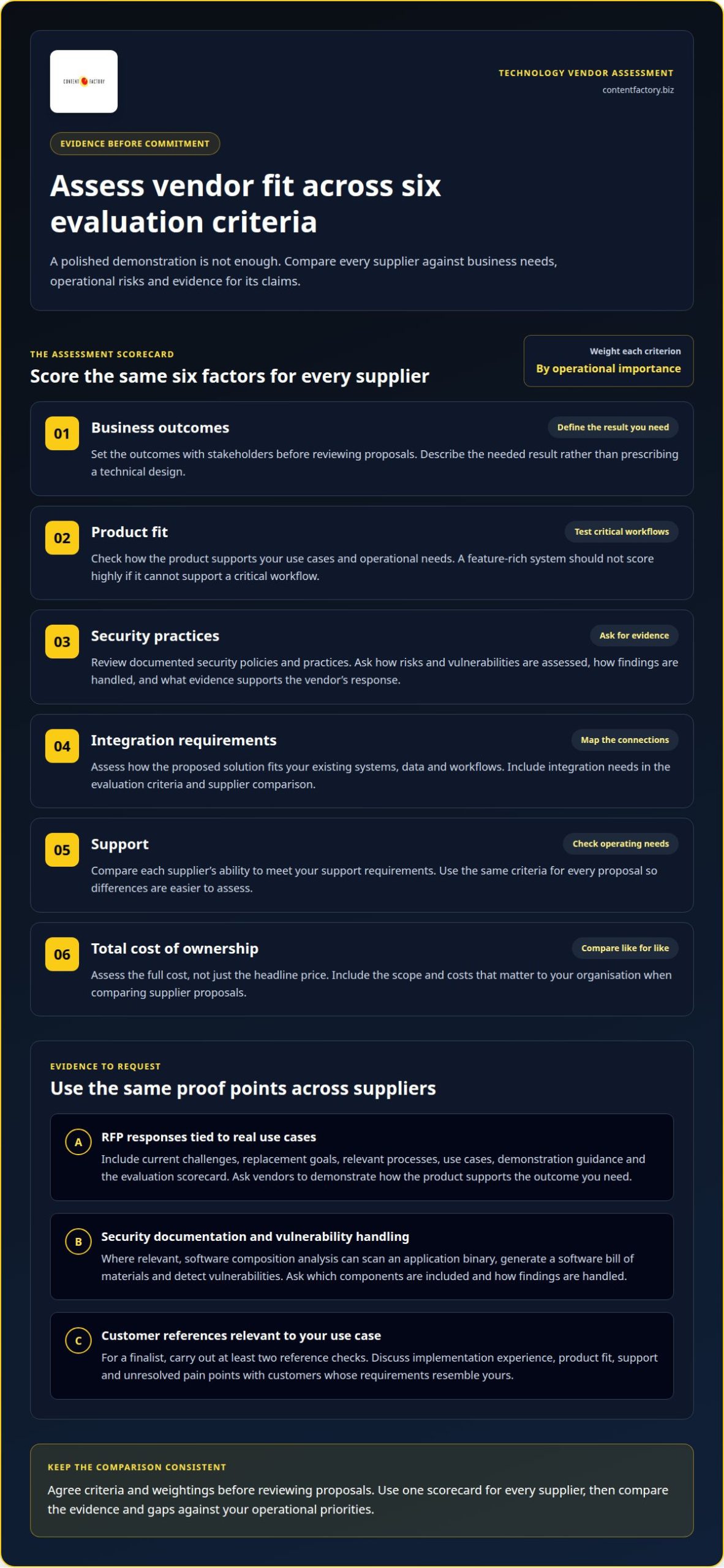
Ask the consultant to agree evaluation criteria with stakeholders before reviewing proposals. Prioritise business outcomes, product fit, security practices, integration requirements, support and total cost of ownership. Assign each criterion a weighting that reflects operational importance, then use the same scorecard for every supplier. This makes strengths and gaps easier to compare. For example, a feature-rich system should not score highly if it cannot support a critical workflow.
Have a professional prepare RFP content and criteria
Ask the consultant to prepare an RFP that explains your organisation, current challenges and replacement goals. Include high-level requirements, relevant processes or use cases, demonstration guidance and the evaluation scorecard. Describe the outcome you need rather than prescribing a technical design before suppliers respond. For example, specify the information staff must access during a process, then ask vendors to demonstrate how their product supports it. Clear criteria help evaluators score proposals consistently.
Ask a consultant what to ask technology vendors during procurement
Ask vendors to explain how they assess security risks, manage vulnerabilities and support your operating needs. A professional can review documented security policies and practices, then assess software composition analysis where relevant. This method can scan an application binary, generate a software bill of materials and detect hidden vulnerabilities. Ask which components are included, how findings are handled and what evidence supports the response. Compare answers against the same security criteria, not broad assurances.
Check References and Customer Evidence
Have the consultant review case studies, customer reviews and reference feedback against your use case. Ask for at least two reference checks on a finalist, then speak with customers whose organisation and requirements resemble yours. Discuss implementation experience, product fit, support and unresolved pain points. Compare those accounts with the vendor’s claims and available case studies. Independent customer feedback can reveal whether a polished demonstration reflects day-to-day operations, not just a carefully prepared presentation.
Have a professional review contract terms, risks and responsibilities
For a vendor arrangement in Singapore, map applicable data-protection obligations to the information and service involved. Assign responsibilities for data access, handling, retention and deletion. Reduce vendor lock-in risks by agreeing data portability, exit assistance and clear terms for configuration changes before signing.
Have a professional check regulations and data protection requirements
Ask the reviewer to identify which data the service handles and how it moves between your organisation and the vendor. Contract terms should define permitted access, handling responsibilities, retention, deletion and incident communication. For example, a service processing customer records needs clear responsibilities for access and removal when the agreement ends. Treat this as a contract review, not a substitute for legal advice.
Have a professional reduce vendor lock-in risks
Ask the reviewer to examine how your organisation can retrieve its data and leave the service. Specify export formats, access during transition, deletion after exit and assistance transferring operational records. Check whether integrations rely on proprietary interfaces or whether configuration changes require vendor support. These terms matter because switching becomes harder when data, workflows or essential functions cannot move cleanly.
- Define service responsibilities and remedies. Have the contract identify who handles configuration, support, maintenance and service issues. A 99.9% uptime commitment means little unless the agreement defines downtime, its measurement method and the remedy for missing the target. The reviewer should also distinguish vendor obligations from tasks your team must perform, such as supplying access or approving changes.
- Assess the full cost of the vendor response. Compare proposals on the same scope, including computing, storage, add-on features, implementation and ongoing support. A low headline price may omit capabilities needed for daily operations. Ask the vendor to identify assumptions, exclusions and costs tied to configuration changes, usage growth or additional modules. This makes competing responses easier to assess on a like-for-like basis.
- Set terms for trade-in equipment and data erasure. Before devices leave your organisation, document who sanitises storage media, how completion is evidenced and who is responsible during transfer. For example, require an asset-level record showing the device identifier and sanitisation status. Specify secure handling and responsible recycling in the agreement, rather than treating disposal as an informal handover.
Single-platform solutions and system integration
A technology solution must fit your existing systems, data, security controls and workflows. A professional assesses whether one platform simplifies operations or creates new dependencies.
Have a professional assess ecosystem fit and integrations
Ask the professional to map how the proposed solution connects with your current technology ecosystem. Include internal systems, external services, data flows, security controls and processes. For example, trace how a customer record moves from an enquiry system into finance, then identify where staff re-enter information. According to the Ministry of Digital Development and Information, interoperability lets different systems work together without becoming identical. That distinction matters: integration should preserve necessary system differences while enabling useful exchange.
Also identify data ownership, access points and dependencies. Document which systems send or receive information, the formats they use, and who manages each connection. An integration diagram can expose duplicate data entry, manual hand-offs or security gaps before implementation. Link findings to business requirements, not simply to a supplier’s list of supported connections.
Have a professional evaluate systems integration
Evaluate each critical integration as a working process, not a box on a product diagram. Trace an example transaction from its source through the solution to its destination. Check how errors appear, how records are reconciled and what happens when a connection is unavailable. For instance, an order that fails to reach finance needs a clear exception process, not an unnoticed gap.
Assess compatibility with your infrastructure and the effort required to maintain connections over time. The review should consider APIs, data quality, security requirements, process changes and the people responsible for ongoing administration. A technology adoption and system integration assessment can translate these dependencies into implementation decisions. Distinguish essential integrations from optional ones so priorities remain clear.
Have a professional consider single-platform solutions
Ask the professional to compare a single-platform approach with connected specialist systems against your actual workflows. A single platform can let users access information in one place and reduce the need to switch between systems. But consolidation is not automatically a better fit. The assessment should test whether the platform supports required processes, preserves access to data and connects with systems you still need.
Examine configuration flexibility, migration implications and future exit options. A solution that covers several functions may simplify user access while increasing reliance on one supplier. Conversely, separate systems may preserve flexibility but require more integration work. Have the professional document these trade-offs and link each one to business needs, operational responsibilities and the planned implementation path.
Have a professional check product roadmaps and test with real data
A roadmap describes intended development, not proven product fit. A professional compares future plans with released capabilities, then tests priority workflows using your data.
- Compare the roadmap with delivery evidence. Ask the consultant to review the vendor’s future 12-month product roadmap against features made generally available during the previous 12 months. This comparison shows whether planned development aligns with a pattern of delivery. For example, if a required reporting capability appears on the roadmap, the assessment should distinguish planned work from functionality you can use now.
Have the consultant map each planned capability to a stated business need. Record dependencies, expected timing and the operational impact if delivery changes. Treat roadmap items as future possibilities, not current product features. This prevents a selection decision from relying on promises that cannot yet address your pain points.
- Translate pain points into test cases. Before development begins, have the professional define user test cases using sample data. Each case should represent a real workflow and identify the expected result. For example, test whether a record can be created, updated and retrieved by the people who need it. Clear cases make demonstrations and trials easier to assess consistently.
Include exceptions, not just the ideal path. Test how the solution handles incomplete information or a correction to an existing record. Record where users need extra steps, manual workarounds or vendor assistance. These observations help distinguish genuine product fit from a smooth demonstration that avoids difficult operational conditions.
- Trial the product with your own data where possible. In a 2025 survey about technology vendor selection, 60-70% of respondents said they would not buy without trying the product first. A trial using your data can expose mismatches that generic sample records conceal. Select representative data and workflows, then observe whether the product supports the required tasks accurately.
Keep testing focused on agreed use cases. Have relevant users complete tasks and capture results, errors and questions. Compare findings with the evaluation’s success criteria. A vendor demonstration can explain capabilities, but a hands-on trial reveals how the solution performs against your organisation’s actual requirements.
- Review progress at project milestones. Schedule check-ins at key milestones and ask the vendor to demonstrate completed deliverables. Compare each demonstration with the agreed test cases and roadmap assumptions. For example, confirm that a completed workflow supports the intended user task before moving to the next stage.
Document gaps, decisions and dependencies as they arise. This creates a clear record of whether the product is addressing the original pain points or introducing new workarounds. Evidence from milestones also helps decision-makers resolve issues before they affect later implementation work.
What questions should a consultant ask technology vendors during a procurement process?
A consultant should ask questions that test the solution across its full lifecycle, from onboarding through maintenance. Use the same prompts for each finalist so answers reveal operational fit, ownership needs and ongoing costs.
- Test scalability and adaptability. Ask, “How can the solution adapt as our operations or customer expectations change?” Request a practical example involving a changed workflow, increased usage or a new business requirement. Clarify which adjustments your team can make and which need vendor involvement. This distinguishes configurable capacity from changes requiring additional services or product development.
- Identify duplicate work. Ask, “Which tasks will this system automate, and where will staff still enter information manually?” Have the vendor walk through a relevant process, such as transferring an order into finance. Note every repeated entry, hand-off and approval. The consultant can then assess whether the proposed solution reduces avoidable re-entry or simply moves it to another stage.
- Confirm administration and maintenance responsibilities. Ask, “Can our team change configuration, manage users and apply upgrades?” Request a demonstration of a routine change, such as updating a field or adjusting access. Establish what your administrators need to learn, what the vendor maintains and how upgrades affect existing settings. A clear division of work helps you plan ownership after implementation.
- Assess implementation readiness and training. Ask, “Which people and processes must be in place before deployment?” The consultant should identify internal owners, workflow decisions and dependencies that could delay adoption. Ask how training is delivered, what support is available after launch and where users can find further learning resources. For example, supervisors may need different guidance from staff completing daily tasks.
- Understand total cost of ownership. Ask, “What costs arise beyond the core subscription or licence?” Request a breakdown covering computing, storage, add-on features, configuration and ongoing support. Have the consultant map each item to a required capability. This helps identify whether a proposal’s headline price excludes components your team needs for routine operations.
- Check lifecycle support and escalation. Ask, “Who supports onboarding, configuration, operations and maintenance, and how are unresolved issues escalated?” Request clear service descriptions for each stage. For example, identify who to contact when an upgrade affects a configured workflow. Answers should show how vendor support connects with your internal ownership, without leaving responsibilities open-ended.
ContentFactory
ContentFactory helps businesses turn technology assessment findings into clear digital transformation priorities. This is useful when vendor proposals, integration requirements and internal needs are hard to reconcile, or when the preferred product still needs to fit an implementable roadmap.
A sound decision needs more than a preferred supplier. It requires a defined business problem, an understanding of current operations and a realistic view of what implementation involves. ContentFactory can help organise these elements into a practical direction, connecting technology selection to intended outcomes rather than isolated product features.
For an initial discussion, bring materials that explain the decision and its constraints. These may include business objectives, current process pain points, system and integration requirements, shortlisted vendor proposals, contract questions and product trial findings. Identify which teams use the affected workflows and where responsibilities or data hand-offs create friction. This gives the discussion a concrete starting point.
The work can then focus on the gaps that matter: whether the proposed solution supports required processes, how it fits the existing technology environment, and what capabilities implementation needs. A digital roadmap connects decisions to sequencing, ownership and practical delivery considerations. The aim is not to select technology for its own sake, but to support business change with clear priorities and an achievable path.
Professional support is especially useful when stakeholders have different priorities, vendors describe similar products in different terms, or a demonstration has not resolved questions about real-world fit. It can also help align product selection with wider process redesign or technology adoption. If your main need is legal interpretation of contract terms, seek advice from a qualified legal professional. Technology planning and integration assessment address different questions.
To discuss your technology decision and next steps, book a 30-minute discovery call with ContentFactory.
Frequently Asked Questions
How can a consultant help you choose a technology vendor?
A consultant can structure how to choose a technology vendor by clarifying who needs to approve the decision and what evidence those decision-makers need. They can document the rationale, including key trade-offs and assumptions. For example, a decision record can explain why a solution was selected when a new stakeholder joins or business priorities shift. This supports continuity without unnecessarily reopening settled choices.
What Is a Technology Supplier?
A technology supplier provides technology products or related services to another organisation. It might supply software, computing equipment, cloud capacity or implementation expertise. The term can refer to a product developer, reseller or service provider, so identify each party’s role. This clarifies who owns the product, who delivers the work and who remains responsible after deployment.
Which suppliers can support us with reliable products, installation and long-term support?
Look for suppliers whose delivery model covers the stages your project requires, from product provision through installation and ongoing support. A consultant can distinguish the product vendor from implementation partners and support providers, then map their hand-offs. For example, if one party configures the system and another maintains it, the project plan should show how operational knowledge passes between them.
What criteria should a consultant use to evaluate technology vendors?
Use criteria tied to your organisation’s priorities, and make the assessment process transparent to stakeholders. A practical approach to how to choose a technology vendor is to document why each criterion matters and who owns the decision. For example, operations may assess workflow fit while finance reviews commercial assumptions. This makes differences in judgement visible instead of burying them in one overall score.
How can a consultant assess a technology vendor’s financial stability, track record and reputation?
A consultant can examine public company information, business continuity disclosures and the supplier’s history delivering comparable work. The aim is to understand dependency risk, not to treat size as a proxy for suitability. For example, assess whether the product depends on a small specialist team and how knowledge is retained if key personnel change. Compare the vendor’s claims with independently obtained customer feedback.
How can a consultant compare vendor features, pricing and total cost of ownership?
Normalise competing proposals so decision-makers compare equivalent scenarios. For example, align assumptions about users, required functions and contract duration before reviewing commercial differences. Separate mandatory capabilities from optional enhancements to clarify which proposal best fits the defined scope. This supports a decision based on comparable offers, not different package labels or sales presentations.
How can a consultant assess a technology vendor’s cybersecurity, data privacy and compliance practices?
A consultant can map what information the proposed service handles, where it flows and which parties can access it. This helps identify sensitive data pathways and questions requiring specialist review. For example, a vendor may rely on subcontractors to host or support part of its service. Understanding that arrangement helps your organisation assess dependencies and ensure the right internal stakeholders review the proposed data flows.
What service-level agreements, support options, and uptime guarantees should a technology contract include?
Set support terms according to the business impact of different incidents. The agreement can define issue categories, escalation contacts, communication channels and the process for tracking unresolved problems. For example, an issue blocking a core transaction may need a different escalation route from a minor display fault. Also document how users submit requests and how responsibilities pass between your internal team and the supplier’s support staff.

Article by
Mayuresh Godse
Mayuresh Godse is a Singapore Certified Management Consultant and Business Strategist specializing in Sustainability, ESG, AI-driven Digital Transformation, and business growth. Based in Singapore, he writes about Sustainability, Digital Innovation, Business Strategy, and Content Marketing for global audiences.
Disclaimer
This article is provided by ContentFactory for general information only and is not legal, tax, accounting or financial advice. Regulations and government scheme criteria change; grant eligibility and quantum are set by the relevant Singapore agencies and assessed case by case, with no outcome guaranteed. Verify current requirements before acting.