

A technology plan without clear business priorities is just a list of purchases. To understand how to create a digital transformation roadmap, start by defining the outcomes your business needs, then assess the gaps between those goals and your current capabilities. Use that assessment to sequence changes across customer needs, people, processes, technology, data architecture and analytics.
It is easy to focus on new systems. The harder work is aligning teams around shared priorities and redesigning processes so technology supports how the business needs to operate. A practical roadmap links each initiative to a business objective, assigns ownership and sets measures to track progress.
This guide explains how to build that plan: clarify objectives, assess current capabilities, prioritise initiatives and define how people, processes, systems and data need to change. The result is a roadmap that guides implementation and adapts as business needs evolve.
Key Takeaways
- Assess the gap between business goals and current capabilities before selecting technology or projects.
- Prioritise initiatives that respond to customer needs and contribute to measurable business objectives.
- Plan changes to people and processes alongside technology adoption so new systems fit how your organisation works.
- Set out how data will be structured and used, then track progress with relevant measures and feedback.
- Turn priorities into an adaptable implementation plan with clear ownership, milestones and checkpoints.
What changes are required to transform?
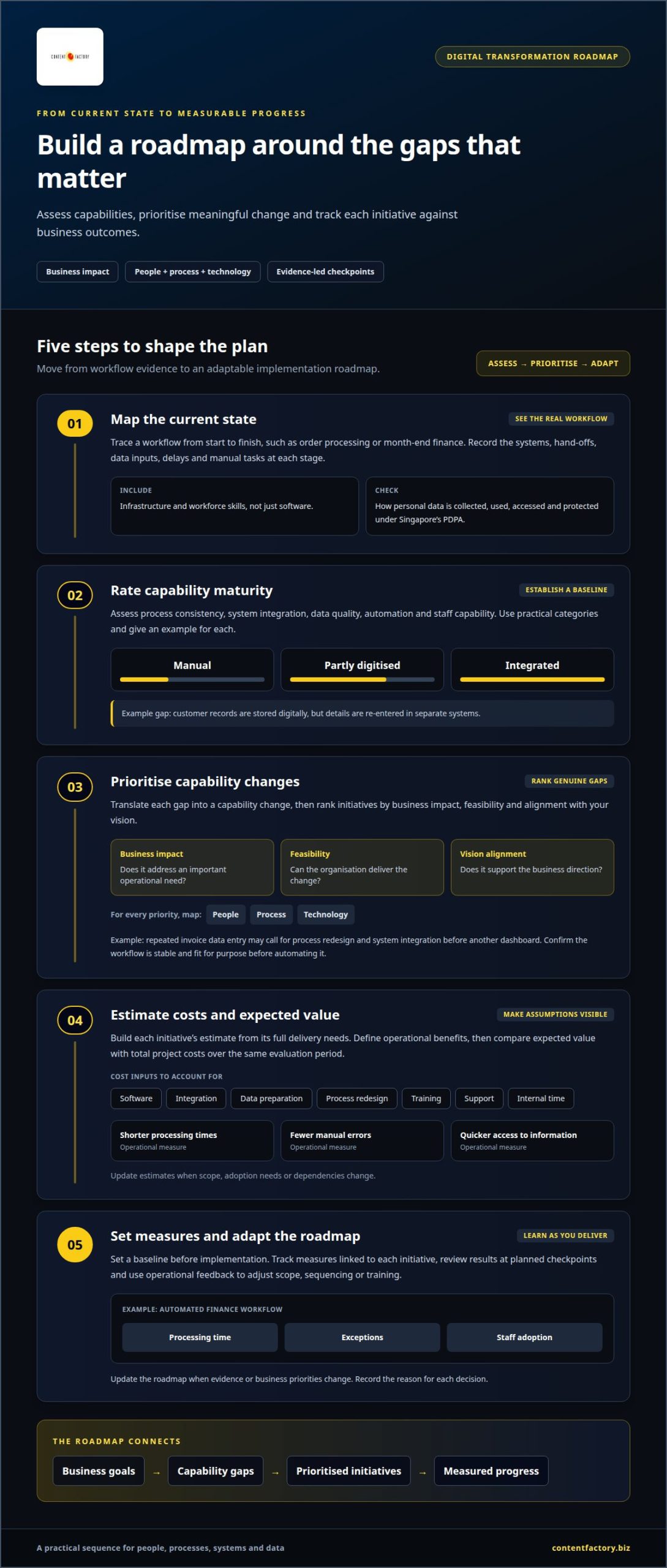
Start with a digital maturity assessment, then compare current capabilities with the business vision. This reveals which initiatives address genuine gaps and which add technology without improving outcomes.
Assess the Current State
Map a workflow from start to finish, such as order processing or month-end finance. Record the systems, hand-offs, data inputs, delays and manual tasks at each stage. Include infrastructure and workforce skills, not just software. Singapore’s Personal Data Protection Act (PDPA), overseen by the Personal Data Protection Commission (PDPC), governs personal data handling. Assess how each workflow collects, uses, accesses and protects personal data.
- Assess maturity across process consistency, system integration, data quality, automation and staff capability. Use practical categories such as “manual”, “partly digitised” and “integrated”, and provide an example for each. A team might store customer records digitally but re-enter the same details in separate systems. This identifies the constraint behind the symptom and establishes a baseline for deciding what needs to change.
Identify Capability Change Priorities
Translate each gap into a capability change, then rank initiatives by business impact, feasibility and alignment with your vision. If staff repeatedly re-key invoice data, process redesign and system integration may matter more than another dashboard. For each priority, record the people, process and technology changes involved. Do not automate a workflow until you have confirmed its steps are stable and fit for purpose.
Estimate Costs and ROI
Estimate costs by listing software, integration, data preparation, process redesign, training, support and internal time for each initiative. Define benefits using operational measures, such as shorter processing times, fewer manual errors or quicker access to information. Compare expected value with total project costs over the same evaluation period. Make assumptions visible and update estimates when scope, adoption needs or dependencies change.
- Set a baseline before implementation, then track measures linked to each initiative. For an automated finance workflow, monitor processing time, exceptions and staff adoption. Review results at planned checkpoints and use operational feedback to adjust scope, sequencing or training. Update the roadmap when evidence or business priorities change, and record the reason for each decision.
For example, a Singapore business can use this assessment to connect workflow changes, data handling and investment decisions in one prioritised plan.
Planning people, process and technology changes
Plan changes to people, processes and technology as connected workstreams. A new system will not improve efficiency if existing workflows and responsibilities stay the same.
Assess Change Readiness and Organisational Capability
Map the roles, skills and decision rights each initiative requires. For an automated invoice workflow, identify who handles exceptions, approves payments and maintains process data. Compare those responsibilities with current capabilities. Check whether managers can make time for staff to practise new tasks. Do not commit to delivery dates before operational teams understand the changes they must absorb.
Map People, Process, and Technology Changes
Create a change map that links staff tasks, process steps and supporting technologies. A finance system, for example, may change invoice submission, approval routines and how records move between teams. Identify dependencies such as process redesign, data migration, training and system integration. Assign an owner to each change. This helps prevent technical deployment from moving ahead while related work remains unresolved.
Compare Technologies and Operating Models
Compare technology options against the operating model each initiative requires. Cloud computing may support shared access across teams, while artificial intelligence may assist with document classification. Assess integration, scalability, security, ongoing support and cost-effectiveness alongside changes to daily work. When transitioning from experimental pilots to full-scale adoption, solutions like pronix.ai can help enterprises implement secure, production-ready AI capabilities. Consider whether decisions should sit centrally or with operational teams. Choose technologies that fit the defined need, not those with the longest feature list.
Engage People in Change
Involve affected employees early. Explain the vision, expected task changes and reasons for each initiative. Ask frontline teams to identify practical obstacles, such as duplicate entry or unclear approvals. Assign managers to share updates, collect feedback and address adoption barriers. If AI changes a task, explain how staff should review its output and handle exceptions. Ignoring these concerns can lead to workarounds and low adoption.
Disconnected teams, unclear ownership and weak adoption planning can undermine a transformation. Put training, responsibilities and adoption checkpoints alongside technical milestones. If you need help planning these workstreams, discuss change management and training for your roadmap.
Capability planning should cover people, processes and physical resources, not just technology. Before selecting initiatives, assess existing IT infrastructure, digital tools, processes and workforce skills. This gives you a basis for identifying gaps and matching changes to operational needs. Cloud computing and artificial intelligence are examples of technologies that may support transformation, but their suitability depends on that initial assessment.
Employee support is part of delivery, not an afterthought. McKinsey reported that employees whose organisations provide reskilling and tools such as dashboards and project plans are 3.8 times more likely to report a successful digital transformation. The Washington State Department of Health increased its change management maturity by 43% and trained 50 new change practitioners. These outcomes underline why capability development and practical support belong alongside system and process changes.
Defining objectives and aligning with customer needs
Set objectives based on customer needs, then connect each initiative to business strategy. The roadmap should link customer evidence to leadership decisions, delivery milestones and measures of progress.
Set Objectives Around Customer Needs
Identify a specific customer friction point, such as having to repeat information across service interactions. Define the intended outcome in measurable terms, such as reducing repeat data entry or making order status easier to access. Use customer feedback and service records to check that the objective addresses a real need. Do not treat a technology purchase as an objective. Name the customer or business result it must support.
Align Leaders and Stakeholders
Bring leaders and affected teams together to agree on priorities, ownership and decision rights. A finance leader may prioritise accurate reporting, while operations teams need fewer manual hand-offs. Resolve these tensions against the organisation’s strategy, rather than allowing each department to build a separate roadmap. Deloitte’s survey on digital transformation in healthcare found that 80% of respondents agreed leadership is a key accelerator.
Connect Roadmap Components to Strategy
For each initiative, record its strategic objective, customer outcome, accountable owner, dependencies, required capabilities and success measure. For example, a customer self-service initiative may depend on accurate product information and connected service records. These links make trade-offs visible: leaders can defer a lower-impact project when it competes for the same people or system capacity as a strategic priority.
- Sequence initiatives by dependency and readiness, not by the order in which teams proposed them. A timeline should show phases, accountable owners, resource needs, dependencies, milestones and review checkpoints. Set a baseline before delivery, then define the evidence needed at each milestone, such as a tested workflow or completed data migration. This makes the roadmap a delivery plan, not a list of aspirations.
The steps for creating a roadmap are to define customer-led objectives, align leadership, link initiatives to strategy, assign ownership and sequence delivery. Include milestones showing what must be completed, who is responsible and how progress will be assessed.
Data architecture and analytics
Reliable analytics depend on usable, connected data, not dashboards alone. Plan how information moves from source systems to decisions, and establish ownership, definitions and measures before expanding reporting.
- Trace the data needed for a business decision, such as resolving a delayed customer order. Identify its source, format, owner, update frequency and users at each stage. Note where staff copy information manually or encounter conflicting records. This map reveals the architecture challenge: a report cannot be trusted if its underlying data is incomplete, duplicated or disconnected.
- Define shared data terms before connecting systems. Finance and operations may use different meanings for “completed order” or “processing time”. Record agreed definitions, required fields and validation rules in a data dictionary. Assign a business owner to resolve exceptions. This creates consistent inputs for analytics and prevents teams from reporting different versions of the same measure.
- Design the flow between source systems, storage and reporting tools around real use cases. For example, a service team may need order status from an operations system alongside customer records. Compare integration options for scalability, ease of maintenance and cost-effectiveness. Avoid building a separate data store for every dashboard, as this can duplicate logic and create more reconciliation work.
- Set access controls and data-handling responsibilities as part of the architecture. Classify information by sensitivity, then define who can view, change and export each category. For example, an operational dashboard may show delivery status without displaying unnecessary personal details. Document retention, correction and incident processes with the relevant internal owners before new data flows go live.
- Choose analytics measures that directly support roadmap objectives. A workflow initiative might track processing time, exception volume and completion rates. Establish a baseline, identify the system of record for each measure and set a review schedule. Use dashboard trends alongside employee feedback: a metric can signal a problem, while frontline context helps explain its cause.
- Use each review to decide whether to continue, adjust or pause an initiative. If data quality falls after a system change, assign an owner, correct the source process and document the decision. Keep definitions and integrations under version control so teams can trace changes over time. This makes analytics a guide for changing course, not just a record of past activity.
A successful data foundation links trusted information to clear decisions. Build it around the business questions your teams need to answer.
Digital transformation strategy and business objectives
A digital transformation strategy connects technology choices to business goals. Use each initiative to solve a defined operational or customer problem, not merely to modernise systems.
- Translate business strategy into specific outcomes before selecting projects. If the goal is faster order fulfilment, identify the delay customers experience and the operational constraint causing it. Define the intended change in observable terms, such as fewer hand-offs or clearer order status. This gives leaders a basis for assessing whether a proposed initiative supports the organisation’s direction.
- Group projects by the business capability they strengthen, such as service delivery, finance operations or decision-making. A new system is a delivery mechanism, not a strategic outcome. For each initiative, record the capability it changes, the teams affected and its dependencies on other work. This helps leaders spot projects solving the same issue while another important capability remains unaddressed.
- Prioritise initiatives by impact, feasibility and strategic fit. For example, a customer portal may improve access to service information, but it depends on accurate records and clear ownership. Compare that dependency with a process change that could address the same customer problem sooner. Choose a sequence that balances expected business value with delivery effort and operational readiness.
- Give every initiative a business owner, delivery lead, decision path and progress measure. Use a concise business case to record the problem, expected outcome, key assumptions, dependencies and resource needs. Leaders can then compare proposals consistently and explain why some work starts first. Do not approve projects based on technical appeal alone. Require a clear link to a business goal.
- Review the strategy as operational evidence changes. At each planned checkpoint, compare actual progress with the initiative’s objective, then decide whether to continue, adjust scope or change the sequence. For example, if a redesigned approval process still leaves work waiting between teams, investigate the hand-off before adding another tool. Record decisions so teams understand what changed and why.
The practical takeaway: test each proposed initiative against a business goal, an accountable owner and a measure. This keeps the roadmap focused on progress, not project volume.
For help connecting strategic priorities to sequenced implementation, Contact Us.
How ContentFactory supports digital roadmap and implementation planning
ContentFactory helps turn digital priorities into a practical plan through Digital Roadmap and Implementation Planning. This is useful when projects lack clear sequencing, teams disagree on priorities, or technology decisions are moving ahead without a shared business direction.
The work starts by clarifying what your organisation needs to change and why. We examine your objectives, current capabilities, process constraints, technology environment and data requirements. This gives you a grounded view of the gaps between your intended direction and how the business operates today. The roadmap connects proposed initiatives to defined business outcomes, rather than treating each system purchase as a strategy.
Next, we shape the delivery sequence around dependencies and organisational capacity. A system integration, for example, may rely on consistent data definitions or changes to an existing workflow. These dependencies need to be visible before teams commit resources or delivery dates. The plan can set out actions, timelines, resource allocation, responsibilities, milestones and checkpoints, giving leaders and operational teams a shared reference during implementation.
Implementation planning also makes trade-offs explicit. If several initiatives need the same internal specialists, the roadmap can show where sequencing or scope needs adjustment. It can identify decision owners, implementation risks and measures for reviewing progress. This gives your leadership team a practical basis for deciding what should start first, what must happen beforehand and what evidence will guide the next decision.
A roadmap is not a fixed document that ignores new information. As priorities, operational needs or implementation findings change, the plan can be reviewed and updated. Regular checkpoints help your team record decisions, address emerging dependencies and keep the work connected to agreed objectives. The aim is a usable implementation plan, not an ambitious list without ownership or a route to delivery.
If your business is ready to move from priorities to a sequenced implementation plan, ContentFactory can help structure the work around your objectives and operating needs. Book a 30-minute discovery call to discuss your digital roadmap and the decisions you need to make.
Put the next decision on the calendar
A roadmap becomes useful when someone acts on its next decision. Choose an initiative and identify the decision currently blocking progress. It might be confirming an accountable owner, resolving a system dependency or agreeing what evidence will support the next phase. Record who will decide, what information they need and when the decision will be reviewed.
This creates a practical starting point for turning planning into delivery. It also gives your leadership team a clear way to address new constraints without losing sight of the intended direction. If you’re deciding how to create a digital transformation roadmap for your Singapore business, focus first on the decision that will make the next step possible.
ContentFactory can help you shape the roadmap and implementation plan around your business priorities. Discuss the decisions, dependencies and delivery questions your team needs to resolve with Contact Us.
Take the next step with a clear decision and a plan to move it forward.
Frequently Asked Questions
What Is a Digital Transformation Roadmap?
A digital transformation roadmap is a working framework for coordinating business change through digital capabilities. It helps leaders connect strategic choices to implementation decisions, dependencies and review points. To understand how to create a digital transformation roadmap, treat it as a management tool that evolves with delivery evidence, not a technology catalogue. Its value lies in making trade-offs visible and keeping decision-makers aligned as conditions change.
How do you assess digital maturity and identify transformation gaps?
Use evidence from different roles and functions, rather than relying on one executive’s view. Compare process records, system usage and staff observations, then discuss inconsistencies with the people doing the work. For example, a procedure may look standard on paper while different teams handle the same exception differently. A maturity assessment should capture that variation and distinguish isolated issues from capability gaps affecting the wider organisation.
How do you align a digital transformation roadmap with business goals?
Turn each business goal into a decision rule for approving and reviewing initiatives. If dependable service is a priority, favour work that reduces avoidable disruption over features with little operational relevance. Agree these rules with leaders who control resources and the teams affected by delivery. This gives decision-makers a consistent way to resolve competing requests when budgets, capacity or timing change.
How do you prioritise digital transformation initiatives by impact, cost, and feasibility?
Compare impact, cost and feasibility separately before making trade-offs. Include ongoing support and internal staff time in cost considerations, not just initial implementation. Assess feasibility against system dependencies, available expertise and disruption to daily operations. When deciding how to create a digital transformation roadmap, distinguish a reversible pilot from a large commitment that depends on several unresolved decisions. This exposes the assumptions behind each priority without relying on false precision.
How do you manage change, skills, and employee adoption during transformation?
Define what competent use looks like for each affected role, then provide practice using realistic work scenarios. A team handling digital approvals, for example, can rehearse routine cases and unusual exceptions before relying on the new workflow. Managers can reinforce expected behaviours during regular reviews. Track whether staff can complete key tasks correctly, rather than treating training attendance as evidence of readiness.

Article by
Mayuresh Godse
Mayuresh Godse is a Singapore Certified Management Consultant and Business Strategist specializing in Sustainability, ESG, AI-driven Digital Transformation, and business growth. Based in Singapore, he writes about Sustainability, Digital Innovation, Business Strategy, and Content Marketing for global audiences.
Disclaimer
This article is provided by ContentFactory for general information only and is not legal, tax, accounting or financial advice. Regulations and government scheme criteria change; grant eligibility and quantum are set by the relevant Singapore agencies and assessed case by case, with no outcome guaranteed. Verify current requirements before acting.