

You can start developing a corporate decarbonization roadmap before every emissions figure is complete. A credible roadmap needs a usable baseline, a clear view of the largest emissions sources and prioritised actions with named owners and measures of progress. It should also make data gaps visible so the team can improve the baseline over time.
If you’re unsure what to measure first or how to turn emissions data into operational decisions, don’t wait for perfect information. Document what you know, record the gaps and decide how to improve the information as better data becomes available.
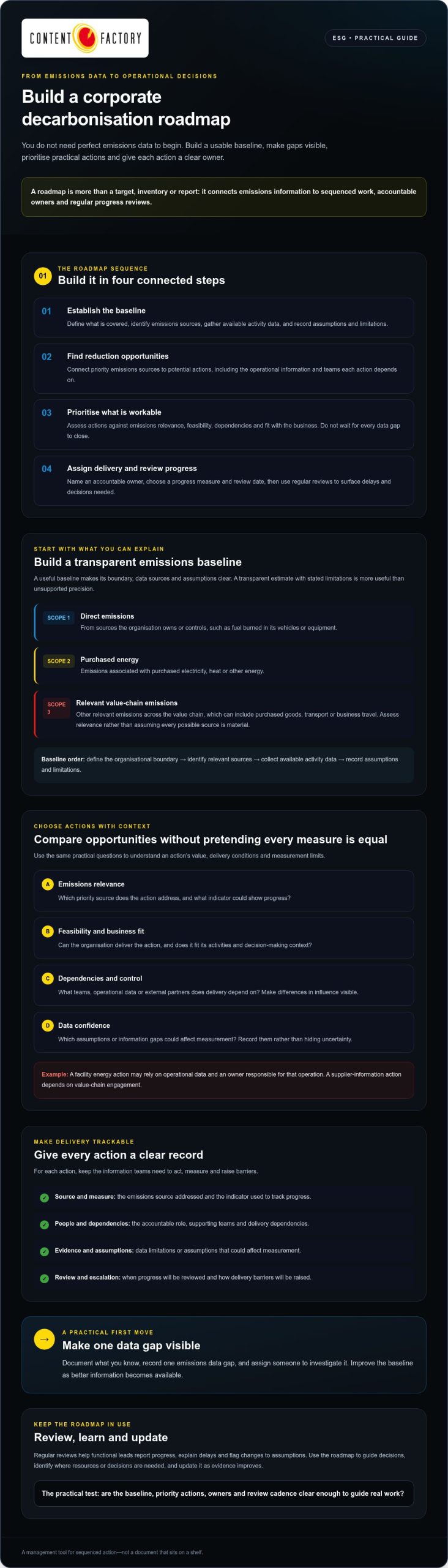
This guide sets out a practical sequence: establish your emissions baseline, identify reduction opportunities, assess them against business relevance, feasibility and emissions impact, then assign responsibility for delivery. It also explains how to monitor progress so the roadmap remains a management tool, not a document that sits on a shelf.
Key Takeaways
- Developing a corporate decarbonization roadmap means linking emissions information to sequenced actions, not simply setting a target or producing a report.
- Build a usable emissions baseline by defining boundaries, identifying sources, gathering available data and recording assumptions.
- Prioritise actions by emissions relevance, operational feasibility, dependencies and fit with your business, even when some data is incomplete.
- Assign each action an owner, a measure and a review date so functional leads can track delivery and raise barriers.
- Start by identifying one emissions data gap and assigning someone to investigate it.
What developing a corporate decarbonization roadmap requires
Developing a corporate decarbonization roadmap means turning emissions information into a sequenced plan of business actions. It links an emissions baseline and organisational boundary to priority sources, selected measures, accountable owners and a process for tracking progress. A target describes an intended direction. An emissions inventory measures a footprint. A sustainability report communicates information. A roadmap sets out the work required to move from current performance towards a defined outcome.
This distinction matters to leaders. Ambition alone doesn’t tell teams what to change, who must act or how to judge whether delivery is on track. A useful roadmap makes those decisions visible and connects climate priorities with operational responsibilities. It can draw on the broad idea of a decarbonization pathway, but it needs to reflect your organisation’s activities and decision-making context.
What belongs in a corporate decarbonization roadmap?
Start with a baseline that states which parts of the organisation it covers, which emissions sources are included and what data limitations remain. It may include Scope 1 emissions from sources your organisation owns or controls, Scope 2 emissions associated with purchased energy, and relevant Scope 3 emissions across the value chain. GHG emissions calculation and carbon accounting can help establish this starting point.
Next, connect priority sources to actions and delivery arrangements. For each action, record:
- The emissions source it addresses and the indicator you’ll use to track progress.
- The accountable role, supporting teams and any dependencies.
- Data limitations or assumptions that could affect measurement.
- When progress will be reviewed and how delivery barriers will be raised.
For example, an action involving energy use at a facility may depend on operational data and an owner responsible for that operation. An action involving supplier information depends on value-chain engagement. Show these differences in the roadmap rather than treating every measure as equally controllable.
Why a roadmap is more than a climate commitment
A commitment states intent; a roadmap translates intent into work. It helps leaders see which actions can proceed, which depend on other teams or external partners, and where decisions or resources are needed. Regular reviews give functional leads a way to report progress, explain delays and flag changes to assumptions.
Publishing a document does not, by itself, reduce emissions or ensure compliance. The practical test is whether your organisation uses it to guide decisions and updates it as evidence improves. Check that the baseline, priority actions, owners and review cadence are clear. If a data gap remains, name it and assign someone to investigate it.
Build the emissions baseline before choosing decarbonisation actions
Before selecting measures, establish what your organisation emits and what the available data can support. Build the baseline in sequence: define the organisational boundary, identify relevant emissions sources, collect activity data, then record assumptions and limitations. This creates a consistent starting point for comparing priorities and tracking change over time.
A baseline is useful only when its boundary, data sources and assumptions are clear. Unsupported precision can create false confidence. A transparent estimate, with its method and limitations recorded, gives decision-makers a better basis for action than a figure whose scope cannot be explained.
Set organisational boundaries and identify emissions sources
First, specify which operations and activities the assessment covers. Consider sites, business units and relevant activities, and document what falls outside the boundary. Use the GHG Protocol as a reference point, checking its current guidance and applicability to your organisation before choosing an approach.
Then map emissions sources by scope. Scope 1 covers direct emissions from sources the organisation owns or controls, such as fuel burned in its vehicles or equipment. Scope 2 covers emissions associated with purchased electricity, heat or other energy. Scope 3 covers other relevant value-chain emissions, which can include purchased goods, transport or business travel. Assess relevance rather than assuming every possible source is material. GHG emissions calculation and carbon accounting can help structure this work.
Manage incomplete or inconsistent emissions data
Not every source will have complete, directly measured data. Separate recorded activity data, such as fuel invoices or electricity bills, from estimates based on proxies or other available information. For each estimate, note the method, the period covered and why you used it. Don’t present estimates as measurements.
Keep a simple data register. Record the emissions source, data owner, source documents, known gaps, assumptions and next steps for improving the information. If teams use different periods or units, flag the inconsistency and agree how to handle it before comparing results. This creates a record the team can refine in the next review cycle.
Data gaps should affect sequencing, not stop planning. You can evaluate actions where the emissions source and operational opportunity are sufficiently understood, while assigning owners to investigate weaker data. As you develop a corporate decarbonization roadmap, this separation lets teams act on credible evidence without hiding uncertainty. To clarify a baseline gap, discuss your emissions data.
Prioritise decarbonisation actions without waiting for perfect data
Incomplete emissions data doesn’t make prioritisation impossible. It means distinguishing well-supported decisions from provisional ones, recording uncertainty and identifying what evidence is needed next. Developing a corporate decarbonization roadmap involves making informed choices and refining them as the baseline improves.
Use the same screening criteria for each proposed action. Consistent criteria make trade-offs easier to explain and help prevent an attractive idea from displacing measures that better fit your emissions profile or operations.
Compare actions using consistent decision criteria
Assess each action against four questions:
- Emissions relevance: Which source does it address, and what does your baseline suggest about its significance? State the assumptions behind any estimate.
- Operational feasibility: Can your team implement it within normal operating requirements? Consider the disruption and capability involved.
- Dependencies: Does it require a decision from another function, better data or cooperation from a supplier or other value-chain partner?
- Business fit: Does it align with planned operational changes and the organisation’s priorities?
For example, a change to equipment use may sit largely within your operational control, but it still needs an owner and evidence that the change is workable. An action that relies on supplier data or purchasing choices involves external dependencies. Treat these differently: an internally controlled action may be ready for assessment, while a supplier-dependent action may need more engagement and information before you can judge its likely impact.
If estimates are uncertain, record a confidence note and the reason. You might mark an action as “provisional pending activity data” rather than assign it a precise emissions benefit you can’t support. Then decide whether to proceed with a low-regret operational step, gather evidence first or revisit the action at the next review. This makes uncertainty a work item, not a reason for inaction.
Set targets that connect ambition with evidence
A long-term target gives your organisation direction. Nearer-term milestones turn that direction into steps teams can monitor, such as completing a data assessment, evaluating a proposed operational change or reviewing progress against an agreed indicator. Set milestones that reflect your baseline, decision cycle and ability to measure results.
The Science Based Targets initiative (SBTi) may be relevant if your organisation is considering its target-setting approach. Check current SBTi guidance and eligibility requirements before using it to shape targets. Don’t assume that one pathway applies to every organisation or is mandatory. Your roadmap should explain how each milestone relates to your chosen ambition, what evidence supports it and when you’ll reassess it.
To test your shortlist, document the evidence, owner, dependencies and next decision for each action. If you need help assessing emissions priorities, discuss your decarbonisation priorities.
Turn the decarbonisation roadmap into owned work and regular review
A roadmap becomes operational when every action has a responsible owner, a way to assess progress and a route for resolving barriers. Executive sponsorship keeps priorities visible and helps teams raise decisions that cross functions. Operational owners coordinate delivery, while named data owners maintain the information used to measure emissions and progress.
A useful progress measure links evidence to a specific action and the person accountable for delivery. That evidence might show an action’s status, a change in an agreed indicator or a data gap that still needs investigation. It should be clear enough for a functional lead to explain what has happened and what decision is needed next.
Assign accountability across the organisation
For each action, document the owner, supporting roles, dependencies, expected evidence, review date and escalation route. Make one person accountable for coordinating delivery, even if several teams contribute. For example, an operational change may need input from an operations lead and emissions data from another team. State who brings those inputs together and who resolves delays or conflicting priorities.
Check whether action owners and data stewards have the knowledge to maintain the process. If they need more capability, provide practical guidance on collecting source information, applying agreed methods and recording limitations. This reduces reliance on one individual and makes consistent updates easier when responsibilities change.
Monitor progress and revise the roadmap
Set a review cadence that fits your organisation’s operating cycle and the pace of each action. At each review, functional leads can report status, evidence, upcoming dependencies and barriers. Leadership can confirm decisions, adjust sequencing or assign follow-up work, rather than receiving a summary with no clear route to action.
Keep the review focused. Track:
- Action status against the agreed milestone and measure.
- Changes in data quality, outstanding gaps and revised assumptions.
- Dependencies or delivery barriers that need escalation.
- Updates needed to the baseline, action sequence or ownership.
When better activity data becomes available, update the baseline and check whether it changes an action’s priority or expected measure. Keep a short record of what changed, why it changed, who approved the revision and when it took effect. This gives leaders a traceable view of the roadmap’s development and helps teams avoid comparing inconsistent versions.
When developing a corporate decarbonization roadmap, treat review as part of delivery, not an administrative task. Use each cycle to resolve barriers, improve data and confirm the next decision. ContentFactory’s ESG capability building can help teams strengthen the skills needed to maintain the process.
Make corporate decarbonisation roadmap development practical for your business
A roadmap doesn’t need perfect data or a long list of initiatives to be useful. It needs a clear boundary, priorities your organisation can explain, owners who can act and a process for reviewing what changes. Use the checks below to identify what is ready and where your next decision should focus.
A practical starting checklist for leadership
Review the roadmap as a working document. Confirm which operations it covers and which emissions sources you understand. Then check whether each priority action has a responsible owner, a measure of progress and a next review point. Make unresolved assumptions and data gaps visible rather than treating them as settled facts.
Start with one specific gap. For example, if a relevant emissions source lacks reliable activity data, name the source, assign someone to investigate it and agree what evidence they should collect. This turns uncertainty into defined work.
- Is the organisational boundary clear?
- Which emissions sources have usable data, and which still need investigation?
- Are priority actions, owners and dependencies recorded?
- When will leadership review progress and unresolved issues?
This checklist supports internal discussion. It doesn’t replace source evidence, documented methods or appropriate emissions accounting.
When specialist ESG support can help
External support may help when your organisation needs a structured view of ESG readiness, consistent GHG emissions accounting or stronger internal capability to maintain the roadmap. These inputs can help establish a more usable baseline and clarify data limitations. They don’t guarantee a particular emissions outcome or ensure every action will be delivered.
ContentFactory supports SMEs and mid-market organisations with ESG readiness, GHG emissions calculation and carbon accounting. Its carbon accounting service can help organise Scope 1-3 information as an input to roadmap decisions. Digital ESG integration may also help organise and monitor ESG data, but it does not replace clear ownership or regular review.
As you continue developing a corporate decarbonization roadmap, keep the next step proportionate: choose one data gap, assign an owner and agree how the finding will inform a decision. ContentFactory can support your ESG readiness, emissions accounting and capability building as you put that process in place.
Put your decarbonisation roadmap into motion
Developing a corporate decarbonization roadmap is an ongoing management process, not a one-off reporting exercise. A clear baseline helps you understand where emissions arise, while documented assumptions support decisions as data improves. Prioritised actions, named owners and regular reviews turn that information into accountable work.
Your next step can be straightforward: choose one emissions data gap, assign an owner to investigate it and agree how the findings will inform your priorities. Build from evidence you can explain, then refine the roadmap as your organisation learns more.
ContentFactory supports ESG readiness and GHG emissions calculation and carbon accounting for organisations building practical sustainability plans. Its team can help connect emissions information with actions, ownership and progress tracking.
Start with the gap or decision that matters most to your organisation. A clear first step gives your team a practical basis for moving forward.
Frequently Asked Questions
What is a corporate decarbonisation roadmap?
A corporate decarbonisation roadmap is a sequenced plan that connects an organisation’s emissions baseline to practical actions, responsibilities and progress monitoring. It differs from a target, which states an intended outcome, and an emissions inventory, which measures emissions. A roadmap helps leaders decide what work should happen, who is accountable and how the organisation will review progress.
How do you develop a corporate decarbonisation roadmap?
Start by defining which parts of the organisation the assessment covers. Identify relevant emissions sources, collect available activity data and record assumptions or gaps. Then assess potential actions against emissions relevance, feasibility, dependencies and business fit. Assign each selected action an owner, a measure and a review point. Update the baseline and plan as data improves or delivery conditions change.
Do you need a complete emissions baseline before creating a roadmap?
No. You can begin planning with the data available, provided you distinguish measured information from estimates and document limitations. Identify which emissions sources are understood, where evidence is incomplete and who will investigate each gap. Avoid treating uncertain estimates as precise results. A clear record of assumptions lets you sequence work responsibly while improving the baseline, rather than delaying every decision until all data is complete.
What should a corporate decarbonisation roadmap include?
Include the organisational boundary, emissions baseline, priority sources and known data limitations. For each selected action, record its intended outcome or progress indicator, accountable owner, dependencies and next review point. The roadmap should also explain how teams will report progress and raise barriers. Keep the level of detail relevant to your operations, available evidence and decision-making process, and revise it when those conditions change.
How should a business prioritise decarbonisation actions?
Compare actions using consistent criteria: relevance to emissions sources, operational feasibility, dependencies and fit with business priorities. Separate actions largely under your organisation’s control from those that rely on suppliers or other value-chain partners. Record uncertainty and identify what evidence is needed before making a decision. No single action is best for every business; priorities depend on your emissions profile, operating context and capacity to deliver.
What is the difference between Scope 1, Scope 2 and Scope 3 emissions?
Scope 1 covers direct emissions from sources an organisation owns or controls, such as fuel burned in its vehicles or equipment. Scope 2 covers emissions associated with purchased energy, such as electricity. Scope 3 covers other relevant indirect emissions across the value chain, which may include purchased goods, transport or business travel. Relevant sources depend on the organisation’s activities and assessment boundary.
How often should a corporate decarbonisation roadmap be reviewed?
Set a review cadence that fits your organisation’s operating cycle and the pace of its actions. At each review, check action status, available evidence, data gaps, assumptions and delivery barriers. Revisit the baseline and priorities when better information or changed circumstances affect decisions. Record what changed, why it changed and who is responsible for follow-up so teams can work from a consistent plan.

Article by
Mayuresh Godse
Mayuresh Godse is a Singapore Certified Management Consultant and Business Strategist specializing in Sustainability, ESG, AI-driven Digital Transformation, and business growth. Based in Singapore, he writes about Sustainability, Digital Innovation, Business Strategy, and Content Marketing for global audiences.
Disclaimer
This article is provided by ContentFactory for general information only and is not legal, tax, accounting or financial advice. Regulations and government scheme criteria change; grant eligibility and quantum are set by the relevant Singapore agencies and assessed case by case, with no outcome guaranteed. Verify current requirements before acting.
One thing worth checking on the tool side: if the disclaimer is switched on globally, the grant caveat already written into your Global Writing Instructions will appear as well, so grant articles will carry the same point twice. Remove the required-disclaimer section from the instructions file if you enable this one.