

What if the technology you choose to speed up work ends up creating more of it? For Singapore SMEs, choosing a system is only one part of the decision. Unclear requirements, integration gaps and low staff adoption can turn a promising investment into disruption, particularly when the business case is difficult to measure. Effective digital technology implementation planning starts with the business problem, not a product shortlist.
You need a plan that connects technology choices to practical outcomes, with clear ownership and a realistic path to adoption. This guide shows you how to assess needs, compare implementation options and prioritise projects against business goals. It also covers integration, disruption and project risks, along with milestones and success measures to keep delivery on track. Finally, it explains what to consider when assessing implementation support and possible funding routes in Singapore, including grant advisory as a planning workstream. A project’s eligibility should always be checked rather than assumed. The result is a practical decision framework, not another technology shopping list.
Key Takeaways
- Distinguish a decision-ready implementation plan from a broad digital vision or vendor proposal by defining the business need, scope and governance.
- Use digital technology implementation planning to move from process evidence to prioritised requirements and delivery decisions, rather than selecting a platform first.
- Choose a pilot, phased rollout or broader deployment based on project complexity, dependencies, risk and user impact.
- Set baseline measures, accountable owners and acceptance criteria before launch so you can assess progress against the business case.
- Ask prospective advisers to clarify their deliverables and role, including whether they provide planning advice, implementation support, technology or software development.
Digital technology implementation planning: what the work should deliver
Digital technology implementation planning turns a defined business need into a scoped, resourced and governed technology change with clear owners and measures. It connects the problem to the work required to address it, helping decision-makers assess what should change, why it matters and how they will know whether the change is working.
A digital transformation vision can set direction, while a vendor proposal can describe a particular solution. Neither necessarily gives an SME enough information to make a decision or coordinate delivery. Digital transformation provides the broader context of organisational technology adoption. An implementation plan translates that ambition into a specific business case, requirements and executable steps.
What should an implementation plan include?
Start with the operational reality: what problem needs to be solved, which workflows are affected, who will use the technology and what business outcome should change? For example, if staff enter the same customer information into separate systems or struggle to connect sales and marketing data, teams often look to strategic growth agencies like Stratagon to align customer-centric workflows before choosing software. Defining what the improved process must achieve ensures you compare tools against clear requirements rather than vendor features.
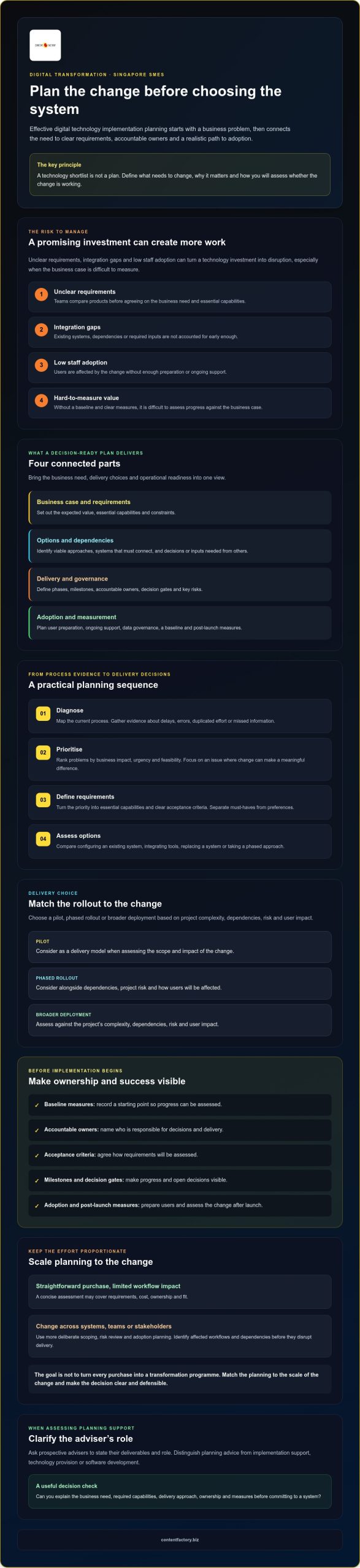
A decision-ready plan typically sets out:
- Business case and requirements: the expected value, essential capabilities and constraints.
- Options and dependencies: viable approaches, existing systems that must connect, and decisions or inputs needed from others.
- Delivery and governance: phases, milestones, accountable owners, decision gates and key risks.
- Adoption and measurement: user preparation, ongoing support, data governance, a baseline and post-launch measures.
These outputs make trade-offs visible. You can assess a preferred option against business needs and delivery implications, not just its feature list. Named owners and decision gates also help surface unresolved questions before implementation begins.
When does an SME need structured planning?
Use a structured approach when a change crosses systems, processes, teams or external stakeholders. Duplicated work, fragmented data, manual workarounds and unclear accountability can signal that the issue is broader than a single software purchase. Planning helps identify who and what will be affected before those dependencies disrupt delivery.
Keep the effort proportionate. A straightforward purchase with limited workflow impact may need only a concise assessment of requirements, cost, ownership and fit. A change involving connected systems or multiple teams needs more deliberate scoping, risk review and adoption planning. The goal is not to turn every purchase into a transformation programme. It is to match the planning to the scale of the change and make the decision clear and defensible.
Build the digital technology implementation plan around business value
Good digital technology implementation planning starts with evidence: how work happens now, where friction occurs and which business outcome needs to change. Don’t begin with a platform shortlist. A tool can look compelling and still fail to address the cause of delays, rework or poor visibility. Understanding broader industry frameworks can help frame the wider topic effectively. Your plan must translate your organisation’s needs into decisions that can be tested.
Use this sequence to keep the work focused:
- 1. Diagnose: Map the current process and gather evidence about delays, errors, duplicated effort or missed information.
- 2. Prioritise: Rank problems by business impact, urgency and feasibility. Choose an issue where change can make a meaningful difference.
- 3. Define requirements: Turn the priority into essential capabilities and clear acceptance criteria. Separate must-haves from preferences.
- 4. Assess options: Compare configuring an existing system, integrating tools, replacing a system or taking a phased approach.
- 5. Plan delivery: Identify owners, dependencies, internal capacity, risks, stages and decisions needed to proceed.
- 6. Measure: Set a baseline and define how the business will evaluate the outcome after launch.
Define success measures before implementation begins. Without a baseline, you won’t have a reliable way to judge whether the change delivered value. Choose measures that match the business case, such as processing time, error frequency or the amount of manual re-entry. Assign an accountable business owner to each priority so requirements and trade-offs stay connected to the people responsible for the outcome.
From business problem to requirements
Map the workflow step by step: who performs each task, what information they use, where hand-offs happen and where work stalls. Then express each priority as something that can be tested. For example, if approval status is difficult to track, specify which roles need visibility and what status information they need. Check constraints early, including legacy systems, data quality, security needs and staff capacity.
How to compare implementation options
Assess each approach against the same requirements, rather than a supplier’s preferred feature set. Consider integration effort, ongoing operating implications, reliance on a supplier, ability to scale and whether your team can support the change. Record assumptions and open questions separately from confirmed facts. A planning adviser can help structure these decisions through digital roadmap and implementation planning, without acting as a software developer or vendor.
Compare delivery models, risks, and readiness before committing
There’s no universally best rollout model. The right choice depends on the complexity of the change, how many people and systems it affects, and what could happen if something goes wrong. Use the planning process to make delivery choices and next steps clear, rather than producing a report that sits unused. A broader overview of digital change is available at wikipedia.org. Your delivery model should reflect your operational constraints.
| Approach | May suit a project when… | Key trade-off to assess |
|---|---|---|
| Pilot-first | The solution or workflow is unfamiliar, and a limited trial can test assumptions with a defined user group. | Learning is contained, but the pilot still needs success criteria and a decision on whether to proceed. |
| Phased rollout | Several teams, locations, processes or system dependencies need to change in a controlled sequence. | Each phase creates a review point, but teams may need to manage old and new ways of working in parallel. |
| Broader deployment | Requirements are stable, dependencies are understood, and the organisation can support a coordinated change. | It may reduce the period of split operations, but concentrates adoption and disruption risks. |
How to assess organisational readiness
Before committing, confirm that an executive sponsor can resolve trade-offs and that process owners can make day-to-day decisions. Check whether staff have capacity to participate alongside their usual work. Review system access, data quality, integration needs and who is responsible for information security. If the organisation lacks skills or change capacity, plan for training, external expertise from technical partners such as reisinformatica.com, or a more staged approach instead of assuming the team is ready.
Which implementation risks should the plan manage?
Track scope changes, uncertain integrations, adoption barriers, supplier reliance and potential operational disruption. For every material risk, name an owner, define a mitigation action and set a point to review it. For example, if a critical system connection hasn’t been confirmed, make validation a decision gate rather than treating an early estimate as settled. Set contingency assumptions only after project-specific discovery.
Planning is useful when it clarifies what must happen next, who has authority to act and how unresolved issues will be handled. ContentFactory provides advisory and implementation-planning support, not custom software development. To explore support with turning priorities into an executable roadmap, see digital roadmap and implementation planning.
Turn the plan into milestones, adoption, and measurable results
A selected technology option creates value only when people can use it reliably and the business can verify the result. Turn the decision into a delivery sequence with clear phases, dependencies, owners and acceptance criteria. For example, a phase might be complete only when a workflow has been tested, the accountable process owner has approved it and users are ready to proceed.
Set a baseline before launch, then choose target outcomes that match the business case. If the aim is to improve processing, track cycle time. If the goal is more reliable reporting, track data completeness or correction rates. Measure adoption alongside operational results, because a system can be technically live while staff continue using old workarounds.
Set governance and implementation checkpoints
Name an executive sponsor, project lead, process owners and the decision-makers authorised to approve scope changes. Keep checkpoints proportionate to the project, but make them explicit: requirements sign-off, testing, readiness, launch and post-launch review. At each gate, record the evidence needed to proceed, who makes the decision and how unresolved issues will be escalated.
Agree on a reporting cadence that fits the work. A small, contained change may need brief regular updates, while a project with multiple teams or system dependencies may need more structured reviews. The aim is not to add meetings. It is to make decisions, risks and blockers visible in time to act.
Plan adoption and benefits tracking
Communication, training, support and user feedback belong in the delivery plan, not in a last-minute launch checklist. Explain what will change, who is affected and where users can raise issues. After rollout, schedule feedback and assign someone to assess it and coordinate corrective action. Compare actual results with the baseline and intended outcomes, then decide whether to adjust the process, provide further support or revisit an assumption.
If the project supports emissions data collection or carbon-accounting workflows, connect system requirements to the information the business needs to capture and use. SME carbon accounting can help frame that work. If the scope also involves sustainability priorities and organisational readiness, see the ESG readiness assessment guidance.
Strong digital technology implementation planning links each milestone to an owner, an adoption action and a measure of business value. ContentFactory offers advisory support through digital roadmap and implementation planning.
Choose digital technology implementation planning support that can move work forward
The right adviser should help turn business priorities into documented decisions and an executable plan. Before engaging anyone, check that their role matches the work you need. An adviser may assess needs and compare options; another provider may manage delivery, supply technology or develop software. These are distinct responsibilities. Confirm who will own each one instead of assuming “implementation support” covers them all.
What to ask a planning adviser before engaging
Use the discussion to assess how the provider works, not just what they promise. Ask:
- Discovery: How will you understand our processes, users, business outcomes and constraints?
- Deliverables: What decisions and documents will we receive, such as requirements, options, risks, milestones and success measures?
- Stakeholder involvement: Which employees and decision-makers need to contribute, and how will their input shape the plan?
- Governance: How will ownership, scope changes, dependencies and unresolved issues be tracked?
- Handover: What will our team or delivery provider need to continue the work, and who is responsible for post-launch support?
Also clarify who selects vendors, makes technical decisions, manages internal change and leads delivery. Request a defined scope that includes assumptions, exclusions and how proposed changes will be assessed. If the provider’s role is advisory, confirm where its work ends and who takes responsibility for execution. Clear boundaries help prevent gaps between planning and delivery.
How ContentFactory can support the next step
For Singapore SMEs, digital technology implementation planning can create a structured bridge between business priorities and technology adoption. ContentFactory offers digital roadmap and implementation planning as an advisory service. Its role is not custom software development. The focus is helping businesses assess needs, evaluate implementation choices and shape a practical path forward.
Grant advisory may also be considered as a workstream when assessing a project. Don’t assume that a particular business or project qualifies for funding. Enterprise Singapore grant names, eligibility criteria and application requirements can change, so verify the current details for the specific project before relying on a funding route or building it into the plan.
To clarify the scope, decisions and next steps for your project, Discuss your digital implementation plan.
Turn your technology priorities into a plan you can deliver
Technology creates business value when it addresses a proven need, fits your organisation’s readiness and has clear measures of success. Strong digital technology implementation planning helps you compare options before committing, assign ownership and make adoption part of delivery rather than an afterthought.
Keep the plan practical: define the outcome, choose a delivery approach that matches the risks and set milestones your team can act on. You don’t need a sprawling transformation programme to make progress. You need sound decisions and a clear path from priority to execution.
ContentFactory provides digital roadmap and implementation planning as an advisory service for businesses in Singapore. Led by Mayuresh Godse, a Singapore Certified Management Consultant (SCMC), the firm can help connect business priorities with technology adoption and implementation decisions.
Discuss your digital implementation plan to clarify your project’s priorities and next steps.
Frequently Asked Questions
What is digital technology implementation planning?
Digital technology implementation planning is the process of turning a business need into a defined, resourced and governed technology change. It helps an SME clarify the problem, identify affected workflows and users, compare suitable options and decide how delivery will be managed. A practical plan also assigns owners, records dependencies and risks, and sets measures to assess whether the change achieves its intended business outcomes.
How do you create a digital technology implementation plan?
Start by documenting the business problem and how the current process works. Prioritise the outcome that matters most, then define testable requirements and constraints such as existing systems, data quality and staff capacity. Compare configuration, integration, replacement or staged delivery options against those requirements. Once you select an approach, assign owners, milestones and decision points, and set baseline measures and target outcomes before implementation begins.
What should a technology implementation plan include?
A technology implementation plan should include the business case, problem definition, affected processes and users, and essential requirements. It should also record options considered, system dependencies, delivery phases, accountabilities, decision gates and material risks. Include user communication, training, support and data governance where relevant. Finally, define acceptance criteria and how the business will measure performance after launch, so completion means more than simply switching on a new system.
How do SMEs choose the right technology implementation approach?
Choose an approach based on project complexity, dependencies, user impact and organisational readiness, not on a standard rule. A pilot can test uncertain requirements with a limited user group. A phased rollout may help coordinate change across connected processes or teams. Broader deployment may suit a well-understood change with stable requirements and sufficient capacity. Compare each option’s risks and operational implications before deciding.
How can a business reduce risk during technology implementation?
Reduce risk by identifying dependencies and assumptions early, assigning owners to material risks and reviewing them at planned decision points. Validate integrations and data requirements before relying on estimates. Involve affected users, plan training and support, and define how scope changes will be assessed. Set a baseline and acceptance criteria before launch, then collect feedback and monitor business measures so issues can be addressed rather than left unresolved.
Can Singapore SMEs use an Enterprise Development Grant for digital projects?
Some digital projects may be considered for Enterprise Singapore’s Enterprise Development Grant (EDG), but support depends on the project’s fit with current grant criteria and application requirements. Don’t assume your business or project qualifies. Check Enterprise Singapore’s latest official guidance for the relevant requirements before making funding part of the plan. Grant advisory can help assess a possible route, but it can’t guarantee eligibility, approval or funding.
Does digital implementation planning include custom software development?
Not necessarily. Planning can define business requirements, assess technology options and prepare a delivery roadmap without developing software. ContentFactory offers digital roadmap and implementation planning as an advisory service; it does not sell custom software development. If a project requires custom-built software, clarify who will scope, develop, test and maintain it, and how that work will connect to the wider implementation plan.
Discuss your digital implementation plan with ContentFactory to map your priorities into practical next steps.

Article by
Mayuresh Godse
Mayuresh Godse is a Singapore Certified Management Consultant and Business Strategist specializing in Sustainability, ESG, AI-driven Digital Transformation, and business growth. Based in Singapore, he writes about Sustainability, Digital Innovation, Business Strategy, and Content Marketing for global audiences.
Disclaimer
This article is provided by ContentFactory for general information only and is not legal, tax, accounting or financial advice. Regulations and government scheme criteria change; grant eligibility and quantum are set by the relevant Singapore agencies and assessed case by case, with no outcome guaranteed. Verify current requirements before acting.