

A digital roadmap should not be a catalogue of software your business might buy. It should show which operational problems to solve first, what needs to happen next and who is accountable. That distinction matters when projects compete for limited time and management attention.
Disconnected systems and manual workarounds can make change feel urgent, but urgency alone does not tell you where to start. The right sequence comes from understanding how work gets done, where friction slows teams down and which improvements support business priorities. Technology should follow the need, not lead it.
This article explains how to turn operational priorities into a workable plan. You will learn how to identify worthwhile problems, compare initiatives using clear criteria, sequence work around your organisation’s capacity and assign owners and measures of progress. It also covers how to plan for adoption so the roadmap does not stall after a decision is made.
Key Takeaways
- Start SME digital roadmap planning by identifying an operational problem worth solving, not by choosing a tool.
- Use workflow evidence, staff input and system observations to build a shortlist of initiatives grounded in how work gets done.
- Compare priorities consistently by business relevance, user impact, readiness, dependencies and available capacity.
- Phase initiatives around dependencies and decision points, with a sponsor, operational owner and affected users identified for each.
- Review progress and update assumptions when operational evidence or business priorities change.
Why SME digital roadmap planning should start with operational problems
Choosing a tool before agreeing on the problem can leave you with a new system and the same operational bottleneck. One team may want faster approvals, while another struggles to reconcile information across separate records. If the underlying need is unclear, it is difficult to judge which change matters most or whether technology is the right response.
Start by examining how work happens today. A digital roadmap is a sequenced plan that connects business needs to initiatives, accountable owners and evidence of progress. It guides decisions as you learn more. It is not a software catalogue or a fixed promise that every project will proceed as first imagined. Priorities and sequencing may change as new evidence emerges.
What should an SME digital roadmap achieve?
Each proposed initiative should address a specific operational need or business objective. The roadmap should show what must happen first, who is accountable and what evidence would indicate progress. That evidence might be a process record or a clearer view of how work moves between teams, rather than a target chosen without a reliable baseline.
Some initiatives become clear only after you examine the process. A roadmap helps you make choices in sequence without pretending every project is already known. ContentFactory’s digital roadmap and implementation planning connects operational needs to technology adoption and implementation decisions.
Which signs suggest your business needs a roadmap?
Repeated manual work, inconsistent information and avoidable hand-offs are prompts to investigate, not automatic reasons to buy software. If staff repeatedly re-enter the same information, trace where it comes from, who uses it and where errors or delays occur. The cause might be unclear responsibilities or a process gap, not just disconnected systems.
Ask leaders and staff where work regularly slows down, which errors recur and where decisions rely on information that is difficult to verify. Separate symptoms from root causes before recommending a digital change. “Approvals take too long” describes a symptom. Mapping the hand-offs may reveal that requests arrive incomplete or no one owns the decision.
Practical takeaway: Before discussing technology, write down recurring operational friction, where it occurs, who experiences it and what evidence supports it. That list gives your planning a clear starting point.
Build an SME digital roadmap from evidence, not assumptions
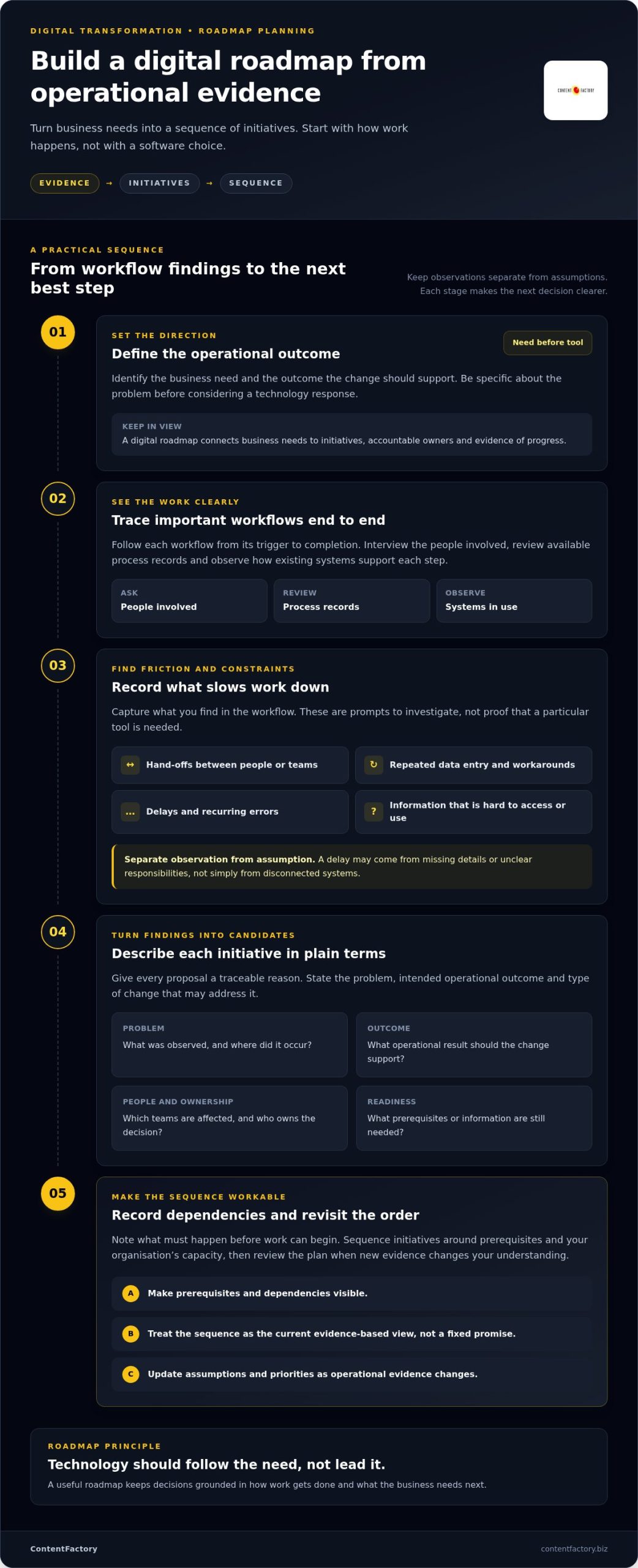
A roadmap becomes useful when each proposed change has a traceable reason. For SME digital roadmap planning, work through a clear sequence: define the outcomes your business needs, map the workflows involved, identify constraints, shortlist possible initiatives and record dependencies. This turns operational evidence into decisions instead of turning the latest technology idea into a project by default.
How do you assess current processes and systems?
Choose important workflows and follow each from its trigger to completion. Interview the people involved, review available process records and observe how existing systems support each step. Note hand-offs, repeated data entry, delays and workarounds as findings to investigate, not proof that a specific tool is needed. Record where information becomes difficult to access or use, and what the team does next.
For example, trace a purchase request from submission through review, ordering and receipt. Delays may occur because details are missing, responsibilities are unclear or information sits in separate records. Each points to a different possible response. Keep observations distinct from assumptions so a proposed change can be tested against what actually happens.
How do you turn findings into roadmap initiatives?
Translate each finding into a short initiative statement: the problem, the intended operational outcome and the type of change that may address it. Then note the affected teams, decision owner, prerequisites and information still needed. A useful evidence statement explains what was observed, where it occurred and why the issue merits consideration, without claiming benefits you have not established.
Before shortlisting, distinguish a pressing operational need from an appealing technology idea. Ask whether the initiative addresses a documented problem, whether its outcome matters to the business and what must be true before work can begin. A team may be keen to introduce automation, for example, but first need to clarify and stabilise the steps being automated.
Keep the roadmap alive. Treat its sequence as the current view of the best-supported work, not a one-off technology plan carved in stone. When interviews, process records or system observations change your understanding, revisit the assumptions, prerequisites and order of initiatives. This lets you ground later decisions without committing to every project at the outset.
ContentFactory’s Digital Transformation services connect operational discovery with roadmap and implementation planning. If you want support turning findings into sequenced initiatives, discuss your digital roadmap.
Prioritise roadmap initiatives by value, readiness and dependency
A long project list does not tell you what to do first. In SME digital roadmap planning, compare initiatives using the same questions, then make the trade-offs visible. A project can address a real problem but still be a poor immediate choice if ownership is unclear, prerequisites are missing or the team lacks capacity to adopt the change.
Which criteria help SMEs compare digital projects?
Assess each initiative against consistent prompts. Keep the discussion grounded in what you know, not invented scores or assumed returns.
- Business relevance: Which operational outcome does this support, and why does it matter now?
- User impact: Which teams will experience a change, and how will the business observe progress?
- Readiness: Is there a clear process owner, and are the workflow and information involved sufficiently understood?
- Dependencies: Does this rely on a process decision, information improvement or system change happening first?
- Capacity and adoption: Can the affected teams contribute to the work and learn the new way of working without disrupting essential operations?
These prompts expose trade-offs. One initiative may address a recurring operational issue but require substantial coordination. Another may be easier to begin, yet have limited relevance to current priorities. Neither should win by default. Record why you chose one, including what would need to change before a deferred initiative becomes viable.
How should you handle dependencies and competing priorities?
Sequence foundational work before changes that depend on it. If a system improvement relies on consistent information or a stable process, address those prerequisites first. Defer proposals whose purpose, ownership or dependencies remain unclear. Uncertainty is a reason to investigate, not to commit.
A roadmap decision gate is a review point where leaders check the evidence, readiness, dependencies and capacity before committing to the next initiative. At that point, proceed, revise the proposal or pause it. This gives decision-makers a practical way to manage risk without treating the roadmap as an unchangeable schedule.
Document the decision in plain language: why the initiative is prioritised, what must be in place, who owns the next decision and what evidence would prompt a review. That record helps leaders revisit the sequence when business conditions or operational knowledge change. For support connecting priorities with delivery, explore digital roadmap and implementation planning, or discuss your roadmap priorities.
Turn priorities into phased delivery with clear ownership
A prioritised initiative still needs a delivery structure. Group related work into phases that reflect dependencies, available capacity and decisions that must be made along the way. Do not assign arbitrary durations to make the plan look precise. Each phase should show what it is intended to achieve and what needs to be true before the next phase can proceed.
What belongs in each roadmap phase?
For every phase, record the intended outcome, scope, dependencies and decision required. Name a sponsor who can resolve business-level issues and an operational owner responsible for coordinating the work. Identify the teams whose tasks or hand-offs will change. Clear roles prevent a roadmap item from becoming a project that everyone supports in principle but no one drives.
Set out how progress will be reviewed using evidence that fits the initiative. This could include whether an agreed process is being followed or whether required information is available at the right point in a workflow. Define the evidence before delivery begins, but treat it as a basis for review, not a promise of a particular result.
How can SMEs support adoption and manage risk?
Involve affected users early enough to explain the proposed change and surface practical needs. Staff who carry out a process can identify where instructions, training or workflow adjustments may be required. Include communication, training and feedback in the implementation work itself. Do not leave them until after a system or process change is ready.
Before a phase proceeds, involve the relevant owners in considering data access, security responsibilities and system integration. Make responsibilities explicit, especially where teams rely on information from different systems or need to change how they handle it. The roadmap should show who needs to decide, rather than assume technical and operational details will resolve themselves.
After a phase, gather feedback from the people using the changed process and compare it with the assumptions behind the next phase. If those assumptions no longer hold, adjust the sequence, scope or support needed before moving forward. This keeps the plan responsive while maintaining accountability. Digital Roadmap and Implementation Planning connects sequencing with practical implementation. For support shaping phases, owners and adoption activities, Contact Us.
Keep the SME digital roadmap useful through review and implementation
A roadmap loses value when it is treated as a document to approve once and file away. Use it as a working decision tool: review what has progressed, what is blocked, whether dependencies still hold and whether the business has capacity for the next piece of work. The aim is not to keep changing direction. It is to keep decisions aligned with current evidence and priorities.
How often should you review the roadmap?
There is no universal review interval that fits every SME. Match reviews to meaningful project decisions, changes in operational needs and points where leaders must decide whether to proceed, revise or pause an initiative. At each review, check the intended outcome, accountable owner, dependencies, risks and the capacity of affected teams.
Record both the decision and its reason. If a dependency has changed or a priority has moved, note what new information prompted the adjustment. This gives teams a clear view of the current plan and prevents old assumptions from quietly shaping new work. It also helps leaders distinguish a deliberate change in sequence from a project that has lost momentum.
When can specialist roadmap support help?
Specialist support can help when priorities cross teams, dependencies are difficult to resolve or implementation choices require decisions about processes and systems together. In these situations, the roadmap needs to connect business needs with ownership and practical delivery, rather than leave operational teams to reconcile competing plans on their own.
ContentFactory supports digital roadmap and implementation planning, process redesign and technology adoption through senior-led planning focused on practical business decisions. This work helps clarify dependencies, sequence initiatives and connect planning with implementation needs. For related guidance on implementation decisions, see the Digital Roadmap and Implementation Planning service.
Keep the next review simple: confirm what has changed, what remains blocked, who owns the next decision and whether the planned sequence still fits the business’s capacity. If you need support reviewing or developing your roadmap, Contact Us.
Make your next digital decision count
A durable digital roadmap does not depend on predicting every future project. It gives your business a clear way to connect operational needs with initiatives, accountable owners and evidence of progress, then adjust the sequence as conditions change.
Strong SME digital roadmap planning starts with the problems affecting work today. Use evidence to compare priorities, check readiness and dependencies, then phase delivery around your team’s capacity. Clear ownership and regular decision points help keep implementation practical and adoption in view.
ContentFactory provides digital roadmap and implementation planning, supported by process redesign and technology adoption expertise. Mayuresh Godse is a Singapore Certified Management Consultant with 25+ years of consulting experience. To discuss a roadmap for your business, Book a Strategic Consultation (30-minute discovery call).
Frequently Asked Questions
What is an SME digital roadmap?
An SME digital roadmap is a sequenced plan for using process changes and technology to address business needs. It connects each initiative to an intended outcome, an accountable owner, relevant dependencies and evidence for reviewing progress. Unlike a software catalogue, it helps leaders decide what to tackle, what must come first and what needs further investigation before a commitment is made.
How do you create a digital roadmap for an SME?
Start by defining the operational outcomes your business needs, then examine how key workflows operate today. Use staff interviews, available process records and system observations to identify friction and constraints. Turn supported findings into initiatives, compare them against consistent criteria and sequence the work around dependencies and capacity. Assign owners and identify how progress will be reviewed. Treat the plan as revisable as your understanding changes.
What should a digital transformation roadmap include?
A useful roadmap records the business need, intended outcome, proposed initiative, sequence and dependencies. It should name a sponsor, an operational owner and the teams affected by each change. Include prerequisites, relevant decision points, adoption and training needs, and the evidence leaders will use to review progress. Keep assumptions visible so you can revisit them rather than treating every proposed project as a fixed commitment.
How do SMEs prioritise digital transformation projects?
Compare projects using the same practical questions: which business need does each address, who will be affected and how will progress be observed? Check readiness, dependencies and the capacity available to deliver and adopt the change. Prioritise initiatives that address evidenced needs and can be responsibly advanced. Defer proposals with unclear ownership or prerequisites, and record why each decision was made so it can be reviewed later.
How long does it take to create a digital roadmap?
There is no reliable universal timeframe. The work depends on how many workflows need examining, how readily people and process information are available, and how many teams or system dependencies must be considered. Keep the first planning effort focused on important operational needs rather than trying to document everything. The roadmap can develop as evidence improves, with priorities and sequencing reviewed at meaningful decision points.
Who should own a digital roadmap in a small business?
A senior sponsor should connect roadmap decisions to business priorities and resolve issues that cross teams. Each initiative also needs an operational owner who can coordinate the work and involve affected users. The sponsor and owner may work closely, but their responsibilities should be clear. In a small business, named accountability matters more than creating a large governance structure. Avoid leaving delivery as a shared responsibility with no decision-maker.
What is the difference between a digital strategy and a digital roadmap?
A digital strategy sets the direction: what the business needs to achieve through process change and technology, and why those outcomes matter. A digital roadmap translates that direction into a practical sequence of initiatives, owners, dependencies and review points. The strategy guides choices; the roadmap helps organise action. Both should adapt when operational evidence or business priorities change, rather than remain fixed after approval.

Article by
Mayuresh Godse
Mayuresh Godse is a Singapore Certified Management Consultant and Business Strategist specializing in Sustainability, ESG, AI-driven Digital Transformation, and business growth. Based in Singapore, he writes about Sustainability, Digital Innovation, Business Strategy, and Content Marketing for global audiences.
Disclaimer
This article is provided by ContentFactory for general information only and is not legal, tax, accounting or financial advice. Regulations and government scheme criteria change; grant eligibility and quantum are set by the relevant Singapore agencies and assessed case by case, with no outcome guaranteed. Verify current requirements before acting.