

What if the primary value of the Enterprise Development Grant isn’t the capital injection, but the structural transformation it forces your business to undergo? Many Singaporean leadership teams view the application process as a bureaucratic minefield of complex paperwork and rigid EnterpriseSG criteria. You’re likely feeling the pressure of rising operational costs and the daunting task of finding a certified management consultant who actually understands your industry vertical. It’s a common frustration to see growth stalled by the fear of project rejection or the weight of administrative requirements.
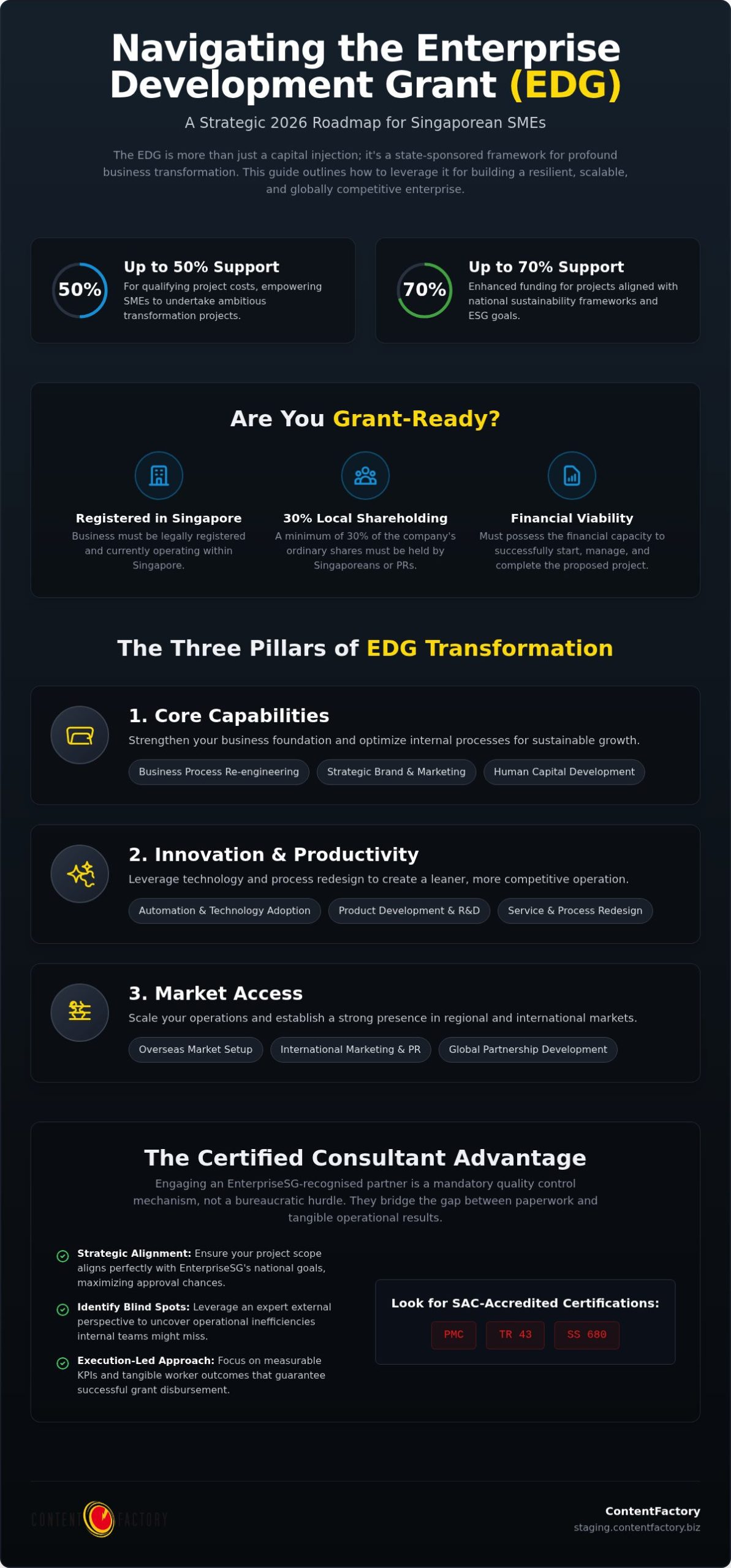
This guide moves beyond the paperwork. You’ll learn how a pragmatic, results-led enterprise development grant advisory approach scales your business by aligning grant capture with tangible operational efficiency. We’ll break down the 2026 funding frameworks, including the 50% support levels for SMEs and the enhanced 70% sustainability bonuses. This article provides a clear execution engine for regional expansion and ESG readiness that satisfies both government auditors and your own bottom line.
Key Takeaways
- Identify how to align your business strategy with EnterpriseSG’s three pillars to ensure your project is viewed as a high-impact transformation rather than a routine expense.
- Navigate the critical eligibility criteria, including the 30% local shareholding rule and specific financial viability benchmarks required for successful grant approval.
- Secure maximum ROI by engaging a certified enterprise development grant advisory partner who bridges the gap between complex grant paperwork and tangible operational execution.
- Discover how to integrate ESG capability building and materiality assessments into your project to future-proof your business for global supply chain compliance.
- Learn the methodical roadmap for scoping projects with measurable KPIs that guarantee successful grant disbursement and long-term scalability.
Navigating the Enterprise Development Grant (EDG) Landscape in 2026
In 2026, the Singapore business environment demands more than incremental growth. It requires a fundamental re-engineering of core processes to maintain a competitive edge. The Enterprise Development Grant (EDG), administered by Enterprise Singapore, serves as the primary catalyst for this transformation. Rather than treating the grant as a simple reimbursement for costs, high-performing SMEs use it to fund the high-level strategic shifts necessary to compete in a fragmented regional market. This isn’t about grant hunting; it’s about architecting a resilient, scalable enterprise through strategic business engineering.
To better understand how this grant facilitates growth and the specific pillars it supports, watch this helpful video:
The Strategic Shift: Why Grant Advisory Matters Now
The current landscape has shifted. Survival mode is no longer a viable strategy for mid-market firms looking to thrive in 2026. The EDG framework targets three specific pillars: Core Capabilities, Innovation and Productivity, and Market Access. Aligning your internal roadmap with these national goals ensures your project is viewed as a high-impact transformation rather than a routine expense. Professional enterprise development grant advisory bridges the gap between vision and execution. It ensures that every dollar spent on business strategy or financial management leads to a measurable increase in your competitive advantage. You aren’t just filling forms; you’re building a roadmap for regional ASEAN expansion.
The Value of a Certified Management Consultant
EnterpriseSG mandates that consultancy-related costs are only eligible if you engage a certified professional. This includes Practising Management Consultants (PMC) or those with SAC-accredited certifications like TR 43 or SS 680. This requirement isn’t just a regulatory hurdle; it’s a quality control mechanism designed to protect your investment. A certified consultant acts as a hands-on extension of your leadership team. They identify operational blind spots that internal teams often miss due to daily operational pressures.
There is a clear difference between a software vendor and a strategic advisory partner. A vendor sells a tool. A strategic advisor integrates that tool into your wider business process reengineering efforts. By leveraging expert enterprise development grant advisory, you ensure your project commits to meaningful worker outcomes, such as job redesign or training, which are essential for grant approval. This results-led approach prioritizes doing over reporting, ensuring your business emerges leaner and more profitable.
The Three Pillars of EDG: Architecting Your Transformation
Enterprise Singapore organizes the EDG into three distinct pillars to address different stages of business maturity. While the EDG Explained by SIRS provides a foundational overview, a pragmatic strategy integrates these pillars into a single execution engine. In 2026, successful SMEs don’t just pick one track in isolation; they understand how core strengths fuel innovation, which in turn facilitates regional expansion. Each pillar serves as a structural component in a larger roadmap toward market leadership.
Core Capabilities: Strengthening the Business Foundation
This pillar is the bedrock of your transformation. It includes Business Process Reengineering to eliminate operational waste and Strategic Brand and Marketing Development to drive B2B growth. By refining your internal workflows, you create the financial headroom needed for larger investments. Human Capital Development also falls under this category, ensuring your team possesses the technical literacy to manage sophisticated new systems. It’s about moving from a reactive stance to a proactive, strategy-led operation where every business function is synchronized for efficiency.
Innovation and Productivity: The Digital Growth Engine
Innovation isn’t just about R&D; it’s about measurable efficiency gains through technology. This track supports the implementation of high-intent SEO and content marketing frameworks that generate qualified B2B leads. It also funds the automation of manual workflows, significantly reducing reliance on labor-intensive processes. By developing proprietary technology or optimizing existing digital stacks, your firm achieves a level of scalability that manual operations can’t match. Professional enterprise development grant advisory ensures these digital tools solve specific business bottlenecks rather than adding unnecessary complexity to your stack.
Market Access: Scaling Beyond Singapore
For many Singaporean SMEs, the next growth frontier is the wider ASEAN region. This pillar supports market entry feasibility studies and complex financial modelling for business expansion to de-risk entry into new territories. A critical addition in 2026 is strategic advisory for cross-border ESG compliance. As global supply chains tighten their requirements, your regional growth must be backed by carbon accounting and materiality assessments. Integrating these elements early ensures your expansion is both profitable and resilient against shifting global regulations. If you’re ready to map these pillars to your specific growth targets, consider engaging a specialist for a preliminary assessment to identify your highest-ROI opportunities.
Eligibility and Financial Readiness: Are You Grant-Ready?
Securing the Enterprise Development Grant requires more than just a visionary project; it demands a rigorous audit of your corporate structure and balance sheet health. EnterpriseSG evaluates applications through a lens of risk management and national impact. Many firms fail because they underestimate the scrutiny applied to their financial standing or misinterpret equity rules. Strategic enterprise development grant advisory serves as a pre-submission audit, ensuring your business meets the baseline criteria before you commit resources to a full application.
The 30% Local Equity Requirement
The most fundamental barrier is the local shareholding rule. Your company must be registered and operating in Singapore with a minimum of 30% local equity. This is calculated based on ultimate individual ownership. If your firm is owned by another corporate entity, EnterpriseSG traces the shareholding through the parent companies to identify the individual Singaporean or Permanent Resident owners. Complex structures involving holding companies require careful mapping to prove eligibility. For non-SMEs, defined as companies exceeding S$100 million in annual turnover or employing more than 200 people, the funding cap drops to 30%. This makes the precision of your financial case even more critical for a positive ROI.
Demonstrating Financial Viability
Professional enterprise development grant advisory helps present these metrics effectively. By using financial modelling for business expansion to bridge the gap between current performance and future growth, an advisor proves to the government that the project is a sound investment. Common reasons for rejection include vague project scoping, lack of measurable KPIs, or projects that have already commenced before submission. You can’t claim for work started before the application date. Your business case must prove that the project is a bespoke transformation, not an off-the-shelf purchase. By defining clear worker outcomes and ensuring every budget line item is a qualifying cost, you significantly increase your approval probability. For firms that have previously faced rejection due to poor project scoping, investing in strategic grant application help can transform these administrative hurdles into catalysts for genuine business growth.
Successful grant acquisition begins months before you first log in to the Business Grants Portal (BGP). It starts with a rigorous scoping phase that translates abstract growth goals into a structured project plan. A pragmatic enterprise development grant advisory partner ensures that your proposal isn’t just fundable but also executable within your operational constraints. You must define clear, measurable KPIs that satisfy EnterpriseSG’s requirement for significant business transformation and committed worker outcomes. This alignment is critical; without it, even a technically eligible project risks rejection during the 8 to 12-week approval window.
Scoping for Success: KPIs and Outcomes
Scoping isn’t a formality; it’s a blueprint for your business’s future state. You need to categorize your budget into qualifying costs, which primarily include third-party consultancy fees, software and equipment, and incremental internal manpower costs. It’s vital to set a realistic timeline, as most EDG projects are expected to reach completion within 12 to 18 months. Every milestone you define must link back to commercial growth. If you’re implementing a new financial modelling system, the KPI shouldn’t just be “system installed,” it should be “20% reduction in monthly closing time” or “real-time visibility into regional cash flow.” This focus on outcomes demonstrates to auditors that the project has a clear, high-impact ROI.
Engaging the right consultant is a mandatory step in this roadmap. You must verify that your advisor holds the necessary certifications, such as a Practising Management Consultant (PMC) designation. Professional enterprise development grant advisory streamlines the submission process by identifying potential red flags in your documentation before they reach the government officer. This proactive approach minimizes back-and-forth clarifications and accelerates the move from application to approval.
Managing the Claims and Audit Phase
The work doesn’t end once you receive the Letter of Offer. The claims process is where many SMEs struggle due to poor documentation management. To ensure successful disbursement, you must maintain meticulous records of all project-related expenditures, including signed contracts, invoices, and proof of payment. If your project undergoes variations, such as a shift in software vendors or a slight timeline delay, you must manage these changes through the BGP promptly. Failure to document these shifts can lead to complications during the final audit. Your project must meet all stated KPIs before the final claim is processed, making the initial scoping phase even more critical for back-end success.
ContentFactory: Your Results-Led EDG Advisory Partner
ContentFactory operates as a high-intellect partner for firms that have outgrown generic consulting. Led by a Singapore Certified Management Consultant (SCMC), we provide an enterprise development grant advisory service that prioritizes execution over mere reporting. We function as a hands-on extension of your leadership team. This ensures that strategic grant acquisition translates into tangible operational resilience and localized expertise. We understand the specific pressures of the mid-market sector and provide the structural change necessary for scalability in the regional ASEAN market.
ESG and Sustainability Integration
Sustainability is no longer a peripheral concern for Singaporean suppliers; it’s a prerequisite for participation in global supply chains. We integrate ESG Readiness and Materiality Assessments directly into your growth roadmap. By utilizing EDG-funded workshops, we help your team build internal ESG capabilities, moving beyond compliance to create a genuine competitive advantage. Our approach includes Carbon Accounting (Scope 1, 3) and Multi-Framework Reporting to ensure your business remains resilient against shifting global regulations. You can explore our ESG Readiness Assessment Singapore to benchmark your current standing against 2026 standards and identify critical material risks.
Performance-Driven Digital Growth
High-intent commercial growth requires a synchronization of technology and strategy. Our advisory doesn’t just suggest tools; it builds performance-driven digital engines. We optimize B2B lead generation through high-intent SEO and content marketing advisory, ensuring your digital presence captures qualified demand rather than just traffic. As a specialized B2B Lead Generation Agency Singapore, we align your digital transformation with the EDG Innovation and Productivity pillar for maximum ROI. This integration ensures that your digital advertising and lead generation efforts are backed by robust Business Process Reengineering.
Our methodology bridges the gap between vision and execution. Whether you’re pursuing regional expansion or complex financial modelling, our enterprise development grant advisory ensures your project meets EnterpriseSG’s standards while delivering measurable efficiency gains. We focus on the “doing” to ensure your business emerges leaner and more profitable. We act as the execution engine that drives your transformation forward.
Architecting Your 2026 Transformation Strategy
Navigating the Enterprise Development Grant requires a shift from administrative compliance to high-level strategic engineering. Successful SMEs in 2026 recognize that the grant is a catalyst for deep-seated change; whether through Business Process Reengineering or regional ASEAN expansion. By prioritizing financial readiness and aligning your project with national innovation goals, you secure more than just funding; you secure a sustainable competitive advantage. Professional enterprise development grant advisory ensures that your transformation remains grounded in measurable efficiency gains and robust ESG compliance.
ContentFactory serves as your execution engine, led by Singapore Certified Management Consultants who specialize in ESG and B2B digital transformation. We move beyond theoretical reporting to deliver hands-on, pragmatic results that scale your operations. Your business deserves a partner that understands the intricacies of the local ecosystem and the specific pressures of the mid-market sector. We provide the expert-led stability needed to navigate complex government frameworks while driving high-intent commercial growth.
The roadmap to scalability is complex, but with the right strategic framework, your firm is well-positioned to lead in the regional market. It’s time to turn your vision for growth into a reality.
Frequently Asked Questions
What is the maximum support level for the Enterprise Development Grant in 2026?
In 2026, the standard maximum support level for SMEs is 50% of qualifying costs. Non-SMEs are eligible for up to 30% support. These rates apply to projects across the three pillars: Core Capabilities, Innovation and Productivity, and Market Access. While enhanced support for sustainability projects reached 70% in previous cycles, standard 2026 applications focus on these baseline rates unless new budgetary enhancements are announced by EnterpriseSG.
Can I apply for multiple EDG projects at the same time?
You typically cannot run multiple EDG projects simultaneously within the same pillar. EnterpriseSG requires companies to demonstrate successful completion and outcome delivery of one project before approving another. However, if your business demonstrates sufficient financial and manpower capacity to handle distinct transformations in different pillars, concurrent applications might be considered. Most firms find that a sequential approach, guided by professional enterprise development grant advisory, ensures better resource allocation and higher KPI achievement.
How long does the EDG application approval process typically take?
The application approval process typically takes between 8 and 12 weeks from the date of submission in the Business Grants Portal. This timeline depends on the complexity of your project scope and the clarity of your submitted documentation. Delays often occur if EnterpriseSG requires additional clarifications regarding your financial viability or project KPIs. Engaging a certified consultant helps streamline this window by ensuring all technical requirements are met before the initial submission.
Is my company eligible if we have less than 30% local shareholding?
Your company is not eligible for the EDG if local shareholding falls below the 30% threshold. This is a non-negotiable criterion verified through ultimate individual ownership. EnterpriseSG traces shareholding through corporate layers to ensure that at least 30% of the equity is held by Singaporeans or Permanent Residents. If your structure is complex, an advisor can help map your equity to confirm eligibility before you invest time in the application process.
What are the qualifying costs covered under the EDG?
Qualifying costs primarily include third-party consultancy fees, software and equipment purchases, and incremental internal manpower costs. Internal manpower claims are limited to staff dedicated to the project’s execution. It’s important to note that the grant excludes recurring operating expenses like rent, taxes, or basic marketing implementation like SEO execution. The focus remains on high-impact transformation and capability building rather than subsidizing daily business operations or off-the-shelf software solutions.
Do I need to pay the consultant upfront before the grant is disbursed?
You must pay your consultants and vendors according to your agreed contract before claiming the grant. The EDG operates strictly on a reimbursement basis. Once your project reaches its milestones and passes the final audit, you submit a claim through the Business Grants Portal for disbursement. This means your business must maintain sufficient cash flow to fund the project’s entire duration, which typically spans 12 to 18 months, before receiving the government’s co-funding.
What happens if my EDG project fails to meet its KPIs?
If your project fails to meet its committed KPIs, EnterpriseSG may reduce the final grant disbursement or reject the claim entirely. The grant is contingent upon achieving the “worker outcomes” and business transformation goals stated in your Letter of Offer. If unforeseen market shifts affect your project, you must communicate with your case officer early to manage variations. A results-led enterprise development grant advisory partner focuses on setting realistic, measurable targets to mitigate this risk.
How does the ESG readiness assessment fit into an EDG application?
An ESG readiness assessment integrates into the Core Capabilities pillar under the Strategic Brand and Marketing Development or Business Strategy tracks. As global supply chains demand higher transparency, using the EDG to fund materiality assessments and carbon accounting is a strategic move for 2026. This assessment identifies structural risks and opportunities, allowing your business to build the necessary internal capabilities to meet international sustainability frameworks while leveraging government co-funding for the transition.

Article by
Mayuresh Godse
Mayuresh Godse is a Singapore Certified Management Consultant and Business Strategist specializing in Sustainability, ESG, AI-driven Digital Transformation, and business growth. Based in Singapore, he writes about Sustainability, Digital Innovation, Business Strategy, and Content Marketing for global audiences.
Disclaimer
This article is provided by ContentFactory for general information only and is not legal, tax, accounting or financial advice. Regulations and government scheme criteria change; grant eligibility and quantum are set by the relevant Singapore agencies and assessed case by case, with no outcome guaranteed. Verify current requirements before acting.
One thing worth checking on the tool side: if the disclaimer is switched on globally, the grant caveat already written into your Global Writing Instructions will appear as well, so grant articles will carry the same point twice. Remove the required-disclaimer section from the instructions file if you enable this one.