

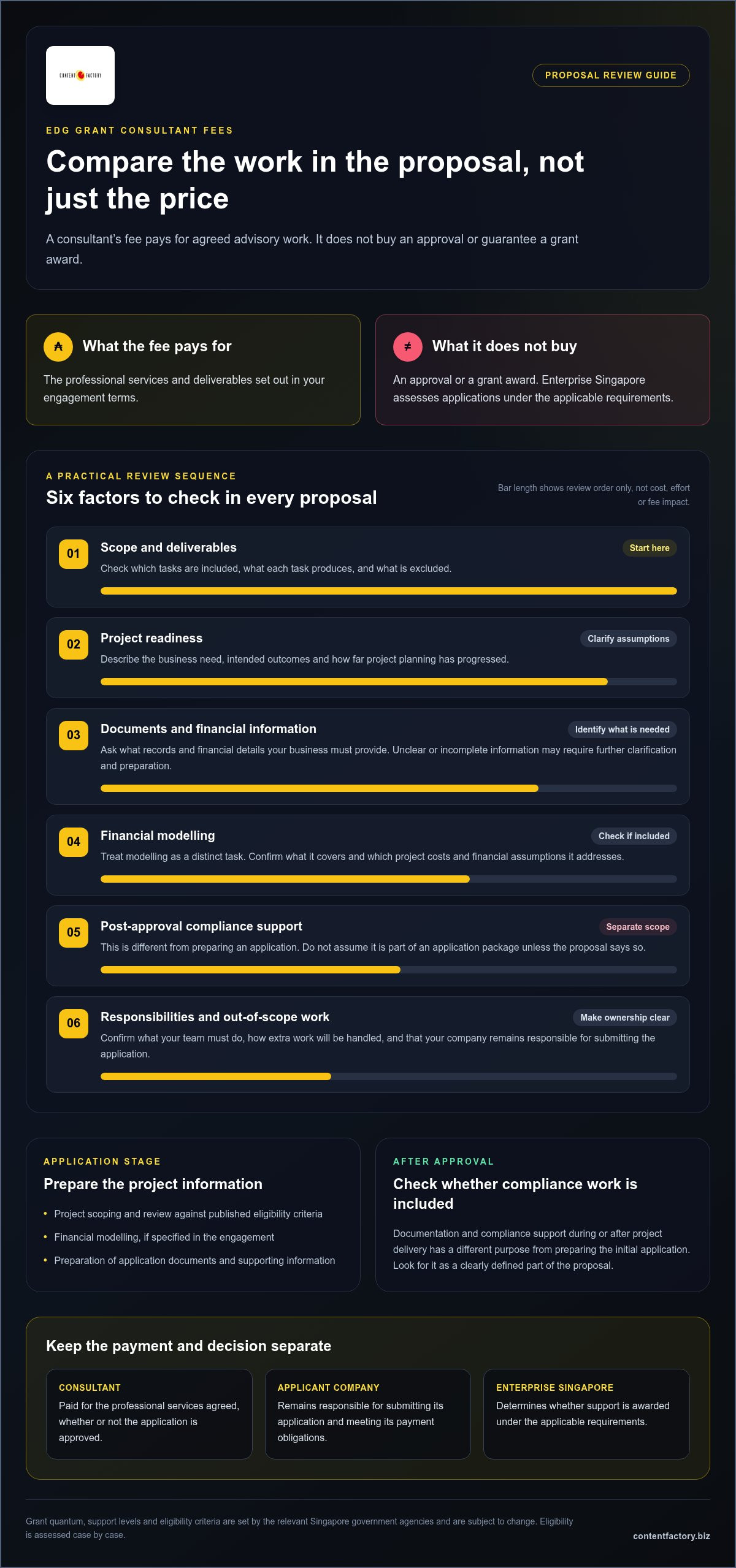
EDG grant consultant fees pay for agreed advisory work, not an upfront grant payment or a guaranteed funding outcome. Your business pays the consultant under the engagement terms, then claims any eligible support through the applicable scheme. When assessing a proposal, focus on the work it covers, not just the price.
If you’re comparing advisers, look for clarity on scope, deliverables and what happens after an application is submitted. Support may include project scoping, financial modelling and preparing application documents. Post-approval compliance support is a separate part of the process unless the proposal includes it. The applicant company remains responsible for submitting its application.
This guide explains what fees may cover, how to compare proposals and what to clarify before engaging an adviser. It also considers the scheme transition: new applications under EDG closed on 29 September 2026, and the EDGE Grant framework began on 30 September. Applications submitted before the cut-off continue under the original rules. Establish which framework applies to your project before deciding what advisory support you need.
Key Takeaways
- Assess EDG grant consultant fees against defined advisory work, not promises about an approval outcome.
- Compare proposals by checking whether project scoping, financial modelling and application documentation are listed as specific deliverables.
- Clarify what may affect the scope, including your project’s readiness and the documents it needs.
- Separate application-stage work from post-approval compliance support so you know what each part of the engagement covers.
- Before discussing a proposal, outline the business need, intended outcomes and current project readiness, then gather relevant documents and financial information.
What EDG grant consultant fees pay for, and what they do not
EDG grant consultant fees cover the professional work agreed in an engagement. They do not buy an approval or a grant award. Eligible project expenditure is spending that meets the scheme’s requirements. Enterprise Singapore determines whether support is awarded, in line with the applicable terms.
These amounts are related, but they are not interchangeable. A consultant’s fee may form part of qualifying project costs where the scheme allows it, but not every fee or service is eligible. Under the EDG, support is disbursed on a reimbursement basis after the project is completed and paid for. Your business should understand its payment obligations and how proposed costs are treated under the relevant requirements. Enterprise Singapore’s EDG guidance sets out the scheme requirements.
Which work may sit within an EDG advisory engagement?
An engagement can cover distinct tasks, including scoping the project, reviewing it against published eligibility criteria, preparing financial modelling and developing application documents. A clear proposal identifies each included task, the deliverables and the responsibilities that remain with your team. ContentFactory provides strategic grant advisory and financial modelling to support this work.
The work required depends on the project’s starting point. A clear business need and organised records may require less preparation than a project with unresolved scope, costs or supporting documents. The proposal should state its assumptions and avoid bundling every possible task into a vague promise of “grant assistance”.
Why a consultant fee is not an approval fee
You pay for the agreed professional services whether or not an application is approved. Enterprise Singapore assesses applications under its own requirements and processes. A consultant can help prepare and organise information, but cannot determine the agency’s decision or guarantee that funding will be awarded.
A consultant’s fee pays for defined advisory work. Only the agency decides whether to provide grant support.
Check the division of responsibilities when reviewing a proposal. Does it cover advice and document preparation, or other specified work as well? The applicant company remains responsible for submitting its application through the required process. A clear division helps you understand what the fee covers and what your business must do.
What can change EDG grant consultant fees? Assess the work, not a headline
Proposals can use similar labels while covering different tasks. One may focus on reviewing project fit and preparing application documents. Another may also include financial modelling, coordination of supporting information or defined post-approval compliance support. To assess EDG grant consultant fees, compare the written tasks and deliverables, not just the headline description or fee structure.
How project readiness and documentation affect scope
Start with a clear account of the project: what your business plans to do, why it needs the project, its intended outcomes and how far planning has progressed. Relevant project records and financial information help an adviser understand the scope and identify what needs explanation.
Incomplete, inconsistent or unclear records may require more clarification and preparation. That can change the work involved, but it does not justify assuming a standard number of extra hours or a fixed fee increase. The proposal should state its assumptions, identify what information your business must provide and explain how work outside the agreed scope will be handled.
Enterprise Singapore’s Enterprise Development Grant (EDG) guidance explains the scheme’s requirements, including how qualifying costs are treated. A consultant can help organise and present project information, but the agency determines eligibility and support under its published requirements.
How application and post-approval support differ
Application-stage advisory covers preparing the project proposal and supporting information. Financial modelling is a distinct task that sets out project costs and financial assumptions. Check whether it is included, what it covers and what information your business must supply.
Post-approval work has a different purpose. It may involve documentation and compliance support during or after project delivery, rather than preparing the initial application. ContentFactory offers post-approval audit and compliance support as a separately defined service. Do not assume it is included in an application package unless the proposal says so.
ContentFactory’s strategic grant advisory and financial modelling can be scoped around the work your project needs. Before comparing proposals, mark each task as included, excluded or dependent on further information. To discuss how the advisory scope could be set out for your project, contact ContentFactory about grant advisory.
How to compare EDG grant consultant proposals without chasing promises
A useful proposal makes clear what you are paying for and what remains your responsibility. Compare each written scope, deliverables, assumptions and exclusions. Do not assume that proposals labelled “application support” cover the same work. One may cover document preparation only, while another specifies project scoping and financial modelling.
Questions a clear proposal should answer
Use these questions to check whether each proposal gives you a sound basis for comparison:
- What work will be completed? Look for specific tasks, such as reviewing project information, preparing application documents or developing financial modelling.
- What will your business receive? Identify the promised outputs, such as completed documents, a financial model or defined advisory recommendations.
- What must you provide or decide? The proposal should clarify your responsibilities, including supplying project information and making decisions needed to complete the work.
- What is excluded? Check whether revisions, additional documents or post-approval support fall outside the agreed scope or are offered separately.
Compare equivalent work. If one proposal includes modelling and another excludes it, their headline fees do not represent the same scope. The same applies if one describes post-approval compliance support and another says nothing about work after submission.
Warning signs in fee and approval claims
Be cautious of wording that promises approval, implies influence over Enterprise Singapore’s assessment or assures a specific funding amount. A consultant can support application preparation, but the agency makes its decision under the applicable requirements. Support with a submission is not control over that decision.
A credible proposal describes the work and its limits, not a promised decision. Check whether each claim refers to a deliverable the consultant controls or an outcome determined by the agency. A promised funding amount is no substitute for a clear scope.
The lowest headline fee does not automatically represent the best value. It may reflect a narrower scope, fewer deliverables or exclusions that matter to your project. Assess EDG grant consultant fees against the specified work, the responsibilities assigned to your business and any separate support you may need later. Ask for unclear assumptions to be stated in writing before agreeing.
ContentFactory’s grant advisory and financial modelling can be scoped around defined project work and documentation. To discuss the support your project may need, contact ContentFactory about grant advisory.
What to prepare before discussing EDG grant consultant fees
Start the discussion with the project, not the fee. Explain what your business plans to do, the business need behind it, the intended outcomes and how ready the project is to proceed. This gives an adviser a practical basis for discussing the work and identifying information that is still needed.
Information to organise for an initial discussion
Gather the information you already have. You do not need a complete document pack for an initial conversation, but relevant records make the discussion more specific. Organise:
- A short project summary, including the business problem it is intended to address.
- Available project plans, proposed activities and intended outcomes.
- Cost assumptions and relevant financial information that explain the project’s scope.
- Existing business records or supporting documents relevant to the proposed work.
- The name of the person who will coordinate internal information and decisions.
Note what is settled and what remains uncertain. You may have identified the intended outcome but still be refining the project scope or cost assumptions. Being clear about those gaps helps distinguish advisory work you need from information your team can provide.
Before engaging a consultant, get the responsibilities, deliverables, assumptions and exclusions in writing. Specify whether the engagement covers financial modelling, application documentation and application-stage support. Record separately whether post-approval compliance support is included or requires a separate engagement. Clear terms help you assess the proposal against your project rather than relying on broad labels.
Interpret grant support figures against the applicable scheme
Check which scheme and application rules apply before using a support figure in your project planning. Enterprise Singapore’s EDG application window for new applications ended on 29 September 2026. The EDGE Grant framework began on 30 September 2026, so the former EDG rates should not be treated as current figures for new applications.
For applications under EDGE, Enterprise Singapore states support of up to 70% for eligible SMEs and up to 50% for eligible non-SMEs, with the support level varying by activity. These are scheme support levels, not consultant fee discounts or guaranteed reimbursements. Applications submitted before the EDG cut-off continue under the original rules. Check the relevant Enterprise Singapore guidance for the scheme that applies to your project, and consider this Singapore grants guide for broader context.
Preparing this information gives you a stronger basis for discussing scope without treating funding as assured. To discuss your project and the advisory work it may require, Contact Us.
Choose EDG grant advisory for clear scope and accountable support
The right advisory engagement is defined by the work, not a promise about funding. Before comparing EDG grant consultant fees, check that the proposal sets out deliverables, your business’s responsibilities, exclusions and whether compliance support after approval is included. These details help you assess the engagement and understand where your team must remain involved.
What ContentFactory can support across the grant process
ContentFactory provides strategic grant advisory and financial modelling to help businesses structure project information, document assumptions and prepare for the applicable grant process. The scope centres on defined advisory work. It does not determine the agency’s decision or guarantee a grant award.
Application-stage preparation and post-approval work serve different purposes. If your project needs compliance support after approval, treat it as a separate scope with its own responsibilities and deliverables. ContentFactory’s strategic grant advisory and financial modelling provide a starting point for discussing the work your project requires.
A practical next step for your business
Bring a short project outline to the initial discussion. Include the business need, intended outcomes, current readiness and any project or financial information already available. Ask specific questions: What work will be delivered? What must your team provide? Which tasks are excluded? Is post-approval compliance support part of the scope or a separate engagement?
Because the EDG framework has transitioned, make sure your discussion reflects the scheme and requirements that apply to your application or project. A clear scope helps you evaluate the advisory work without treating grant support as certain.
ContentFactory can discuss your project and the advisory scope it may need in a 30-minute discovery call. Contact Us to arrange a discussion.
Make your next grant advisory decision with clarity
Assess EDG grant consultant fees against defined work, not a headline figure or a promise of funding. A clear proposal identifies its deliverables, your business’s responsibilities, exclusions and whether post-approval compliance support is included. Prepare a concise project outline and the information you already have so you can discuss the scope in practical terms.
Consultant fees pay for advisory services, not an agency decision. Enterprise Singapore assesses applications under its own requirements. Keep that distinction clear as you consider the work your project needs and any support required after approval.
ContentFactory provides Strategic Grant Advisory and Financial Modelling, as well as Post-Approval Audit and Compliance Support for the later stage of the grant process. Use a 30-minute discovery call to discuss your project and clarify the work involved.
Grant quantum, support levels and eligibility criteria are set by the relevant Singapore government agencies and are subject to change. Eligibility is assessed case by case.
Frequently Asked Questions
How much do EDG grant consultant fees cost in Singapore?
There is no single fee for every engagement. EDG grant consultant fees depend on the agreed scope, project readiness, documentation needs and whether financial modelling or other advisory work is included. Ask for a written proposal that sets out deliverables, assumptions, exclusions and payment terms. Compare the work described rather than relying on a headline figure or an assumed market rate.
What do EDG grant consultants typically help with?
An EDG grant consultant may help define the project scope, assess its fit against published scheme requirements, prepare financial modelling and organise application documents. The proposal should identify the included tasks and what your business must supply or decide. Consultants can support preparation, but the applicant company remains responsible for submitting its application through the required process. The agency assesses applications under its own requirements.
Are EDG grant consultant fees covered by the grant?
For EDG applications submitted by 29 September 2026, third-party consultancy fees may be treated as qualifying project costs when they meet Enterprise Singapore’s requirements and relate to the approved project. The company pays the consultant first, then claims any approved support on a reimbursement basis after completing and paying for the project. New EDG applications are no longer accepted. Check current guidance for the applicable scheme before relying on any support.
Can an EDG grant consultant guarantee approval?
No. A consultant cannot guarantee EDG approval or determine the amount of support awarded. Enterprise Singapore assesses each application under its published requirements and processes. An adviser may help organise project information, prepare documents and model costs, but those services are separate from the agency’s funding decision. Treat promises of guaranteed approval, agency influence or a certain grant amount as a reason to examine a proposal carefully.
When should a business engage an EDG grant consultant?
Engage an adviser when you can explain the project’s business need and intended outcomes but need support defining scope, preparing documents or modelling costs. Involve one early enough to clarify responsibilities and deliverables before agreeing to an engagement. Since new EDG applications closed on 29 September 2026, businesses considering a new application should first check Enterprise Singapore’s current guidance on the applicable grant framework.
What should I compare in EDG grant consultant proposals?
Compare the defined tasks, deliverables, assumptions, exclusions and your team’s responsibilities. Check whether financial modelling, application documentation and application support are specified, and whether post-approval compliance work is included or separate. Assess the fee against the work described, not just its headline amount. EDG grant consultant fees do not buy an agency decision, so be cautious of proposals that promise approval or a fixed funding outcome.
Does EDG grant advisory include post-approval compliance support?
Not automatically. Application preparation and post-approval compliance are different scopes of work. A proposal should state whether it covers project scoping and application-stage support only, or also includes assistance with documentation and compliance after approval. ContentFactory offers Post-Approval Audit and Compliance Support as a named service. Set out any required post-approval work, responsibilities and deliverables in writing.

Article by
Mayuresh Godse
Mayuresh Godse is a Singapore Certified Management Consultant and Business Strategist specializing in Sustainability, ESG, AI-driven Digital Transformation, and business growth. Based in Singapore, he writes about Sustainability, Digital Innovation, Business Strategy, and Content Marketing for global audiences.
Disclaimer
This article is provided by ContentFactory for general information only and is not legal, tax, accounting or financial advice. Regulations and government scheme criteria change; grant eligibility and quantum are set by the relevant Singapore agencies and assessed case by case, with no outcome guaranteed. Verify current requirements before acting.