

When planning a project, it can be difficult to tell which costs fit the grant scope and which are routine business expenses. What costs are covered by the EDG grant depends on the project, the cost item and the applicable Enterprise Singapore criteria. A budget line is not eligible simply because it supports your business.
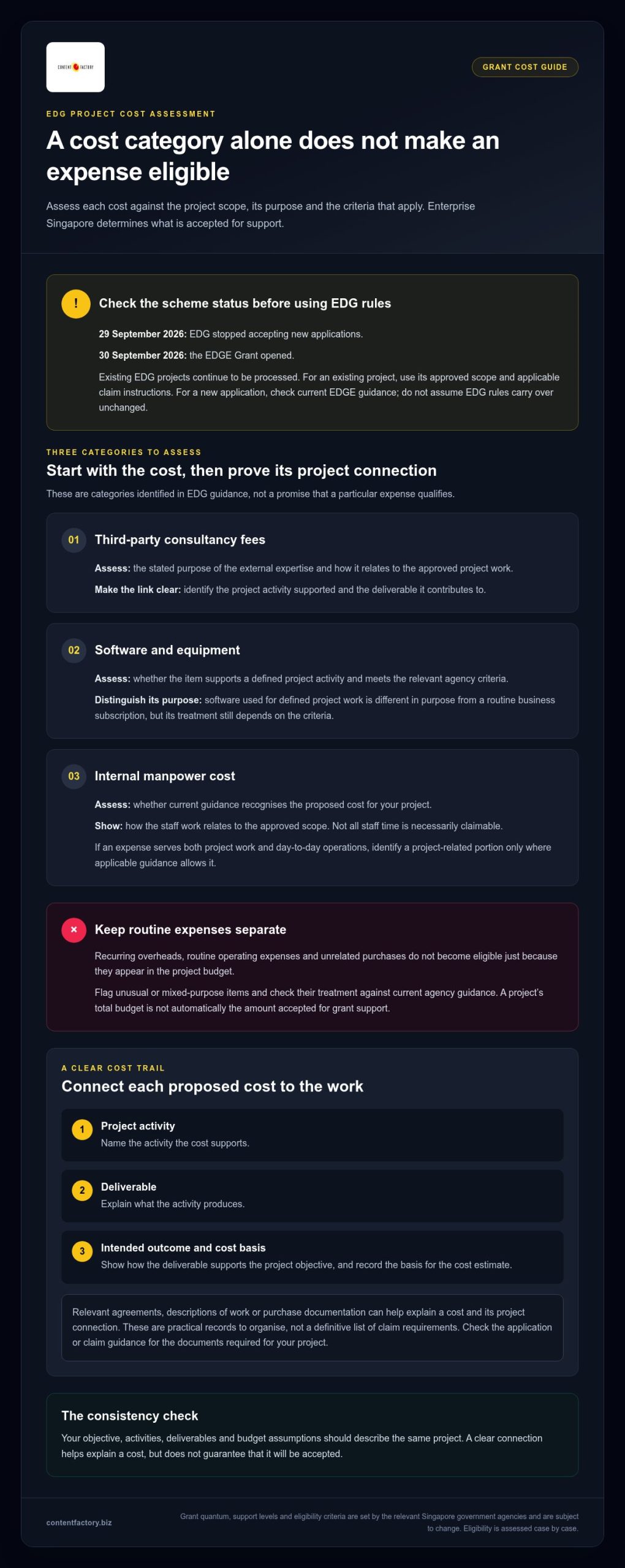
EDG stopped accepting new applications on 29 September 2026, and the EDGE Grant opened on 30 September 2026. Existing EDG projects continue to be processed. If you are managing an existing project, use its approved scope and applicable claim instructions. For a new application, refer to current EDGE guidance rather than assuming EDG rules still apply.
This guide explains how to assess project costs, distinguish them from ordinary expenses and keep the scope, budget and supporting records aligned. It also outlines how grant advisory and compliance support can help organise the process.
Key Takeaways
- Assess each proposed cost against the project scope and current Enterprise Singapore guidance.
- Separate project-specific costs from routine operating expenses by linking each item to a defined activity.
- Check that your objectives, deliverables and budget assumptions describe the same project.
- Map project outcomes to activities and costs, then flag any items that need closer review.
- Grant advisory, financial modelling and post-approval compliance support can help organise project documentation.
What costs are covered by the EDG grant, and what does coverage mean?
What costs are covered by the EDG grant depends on whether they are qualifying project costs, not simply whether your business has incurred them. Enterprise Singapore assesses a project and its costs against the applicable scheme criteria. An expense is not automatically supportable because it appears in a project budget.
Keep three parts of the proposal distinct. The project objective is the business outcome you intend to achieve. The project scope sets out the activities and deliverables planned to achieve it. The project costs are the expenses tied to carrying out those activities. Each proposed cost needs a clear connection to the scope. The agency’s assessment determines what is accepted for support.
Enterprise Singapore guidance can change. Check the current criteria for the relevant project and application or claim before relying on an older summary. The agency’s decision, not the label used in your budget, determines how a cost is treated.
How EDG project scope relates to covered costs
Start with a defined project outcome, then map the work needed to deliver it. For example, if a project aims to improve a specific business capability, set out the activities and deliverables that contribute to that objective. A general expense that continues as part of ordinary operations has a less direct link to the project than a cost tied to its defined work.
For each proposed cost, explain why it is needed to complete the scope. Then compare it with Enterprise Singapore’s current criteria. A clear project connection makes the cost easier to assess, but does not make it automatically eligible.
Does the EDG cover the whole project budget?
No. An eligible project does not make every budget line eligible. Your total project spending is the full amount budgeted or incurred. The portion accepted for grant support may be narrower, depending on the approved scope and applicable criteria.
Keep that distinction clear in your working budget. Separate project-related costs, record the basis for each estimate and do not treat the total project value as the supported amount. For an existing project, check the approval terms and claim guidance to see how each cost is treated.
Which EDG cost categories should your business assess?
Enterprise Singapore’s EDG guidance identifies three cost categories to assess: third-party consultancy fees, software and equipment, and internal manpower cost. These categories are a starting point, not confirmation that a particular expense qualifies. The cost must relate to the project and meet the criteria that apply to it.
EDG stopped accepting new applications on 29 September 2026, and the EDGE Grant opened on 30 September 2026. If you are preparing a new application, refer to the current Enterprise Development Grant (EDG) guidance alongside the applicable EDGE guidance. Do not assume that EDG cost categories or rules carry over unchanged to its successor.
How to assess consultancy, software and equipment costs
For an existing EDG project, assess each cost against its stated purpose and its connection to the approved work. Consultancy fees may relate to external expertise, while software or equipment may support a project activity. Neither category label makes an expense automatically eligible. For instance, software used for a defined project differs in purpose from a routine business subscription, but its treatment still depends on the relevant agency criteria.
Organise records that explain the cost and its connection to the project, such as the relevant agreement, description of work or purchase documentation. Treat these as practical records to assemble, not a definitive list of claim requirements. Check the application or claim guidance for the documents required for your project.
How to assess internal manpower and other project expenses
Internal manpower cost is a named EDG category, but not all staff time is necessarily claimable. Check whether current guidance recognises the proposed cost for your project, and show how the work relates to the approved scope. If an expense serves both project work and day-to-day operations, identify a project-related portion only where the applicable guidance allows that treatment.
Do not treat recurring overheads, routine operating expenses or unrelated purchases as eligible simply because they appear in the same budget. Flag unusual or mixed-purpose items and check their treatment against current agency guidance. This is especially important for a new application under EDGE, whose rules may differ from EDG.
ContentFactory provides grant advisory and financial modelling to help organise cost assumptions against a proposed scope. You can discuss your grant cost planning with the team.
How project scope and supporting evidence affect EDG cost assessment
A cost is easier to assess when your application explains its role in the project, rather than only stating its price or supplier. The objective, planned activities, deliverables and budget assumptions should describe one consistent piece of work. This helps distinguish a project expense from an ordinary purchase, but clear documentation does not guarantee that a cost will be accepted or that an application will be approved.
For current information on EDG cost eligibility, use Enterprise Singapore’s published guidance for the relevant scheme and project. The Enterprise Development Grant SME guide offers a related overview, but it does not replace current agency requirements, particularly when the scheme or application route has changed.
What makes a cost clearly connected to the project?
Trace each proposed cost through three points: the project activity it supports, the deliverable produced and the intended outcome. For example, a project that includes a defined assessment might require a related external service. This is an illustration, not confirmation of eligibility. Check the cost against the applicable Enterprise Singapore guidance.
A description such as “consulting” or “software” does not explain the project connection on its own. Flag vague items, purchases with both project and routine business use, and unrelated expenses for closer review. State the project-specific purpose and verify the proposed treatment rather than assuming that a connection makes the cost eligible.
What records should you organise before applying?
Start with the live application instructions. Check whether Enterprise Singapore specifies quotations, invoices or other evidence for the application or claim. Do not assume a generic checklist is definitive: required records can depend on the scheme, application stage and cost type.
Keep the project description, supplier information, deliverables and budget assumptions consistent across your working materials. If a proposed cost changes, review whether the change affects the scope or its explanation. A useful check is whether someone reading the documents can follow the path from objective to activity, deliverable and cost without having to fill in missing steps.
For a broader overview, refer to ContentFactory’s EDG advisory guide for Singapore SMEs, while using Enterprise Singapore guidance for current criteria. ContentFactory’s strategic grant advisory and financial modelling can help align the scope, assumptions and supporting records. You can also contact ContentFactory about grant preparation.
How to review your EDG budget before submitting an application
First, check which scheme applies. Enterprise Singapore’s EDG stopped accepting new applications on 29 September 2026, and the EDGE Grant opened on 30 September 2026. For a new application, use current EDGE guidance rather than assuming EDG cost rules still apply. For an existing EDG project, review the budget and records against its approved scope.
A practical EDG cost review in five steps
Work through this sequence before finalising your figures:
- Define the outcome. State what the project is intended to achieve and describe the scope of work.
- Map the activities. List the activities and deliverables needed to meet that outcome.
- Connect each cost. For every budget line, state which activity it supports and why it is included. Keep routine and unrelated expenses separate.
- Check current criteria. Compare each cost category and evidence requirement with Enterprise Singapore’s current instructions for the relevant scheme and application stage.
- Flag and resolve uncertainty. Mark unclear or mixed-purpose costs for review. Update the budget if the applicable guidance requires a different treatment.
This sequence helps you build a traceable budget. It does not determine eligibility. For an existing EDG project, cost treatment depends on the applicable criteria and approved scope.
Common budget assumptions to avoid
Do not treat a maximum support level as a guaranteed reimbursement rate. Support is subject to eligibility and assessment, and the accepted amount may not match your total project budget. Approval of a project also does not mean every listed cost has been accepted for support.
Check timing before committing expenditure or preparing a claim. Enterprise Singapore’s instructions for your scheme and project determine what applies. For ongoing EDG projects, follow the approval terms and current claim guidance. Do not assume new EDGE rules apply to an existing EDG approval.
For a broader overview of grant preparation, read ContentFactory’s EDG advisory guide for Singapore SMEs. ContentFactory can also help review the scope, budget assumptions and documentation for your grant application. Contact Us.
How ContentFactory supports EDG cost planning and compliance
Grant cost planning involves more than entering figures in a form. The project scope, cost assumptions and supporting records need to describe the same work. ContentFactory provides grant advisory and financial modelling to help organise those elements into a coherent plan. Enterprise Singapore determines eligibility and any grant outcome.
EDG stopped accepting new applications on 29 September 2026. For a new application, use the current EDGE Grant guidance. For an existing EDG project, follow its approved scope and applicable claim instructions.
From project idea to a documented cost plan
ContentFactory can help structure a project cost plan by linking its objective and activities to proposed expenses and budget assumptions. Financial modelling makes the basis for those assumptions clear, while grant documentation support helps organise the information needed to describe the project.
Use a simple test for each proposed cost: does it have a clear place in the scope, and can you explain why it is needed? Flag uncertain items for review against the relevant agency guidance instead of treating them as eligible by default. Preparation support helps organise application materials. It does not determine eligibility or influence Enterprise Singapore’s decision.
After approval: records, audit and compliance
Manage an approved project against its approved scope and applicable agency instructions. Keep records aligned with the work delivered. Before changing the scope or cost plan, review the approval terms and current guidance so your project records continue to reflect the approved work.
ContentFactory provides post-approval grant audit and compliance support to help organise project records and review them against relevant grant requirements. This is compliance support, not an independent audit opinion. Enterprise Singapore remains responsible for assessing claims and determining grant matters.
ContentFactory’s grant consulting includes advisory, financial modelling, documentation support and post-approval compliance assistance. To discuss support for your grant project, Contact Us.
Build your next grant budget around a clear scope
To assess what costs are covered by the EDG grant, connect each proposed expense to a defined project activity, then check it against current Enterprise Singapore guidance. A project may fit a grant’s purpose without every budget line qualifying. Keep uncertain items visible and confirm their treatment before relying on them.
EDG stopped accepting new applications on 29 September 2026. Businesses planning a new application should review current EDGE Grant guidance. For an existing EDG project, follow the approved scope and applicable claim instructions.
ContentFactory provides strategic grant advisory, financial modelling and post-approval compliance support. Mayuresh Godse, a Singapore Certified Management Consultant with 25+ years of consulting experience, supports businesses in organising project scope, cost assumptions and documentation. Enterprise Singapore, not an adviser, determines eligibility and grant outcomes.
Grant quantum, support levels and eligibility criteria are set by the relevant Singapore government agencies and are subject to change. Eligibility is assessed case by case.
Frequently Asked Questions
What costs are covered by the EDG grant?
The EDG supports qualifying costs linked to an approved project scope, not every expense your business incurs. Assess each item against the project and the relevant Enterprise Singapore guidance. Existing projects continue to be processed, with claims handled under the applicable approval terms and agency instructions.
Does the EDG grant cover consultancy fees?
Consultancy fees may be relevant to an EDG project, but not every engagement or fee automatically qualifies. For an existing project, check the approval terms and Enterprise Singapore guidance, and make sure the work relates to the project scope. Keep the supporting information required by the agency. Enterprise Singapore assesses eligibility and determines which costs are accepted for support.
Can the EDG grant cover software and equipment?
Software or equipment may be considered if the applicable guidance and project scope support the cost. A purchase being useful to your business does not, by itself, make it eligible. For an existing EDG project, check its approval terms and Enterprise Singapore’s current instructions. Explain how the item relates to the project and retain the evidence required for the relevant application or claim stage.
Are internal manpower costs covered by the EDG grant?
Internal manpower cost is a category identified in EDG guidance, but not all staff time qualifies. Its treatment depends on the project and agency requirements. For an existing project, check the approval terms and current Enterprise Singapore instructions before including staff time or related amounts in a claim. Keep records consistent with those instructions, and distinguish project activities from routine business work.
Does the EDG grant cover all costs in an approved project?
No. Approval of a project does not mean every expense is eligible or supported. The approved scope, accepted cost items and applicable Enterprise Singapore requirements determine how costs are treated. Keep your budget and records aligned with the project approval. If a proposed expense or change falls outside the documented scope, review the relevant agency instructions before treating it as supported.
How much of project costs can the EDG grant cover?
Support levels depend on the applicable scheme criteria and project. EDG stopped accepting new applications on 29 September 2026, so new applicants should check Enterprise Singapore’s EDGE Grant guidance for current support levels and eligibility. For an existing EDG project, refer to its approval terms. Support is assessed case by case and is not a guaranteed reimbursement rate.
What happens if a cost is not eligible under the EDG?
Do not present a cost as eligible if it does not meet the applicable criteria. Review the budget against Enterprise Singapore’s guidance, separate uncertain items and revise the cost plan where needed. For an approved EDG project, follow the approved scope and claim instructions. Do not assume you can replace an ineligible item or change the scope without checking the relevant agency requirements.
When should a business get help reviewing EDG costs?
Grant advisory may help when the project scope, budget assumptions or supporting documents are difficult to align. An adviser can help organise the project rationale, model cost assumptions and prepare documentation, but cannot determine eligibility or guarantee an agency outcome. ContentFactory also provides post-approval compliance support to help organise project records against applicable requirements. For a new application, use current EDGE Grant guidance.
Grant quantum, support levels and eligibility criteria are set by the relevant Singapore government agencies and are subject to change. Eligibility is assessed case by case.
ContentFactory provides strategic grant advisory, financial modelling and post-approval compliance support. To discuss your grant preparation, book a 30-minute discovery call: Book a Strategic Consultation.

Article by
Mayuresh Godse
Mayuresh Godse is a Singapore Certified Management Consultant and Business Strategist specializing in Sustainability, ESG, AI-driven Digital Transformation, and business growth. Based in Singapore, he writes about Sustainability, Digital Innovation, Business Strategy, and Content Marketing for global audiences.
Disclaimer
This article is provided by ContentFactory for general information only and is not legal, tax, accounting or financial advice. Regulations and government scheme criteria change; grant eligibility and quantum are set by the relevant Singapore agencies and assessed case by case, with no outcome guaranteed. Verify current requirements before acting.