

A worthwhile project is not enough if your company or application is not ready. Enterprise Singapore assesses three things: whether your business meets the company requirements, whether the project qualifies and has not started, and whether your business can fund the work as it progresses.
These are separate tests. A routine expense is not automatically an eligible project, and meeting the company requirements alone does not make an application ready. Use this guide to distinguish applicant criteria from project criteria, organise relevant information and assess whether your business can carry the project through to completion.
There is also an important timing change. EnterpriseSG stopped accepting new EDG applications after 29 September 2026. Applications submitted before that date and ongoing projects continue under their original terms. The checklist below explains the requirements relevant to those submissions and helps you review your company, project scope and financial readiness.
Key Takeaways
- Assess company eligibility, project fit and financial readiness separately. Passing one test does not establish that the others are met.
- The EDG grant eligibility criteria included Singapore registration and operations, at least 30% local shareholding, and financial viability to start and complete the project.
- A project category may fit EDG’s scope, but the project still needs to meet the scheme’s specific requirements, including the rule against starting before application.
- Use the relevant Business Grants Portal instructions to organise application details and supporting documents.
- EnterpriseSG stopped accepting new EDG applications after 29 September 2026. Check the applicable scheme guidance for an existing submission or project.
EDG grant eligibility criteria: what businesses need to assess first
Start with three questions: does the applicant meet the company requirements, does the proposed project fit the grant, and is the business ready to carry it out? The Enterprise Development Grant (EDG), administered by Enterprise Singapore (EnterpriseSG), supports qualifying projects that help businesses upgrade and transform. A promising idea alone is not enough. The applicant, project scope and readiness must each meet the requirements that apply.
Check the timing before using this checklist. EnterpriseSG stopped accepting new EDG applications after 29 September 2026. Applications submitted before that date and ongoing projects continue under their original terms. Review EnterpriseSG’s guidance for the requirements relevant to your submission or project before acting.
For a general application walkthrough, watch this video from The Brand Theatre Worldwide:
Who should use this EDG eligibility checklist?
This preliminary self-assessment is for Singapore SMEs and mid-market businesses reviewing a defined project, especially when a decision about scope, timing or funding is approaching. Business owners can clarify intended outcomes, finance leads can examine affordability, and operations decision-makers can check whether the work is properly scoped and ready to proceed. Use the checklist to identify questions to resolve, not as a substitute for an agency decision.
Eligibility is not the same as approval
Meeting the baseline applicant requirements is only one part of the assessment. EnterpriseSG also considers the proposed project and the information in the application. A clear scope and organised documents help present the project accurately, but neither an adviser nor a preliminary checklist can determine the agency’s decision.
As a practical first step, write a short project summary covering the business need, intended changes, key activities, expected outcomes and current status. Compare it with the EnterpriseSG guidance that applies before committing project expenditure. Keep unresolved questions separate from confirmed details so you can verify each point.
Check your company against the EDG grant eligibility criteria
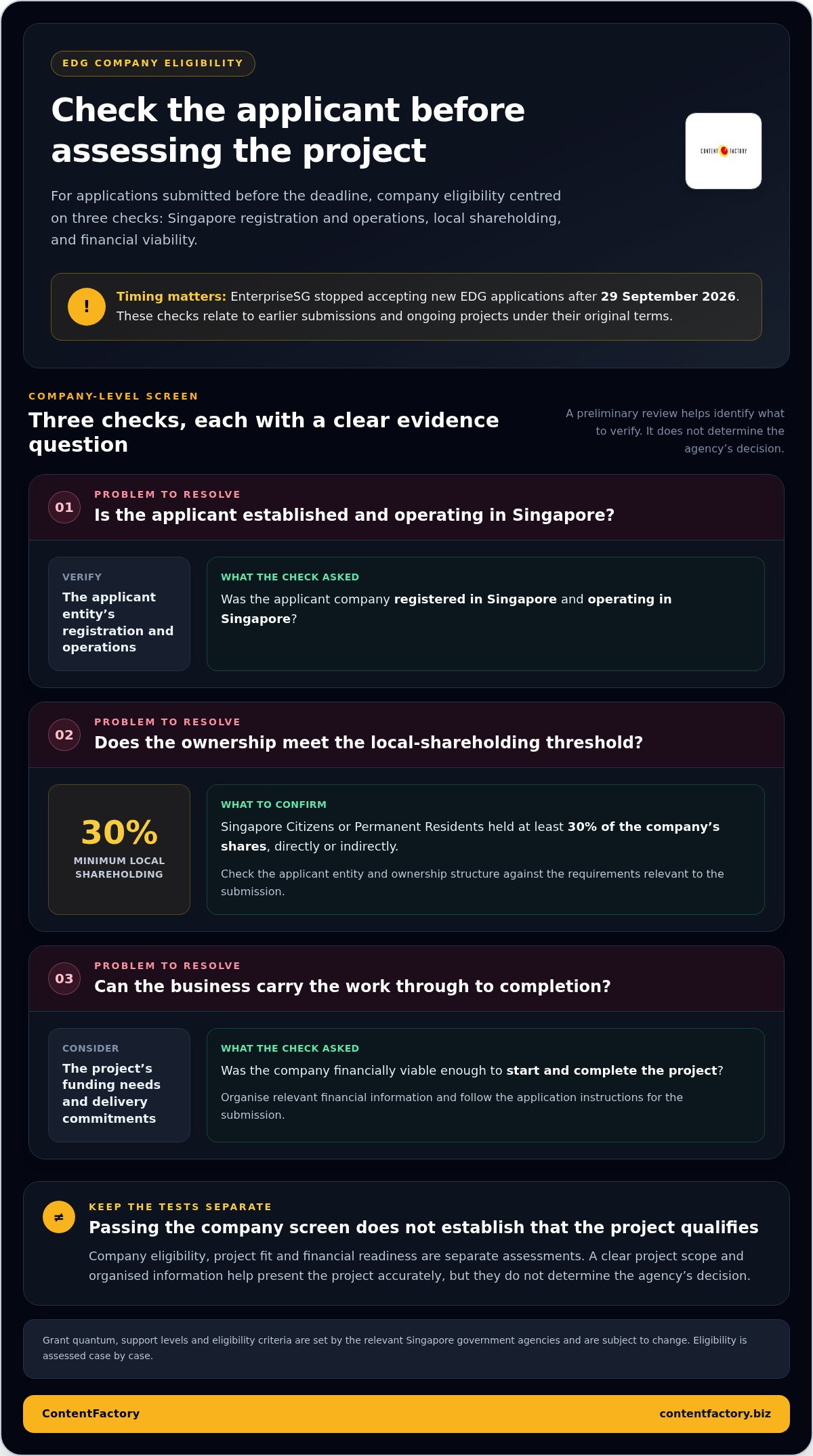
For EDG applications submitted by 29 September 2026, Enterprise Singapore’s company-level eligibility checks covered Singapore registration and operations, local shareholding and financial viability. EnterpriseSG stopped accepting new applications after that date, so these checks should not be treated as eligibility for a new application under another scheme. Review the Enterprise Development Grant (EDG) guidance for the rules relevant to your submission or project.
Company registration, operations and local shareholding
Use this checklist as a preliminary screen for an EDG application made before the deadline. Each point remains subject to the applicable EnterpriseSG requirements and case-by-case assessment:
- Registration: Was the applicant company registered in Singapore?
- Operations: Was the company operating in Singapore?
- Local shareholding: Did Singapore Citizens or Permanent Residents hold at least 30% of the company’s shares, directly or indirectly?
Check the applicant entity and ownership structure against the scheme guidance relevant to the application. Do not rely on a general description of the wider business or assume that company size, revenue or group structure determines eligibility. These points reflect the stated EDG criteria for applications under the previous scheme. The applicable EnterpriseSG requirements take precedence.
Financial readiness and ability to complete the project
EnterpriseSG’s stated criterion also required the company to be financially viable enough to start and complete the project. This is a practical test, not a box to tick based on the project’s potential value. Consider whether your business can meet its project commitments and sustain delivery through to completion.
Organise the financial information that helps you understand the project’s funding needs and your capacity to carry it out. Follow the relevant EnterpriseSG application instructions for supporting information. A generic document list may not meet the requirements for your submission.
An internal review can surface gaps early. Record the applicant’s registration and operating details, confirm the relevant ownership information, and assess whether the business can complete the defined work. Then check each point against the scheme rules that apply. Passing this company-level screen does not establish that the project qualifies or guarantee approval.
ContentFactory helps businesses organise project scope and financial modelling for grant applications and ongoing projects. Discuss your grant preparation requirements.
Test whether your proposed project fits EDG support
A project may resemble an EDG-supported activity without meeting the requirements for funding. For applications submitted before 30 September 2026, Enterprise Singapore grouped projects under Core Capabilities, Innovation & Productivity, and Market Access. A category is a starting point, not proof that a specific scope or cost qualifies. New EDG applications are no longer accepted, so these checks relate to earlier submissions and ongoing projects governed by their original terms.
Match the project objective to the applicable EDG categories
Start with the business need. Then check how the proposed work fits the category and description that applied to the submission. Refer to Enterprise Singapore’s EDG guidelines and confirm the terms that apply to your project.
Make the proposal specific enough to assess. Write down:
- Objective: What defined business need is the project intended to address?
- Scope: What activities and deliverables are included, and where does the work begin and end?
- Outcome: What business capability or performance change is the project intended to deliver?
A clearly scoped project to build a business capability is easier to assess against a stated objective than a broad request to fund general improvements. That distinction does not establish eligibility. EnterpriseSG assesses the proposal against the applicable scheme requirements, including its scope and costs.
Check project timing and scope before committing
Under the previous EDG framework, a project must not have commenced before the application date. The stated commencement indicators include signing a contract, starting work or making payments to third parties. If any of these occurred, review the rules applicable to the submission rather than assuming that an incomplete project still qualifies.
Keep the proposed work bounded. Separate specific project activities from routine business expenditure, and identify the relevant providers, deliverables and costs. Verify each item against the official requirements for the application or ongoing project. A project category does not make every related expense eligible, and a provider’s involvement does not automatically make the work fundable.
Record the objective, scope, intended outcome, start status and costs that need verification in a short project note. This gives your team a practical basis for checking project fit without treating a category match as an approval decision. ContentFactory helps organise project scope and grant documentation. Discuss your grant application requirements.
Use this EDG application-readiness checklist before submitting
Enterprise Singapore stopped accepting new EDG applications after 29 September 2026. This checklist is for reviewing an application submitted before the deadline or preparing follow-up on an ongoing EDG project, not for starting a new application. Use the instructions that apply to your submission in the Business Grants Portal (BGP), rather than relying on a generic document list.
Prepare the project case and supporting information
Organise the information so the project rationale, scope and costs are consistent across your records and application:
- Define the business need. State the issue or capability gap the project was designed to address.
- Set out the scope. Describe the work, deliverables and boundaries. Distinguish the project from routine operating activities.
- Clarify objectives and outcomes. Explain what the project aimed to achieve, using claims your business can substantiate.
- Organise financial assumptions. Keep the cost breakdown and supporting information aligned with the project scope. Follow the document requirements in the relevant BGP instructions.
- Check consistency. Make sure the scope, schedule and costs agree across the application and supporting materials.
Requirements can depend on the applicable scheme instructions and project circumstances. Do not add documents simply because they appear on an unrelated checklist, and avoid unsupported claims or projections. ContentFactory’s strategic grant advisory and financial modelling service helps organise project scope, assumptions and application documentation.
Check application timing, submission and follow-up
For an EDG submission made before the deadline, review the BGP record and relevant EnterpriseSG instructions to confirm what was submitted and whether follow-up is required. Keep application preparation separate from agency evaluation: complete materials do not determine the assessment outcome. If the project is approved, claims and compliance steps are separate stages and should follow the applicable project instructions.
Before acting, check that the application date, project commencement status and supporting information match the requirements for your submission. ContentFactory provides post-approval audit and compliance support.
ContentFactory can also help organise grant documentation and financial modelling. Discuss your requirements.
What to do if your EDG eligibility is uncertain
Do not guess at an unclear criterion or commit project expenditure on the assumption that it will qualify. Enterprise Singapore stopped accepting new EDG applications after 29 September 2026. If you submitted an application before that date or have an ongoing EDG project, check the requirements that apply to its status. For a future project, verify the relevant current grant rules before committing funds.
When to seek grant advisory support
Advisory support can help when you cannot yet explain how a project fits the applicable criteria, its scope is changing, or the financial assumptions need organising. First, identify the uncertainty: is it about the applicant, project activities, timing, costs or supporting information? A precise question makes it easier to identify what needs checking against agency guidance.
ContentFactory helps organise project scope, financial modelling and application documentation. This is preparation, not a route to an agency decision. Enterprise Singapore assesses applications under the relevant scheme requirements, and no adviser can guarantee the outcome. ContentFactory’s EDG advisory guide for Singapore SMEs provides further context on grant preparation.
Before seeking support, gather what you already have: a concise project description, the point you are unsure about, relevant cost assumptions and any application or project records. Do not fill gaps with optimistic projections or treat an adviser’s preliminary view as confirmation of eligibility. Verify unresolved criteria against the appropriate EnterpriseSG guidance before deciding on expenditure.
Take the next step without assuming approval
Separate what you know from what still needs verification. Record the open questions, check the applicable agency instructions, and base project decisions on confirmed requirements. This matters for an EDG submission or ongoing project because new applications under the scheme have closed.
ContentFactory supports grant preparation through scope organisation, financial modelling, application documentation and post-approval compliance support. A discovery call can help you outline the questions and preparation needs to address. It cannot replace EnterpriseSG’s assessment or determine eligibility.
Make your next grant decision with clarity
Assess the EDG grant eligibility criteria in three parts: your company’s eligibility, the project’s fit and timing, and your readiness to deliver it. Meeting baseline requirements does not guarantee approval. Enterprise Singapore stopped accepting new EDG applications after 29 September 2026, so check the applicable guidance for an earlier submission or ongoing project before making decisions.
Where uncertainty remains, organise the open questions, project scope and financial assumptions before committing expenditure. ContentFactory provides grant advisory, financial modelling, application documentation and post-approval compliance support. Mayuresh Godse, a Singapore Certified Management Consultant with more than 25 years of consulting experience, leads this work. Advisory support helps prepare and organise information, but Enterprise Singapore determines eligibility and application outcomes.
ContentFactory can help you assess your grant preparation requirements and define a practical next step. Book a Strategic Consultation.
Frequently Asked Questions
Is my company eligible for the EDG if it is registered in Singapore?
Not on registration alone. Under the previous EDG framework, the company also needed to operate in Singapore, meet the local shareholding requirement and be financially viable enough to start and complete the project. Check the applicable Enterprise Singapore guidance for your application or ongoing project. These points are a preliminary screen, not an eligibility decision or guarantee of support.
Does a business need local shareholding to qualify for the EDG?
Local shareholding was a company-level criterion under the previous EDG framework. The stated threshold was at least 30% held directly or indirectly by Singapore Citizens or Permanent Residents. This applies to EDG applications made under those terms, not new applications, which closed on 29 September 2026. Confirm the rules relevant to your submission with Enterprise Singapore. Meeting the threshold alone did not guarantee approval.
Can a company apply for the EDG after starting its project?
Under the previous EDG rules, the project must not have commenced before the application date. Signing a contract, starting work or making payments to third parties were identified as signs that work had commenced. For a pre-deadline submission or ongoing project, check the relevant Enterprise Singapore guidance and Business Grants Portal (BGP) instructions before relying on a timing rule.
What types of projects can the EDG support?
Under the previous EDG framework, projects were grouped into Core Capabilities, Innovation & Productivity, and Market Access. These categories describe broad areas of support, but a category match alone does not establish that an individual project or its costs qualify. For an earlier submission or ongoing project, refer to the scheme terms and guidance that apply to it.
How much funding can an eligible business receive through the EDG?
Under the previous framework, Enterprise Singapore provided eligible SMEs with support of up to 50% of qualifying project costs. A sustainability-related enhanced rate of up to 70% was available only until 31 March 2026, subject to the applicable eligibility requirements. New EDG applications closed on 29 September 2026. For an existing application or approved project, check its applicable terms. Support levels and qualifying costs are assessed case by case.
Does meeting the EDG eligibility criteria guarantee approval?
No. Meeting the EDG grant eligibility criteria is not the same as receiving approval. Enterprise Singapore assesses each application against the requirements that apply, including the company, project and submitted information. An adviser can help organise project scope, financial assumptions and application documentation, but cannot influence the agency’s decision or promise an outcome. Use current EnterpriseSG guidance for your submission or ongoing project, and treat any preliminary self-assessment as a planning tool only.
Grant quantum, support levels and eligibility criteria are set by the relevant Singapore government agencies and are subject to change. Eligibility is assessed case by case.
Book a Strategic Consultation (30-minute discovery call).

Article by
Mayuresh Godse
Mayuresh Godse is a Singapore Certified Management Consultant and Business Strategist specializing in Sustainability, ESG, AI-driven Digital Transformation, and business growth. Based in Singapore, he writes about Sustainability, Digital Innovation, Business Strategy, and Content Marketing for global audiences.
Disclaimer
This article is provided by ContentFactory for general information only and is not legal, tax, accounting or financial advice. Regulations and government scheme criteria change; grant eligibility and quantum are set by the relevant Singapore agencies and assessed case by case, with no outcome guaranteed. Verify current requirements before acting.