

The EDG grant success rate cannot tell you whether your project will be approved. Enterprise Singapore does not publish an official EDG approval rate, so treat online figures as historical context unless they identify a reliable source, reporting period and calculation method.
Timing matters. EDG stopped accepting new applications on 29 September 2026, and the EDGE Grant replaced it from 30 September. Historical EDG figures are not a forecast for an application under the current scheme. Existing EDG projects that were approved can continue through completion and claims.
Rather than relying on a headline percentage, check whether your project is clearly scoped, its intended outcomes are explained and the service provider’s competency is addressed. This guide shows you how to assess reported figures, review readiness against current official guidance and prepare for the application, decision and post-approval stages. It also explains what to verify before using EDG requirements for a different scheme.
Key Takeaways
- An aggregate EDG approval figure cannot predict an individual application’s outcome. Check how it defines applications, decisions and the reporting period.
- Separate official Enterprise Singapore requirements from historical statistics, general commentary and adviser claims.
- Check current scheme requirements with Enterprise Singapore and the Business Grants Portal, especially given the transition from EDG to EDGE.
- Use a readiness review to decide whether to check requirements, clarify project details or pause to gather evidence.
- Plan for preparation, submission, assessment and post-approval compliance as distinct stages.
What does the EDG grant success rate actually tell you?
An aggregate approval rate describes outcomes for a defined group of applications during a stated period. It cannot show how an application with a different project scope, evidence base or set of circumstances will be assessed.
Enterprise Singapore does not publish an official EDG approval-rate statistic. Media reports and other commentary may refer to historical programme data, but without the underlying definition and reporting period, the figure cannot serve as a current applicant forecast. This distinction matters now that EDG stopped accepting new applications on 29 September 2026, ahead of its replacement by the EDGE Grant from 30 September 2026.
Historical programme statistics describe past decisions, not an individual business’s probability of approval. Use a reported figure to understand a defined period, not to assume your application will have the same outcome.
Why the reporting period and denominator matter
A percentage is meaningful only when you know what was counted. A reported rate might compare approvals with applications submitted, applications completed, applications considered valid or applications that received a decision. These are different denominators and can produce different results from the same pool of activity.
The timeframe matters too. A figure from a past period may reflect a different mix of projects or a different stage of the programme. Compare rates only when the source, period, scheme and calculation method are clear. If one figure counts decided applications and another counts all submissions, they are not directly comparable.
What to check before trusting a success-rate claim
Before relying on a reported number, look for four details:
- Source: Is the figure published by Enterprise Singapore, or reported by a media outlet or adviser?
- Date: What period does it cover, and when was it published?
- Scheme: Does it refer specifically to EDG, rather than another grant or a group of schemes?
- Definition: Does it explain which applications and decisions are included?
Use official information as the reference point for current scheme requirements. Historical figures reported in the media may add context, but they are not current agency guidance. The official Enterprise Singapore EDG page is a reference for EDG information. General commentary and adviser claims need the same scrutiny: a broad statistic cannot establish the outcome for your project, and no figure should be presented as a promise.
For a practical check, record the source, reporting period, scheme and denominator for every figure you encounter. If any detail is missing, treat the number as incomplete rather than filling the gap with assumptions. Then assess your project directly. ContentFactory’s strategic grant advisory and financial modelling support the review of project scope and documentation, not predictions about an agency decision.
How EDG assessment works, and what an applicant can control
An application moves through distinct stages: define the project, check the relevant scheme’s requirements, prepare and submit the application, wait for the agency’s assessment, then meet any post-approval conditions and claim requirements if approved. Your business controls the clarity of its project and the accuracy of its records. Enterprise Singapore makes the assessment and decision. A complete submission is good preparation, not a promise of approval.
EDG stopped accepting new applications on 29 September 2026, with the EDGE Grant replacing it from 30 September 2026. If you are preparing a new application, do not assume EDG’s former categories or process still apply. Check current requirements with Enterprise Singapore and the Business Grants Portal (BGP). The official Enterprise Singapore EDG page provides information about EDG, while current scheme guidance should inform a new application.
Start with project fit and scope
Before assembling documents, write down the business need, the work proposed and the intended outcomes. Specify the capability the project is meant to build, the activities in scope and how your business will recognise the intended improvement. Then compare the project with the current scheme’s official categories and eligibility conditions. If the scope is vague, the outcome is difficult to explain or an assumption lacks evidence, address that gap before submission.
Keep the assessment grounded in evidence. Separate confirmed facts from estimates, and make clear which activities belong to the project. A defined scope helps you assess scheme fit and prepare a coherent application; it does not determine the agency’s decision. Historical EDG figures cannot replace this project-specific review.
Prepare documentation without treating it as a guarantee
Build the application file around the requirements published for the relevant scheme. This may include a clear project description, supporting records and financial modelling that matches the stated scope. Check names, dates, figures and descriptions across documents. Label estimates clearly and retain their basis rather than presenting them as confirmed facts.
For the former EDG process, applications were submitted through BGP using the company’s CorpPass, and third parties were not permitted to apply on an applicant’s behalf. Enterprise Singapore’s EDG guidance also stated that project work must not begin before the application is submitted and the Letter of Offer is received. Treat these as EDG-specific instructions, not assumptions about EDGE. For an approved EDG project, post-approval claims and supporting evidence are a separate stage. Review the applicable terms before incurring costs or submitting a claim.
Grant advisory and financial modelling can help organise project scope and documentation without predicting the outcome. To discuss preparation for a relevant Singapore grant, discuss your project requirements.
How to compare EDG success-rate claims and grant advice
A useful grant statistic shows its basis. A figure without a source, period or definition may sound precise, but it cannot tell you which applications were counted or whether the data applies to the scheme you are considering. Separate evidence about past decisions from official requirements for a current application. They answer different questions.
Questions to ask of a published statistic
Before relying on an approval figure, check who published it and whether the original source is available. Then look for the reporting period, the applications included and what the source counted as an approval. A figure based on decided EDG applications cannot be compared directly with one based on all submissions if their definitions differ.
Check that the statistic refers to EDG alone rather than combining schemes. A media report may provide historical context, but it does not replace current guidance from Enterprise Singapore. If a claim leaves out its date, scheme or method, treat it as incomplete, not as a forecast.
How to assess grant advisory support
Sound advisory work is clear about what it can control: project scope, financial modelling, application documentation and preparation against published requirements. You should be able to understand what work is proposed, what information supports the application and which assumptions still need attention. That is different from selling a predicted result.
Guarantees of approval, claims of special agency access or language suggesting an adviser can determine the outcome are warning signs. An adviser can help organise and review preparation; Enterprise Singapore makes the grant decision. For wider context on Singapore grant schemes and application preparation, see this Singapore grant application guide.
Use this short check before relying on a number or recommendation:
- Source: Is the figure linked to an identifiable source?
- Date and scheme: Is its reporting period clear, and does it specifically cover EDG?
- Definition: Does it explain which applications and decisions were counted?
- Caveat: Does the source distinguish historical results from current requirements and individual outcomes?
- Advice: Does the adviser explain the preparation work without promising approval or implying agency influence?
If any answer is unclear, seek the underlying source or a more precise explanation before relying on the figure. Do not use a historical rate as a substitute for checking whether your project fits the current scheme and whether its supporting information is ready. If you need help structuring that review, discuss your grant preparation needs with ContentFactory.
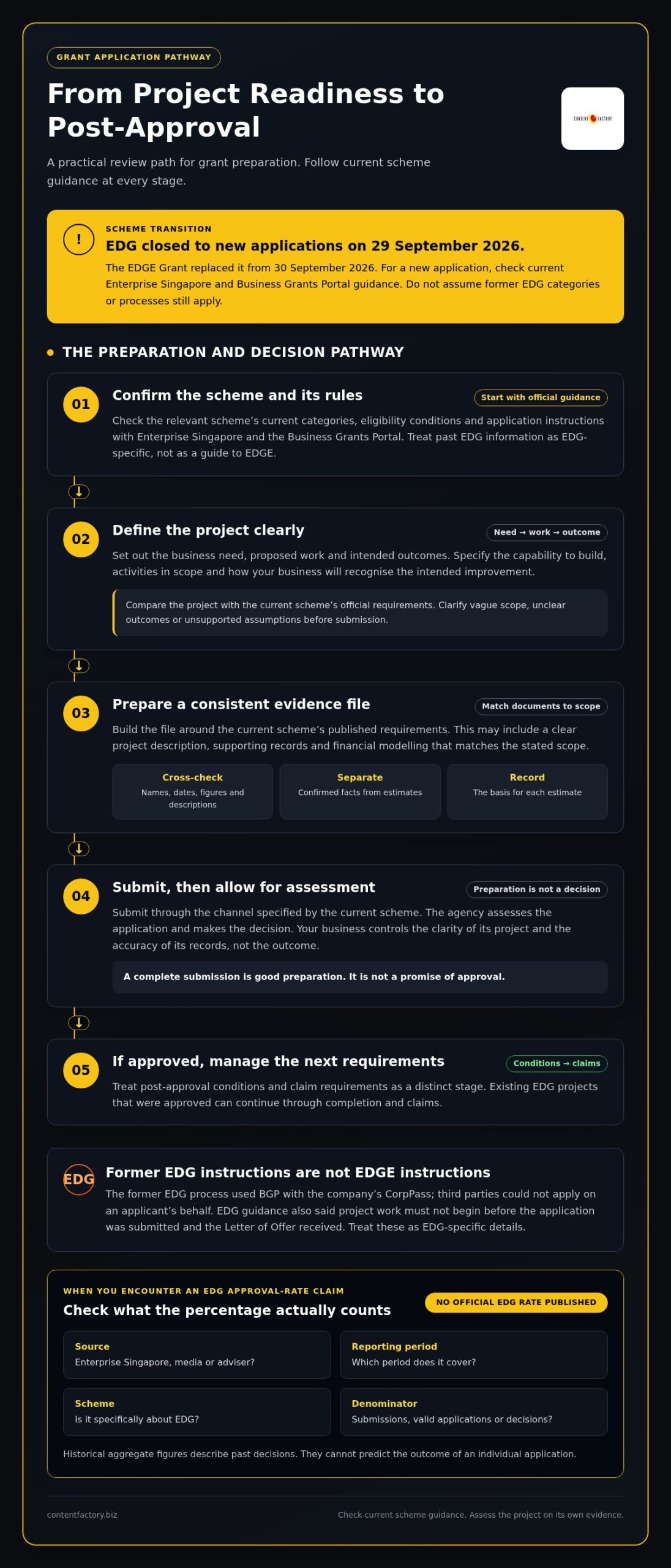
Use this EDG readiness review before deciding to apply
Start with the project, not an approval statistic. Enterprise Singapore’s EDG stopped accepting new applications on 29 September 2026. This review can help you understand an existing EDG application or organise your thinking before checking the current scheme and its requirements. Do not assume EDG categories or application rules apply to a new grant application.
Review the project before reviewing the headline statistic
Set aside the reported figure and write a short project note. State the business need, the work you propose, who will own it and the outcomes you expect. Then compare the project with the relevant category and eligibility requirements in current official Enterprise Singapore guidance. Keep the source and date of that guidance with your notes.
Mark any missing evidence, unclear assumptions or unanswered questions. For example, if the outcome is described only in broad terms, identify what information would make it more specific. This is a self-review, not an agency assessment.
- Project need: Can you explain the business issue the project addresses?
- Scope: Are the proposed activities and boundaries clear?
- Ownership: Is it clear who in your business is responsible for the work?
- Outcomes: Can you describe the intended result without presenting assumptions as established facts?
- Fit and evidence: Have you checked current official requirements and noted which records support your statements?
Choose the next step from what you find
Use your answers to choose one practical next step. “Ready for a requirements check” means the project is defined and you can compare it with current official guidance. “Clarify project details” means the need is credible but scope, ownership, outcomes or assumptions need work. “Pause and gather evidence” means key statements lack records or you cannot yet explain the project clearly. None of these outcomes predicts approval.
For a new application, verify the current scheme name, eligibility, supported activities and process through Enterprise Singapore and BGP. Do not rely on an old EDG checklist as current guidance. For a previously approved EDG project, refer to its applicable offer terms and claim requirements.
Outside support is most useful when it addresses a defined preparation gap, such as structuring the project or reviewing financial modelling and documentation. Strategic grant advisory and financial modelling should support clearer preparation, not be presented as a route to a particular decision. If that is the support you need, Contact Us to discuss your project.
Plan EDG preparation and compliance without relying on a success-rate promise
A grant application is not one event. It involves preparation, submission, agency assessment and, if approved, implementation and claims or compliance steps. Treating these as separate stages helps you plan the work and responsibilities without treating a past approval rate as a promise about your outcome.
What support can and cannot do
Before submission, an adviser can help organise project information, review financial modelling and prepare application documentation against the relevant scheme’s published requirements. Your business remains responsible for the information it provides and for ensuring the project is accurately represented.
The agency assesses the application and makes the decision. Advisory support cannot guarantee approval, establish an individual approval probability or influence the agency’s assessment. Judge preparation by whether the project scope, assumptions and supporting records are clear, not by a promised outcome.
Submission begins a decision stage; it is not confirmation of support. Keep the submitted application and its supporting documents together so your team can refer to the actual version. If the agency requests clarification, respond with accurate information and retain the correspondence in the project file.
Keep records and plan for post-approval requirements
If an application is approved, read the approval documents closely. Follow the conditions and claim requirements, and keep records showing how the project was carried out and how submitted claims relate to the approved scope. Application-stage paperwork alone may not cover later compliance needs.
For existing EDG projects, organise the offer documents, project records, invoices and claim materials in a consistent file. ContentFactory’s post-approval audit and compliance support can help businesses maintain documentation and prepare for post-approval requirements. This support concerns records and compliance, not changing the agency’s decision.
For new applications, check the current scheme guidance rather than carrying EDG requirements forward. Enterprise Singapore stopped accepting new EDG applications on 29 September 2026, and the EDGE Grant replaced EDG from 30 September 2026. Verify the relevant scheme, application process and post-approval terms with official agency guidance before committing to project work.
Keep the sequence clear: prepare the project and evidence, submit under the applicable process, wait for the agency’s decision, then follow the approval conditions and claim requirements if support is granted. ContentFactory supports grant preparation, financial modelling, application documentation and post-approval compliance without promising an approval outcome.
Make your next grant decision on current evidence
Make the next step a requirements check, not a prediction. A historical EDG rate cannot tell you whether a particular project is suitable or what decision an agency will make. For a new application, identify the current scheme, then review its official criteria against your project plan and available evidence. This gives your business a sound basis for deciding what to prepare next.
ContentFactory can support project documentation, financial modelling and post-approval compliance. Mayuresh Godse is a Singapore Certified Management Consultant with 25+ years of consulting experience. The focus is clear preparation and records, never a promised agency outcome.
Frequently Asked Questions
What is the EDG grant success rate?
Enterprise Singapore does not publish an official EDG approval rate, so there is no current agency figure that predicts an applicant’s result. A percentage repeated online may come from historical reporting or use a particular set of applications and decisions. Check its source, date and calculation before relying on it. EDG stopped accepting new applications on 29 September 2026; the EDGE Grant replaced it from 30 September 2026.
Is a historical EDG approval rate still useful?
It can provide background on a past reporting period if the source explains what was counted. It cannot establish the prospects of a new application or show how a current scheme will assess it. A figure based on decisions under EDG does not tell you how EDGE requirements apply to your project. Treat historical reporting as context, then use current Enterprise Singapore guidance for decisions you make now.
Can an EDG consultant guarantee approval?
No. An adviser can help organise project information, prepare documentation and review financial modelling, but cannot guarantee that Enterprise Singapore will approve an application. Be cautious of claims of guaranteed outcomes or special agency access. Those claims are not evidence of project fit. Agree on the preparation work to be done and distinguish it from the independent assessment and decision made by the relevant agency.
How does Enterprise Singapore assess an EDG application?
Enterprise Singapore assesses applications on their merits, with reference to factors including project scope, intended outcomes and the competency of the service provider. Connect the business need to the proposed activities and expected capability improvement. These factors help you understand what to address in the application, but they do not provide a formula for predicting the decision. Check the official guidance relevant to the scheme and application date.
What can I do before submitting an EDG application?
First, confirm whether you are dealing with an already approved EDG project, since EDG no longer accepts new applications. For a new grant application, check the current scheme requirements instead. Write a concise project brief, identify the person responsible, list the evidence supporting key statements and flag unresolved assumptions. Compare each proposed activity with the applicable official guidance before committing to project work or submitting information.
Where can I check current EDG requirements?
Start with Enterprise Singapore’s official EDG page for information about the former scheme. For a new application, verify the active scheme and instructions with Enterprise Singapore and BGP rather than assuming EDG rules carry over. If you have an approved EDG project, use the Letter of Offer and related claim instructions as the reference for its conditions.
Does EDG approval mean the grant is paid immediately?
No. EDG support was reimbursement-based, not an immediate payment on approval. The company first paid project costs, then submitted a claim to Enterprise Singapore after completing the project, subject to the approval terms and claim requirements. Keep project records and evidence organised as work proceeds. If you hold an EDG Letter of Offer, follow its conditions and instructions, since the approved scope and claim process govern that project.
Grant quantum, support levels and eligibility criteria are set by the relevant Singapore government agencies and are subject to change. Eligibility is assessed case by case.
For a 30-minute discovery call about grant preparation and compliance, Book a Strategic Consultation.

Article by
Mayuresh Godse
Mayuresh Godse is a Singapore Certified Management Consultant and Business Strategist specializing in Sustainability, ESG, AI-driven Digital Transformation, and business growth. Based in Singapore, he writes about Sustainability, Digital Innovation, Business Strategy, and Content Marketing for global audiences.
Disclaimer
This article is provided by ContentFactory for general information only and is not legal, tax, accounting or financial advice. Regulations and government scheme criteria change; grant eligibility and quantum are set by the relevant Singapore agencies and assessed case by case, with no outcome guaranteed. Verify current requirements before acting.