

A completed course is not proof of a changed workplace. Measure employee training for sustainability practices with pre- and post-training knowledge checks, completion and engagement data, and employee feedback. Then compare energy use, waste and resource consumption before and after training to see whether learning is translating into operational change.
It’s easy to focus on attendance. The more useful question is whether employees apply what they learn. This guide explains what employee training for sustainability practices can cover, how to set measurable objectives and assess learning and environmental outcomes, and how to tailor learning to different roles. It also shows how general training can support specialist responsibilities, making sustainability part of everyday work rather than a one-off course.
Key Takeaways
- Compare employees’ knowledge before and after training to identify learning gaps and changes.
- Track workplace indicators such as energy use, waste and resource consumption alongside feedback and participation.
- Set clear sustainability learning objectives that connect to your organisation’s goals and day-to-day operations.
- Combine learning for all employees with role-specific training, then connect relevant skills to green responsibilities.
- Choose practical topics that help employees apply sustainable practices in the work they actually do.
1. How to measure the effects of training?
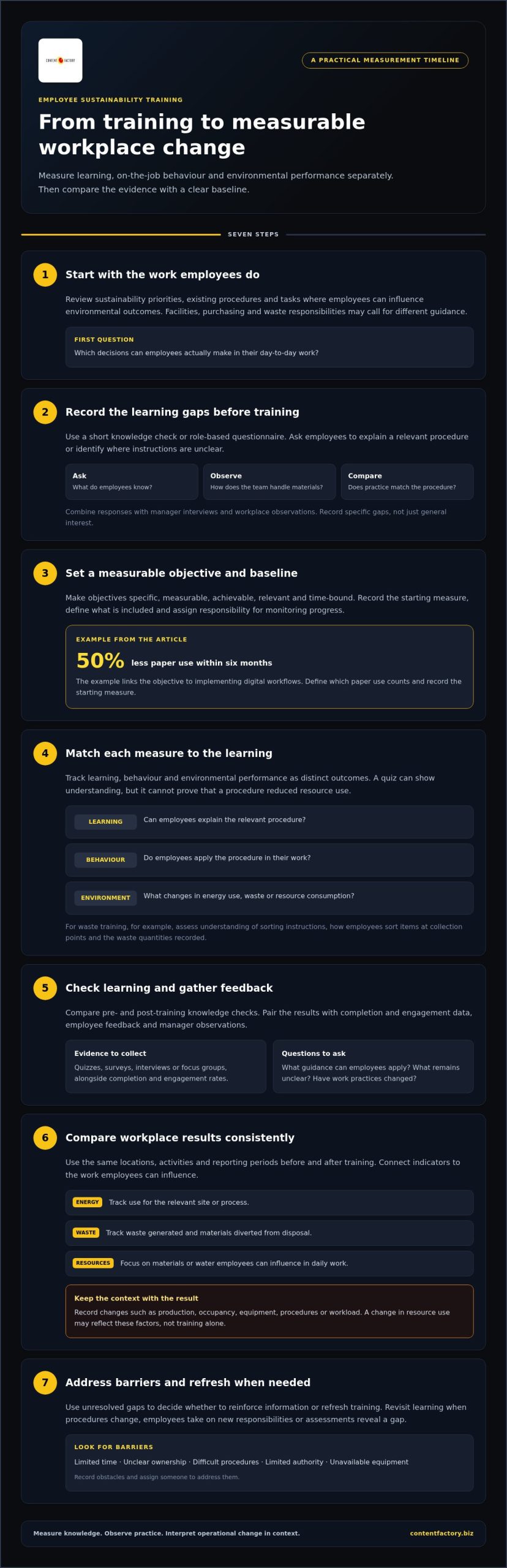
Start by identifying what employees need to learn, rather than choosing a course first. Review sustainability priorities, existing procedures and the tasks where staff can influence environmental outcomes. Facilities employees may need different guidance from colleagues who manage purchasing or waste collection. This assessment helps focus learning on decisions employees can actually make.
Use a short knowledge check or role-based questionnaire before training. Ask employees to explain a relevant procedure or identify where they need clearer instructions. Compare their answers with manager interviews and workplace observations. For example, observe how a team handles materials, then compare its practice with the organisation’s procedure. Record specific learning gaps, not just general interest.
Environmental assessments can help pinpoint which operational areas need attention. Review available information on energy and water use, waste generation and supply chain operations. Then connect the findings to the organisation’s sustainability strategy. If waste handling is a priority, identify the roles involved, the decisions they control and the training needed to support the objective.
For Singapore employers asking which regulations require training, first identify the environmental requirements relevant to the organisation’s activities and roles. Determine what instruction those requirements and workplace procedures call for. Do not assume one general course covers every obligation.
There is no single training price that applies to every organisation. Costs depend on factors such as participant numbers, customisation, delivery format and assessment scope. Define the learning need and intended audience first, then compare proposals for programmes that meet those requirements.
To assess outcomes, compare employees’ ability to apply relevant procedures with the baseline you recorded. Gather feedback through a short survey or manager discussion, and look for changes in work practices linked to the training. Consider other operational changes before attributing environmental results to learning alone.
Repeat or refresh training when procedures change, employees take on new responsibilities, or assessments reveal an unresolved gap. A one-off course may not address a new task or recurring confusion. Common barriers include limited time, unclear ownership and procedures that make the expected action difficult. Record these obstacles and assign someone to address them.
For organisations building a structured learning approach, ESG capability building and training can help connect employee learning with sustainability priorities.
Pre- and post-training assessments can establish a baseline and help evaluate changes in employee knowledge and behaviour. Focus assessments on procedures and environmental decisions relevant to each role, so the comparison reflects the learning need. Assess effectiveness using knowledge checks, engagement and completion rates, and qualitative feedback. Consider the measures together to see whether the programme reached participants and whether they found the instruction useful.
Post-training quizzes can help reinforce sustainability knowledge. Gather employee feedback through surveys, interviews or focus groups. Ask which guidance they can apply, what remains unclear and whether workplace practices have changed. Compare responses with the initial assessment and manager observations. Use unresolved gaps to decide whether to reinforce key information or refresh the training.
2. Measuring training outcomes and environmental impact
Assess learning, behaviour and environmental performance separately. A quiz can show whether employees understand a procedure, but it cannot prove that the procedure reduced resource use. Set an indicator for each outcome before training. For a waste session, these might be understanding sorting instructions, applying them at collection points and tracking waste quantities.
Make sustainability objectives specific, measurable, achievable, relevant, and time-bound. For example, an organisation could aim to reduce paper use by 50% within six months by implementing digital workflows. Record the starting measure, define which paper use counts, and assign responsibility for monitoring progress. This gives employees a clear objective and managers a practical way to review progress.
Choose indicators that match the learning. Link energy optimisation training to energy use for the relevant site or process. Connect waste-minimisation learning with waste generated and materials diverted from disposal. For resource-management training, focus on the materials or water employees can influence in their daily work.
Keep comparisons consistent by using the same locations, activities and reporting periods before and after training. Record relevant operational changes, such as changes in production or occupancy. A drop in total energy use may reflect reduced activity rather than changed employee behaviour. Context helps managers interpret results without overstating the training’s impact.
Design employee training for sustainability practices around observable work decisions. Assess learning with a short, task-specific knowledge check, then review whether employees apply the procedure. For example, ask staff to identify the correct waste stream for an item, then observe how they sort it at the collection point. Pair this evidence with completion and engagement rates, and employee feedback.
Evaluate employee training for sustainability practices alongside operational measures, but do not attribute every change to the course. Equipment upgrades, revised procedures and workload shifts can also affect performance. Record these changes with the results. If employees understand the material but cannot apply it, investigate barriers such as unclear responsibility, limited authority or unavailable equipment.
Set review points that match the objective’s timeframe. A paper-use target with a six-month deadline needs progress checks before the deadline, not just a final comparison. Discuss findings with the relevant team, identify what supports or blocks action, and adjust the learning or workplace process. This makes measurement useful for the next decision.
A practical scorecard pairs a learning measure, a behaviour measure, and an environmental indicator. For example, combine knowledge-check results, observed sorting, and waste quantities. If you need help aligning sustainability goals with training measures, discuss a measurement approach suited to your organisation’s priorities.
3. Definition and scope of employee sustainability training
Employee sustainability training is planned learning that equips staff to understand and act on an organisation’s sustainability priorities. Its scope includes the knowledge, judgement, and practical skills needed for relevant work decisions. It is broader than an awareness message, but narrower than transferring responsibility for the whole sustainability agenda to every employee.
A useful boundary is the connection between a business priority and an employee’s sphere of influence. If responsible procurement is a priority, employees involved in purchasing need guidance on applying the organisation’s criteria. Colleagues who do not make those decisions may need to understand the policy’s purpose and where to direct supplier questions. Match the depth of learning to each role’s authority.
Define the scope by identifying the objective, affected work, required capability and decision owner. For example, a supplier-engagement objective may require employees to know what information to collect, how to record it and when to escalate an incomplete response. That is a specific capability, not a general instruction to “consider sustainability”.
Distinguish awareness, knowledge and application. Awareness helps staff recognise why a topic matters. Knowledge explains relevant concepts and organisational expectations. Application enables employees to use that understanding in a real task. A course can address all three, but assessment should match its intended scope. A policy recall check cannot demonstrate sound judgement in a supplier discussion.
Scope should also reflect the organisation’s sustainability priorities across environmental, social and economic considerations. A proposed materials change, for instance, may affect resource use, worker practices and operating decisions. Employees need to know which considerations belong in their role, which trade-offs require discussion and who has authority to approve a change.
Set clear boundaries around technical and management decisions. Training can help an employee recognise an issue, follow an established process and raise a concern. It should not suggest that staff can make specialist assessments or approve changes beyond their remit. Clear escalation routes prevent responsibility from becoming vague across teams.
For a multi-site organisation, define a shared core and local application. The core can explain common principles and decision rules. Local examples can reflect different processes, suppliers or workplace arrangements. Keep the learning objective consistent while adapting scenarios to the work employees actually do. This avoids training that is either too generic or fragmented.
Document the scope in a short programme brief before selecting learning materials. State the objective, audience, expected decisions, boundaries and evidence of application. For example, staff might need to recognise a sustainability issue, record it using the organisation’s process and escalate it to the designated owner. This gives programme design and review a clear basis.
4. Sustainability learning programs and green roles
Build the programme around responsibilities, not a generic sustainability course. Map each business priority to the roles that influence it, then define what employees should do differently. A logistics team, for example, could practise reviewing dispatch decisions against the organisation’s resource-use criteria. The learning task should reflect a real decision, not rely on abstract principles alone.
Effective delivery combines explanation, practice and feedback. A facilitator can introduce a procedure, ask participants to work through a realistic scenario, then discuss where judgement or escalation is needed. Managers can reinforce the lesson during routine work reviews. This gives employees a chance to test their understanding before applying it independently.
A practical programme for a Singapore SME could combine shared sustainability learning with role-based exercises. Retail staff might consider how inventory handling affects avoidable packaging, while supervisors discuss how to raise recurring issues through internal processes. This is an example of programme design, not a claim about a particular company or measured result.
Create green roles by assigning clear responsibilities, rather than adding an undefined title. A sustainability lead might coordinate priorities, gather updates from teams and bring unresolved decisions to management. A cross-functional green team can contribute operational knowledge, but its remit should specify what it can recommend and who approves changes.
Senior leaders need to participate in a visible way. They can explain why a priority matters, make time for learning, and follow the same decision principles expected of employees. Managers can translate those principles into team routines. For example, a monthly operational review could include a discussion of one sustainability initiative and the obstacles staff encountered.
Build relevant practices into role expectations. Job descriptions can identify responsibilities such as recording resource issues or following a waste procedure. Performance conversations can use specific examples of how employees apply those responsibilities. Recognition can acknowledge useful contributions, such as identifying a process problem, without rewarding superficial participation or unsupported environmental claims.
Give employees a path from learning to greater responsibility. Someone who identifies recurring issues could contribute to a team review or help explain a procedure to colleagues. Keep specialist responsibilities clear, with appropriate decision authority and management oversight. This supports progression without implying that every employee needs to become a sustainability specialist.
Review the programme when priorities, roles or operating procedures change. Gather questions from managers and employees, identify unclear guidance and update the relevant learning activity. A simple programme record can capture its objective, audience, owner and follow-up actions. This helps leaders connect learning with implementation and decide what needs attention next.
Support this progression with learning tailored to job roles and aligned with the organisation’s sustainability objectives. General skills training can reach all employees, while targeted training addresses specific roles. Delivery can include e-learning, workshops or on-the-job training, covering energy optimisation, waste minimisation and sustainable resource management.
E-learning courses can produce 85% less CO2 than traditional campus-based courses. Dedicated sustainability roles or teams can identify, devise, and implement green initiatives. A green team or sustainability committee can promote and implement sustainable practices, while monitoring progress and employee involvement.
5. What sustainability practices should employee training cover?
Choose practices that connect environmental, social and economic priorities with employees’ actual decisions. Start by mapping each company objective to a work activity. For example, an office team can learn to reduce avoidable energy use, while a warehouse team focuses on materials handling and waste prevention.
Energy training should focus on actions employees can influence. In a home-office programme, this could include switching off equipment when it is not needed and choosing energy-efficient devices. A company may set a 20% home-office energy reduction target, supported by practical guidance and clear measurement boundaries. Treat this as an organisational goal, not a guaranteed result.
Waste training should show employees what to do at the point of disposal. Explain how to separate the waste streams available at each workplace, reduce unnecessary packaging and reuse materials where operations allow. A Singapore office could use its own labelled collection points for a short demonstration, rather than relying on broad advice staff cannot apply.
Resource management covers more than electricity. Employees can learn to avoid unnecessary printing, use materials efficiently and report leaks or equipment problems through established workplace channels. Procurement teams may need guidance on considering resource use when reviewing purchases. Choose examples that reflect the company’s processes and the decisions each role can make.
Include social and economic considerations alongside environmental actions. A sustainability decision can affect workers, suppliers, customers and operating costs. For example, a purchasing discussion can examine whether a proposed change reduces material use while maintaining product quality and safe working conditions. Training should help employees recognise these trade-offs and know when to escalate a decision.
Connect every topic to a company objective. If reducing waste is a priority, explain the relevant procedure and employees’ responsibilities. If efficient energy use is the priority, demonstrate the practices expected in offices or operational areas. Linking the objective to a daily task makes learning specific without asking every employee to solve the entire sustainability agenda.
Keep the content practical. Use a workplace scenario, demonstrate the correct action and give employees a chance to apply it. For example, ask a team to identify avoidable material use in a routine task, then discuss which changes fall within its authority. This can reveal process barriers that a presentation alone may miss.
Before designing a course, list the company’s sustainability objectives, the practices that support them, and the roles responsible for those practices. Prioritise topics where employees have a clear opportunity to act. To shape learning around your organisation’s sustainability priorities, Contact Us.
ContentFactory: ESG Readiness & Materiality Assessments
ContentFactory helps organisations connect sustainability priorities with practical capability building. An ESG Readiness & Materiality Assessment can clarify which topics matter to your business, where existing processes have gaps and what capabilities employees need to support your priorities. This is a useful next step when training objectives feel disconnected from operational needs or sustainability plans.
Where measurement needs a stronger foundation, GHG Emissions Calculation and Carbon Accounting can help structure emissions data, while Multi-Framework Sustainability Reporting supports reporting needs. These services can connect workforce learning with wider sustainability priorities, rather than treating training as a standalone activity.
If your organisation is defining its sustainability priorities or aligning staff development with them, explore ContentFactory’s ESG services and capability-building support.
Make sustainability learning part of how work gets done
Give sustainability learning a clear owner inside your organisation. That person can coordinate priorities across teams, identify decisions that need support and keep learning connected to operational changes. Without ownership, useful ideas can stall between a course and the workplace.
Treat employee training for sustainability practices as an operating capability, not a standalone event. Start by choosing one organisational priority and identifying who can influence it. Then set a practical next action, such as reviewing a procedure, clarifying responsibilities or including sustainability learning in an upcoming team plan.
ContentFactory can help your organisation connect its sustainability priorities with a structured readiness plan. Bring your current objectives and capability questions into a discussion, then decide what support fits your next step. Contact Us to discuss your sustainability priorities. A clear owner and a focused first action can give your programme a practical direction.
Frequently Asked Questions
How to measure the effects of training?
Measure whether employees apply what they learn to relevant work decisions, then interpret operational changes in context. For example, after a purchasing session, review whether sustainability criteria appear in supplier evaluations and discuss barriers with the team. Check for changes in related resource or waste data, while accounting for other process changes. This helps distinguish evidence of learning application from results driven by unrelated factors.
What is sustainability training?
Sustainability training helps employees understand how their work connects with an organisation’s environmental, social and economic priorities. It goes beyond general awareness by guiding people through decisions they encounter in their roles. For example, a purchasing employee might learn when to consider material use or supplier information, and when to refer a decision to a manager responsible for sustainability priorities.
How can employers assess employee sustainability training needs?
Review real work before choosing course topics. Walk through tasks with employees, ask managers where procedures cause confusion, and examine recurring issues such as avoidable material use or unclear waste handling. Then identify the roles making decisions connected to those issues and the knowledge that would help. Employee suggestions can reveal practical obstacles, such as unclear instructions, that a general course would not address.

Article by
Mayuresh Godse
Mayuresh Godse is a Singapore Certified Management Consultant and Business Strategist specializing in Sustainability, ESG, AI-driven Digital Transformation, and business growth. Based in Singapore, he writes about Sustainability, Digital Innovation, Business Strategy, and Content Marketing for global audiences.
Disclaimer
This article is provided by ContentFactory for general information only and is not legal, tax, accounting or financial advice. Regulations and government scheme criteria change; grant eligibility and quantum are set by the relevant Singapore agencies and assessed case by case, with no outcome guaranteed. Verify current requirements before acting.