

The wrong grant won’t rescue an unclear project. For Singapore SMEs, the first step is to define the business outcome, then check whether an enterprise singapore grant pathway fits the work, costs and timing.
If you’re unsure whether your project or planned expenses qualify, you’re not alone. The grant landscape changed on 30 September 2026: the EDGE Grant replaced the EDG, PSG and MRA for new applications, while previously approved projects continue under their existing arrangements. Choosing a pathway is now less about matching a familiar grant name and more about matching a ready-to-execute project to the right business area.
This guide explains the main routes to consider, the SME eligibility points and project costs to verify in current official guidance, and what to prepare before applying. You’ll also see why timing matters: don’t sign a vendor contract or make a payment before approval, and plan for the application and claims process from the outset. The goal is a sound project decision, not a funding application at any cost.
Key Takeaways
- From 30 September 2026, the EDGE Grant replaces EDG, PSG and MRA for new applications. Check current official guidance to identify the relevant activity and support rules.
- Assess business eligibility, project fit and expense eligibility separately. A promising project does not automatically make every cost claimable.
- Define the project outcome and gather supporting documents before applying through the Business Grants Portal, using Corppass.
- For an enterprise singapore grant, timing is critical: wait for approval before starting project work or making financial commitments, then keep records for the claims process.
- ESG readiness, carbon accounting, digital transformation and overseas expansion can be useful project themes to assess against the grant’s current business areas.
What Is an Enterprise Singapore Grant, and What Can It Support?
An enterprise singapore grant isn’t one universal fund available for any business expense. It refers to support under specific government programmes, each with its own purpose, eligibility conditions and assessment criteria. Enterprise Singapore, or EnterpriseSG, supports local businesses through different initiatives; its role and background are outlined by Enterprise Singapore (EnterpriseSG).
That distinction matters in 2026. The Enterprise Development Grant (EDG) and Market Readiness Assistance (MRA) previously served different needs: EDG supported business upgrading and transformation, while MRA focused on qualifying overseas expansion activities. From 30 September 2026, the EDGE Grant replaced EDG, the Productivity Solutions Grant (PSG) and MRA for new applications. Existing projects under the earlier grants continue to be processed. Confirm current programme names, scope and criteria in official guidance before planning around a grant.
For a general overview of government support for local businesses, watch this video:
What kinds of business projects might be relevant?
Start with the business change, not a list of purchases. A company might explore support for transformation, capability-building or market expansion. For example, a sustainability initiative could aim to strengthen emissions measurement and management; a digitalisation project could target more integrated operations. These are possible project themes, not confirmation that particular services or expenses qualify. Check the current programme’s eligible activities and costs.
For overseas growth, define the market objective and the work required to pursue it. Then verify which current pathway, if any, covers that project. A grant’s name or broad theme alone doesn’t establish fit.
Grant, project, and business outcome: how do they relate?
The project is the specific work your business proposes to carry out. The business outcome explains why that work matters, such as improving a process, building a capability or entering a market. The grant is a possible support route for eligible project activities, subject to programme rules and assessment.
Grant support is potential financial assistance for an eligible project, not guaranteed approval or funding. State the intended outcome clearly, then compare the project with current official criteria. That turns grant research from a broad search into a focused fit check, while keeping the business case sound even if support isn’t approved.
EDG or MRA? Match the Grant Pathway to Your SME Project
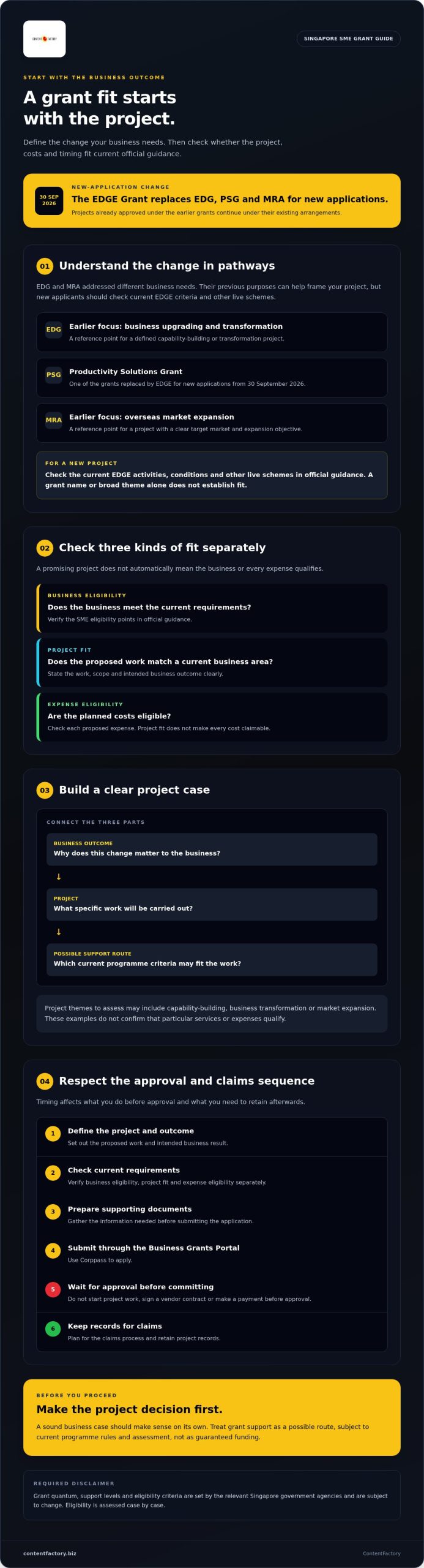
EDG and MRA addressed different business needs, so their names were never interchangeable. There’s also a critical 2026 update: from 30 September, the EDGE Grant replaced EDG, PSG and MRA for new applications. Existing projects under the earlier grants continue to be processed. For a new project, use EDG and MRA as reference points for its purpose, then check the current EDGE criteria and other live schemes in Enterprise Singapore Financial Support.
This comparison helps clarify which route historically aligned with a project and what to verify now. It’s a fit-check, not confirmation that a business or expense qualifies.
| Pathway | Project purpose | Likely fit to investigate | Preparation question | Official verification |
|---|---|---|---|---|
| EDG | Business upgrading, innovation, growth or transformation | A defined capability-building or transformation project | What business outcome will the project deliver, and what work is in scope? | For existing projects, confirm applicable EDG terms. For new applications, check relevant EDGE activities and conditions. |
| MRA | Overseas market expansion | A project with a clear target market and expansion objective | Which market, activities and project stages are involved? | Check current schemes and criteria. MRA is no longer open to new applications from 30 September 2026. |
When should an SME investigate EDG?
Consider EDG’s historical focus when a project aims to build capability, innovate, grow or transform the business. Before looking at funding, write down the project scope, business rationale and intended outcome. A broad ambition such as “improve operations” needs a defined work plan to support meaningful programme research. For more detail on its original scope, consult the planned Enterprise Development Grant guide; new applicants should assess the current EDGE pathway instead.
When should an SME investigate MRA?
MRA was designed around overseas expansion, making its purpose distinct from EDG. If the project concerns entering or developing an overseas market, clarify the target market and planned activities, then verify current eligible activities, markets and conditions officially. The MRA grant for market expansion guide can explain the pathway’s market-expansion context, but it shouldn’t be treated as an open route for new applications.
The practical rule is simple: match the project to its intended outcome, not to a familiar acronym. A sustainability or digitalisation initiative may support a wider transformation objective, but the project’s label alone doesn’t establish eligibility. Businesses shaping a digital transformation plan can also explore digital roadmap and implementation planning as a way to clarify scope and intended outcomes.
Is Your Business Ready to Apply for an Enterprise Singapore Grant?
A readiness checklist can expose gaps before they become application problems. It isn’t an official eligibility test, and a well-prepared application still doesn’t guarantee approval. For new applications from 30 September 2026, check the EDGE Grant’s current rules, since it replaced EDG, PSG and MRA for new projects. Existing projects under the earlier grants continue to be processed.
Assess three questions separately: does the business meet the programme’s conditions, does the project fit its purpose, and are the proposed expenses eligible? A “yes” to one doesn’t settle the others.
What should be clear before researching eligibility?
Define the business problem and the work proposed to address it. Name the project lead, set a realistic timeline, and describe the intended outcome in terms the business can track. For example, explain what capability or process should change, rather than relying on a broad ambition such as “become more sustainable.”
Then identify the people, resources, dependencies and decisions needed to deliver the work. If a project depends on a vendor, internal data or leadership approval, flag that early. This is practical preparation, not a substitute for programme criteria.
Apply a simple test: would the project still make sense for the business if no grant were approved? If the answer is no, revisit the business case before investing time in an application. Grant support may help a viable project proceed; it shouldn’t be the reason the project exists.
What evidence and eligibility details should SMEs verify?
Use current official guidance to check the company’s eligibility, project requirements and eligible costs separately. For EDGE, the stated SME criteria include annual group sales turnover of no more than S$100 million or 200 or fewer employees, Singapore registration and operations, and at least 30% local shareholding. Confirm how these criteria apply to your company and project before relying on them.
Applications are made through the Business Grants Portal using Corppass. Review the live application process to see which business records, quotations, project details or other evidence are requested; don’t assume that a document list from an older scheme still applies.
- Business: Confirm registration, Singapore operations, ownership and applicable SME criteria against current official guidance.
- Project: Document the problem, scope, accountable lead, timeline, dependencies and intended outcome.
- Expenses: Check each proposed cost against the programme’s current eligible-cost rules.
- Open questions: Label anything unverified as a question, not a confirmed requirement or assumption.
This discipline makes an enterprise singapore grant application a structured business decision, not a funding-led guess.
From Application to Claims: Understand the Grant Process Before Committing
A grant project doesn’t end when the application is submitted. Treat the full sequence as one managed workstream: confirm programme fit, prepare the scope and evidence, apply, wait for the decision, deliver the approved work, then submit claims under the applicable rules.
For new EDGE Grant applications, approval must come before project commencement. The current guidance defines commencement to include signing vendor contracts or making payments. Don’t assume that planning discussions or an application submission count as approval. Verify exactly what can happen, and when, before making commitments.
What happens during application preparation and review?
Build a coherent application around the business need, proposed activities and intended outcome. Assemble the supporting information and documents requested by the current programme, checking that the scope, timeline and costs tell a consistent story. Follow the official instructions for the relevant scheme and application channel. Procedures can change, so don’t rely on an old checklist or a process described for a different grant.
Submission is not approval. Wait for the formal decision and review its terms before proceeding. If approved, use the decision and approved scope as the baseline for project delivery. If the application is not approved, reassess the business plan rather than committing on the assumption that support will follow.
How can SMEs reduce post-approval compliance risk?
Keep a clear record from the start. Retain relevant project decisions, delivery evidence, correspondence and expenditure records in an organised file. This makes it easier to demonstrate what was approved, what was delivered and how claimed costs relate to the project.
Before work begins, check the approval conditions, claim requirements, submission timelines and any reporting obligations in the current official guidance. If the project scope, delivery plan or costs need to change, don’t treat the adjustment as automatically covered. Find out how changes must be handled before proceeding, and document the decision.
- Confirm fit: Match the business need and project to current programme rules.
- Prepare and apply: Submit the requested scope, rationale and supporting documents through the stated channel.
- Wait for approval: Check the decision and conditions before starting work or making commitments.
- Deliver and claim: Keep evidence of delivery and expenditure, then follow the applicable claims process.
This is where grant compliance support can help connect project structure, delivery records and claims preparation, without implying approval is assured. To strengthen your project and compliance planning, explore grant compliance support.
Build a Grant-Ready Growth Plan with Clear Next Steps
Grant readiness starts with a business priority, not an application form. Identify the outcome the company needs, define the project that can deliver it, test that project against a current support pathway, and verify the official rules before preparing an application. This sequence keeps the plan grounded in operational value, whether or not grant support is available.
Potential project themes include ESG readiness, carbon accounting, digital transformation and overseas market expansion. Treat these as starting points for project design, not proof that a programme will support the work. A strong enterprise singapore grant plan connects each activity to a specific business need and checks the live criteria before any commitment.
How can an SME connect grant research to its strategy?
Start with the operating or growth priority. For example, if the business needs stronger sustainability oversight, define the decisions or capabilities it wants to improve before exploring an ESG-related project. If the priority is to develop an overseas presence, specify the market objective and the work involved. In both cases, separate the project’s strategic value from possible grant support. The project should make sense on its own merits.
For businesses assessing sustainability priorities, the ESG readiness assessment guide can help frame the work without assuming that a particular activity qualifies for funding.
What should a business do next?
Write a short project brief before opening an application. Record the objective, scope, accountable owner and intended outcome. Add a timeline, key dependencies and a list of eligibility or expense questions that still need official confirmation. Keep verified programme requirements separate from assumptions; that simple distinction can prevent a planning guess from becoming a costly commitment.
- Define: State the business problem and desired outcome.
- Scope: List the work, resources, owner and delivery dependencies.
- Verify: Check current programme fit, company conditions and expense rules through official guidance.
- Prepare: Gather the evidence and records requested for the application and future claims.
If emissions measurement is part of the project, consult the SME carbon accounting guide for relevant planning context. It can inform project design, but current programme criteria determine whether specific activities or costs may qualify.
ContentFactory’s grant advisory can support project structuring and post-approval audit and compliance planning. If you’d like to discuss grant readiness and project planning, explore a project-planning discussion. Advisory can help clarify decisions and compliance; it can’t guarantee eligibility, approval or funding.
Turn Grant Research into a Stronger Business Plan
The right enterprise singapore grant pathway starts with a defined business outcome, not a search for funding. Match the project to its purpose, check current official criteria, and confirm eligibility for the business, project and expenses separately. For new applications, remember that EDGE replaced EDG, PSG and MRA from 30 September 2026; verify the latest programme guidance before acting.
A viable project should make business sense even without grant support. Clear scope, ownership, evidence and delivery records can help you prepare responsibly, from application through claims. ContentFactory’s grant advisory includes project structuring and post-approval compliance support, backed by certified management consultants experienced in Singapore’s business landscape.
If you’d like support turning a business priority into a structured, grant-ready project, discuss your project and grant readiness with ContentFactory. Make the next step a stronger plan, and pursue support only where the current rules and your business objectives align.
Frequently Asked Questions
What is the Enterprise Singapore grant for SMEs?
An Enterprise Singapore grant is programme-specific support for eligible business projects, not a universal fund for any expense. From 30 September 2026, the EDGE Grant replaced EDG, PSG and MRA for new applications. It supports eligible activities across areas such as digitalisation, business strategy, internationalisation and sustainability. A project must meet the current programme requirements, and applying doesn’t guarantee approval or funding. Check official guidance for the latest scope and conditions.
What is the difference between EDG and MRA?
EDG previously supported projects focused on upgrading, innovation, growth and business transformation. MRA focused on qualifying activities for overseas market expansion. They served different purposes, not interchangeable versions of the same grant. From 30 September 2026, both were replaced by the EDGE Grant for new applications. Existing projects under the earlier schemes continue to be processed. For a new project, check current EDGE criteria rather than assuming the old pathways remain open.
Who is eligible for an Enterprise Singapore grant?
Eligibility depends on the current programme, the company and the proposed project. Under the stated EDGE SME criteria, a company must be registered and operating in Singapore, with at least 30% local shareholding. It must also have group annual sales turnover of no more than S$100 million or employ 200 or fewer people. Treat these as criteria to verify, not a complete eligibility test. Project fit and eligible costs require separate checks.
Can a Singapore SME apply for more than one grant?
It may be possible to explore different support programmes, but don’t assume that multiple applications or support for overlapping costs are allowed. EDGE consolidates EDG, PSG and MRA for new applications, with a total support cap of S$100,000 per company per year across EDGE-supported activities. Other programmes have their own terms. Check the current official rules for each pathway, including any conditions on combining support or claiming the same project costs.
What projects can an Enterprise Singapore grant support?
Potential projects may involve automation and digitalisation, business strategy, financial management, innovation, internationalisation, standards or sustainability. For example, an SME might define a digital transformation project around a specific operational outcome, or assess a sustainability initiative against current criteria. These themes don’t mean every activity or expense qualifies. The project needs a clear business rationale, and you should verify eligible activities and costs in the relevant official guidance before applying.
When should a business apply for a grant?
Apply before commencing the project, and wait for approval before making commitments. Under the current guidance, commencement includes signing vendor contracts or making payments. First define the project scope, objective and intended business outcome, then check programme fit and prepare the requested documents. Applications are made through the Business Grants Portal using Corppass. Confirm the current application process and timing requirements officially, since rules may differ across programmes or change.
What happens after an Enterprise Singapore grant is approved?
After approval, review the decision and conditions, then deliver the project within the approved scope. Keep records of project decisions, delivery evidence and relevant expenditure so you can support the claims process. Check the current claim requirements, submission timelines and any reporting obligations. If the scope, activities or costs need to change, follow official guidance before proceeding. Approval is a milestone, not the end of your responsibilities.

Article by
Mayuresh Godse
Mayuresh Godse is a Singapore Certified Management Consultant and Business Strategist specializing in Sustainability, ESG, AI-driven Digital Transformation, and business growth. Based in Singapore, he writes about Sustainability, Digital Innovation, Business Strategy, and Content Marketing for global audiences.
Disclaimer
This article is provided by ContentFactory for general information only and is not legal, tax, accounting or financial advice. Regulations and government scheme criteria change; grant eligibility and quantum are set by the relevant Singapore agencies and assessed case by case, with no outcome guaranteed. Verify current requirements before acting.