

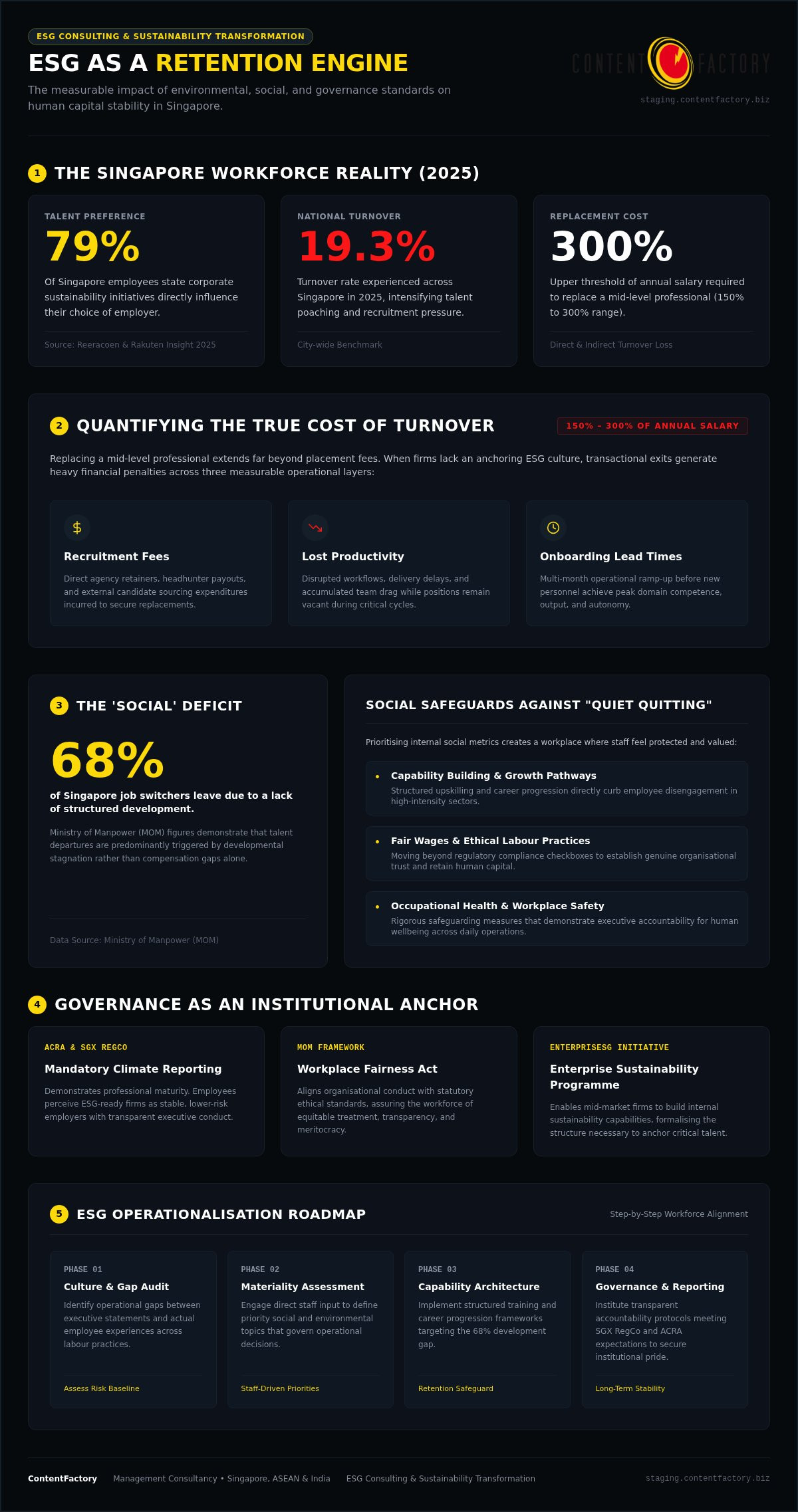
79% of Singapore employees now state that corporate sustainability initiatives directly influence their choice of employer. You’ve likely felt the pressure of the 19.3% turnover rate seen across the city-state in 2025. Replacing a mid-level professional costs your business between 150% and 300% of their annual salary when you account for recruitment fees and lost productivity. It’s a heavy price to pay for a transactional culture that fails to engage the modern workforce.
One of the most overlooked benefits of ESG for employee retention is its ability to anchor your talent through shared purpose rather than just a monthly paycheck. ContentFactory understands that for a Singapore SME, sustainability isn’t about abstract ideals; it’s about operational resilience and human capital stability. Many firms currently struggle with talent poaching while clients demand proof of social and environmental commitment.
This article provides a pragmatic roadmap for your organisation to integrate environmental, social, and governance standards into core operations. You’ll learn how to move beyond simple compliance to build an employer brand that attracts Gen Z and Millennial talent while delivering a measurable ROI on your sustainability initiatives.
Key Takeaways
- Learn how to transform your organisational culture from a transactional workplace into a purpose-led environment that attracts and secures top talent.
- Identify how strengthening the ‘Social’ pillar through capability building and ethical labour practices reduces the risk of “quiet quitting” and talent poaching.
- Discover the measurable benefits of ESG for employee retention by quantifying reductions in recruitment costs and improvements in workforce productivity metrics.
- Understand the role of Materiality Assessments in building accountability and proving to employees that their specific concerns drive executive decision-making.
- Follow a practical roadmap to operationalise ESG by identifying cultural gaps and defining material social topics with direct staff input.
Why ESG has become a critical lever for retention in Singapore
ESG-led retention is the strategic alignment of organisational transparency and employee values. It moves beyond superficial “green” initiatives to embed purpose into the daily operations of your business. By adopting a robust environmental, social, and governance framework, you signal to your workforce that their contribution supports a sustainable and ethical future. This isn’t just a moral choice; it’s an operational necessity for the mid-market.
The “Great Realignment” in Singapore has fundamentally shifted the power dynamic in the talent market. Recent data from the 2025 Reeracoen and Rakuten Insight whitepaper shows that 79% of Singapore employees consider corporate sustainability a primary factor when choosing an employer. High-calibre professionals are prioritising ethics over salary increments. This makes the benefits of ESG for employee retention a critical component of your human capital strategy. If your organisation remains purely transactional, you’ll continue to lose talent to competitors who offer a clear sense of purpose.
Consider the financial impact of turnover versus the investment in sustainability. Replacing a mid-level professional in Singapore typically costs between 150% and 300% of their annual salary. These costs include recruitment fees, lost productivity, and onboarding lead times. Investing in ESG readiness provides a measurable alternative to this cycle of loss. It builds a foundation of trust that prevents talent poaching before it starts, ensuring your firm remains resilient in a competitive landscape.
The shift from transactional to purpose-driven work
Gen Z and Millennials in Singapore demand more than a paycheck. They seek employers whose values mirror their own. ESG principles provide a “North Star” for employees during periods of market volatility and economic uncertainty. When your firm defines its material impact, staff feel a sense of ownership over the outcome. This purpose-led environment transforms your workplace from a temporary stepping stone into a long-term career destination. It builds a resilient employer brand that is difficult for competitors to disrupt through salary alone.
Regulatory pressure as a catalyst for internal stability
Regulatory requirements from ACRA and SGX RegCo act as a signal of stability to your internal team. When your firm proactively implements mandatory climate reporting or aligns with the Workplace Fairness Act, you demonstrate professional maturity. Employees perceive “ESG-ready” firms as lower-risk employers with superior governance. They take pride in working for an organisation that prioritises ethical conduct and transparency. This internal professional pride is a powerful driver of stability, anchoring your staff through institutional trust.
Strengthening the ‘Social’ pillar to build organisational trust
The Social pillar represents the human-centric metrics of a sustainable business. While many firms focus heavily on environmental targets, the “S” in ESG governs the internal relationships that determine your firm’s stability. It extends far beyond basic diversity initiatives to include occupational health, workplace safety, and structured capability building. When you prioritise these factors, you create a culture where staff feel protected and valued rather than exploited.
One of the most immediate benefits of ESG for employee retention is the reduction in “quiet quitting” within high-intensity sectors like logistics and manufacturing. Fair wages and ethical labour practices aren’t just compliance checkboxes; they’re the foundation of organisational trust. Employees who see their firm actively managing social risks are less likely to disengage or seek alternative employment. You can identify your specific social risk factors through a targeted assessment of your current labour practices.
Singaporean mid-market firms often face acute talent shortages. Recent Ministry of Manpower (MOM) data indicates that 68% of job switchers cite a lack of structured development as their primary reason for leaving. By aligning with the Enterprise Sustainability Programme, your business can build the necessary internal competencies to remain competitive. This commitment to growth signals that you’re investing in the individual’s future, not just the company’s bottom line.
Investing in human capital through capability building
Training your staff in sustainability reporting increases their internal value and professional utility. When employees understand how to track GHG emissions or manage social metrics, they become stakeholders in the firm’s ESG journey. Creating clear career pathways through ESG leadership roles encourages long-term loyalty. You can accelerate this transition by implementing a structured ESG Capability Building and Training programme that empowers your middle management to lead sustainability initiatives.
Ethical supply chain management and its impact on staff morale
Modern professionals, particularly in logistics and retail, take immense pride in working for firms with ethical supply chains. Monitoring your Scope 3 social impacts ensures that your business isn’t complicit in labour abuses elsewhere in the value chain. This transparency prevents the reputational damage that often triggers mass staff flight. For a Singaporean SME, proving ethical sourcing is a powerful differentiator that anchors your best talent. It demonstrates that your organisation values human dignity across every touchpoint of the operation.
Measuring the ROI of ESG-led retention strategies
Quantifying the financial return of sustainability initiatives often focuses on energy efficiency. However, the most significant protection of your bottom line comes from stabilising your workforce. Every 10% reduction in turnover can save an SME hundreds of thousands in hidden costs. These savings manifest through reduced recruitment fees, lower onboarding expenses, and the preservation of institutional knowledge. Understanding the benefits of ESG for employee retention requires a shift from viewing sustainability as a cost to seeing it as a profit-protection mechanism.
ESG maturity directly correlates with employee productivity metrics. Workforce engagement increases when staff recognise that their organisation prioritises ethical conduct and social responsibility. This engagement translates into higher output and lower absenteeism. Furthermore, firms with robust ESG profiles often secure a lower cost of capital from Singaporean financial institutions. This financial advantage allows your business to reinvest surplus capital into enhanced employee benefits, creating a competitive advantage that anchors top talent.
Moving from qualitative “culture” to quantitative ESG data
You cannot manage what you do not measure. Moving beyond vague notions of “company culture” requires the integration of hard data. Tracking retention rates alongside social metrics and a rigorous GHG emissions calculation creates a culture of precision and accountability. This data-driven approach ensures that sustainability targets are not just aspirational. You should establish clear KPIs that reward department heads for meeting both emissions targets and talent retention goals. Using credible employee engagement metrics for ESG reporting helps you avoid surface-level data and provides a true reflection of organisational health.
The impact on B2B lead generation and talent attraction
A strong ESG profile acts as a magnet for high-intent talent. These professionals are typically more resilient and stay with an organisation longer because their personal ethics align with the corporate mission. This stability is a key differentiator when bidding for contracts with MNCs or government agencies in Singapore. Top-tier clients prefer vendors with stable, purpose-led teams because high turnover indicates operational risk. By integrating ESG into your brand identity, you create a virtuous cycle where reputation attracts talent, and talent stability secures long-term revenue. This strategic alignment ensures your firm remains a preferred partner in the regional supply chain.
Building a culture of accountability through governance
Transparency in executive decision-making is the ultimate retention tool for the Singaporean mid-market. It eliminates the ambiguity that often leads to staff frustration and voluntary turnover. When your leadership is accountable to formal governance standards, you remove the “managerial bias” that often clouds performance reviews and career progression. This structural clarity prevents the development of toxic work environments and significantly reduces the risk of employee burnout. A robust materiality matrix identifies the intersection of business goals and employee well-being.
One of the primary benefits of ESG for employee retention is the institutional trust created through formalised “G” pillars. In light of the Workplace Fairness Legislation (WFA) passed in 2025, SMEs must move beyond informal HR practices. Governance provides the necessary framework to codify grievance handling and whistleblowing protocols. These structures protect the psychological safety of your workforce and ensure that your organisation remains an attractive, low-risk employer for high-calibre talent.
Using materiality to prioritise employee-centric ESG goals
Engaging your workforce in the materiality process is essential for increasing organisational buy-in. It allows you to identify the specific social issues that directly impact your retention rates, such as work-life balance, fair pay structures, and flexible work arrangements. By conducting a formal Materiality Assessment, you prove to your staff that their concerns drive the firm’s strategic direction. This collaborative approach transforms ESG from a top-down mandate into a shared mission. It ensures your sustainability resources are allocated to the specific areas that matter most to your human capital.
Governance as a shield against corporate misconduct
Governance provides the framework for long-term professional security. Clear anti-corruption policies and transparent board structures ensure that employees can perform their duties without fear of ethical compromise. This level of protection is a significant factor in securing the loyalty of Gen Z and Millennial professionals who prioritise integrity. Additionally, diverse board representation fosters a culture of innovation that resonates with a modern, globalised workforce. The “G” in ESG is the foundation that makes your environmental and social initiatives credible. Without strong governance, your sustainability efforts are often perceived as superficial, which can lead to a rapid loss of trust and higher turnover.
Operationalising ESG to secure your firm’s human capital
Operationalising sustainability requires a shift from high-level reporting to daily execution. You shouldn’t start with a 100-page sustainability report that lacks an agile starting point. Instead, follow a four-step pragmatic roadmap to secure your human capital. First, conduct an ESG Readiness Assessment to identify specific cultural and operational gaps. This diagnostic tool highlights where your organisation fails to meet modern workforce expectations. Second, define material social and governance topics with direct staff input. Third, integrate ESG metrics into existing HR and operational systems to track measurable progress. Finally, communicate this progress transparently to your internal team first. Transparency builds the trust necessary to realise the benefits of ESG for employee retention.
Moving from a transactional workplace to a purpose-led environment isn’t an overnight change. It requires a systematic integration of sustainability goals into your firm’s DNA. When employees see their feedback reflected in corporate policy, their engagement levels rise. This alignment ensures your business remains resilient against talent poaching. By following these steps, you transform ESG from a compliance burden into a strategic lever for human capital stability.
The role of ESG readiness in talent strategy
A gap analysis must include human capital risks to be effective. Traditional audits often ignore the “S” pillar’s impact on staff loyalty. By identifying deficiencies in workplace safety, capability building, or fair pay, you can address the root causes of turnover. This moves your talent strategy from simple compliance to a genuine competitive advantage in the Singapore labour market. An ESG Readiness and Gap Analysis provides the roadmap to bridge these vulnerabilities and secure your best performers.
Next steps for Singaporean mid-market leaders
Bridging the vision-execution gap requires senior-led expertise. Singaporean mid-market leaders don’t need abstract consulting; they need a hands-on extension of their leadership team. ContentFactory helps SMEs operationalise these strategies without the excessive costs or detached approach of global firms. We focus on “doing” over “reporting,” ensuring your sustainability initiatives deliver tangible ROI. It’s about building a resilient, purpose-led organisation that retains top talent through measurable, ethical action. Our team provides the execution engine your business needs to navigate complex reporting frameworks while prioritising your people.
Securing human capital through operational excellence
Integrating ESG principles transforms your organisational culture from a transactional workplace into a purpose-led environment. You’ve discovered how the benefits of ESG for employee retention manifest through reduced recruitment costs, improved employer branding, and higher organisational trust. By prioritising the Social and Governance pillars, your business builds a resilient foundation that attracts top-tier talent while meeting rigorous regulatory demands.
ContentFactory specialises in ESG transformation for Singaporean SMEs and mid-market firms. Led by Singapore Certified Management Consultant Mayuresh Godse, our team prioritises pragmatic, results-led execution over theoretical reporting. We provide the strategic roadmap required to turn sustainability commitments into tangible operational growth and workforce stability.
Your firm’s future resilience depends on the strength of its psychological contract with employees. Start your transformation today to secure your most valuable assets and drive long-term commercial success.
Frequently Asked Questions
How does ESG reporting specifically help with employee retention?
ESG reporting creates a framework of transparency that proves your company’s commitment to ethical standards. When your business publishes measurable progress on social and environmental goals, it strengthens the psychological contract with your workforce. One of the key benefits of ESG for employee retention is that it moves the relationship from a transactional paycheck to a shared purpose. This alignment reduces the likelihood of staff seeking alternative employment based solely on salary increments.
Is ESG only for large MNCs, or can Singapore SMEs benefit too?
Singapore SMEs face significant pressure from tier-one corporate clients who require verified emissions and social data for their own Scope 3 reporting. SMEs benefit by using ESG to compete with larger firms for high-calibre talent. Integrating these principles allows organisations to project a sophisticated image that appeals to professionals prioritising ethical conduct. It transforms a mid-market firm into a preferred employer in a highly competitive regional labour market.
What are the most important “Social” metrics for retaining staff?
The most impactful social metrics for retention include workplace safety, fair wage structures, and structured capability building. Tracking employee turnover rates alongside training hours provides a clear view of how your investment in human capital influences loyalty. You should also monitor diversity data and flexible work arrangement requests. These metrics provide the hard data needed to identify cultural gaps and implement targeted interventions that prevent talent poaching and disengagement.
Can implementing ESG help reduce recruitment costs?
Implementing ESG directly reduces recruitment costs by lowering voluntary turnover and improving your employer brand. Replacing a professional in Singapore can cost up to 300% of their annual salary in lost productivity and fees. By realising the benefits of ESG for employee retention, you anchor talent through shared values and transparent governance. This stability means you spend less on headhunters and onboarding, allowing you to reinvest those savings into core operational growth.
How does a materiality assessment involve employees?
A materiality assessment involves employees by treating them as primary stakeholders during the identification of significant business impacts. You gather direct input through surveys and workshops to determine which social and environmental issues matter most to your team. This process ensures that your ESG strategy addresses the actual concerns of your workforce, such as work-life balance or ethical sourcing. Including staff in these decisions increases buy-in and proves that leadership values their perspective.
What is the link between corporate governance and employee trust?
Corporate governance provides the formal structures that ensure executive accountability and ethical conduct. Clear whistleblowing policies, anti-corruption protocols, and transparent decision-making processes build the psychological safety necessary for employee trust. When your workforce knows that the organisation operates under a rigorous governance framework, they feel more secure in their long-term career prospects. This structural integrity prevents toxic environments and ensures that performance is rewarded through fair, unbiased systems rather than managerial bias.
How long does it take to see retention benefits from ESG initiatives?
Initial improvements in employee morale are often visible immediately after communicating a clear ESG roadmap. However, measurable retention benefits and recruitment cost reductions typically manifest over 12 to 18 months as these initiatives become embedded in your culture. This timeline allows for the completion of a full materiality cycle and the implementation of structured capability building. Consistency is essential; your team must see that ESG is a permanent strategic shift rather than a temporary exercise.

Article by
Mayuresh Godse
Mayuresh Godse is a Singapore Certified Management Consultant and Business Strategist specializing in Sustainability, ESG, AI-driven Digital Transformation, and business growth. Based in Singapore, he writes about Sustainability, Digital Innovation, Business Strategy, and Content Marketing for global audiences.
Disclaimer
This article is provided by ContentFactory for general information only and is not legal, tax, accounting or financial advice. Regulations and government scheme criteria change; grant eligibility and quantum are set by the relevant Singapore agencies and assessed case by case, with no outcome guaranteed. Verify current requirements before acting.
One thing worth checking on the tool side: if the disclaimer is switched on globally, the grant caveat already written into your Global Writing Instructions will appear as well, so grant articles will carry the same point twice. Remove the required-disclaimer section from the instructions file if you enable this one.