

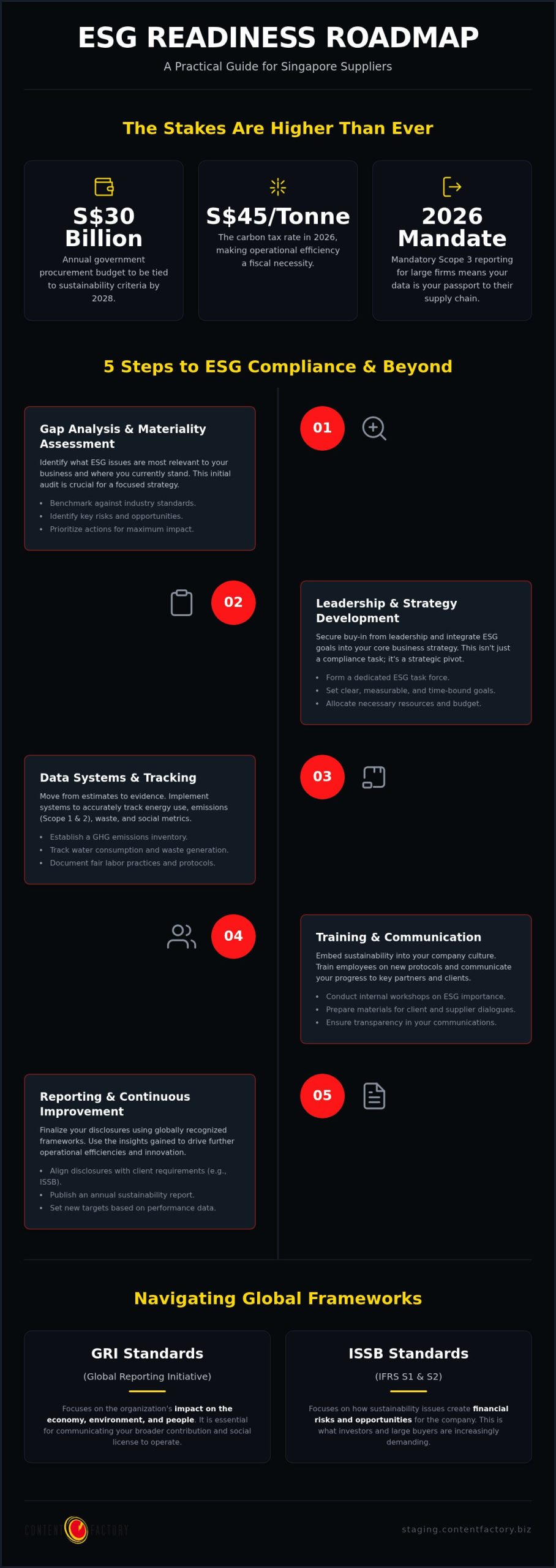
By 2028, every cent of the Singapore government’s S$30 billion annual procurement budget will be tied to environmental sustainability criteria. For mid-market firms, this isn’t a distant policy goal; it’s a fundamental shift in how contracts are won and lost. You’ve likely noticed that high-level ESG compliance for Singapore suppliers has evolved from a “nice-to-have” badge into a non-negotiable quality standard. The pressure is mounting as large-cap partners demand Scope 3 data and the carbon tax jumps to S$45 per tonne in 2026. It’s natural to feel overwhelmed by technical jargon or the lack of internal carbon accounting expertise, but “non-readiness” is a risk your balance sheet can’t afford.
We understand that you need to maintain core operations while meeting these new mandates. This article promises to cut through the noise, offering a pragmatic framework designed for the specific pressures of Singaporean SMEs. You’ll gain a clear understanding of required disclosures and Scope 3 reporting expectations. We’ll provide a roadmap to achieve compliance through a results-oriented checklist that secures your position in the global supply chain while driving internal efficiency.
Key Takeaways
- Understand how the “trickle-down” effect from SGX-listed entities and GreenGov.SG mandates transforms sustainability from a reporting exercise into a critical prerequisite for contract retention.
- Identify the specific environmental and social metrics required to maintain ESG compliance for Singapore suppliers, including carbon footprint tracking and fair labour protocols.
- Navigate the transition between GRI impact standards and mandatory ISSB-aligned climate disclosures to ensure your reporting meets the rigorous expectations of global buyers.
- Execute a structured 5-step implementation roadmap that prioritizes gap analysis and leadership capability building to achieve readiness without stalling core operations.
- Discover how to utilize materiality assessments and strategic grants to pivot ESG from a regulatory cost center into a driver of operational efficiency and market scalability.
The Supplier’s Mandate: Why ESG Compliance is No Longer Optional in Singapore
In the Singaporean context, ESG compliance for Singapore suppliers is the rigorous process of aligning operational data with the transparency requirements of tier-one partners and state regulators. It is no longer a peripheral corporate social responsibility exercise. Instead, it functions as a critical business metric that determines a firm’s eligibility for high-value tenders. This shift is codified through Environmental, Social, and Governance (ESG) frameworks that demand granular evidence of carbon footprints and ethical governance.
The ‘Trickle-Down’ effect is the primary driver of this urgency. As Straits Times Index (STI) constituents face mandatory Scope 3 reporting for financial years starting in 2026, they are aggressively auditing their supply chains. If you don’t provide verified emissions data, you become a liability to their compliance scores. This transition from ‘comply or explain’ to mandatory disclosure means that your data is now your passport to the mid-market.
To better understand this concept, watch this helpful video:
The Singapore Green Plan 2030 reinforces this through the GreenGov.SG initiative. With the government aiming to incorporate sustainability into 100% of public procurement by 2028, the window for voluntary adoption is closing. 2026 stands as a critical pivot point because the carbon tax rate will hit S$45 per tonne, directly impacting the cost structures of energy-intensive suppliers and making efficiency a fiscal necessity.
The Commercial Risk of Non-Compliance
Supply Chain ESG is a mandatory procurement criterion in 2026 that determines whether a firm remains on a preferred vendor list or is phased out during the next contract cycle. Beyond losing contracts with MNCs and government bodies, non-compliant firms face an increased cost of capital. Local banks are increasingly aligning SME lending with MAS guidelines; this means those without clear ESG disclosures will find credit facilities more expensive or entirely inaccessible.
Regulatory Drivers: Beyond Voluntary Reporting
The adoption of ISSB standards (IFRS S1 and S2) has created a global baseline that Singapore is rapidly internalizing. This regulatory push extends beyond listed entities. Large non-listed companies with S$1 billion in revenue must begin ISSB-aligned disclosures by FY2027. To meet these deadlines, these giants are already re-engineering their procurement protocols, forcing their suppliers to adopt carbon accounting and social impact reporting years ahead of formal regulatory deadlines. Achieving ESG compliance for Singapore suppliers is now a matter of fundamental business resilience.
Core ESG Pillars for Singapore Suppliers: A Practical Checklist
Achieving ESG compliance for Singapore suppliers requires a shift from qualitative claims to quantitative proof. Your MNC clients don’t just want to know you’re “green”; they need your specific data to complete their own reporting. This checklist provides a pragmatic starting point to audit your current operations against these evolving expectations.
Environmental Checklist: Tracking Your Footprint
Environmental management starts with rigorous data collection. You must move beyond general energy bills to a granular inventory of energy consumption and Greenhouse Gas (GHG) emissions. This data forms the backbone of your Scope 1 and 2 reporting. Under Singapore’s Environmental Protection and Management Act, firms are already subject to strict pollution and waste controls. However, modern ESG mandates go further, requiring:
- Emissions Inventory: Documenting fuel combustion (Scope 1) and purchased electricity (Scope 2).
- Waste Protocols: Implementing circularity initiatives that track waste-to-landfill ratios and recycling volumes.
- Resource Impact: Conducting water management audits and assessing how your operations affect local biodiversity.
Social and Governance Checklist: Ethics and People
The “S” and “G” in ESG are often where mid-market firms face the most scrutiny during procurement audits. Buyers are looking for structural resilience rather than just good intentions. This means documenting fair employment practices and diversity metrics in a way that is auditable. You don’t need a massive HR department, but you do need clear policies. If you’re unsure where to begin your audit, speak with our consultants to identify your highest-priority gaps.
- Labour and Safety: Maintaining records of fair wages, workplace safety incidents, and adherence to Singapore’s Tripartite Guidelines.
- Integrity Frameworks: Establishing a robust whistleblowing policy and an anti-bribery framework that leadership actively enforces.
- Supply Chain Traceability: Demonstrating that you’ve vetted your own sub-vendors for similar ethical standards.
Data readiness is the final, non-negotiable pillar. You must be able to provide accurate Scope 1 and 2 data on demand. This isn’t a once-a-year reporting exercise; it’s an ongoing operational requirement. Firms that integrate these measurements into their daily business process reengineering gain a significant competitive edge. They don’t just survive audits; they use their transparency as a selling point to win higher-margin contracts.
Navigating Global Frameworks: Which Standards Apply to Your Supply Chain?
The “alphabet soup” of sustainability standards often paralyzes leadership teams. However, for those pursuing ESG compliance for Singapore suppliers, the choice of framework isn’t just about labels; it’s about matching your reporting to your buyer’s specific expectations. As global markets shift their ESG Efforts: The Supply Chain is now the primary battleground for corporate transparency and risk management.
The International Sustainability Standards Board (ISSB) has introduced IFRS S1 and S2, which now serve as the global baseline for climate-related financial disclosures. These standards are what your institutional investors and major banks will look for when assessing your risk profile. While ISSB focuses on how climate risks affect your enterprise value, the Global Reporting Initiative (GRI) remains the most widely used framework for SMEs in Singapore. GRI allows you to communicate your impact on the economy, environment, and people, which is often the data requested in government tenders and multi-stakeholder audits.
ISSB vs. GRI: Choosing the Right Path
Deciding between ISSB and GRI depends on your primary audience. ISSB prioritizes financial materiality, meaning it’s designed for providers of capital who want to know how ESG factors influence your bottom line. In contrast, GRI focuses on your impact on the world, making it a powerful tool for building trust with local communities, employees, and government agencies. We recommend a “report once, use many” strategy. By aligning your data collection with both frameworks, you can repurpose a single carbon audit or social policy document for different reporting requirements, significantly reducing administrative overhead.
The Role of Materiality Assessments
SMEs often make the mistake of trying to track every possible metric, from paper usage to global biodiversity. This leads to reporting fatigue and diluted focus. A Materiality Assessment prevents resource drain in SMEs by filtering out noise and focusing management attention only on the “Critical Few” ESG factors that truly drive business value and stakeholder interest. For a Singaporean manufacturer, this might mean prioritizing energy efficiency and hazardous waste management over less relevant social metrics. By engaging with your key stakeholders, you validate these focus areas, ensuring that your path toward ESG compliance for Singapore suppliers is both efficient and strategically sound. It’s about doing less, better, and with higher impact.
Implementation Roadmap: 5 Steps to ESG Readiness
Transitioning from theoretical frameworks to operational execution requires a methodical roadmap. ESG compliance for Singapore suppliers isn’t achieved through a single report; it’s the result of systemic integration. The process begins with a rigorous gap analysis to assess where your current data falls short of tier-one client expectations. Once you’ve identified these deficits, capability building ensures your leadership and operations teams possess the technical literacy to manage new disclosures. Establishing a carbon accounting baseline for Scope 1, 2, and 3 emissions follows, providing the quantitative backbone for your first sustainability statement. Finally, you must treat ESG as a driver for continuous improvement, weaving sustainability metrics into your broader business process reengineering efforts to ensure long-term resilience.
Leveraging the Enterprise Development Grant (EDG)
Sustainability transformation is a capital-intensive endeavor. Fortunately, the Singapore government provides significant support through the Enterprise Development Grant (EDG). You can secure funding to offset a portion of the costs associated with ESG readiness and materiality assessments. To qualify, you’ll need to work with Singapore Certified Management Consultants who understand the nuances of the grant application process. Strategic grant advisory doesn’t just lower your immediate implementation costs. It ensures your project aligns with national priorities, increasing the likelihood of approval and ensuring your ESG compliance for Singapore suppliers remains financially viable.
Data Collection and Carbon Accounting
Manual spreadsheets are no longer sufficient for the level of transparency required in 2026. You need robust data management systems that can provide a real-time view of your environmental impact. The most significant hurdle is often Scope 3 emissions, which require you to collect verified data from your own vendor network. Ensuring this data is audit-ready is crucial for external assurance. If your figures aren’t accurate, you risk the “greenwashing” label and the potential loss of trust with financial stakeholders. Moving toward digital integration allows you to automate data collection, reducing human error and freeing up your team to focus on strategic decarbonization rather than just data entry.
Scaling Your Sustainability: Beyond Basic Compliance with ContentFactory
Many firms view ESG compliance for Singapore suppliers as a regulatory burden or a defensive necessity to avoid losing contracts. ContentFactory reframes this transition as a strategic opportunity to capture market share. By moving beyond basic reporting, you transform sustainability data into a high-intent marketing asset that resonates with procurement officers looking for long-term stability. This isn’t just about avoiding penalties. It’s about positioning your firm as the most resilient choice in a crowded mid-market. We treat your sustainability disclosures as a driver of operational efficiency rather than a mere administrative cost.
ESG as a B2B Competitive Advantage
- Tender Dominance: Use verified carbon accounting to surpass competitors who lack transparent data.
- Strategic Narrative: Communicate your sustainability milestones through professional B2B lead generation channels.
- Future Resilience: Position your business as a stable, low-risk link in global supply chains.
Your Partner in ESG Transformation
Global consulting firms often provide abstract advice that leaves local SMEs struggling with implementation. ContentFactory operates as an “execution engine.” We provide hands-on support that bridges the gap between strategic vision and operational reality. Our focus remains on tangible outcomes: conducting precise Materiality Assessments, establishing robust carbon accounting, and providing strategic grant advisory to lower your financial barriers. As a boutique specialist, we offer the agility required to pivot as the local regulatory landscape evolves, ensuring your ESG compliance for Singapore suppliers is both practical and profitable.
Your path to leadership in the green economy starts with a clear understanding of your specific impact. A tailored assessment is the first step toward focusing your resources on the metrics that matter most to your clients and your bottom line. We don’t just hand you a report. We integrate ESG readiness with your business process reengineering to ensure long-term scalability.
Future-Proofing Your Supply Chain Position
The transition toward mandatory disclosures isn’t just a regulatory hurdle; it’s a fundamental redefinition of market competitiveness. By 2026, firms that haven’t secured their ESG compliance for Singapore suppliers will face exclusion from high-value procurement cycles. You’ve seen that success lies in moving beyond paperwork to integrate carbon accounting and social governance into your core business processes. This strategic alignment ensures you remain a preferred partner for MNCs and government bodies alike.
Our boutique team of Singapore Certified Management Consultants provides the hands-on execution needed to navigate this shift effectively. We specialize in EDG grant advisory to minimize your implementation costs while maximizing operational efficiency. This isn’t theoretical consulting; it’s a pragmatic engine designed to move your firm from baseline readiness to market leadership.
Take the lead before the 2028 government procurement mandates take full effect. Your resilience today determines your growth tomorrow.
Frequently Asked Questions
Is ESG compliance mandatory for all Singapore suppliers in 2026?
ESG compliance for Singapore suppliers isn’t legally mandated for every private SME in 2026, but it’s a commercial prerequisite. All SGX-listed companies must report Scope 3 emissions for financial years starting January 1, 2026. These firms will require disclosures from their vendors to satisfy their own regulatory obligations. Furthermore, the government’s push for 100% green procurement by 2028 makes compliance essential for any firm targeting public sector contracts.
What is the difference between Scope 1, 2, and 3 emissions for an SME?
How much does an ESG Readiness Assessment cost for a Singapore firm?
The investment for a professional assessment depends on your operational complexity, industry type, and the required depth of data. Factors like the number of sites and the complexity of your vendor network influence the final scope. While costs vary between providers, many Singaporean firms focus on the long-term ROI. The gain in contract retention and operational efficiency typically offsets the initial expenditure, especially when integrated with broader business process reengineering.
Can I use the Enterprise Development Grant (EDG) for ESG reporting?
Yes, the EDG remains a vital funding source for sustainability projects, including readiness assessments and materiality studies. The grant supports consultancy fees for firms looking to build internal capabilities and align with international standards. To qualify, you must engage Singapore Certified Management Consultants. This support is designed to help SMEs transition into the green economy without facing prohibitive upfront costs that could disrupt their core business operations.
Which ESG framework should my business use: GRI or ISSB?
Most Singaporean SMEs begin with the GRI framework because it provides a versatile approach to impact reporting for various stakeholders. However, the ISSB standards are now the global baseline for climate-related financial disclosures required by banks and investors. If your primary goal is to maintain status with SGX-listed clients, aligning with ISSB is critical. Many successful firms adopt a hybrid strategy to ensure they meet both multi-stakeholder and investor-grade data requirements.
What happens if our firm fails to meet an MNC client’s ESG requirements?
Failing to meet these standards usually leads to the loss of preferred supplier status or immediate exclusion from new tenders. As MNCs begin mandatory Scope 3 reporting in 2026, they’re actively purging high-risk or non-transparent vendors from their chains. Beyond losing current revenue, your firm may face higher borrowing costs as local banks align lending with MAS sustainability guidelines. Proactive ESG compliance for Singapore suppliers is the only way to protect your market share.
How long does it take to complete a first-time ESG Materiality Assessment?
A comprehensive materiality assessment typically takes 8 to 12 weeks to complete. This timeframe allows for the identification of relevant ESG issues, stakeholder engagement, and the final prioritization of your most impactful metrics. The schedule depends on your internal data readiness and how quickly your external stakeholders respond. Rushing this process often results in a superficial report that won’t withstand the rigorous audits performed by global procurement teams or financial institutions.
Do I need specialized software for carbon accounting, or are spreadsheets enough?
Spreadsheets can handle basic Scope 1 and 2 tracking, but they’re often inadequate for the complexities of Scope 3 data. Manual files lack the robust audit trails and version control required for external assurance. As the carbon tax increases to S$45 per tonne in 2026, the margin for error disappears. Specialized software automates data collection and provides the precise, audit-ready reports needed to satisfy both regulators and tier-one corporate partners.
Article by
Mayuresh Godse
Mayuresh Godse is a Singapore Certified Management Consultant and Business Strategist specializing in Sustainability, ESG, AI-driven Digital Transformation, and business growth. Based in Singapore, he writes about Sustainability, Digital Innovation, Business Strategy, and Content Marketing for global audiences.
Disclaimer
This article is provided by ContentFactory for general information only and is not legal, tax, accounting or financial advice. Regulations and government scheme criteria change; grant eligibility and quantum are set by the relevant Singapore agencies and assessed case by case, with no outcome guaranteed. Verify current requirements before acting.
One thing worth checking on the tool side: if the disclaimer is switched on globally, the grant caveat already written into your Global Writing Instructions will appear as well, so grant articles will carry the same point twice. Remove the required-disclaimer section from the instructions file if you enable this one.