

What if the greatest threat to your SME isn’t climate change itself, but the thousands of dollars you’re wasting on reporting metrics that don’t actually move the needle? Most business owners feel paralyzed by the sheer volume of sustainability data, stuck between the fear of a greenwashing scandal and the reality of a limited budget that won’t cover high-end consulting fees. You know you need to comply with Singapore’s shifting regulatory landscape, but you don’t have time for abstract theories or the sluggish pace of traditional corporate advisory.
We agree that sustainability shouldn’t be a drain on your resources. This article delivers a pragmatic roadmap to mastering a materiality assessment for ESG, ensuring you identify only the specific issues that drive financial value and regulatory compliance for your business. It’s not about reporting more; it’s about reporting what counts. We’ll show you how to build a prioritized list of ESG topics that satisfy mandatory climate standards and align with local grant requirements like the Enterprise Development Grant (EDG). You’ll learn how to bridge the gap between high-level strategy and operational grit, turning compliance into a lean, strategic advantage for 2026 and beyond.
Key Takeaways
- Stop drowning in irrelevant data by using materiality as a strategic filter to focus exclusively on the ESG issues that impact your bottom line.
- Master the “Double Materiality” framework to identify how external climate risks threaten your profits while simultaneously managing your company’s footprint on the world.
- Follow a structured 5-step materiality assessment for ESG to move beyond guesswork and align your reporting with global standards like GRI and SASB.
- Avoid the common “check-the-box” trap by treating your assessment as a dynamic strategic tool rather than a static compliance exercise or a copy of your competitor’s matrix.
- Unlock Singapore’s Enterprise Development Grant (EDG) to offset advisory fees and transform your sustainability findings into a digital roadmap for measurable growth.
Materiality Assessment: Defining What Actually Matters for Your Bottom Line
Stop treating ESG like a generic compliance checklist. For a Singapore SME, a materiality assessment for ESG isn’t about checking every box in a 200-page framework; it’s about identifying the specific environmental, social, and governance factors that actually dictate your company’s survival and profitability. If you’re a logistics firm, carbon emissions are a critical financial risk. If you’re a software boutique, your paper usage is irrelevant noise. Focusing on everything means excelling at nothing. In 2026, this process acts as a high-precision filter that separates strategic investment from expensive corporate fluff.
The Shift from Voluntary to Mandatory Reporting
The global evolution of sustainability reporting has reached a tipping point, moving from “nice-to-have” marketing collateral to a non-negotiable business requirement. With 17 jurisdictions now adopting or finalizing ISSB standards, the pressure on Singapore SMEs has intensified. It’s no longer just about the regulators. Your supply chain partners, often larger entities facing their own mandatory Scope 3 reporting requirements, now demand materiality data before signing contracts. Ignoring this shift carries a heavy price: lost tenders, higher capital costs, and exclusion from lucrative regional markets. You aren’t just reporting data; you’re defending your seat at the table.
Material vs. Immaterial: A Practical Distinction
Distinguishing between material and immaterial information is what keeps your ESG strategy lean. Material information is any data point that significantly affects your financial performance or the trust of your key stakeholders. We define materiality as the intersection of business risk and societal impact. For example, a manufacturing plant must prioritize waste management and energy efficiency because these factors directly impact operational costs and regulatory compliance. Conversely, a digital agency focusing on its office recycling program while ignoring data privacy is chasing immaterial metrics. This distraction wastes time and leaves the business exposed to genuine risks. By focusing only on what moves the needle through a materiality assessment for ESG, you ensure your resources are spent on resilience rather than optics.
The Double Materiality Framework: Impact vs. Financial Risk
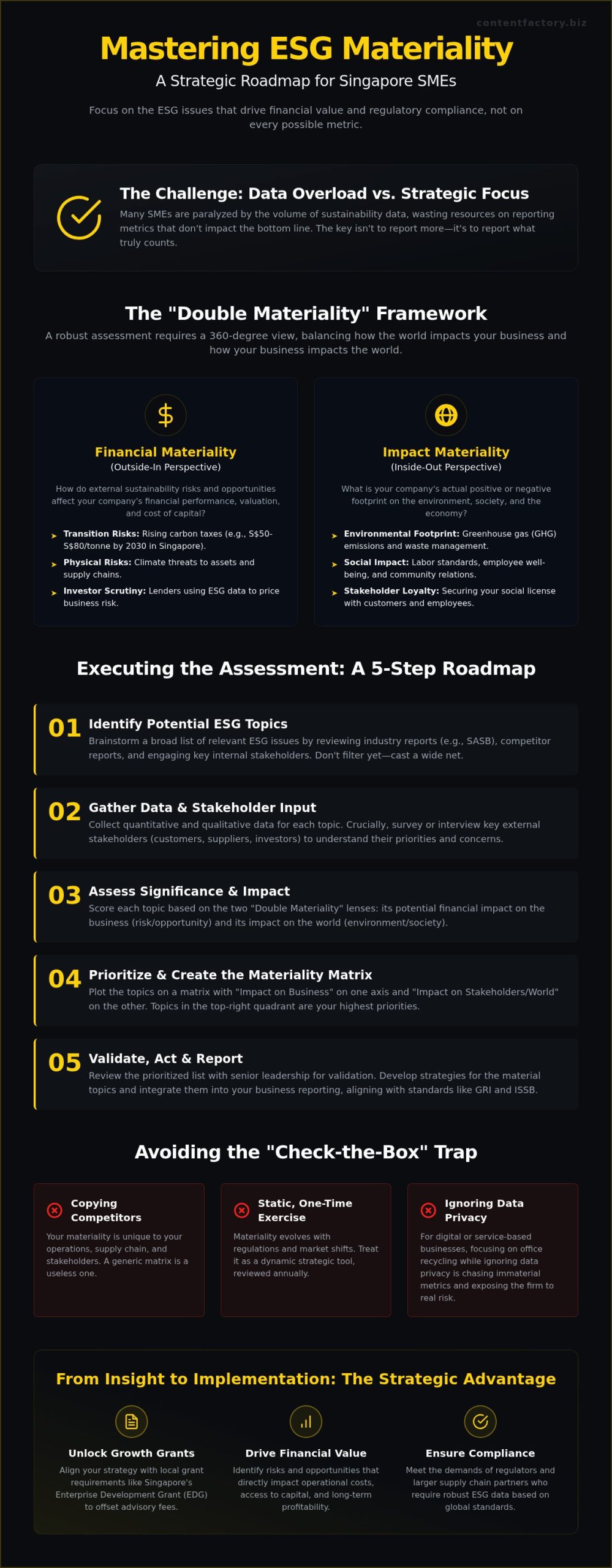
By 2026, the global reporting standard has moved beyond a single-lens view of corporate health. It isn’t enough to simply state that your company “cares” about the environment. A robust materiality assessment for ESG requires you to balance two distinct yet overlapping perspectives: how the world impacts your business and how your business impacts the world. This is the Double Materiality Framework. It rejects the narrow, old-school view that only financial significance matters, forcing a 360-degree evaluation of your company’s place in the ecosystem. For a Singapore SME, this isn’t just a theoretical exercise; it’s a survival mechanism in a market where transparency is the new currency.
Financial Materiality: Protecting Your Valuation
This is the “Outside-In” perspective. It focuses on how sustainability-related risks will erode your profit margins, inflate your debt costs, or threaten your assets. Think of transition risks like Singapore’s rising carbon tax, which is structured to reach S$50 to S$80 per tonne by 2030. Lenders and investors in the region are already using this data to price your business risk. If you can’t demonstrate resilience against physical climate threats or shifting policy landscapes, you’ll find your cost of capital skyrocketing. It’s about protecting your valuation in a world where “business as usual” has become a financial liability. Lenders don’t just want to see your balance sheet anymore; they want to see your climate-adjusted forecast.
Impact Materiality: Securing Your Social License
By 2026, regulations like the ISSB global baseline favor this holistic view because it provides a more accurate picture of long-term viability. Relying on simple financial metrics is a gamble that most SMEs can no longer afford to take. Integrating both perspectives ensures your strategy is grounded in operational reality rather than corporate aspiration. If you’re ready to move beyond theory, our team can help you structure a tailored ESG readiness assessment that captures both sides of the materiality coin, ensuring your business remains resilient and fundable in a rapidly changing economy.
Executing the Assessment: A 5-Step Roadmap for SMEs
Executing a materiality assessment for ESG shouldn’t feel like an academic marathon. For an agile SME, the goal is to move from data collection to strategic decision-making as quickly as possible. This roadmap streamlines the process, focusing on high-value inputs rather than exhaustive, low-impact data gathering. It’s about building a lean framework that satisfies regulators while providing a clear direction for your leadership team.
- Step 1: Identify your stakeholders. Map out the individuals and groups that hold the most influence over your operations, including investors, key employees, major customers, and regulators.
- Step 2: Develop a long-list of potential ESG topics. Use established industry standards like the Global Reporting Initiative (GRI) or the Sustainability Accounting Standards Board (SASB) to identify issues relevant to your specific sector.
- Step 3: Conduct targeted engagement. Move away from massive, generic surveys. Instead, use high-intent interviews to gather deep insights from your most critical stakeholders.
- Step 4: Score and prioritize issues. Use a Materiality Matrix to rank these topics based on their importance to stakeholders and their significance to your business success.
- Step 5: Validate results with senior leadership. Ensure the final list of material issues aligns with your broader business strategy and has full buy-in from the boardroom.
Stakeholder Engagement Without the Complexity
Don’t fall into the trap of trying to reach everyone. Instead, focus your energy on “high-influence” stakeholders who actually dictate your market position. Use digital tools to streamline feedback, turning what could be a months-long process into a series of punchy, structured interactions. This approach converts vague stakeholder sentiment into actionable business intelligence, allowing you to identify emerging risks before they impact your bottom line. It’s not about the volume of feedback; it’s about the quality of the insight.
Building Your Materiality Matrix
The materiality matrix is where your data finally becomes a strategy. By plotting ESG topics on an X-Y axis, Significance to Business versus Importance to Stakeholders, you create a visual filter for your reporting. You must define a clear “Threshold of Materiality” to determine what makes the cut for your final report and what remains internal data. This visualization is essential for board-level decision-making. It allows senior leaders to see exactly where the business is most vulnerable and where it has a competitive advantage. A well-constructed materiality assessment for ESG ensures that your 2026 strategy is built on evidence, not guesswork.
Avoiding the ‘Check-the-Box’ Trap: Common Materiality Mistakes
Many SMEs treat the materiality assessment for ESG as a hurdle to clear before they can return to “real” business. This is a fatal strategic error. When you approach materiality as a static, one-time exercise, you’re essentially building a map for a landscape that no longer exists. A pragmatic assessment is a dynamic tool that must evolve with market shifts, such as Singapore’s transition toward higher carbon pricing and stricter supply chain transparency. If your strategy looks identical to what you drafted two years ago, you’ve already lost the lead.
- Copy-pasting competitor matrices: Your operational footprint is unique. Adopting a rival’s materiality matrix ignores the specific risks inherent to your own supply chain and localized footprint.
- Ignoring financial incentives: If your material issues aren’t linked to actual KPIs and executive compensation, they’ll be ignored by the people who drive growth.
- Over-complicating the process: Don’t let the assessment become a bureaucratic bottleneck. It should clarify your path, not obscure it with hundreds of irrelevant data points.
The Danger of Generic ESG Reporting
Generic reporting is a recipe for mediocrity. Relying on “industry-average” materiality scores might satisfy a basic audit, but it won’t help you win. Specific, localized data beats generic global benchmarks every time. By digging into the nuances of your own operations, you can identify “white space” opportunities that your competitors have overlooked. This isn’t just about risk mitigation; it’s about finding the competitive edge that allows you to outperform less agile players who are still stuck in the world of vague, high-level summaries. Localized insight is the only way to ensure your reporting actually reflects your business reality.
Internal Misalignment: The Silent Project Killer
A materiality strategy only works if the CEO and the Operations team are reading from the same script. We often see a massive gap between “sustainability goals” discussed in the boardroom and the “daily tasks” performed on the operational floor. To bridge this, you need a no-nonsense internal communication plan that translates abstract ESG concepts into concrete operational targets. When everyone understands how a material issue affects their specific role, the assessment stops being a “side project” and starts being the engine of your business. Alignment isn’t about consensus; it’s about ensuring every department is moving toward the same measurable ROI.
Don’t let your sustainability efforts stall due to poor planning or generic data. Our team specializes in helping SMEs avoid these common pitfalls through execution-focused advisory. If you’re ready to build a strategy that actually drives value, book your ESG materiality assessment today and get a roadmap designed specifically for the Singapore market.
From Insight to Implementation: Leveraging Materiality for Growth and Grants
A completed materiality assessment for ESG shouldn’t sit in a digital drawer gathering dust. It is a high-value strategic asset that serves as the foundation for your next phase of growth. By identifying your most critical risks and opportunities, you’ve essentially created a prioritized to-do list for your business. In Singapore’s competitive landscape, this clarity allows you to move faster than larger, more bureaucratic competitors who are still bogged down in theoretical frameworks. We don’t just help you identify what matters; we help you turn those insights into bankable outcomes, often collaborating with specialized sustainability advisors like Symolem to address sector-specific policy requirements.
Funding Your ESG Journey via Singapore Grants
The transition to a sustainable business model requires capital, but you don’t have to shoulder that burden alone. You can position your materiality assessment for ESG as a core component of an “ESG Readiness” project under the Enterprise Development Grant (EDG). To succeed, your application must demonstrate how this assessment builds internal capability and drives long-term sustainability. For a comprehensive breakdown of how to structure and fund this process, our ESG readiness assessment Singapore guide for SMEs walks you through every step of securing grant approval and building a defensible framework. This is where our expertise as a Singapore Certified Management Consultant (SCMC) becomes a decisive advantage. Enterprise Singapore typically requires an SCMC to lead such consultancy projects to ensure the highest standards of delivery. By leveraging these grants, you can offset a significant portion of your advisory fees, making high-level strategy accessible without the Big 4 price tag.
Creating a Resilience-First Strategy
True resilience comes from turning material risks into competitive advantages. For instance, identifying energy consumption as a material issue isn’t just about compliance; it’s a direct prompt to implement energy-efficient technologies that lower your operational costs. This data-driven approach also simplifies your ASEAN market entry. Regional partners and regulators increasingly demand proof of ESG compliance before allowing expansion. When you have a clear materiality roadmap, you can demonstrate that your supply chain is resilient to regional shocks and aligned with international standards. For SMEs targeting growth beyond Asia, particularly in the US or European markets, CiDATax SRL offers the regulatory and tax expertise necessary to manage complex cross-border compliance. We integrate these findings into your broader Digital Roadmap, ensuring that your sustainability goals are supported by the right technological infrastructure.
Choosing a boutique partner like ContentFactory means you get the intellectual weight of a top-tier consultant with the hands-on grit of an entrepreneur. We move at the speed of your business, providing a more agile and cost-effective alternative to impersonal global firms. Don’t wait for regulations to force your hand. Secure your ESG future with a pragmatic materiality assessment from ContentFactory.
Future-Proof Your Business Through Strategic Materiality
The shift toward mandatory sustainability reporting in 2026 isn’t a threat; it’s a strategic opening. By mastering a materiality assessment for ESG, you’ve moved beyond the “check-the-box” mentality to focus on the data that truly impacts your bottom line. You now understand that double materiality is the non-negotiable benchmark for Singapore SMEs and that generic reporting only leads to missed opportunities. This process turns abstract environmental goals into concrete financial resilience, ensuring your business remains fundable and competitive in a tightening market.
ContentFactory offers the strategic depth of a global firm with the agile speed of a boutique partner. Every project is overseen by a Singapore Certified Management Consultant (SCMC), and our proven track record with EDG and MRA grant approvals means you can fund your transition with confidence. Don’t let the complexity of ESG reporting slow your momentum. Download our SME ESG Readiness Checklist or Book a Consultation to start building your roadmap today. You have the tools to transform compliance into a competitive advantage; now it’s time to execute with precision.
Frequently Asked Questions
What is the primary purpose of a materiality assessment for ESG?
The primary purpose is to filter out irrelevant data and identify the specific sustainability factors that dictate your financial performance and stakeholder trust. It acts as a strategic prioritization tool, ensuring your resources are allocated to the risks and opportunities that matter most to your long-term viability. Instead of chasing every generic metric, you focus on what actually moves the needle for your business.
How often should an SME update its materiality assessment?
You should review your assessment annually and conduct a full refresh every two to three years. Market conditions, such as Singapore’s evolving carbon tax rates or shifts in regional supply chain standards, can turn previously immaterial issues into critical risks overnight. Staying static is a recipe for strategic misalignment; your ESG strategy must evolve at the same pace as your operational reality.
Is a materiality assessment mandatory for Singapore SMEs in 2026?
While not every SME faces a direct statutory mandate yet, materiality is effectively mandatory for those within the supply chains of larger, listed entities. These corporations require Scope 3 data from their partners to comply with their own 2026 reporting deadlines. If you can’t provide this data, you risk being excluded from major contracts and tenders as transparency becomes a baseline requirement.
Can I use the Enterprise Development Grant (EDG) for a materiality assessment?
Yes, the EDG can fund a materiality assessment for ESG when it is part of a broader sustainability readiness or capability-building project. To qualify, you must work with a Singapore Certified Management Consultant (SCMC) to ensure the project meets Enterprise Singapore’s rigorous standards for strategic impact and internal growth. This allows you to offset a significant portion of the advisory fees.
What is the difference between GRI and SASB materiality standards?
GRI focuses on “Impact Materiality,” looking at how your business affects the economy, environment, and people. SASB is narrower, focusing on “Financial Materiality” or the ESG issues most likely to impact a company’s financial condition. Most modern frameworks now advocate for a double materiality approach that integrates both perspectives to provide a complete risk profile for investors and stakeholders alike.
How long does a typical materiality assessment take for a mid-sized firm?
A streamlined assessment usually takes between eight to twelve weeks. This timeframe includes stakeholder identification, engagement interviews, data analysis, and the final validation by senior leadership. Trying to rush the process often leads to generic results, while dragging it out beyond three months creates a bottleneck that stalls actual implementation. Efficiency is key to maintaining momentum in your sustainability journey.
Do I need an external consultant to perform a materiality assessment?
While you can attempt it internally, an external consultant provides the objective distance needed to challenge internal biases and identify blind spots. More importantly, using a consultant with SCMC credentials is often a requirement for accessing Singapore government grants like the EDG. Professional oversight ensures your matrix is defensible to auditors, investors, and high-value supply chain partners who demand verified data.
How does materiality help with carbon accounting and Scope 3 emissions?
A materiality assessment for ESG identifies which parts of your value chain contribute most to your environmental footprint. Instead of trying to measure every single emission source, materiality allows you to focus your carbon accounting on the “hotspots” that drive the vast majority of your impact. This precision is essential for managing complex Scope 3 emissions without overwhelming your internal operations team.
Article by
Mayuresh Godse
Mayuresh Godse is a Singapore Certified Management Consultant and Business Strategist specializing in Sustainability, ESG, AI-driven Digital Transformation, and business growth. Based in Singapore, he writes about Sustainability, Digital Innovation, Business Strategy, and Content Marketing for global audiences.
Disclaimer
This article is provided by ContentFactory for general information only and is not legal, tax, accounting or financial advice. Regulations and government scheme criteria change; grant eligibility and quantum are set by the relevant Singapore agencies and assessed case by case, with no outcome guaranteed. Verify current requirements before acting.