

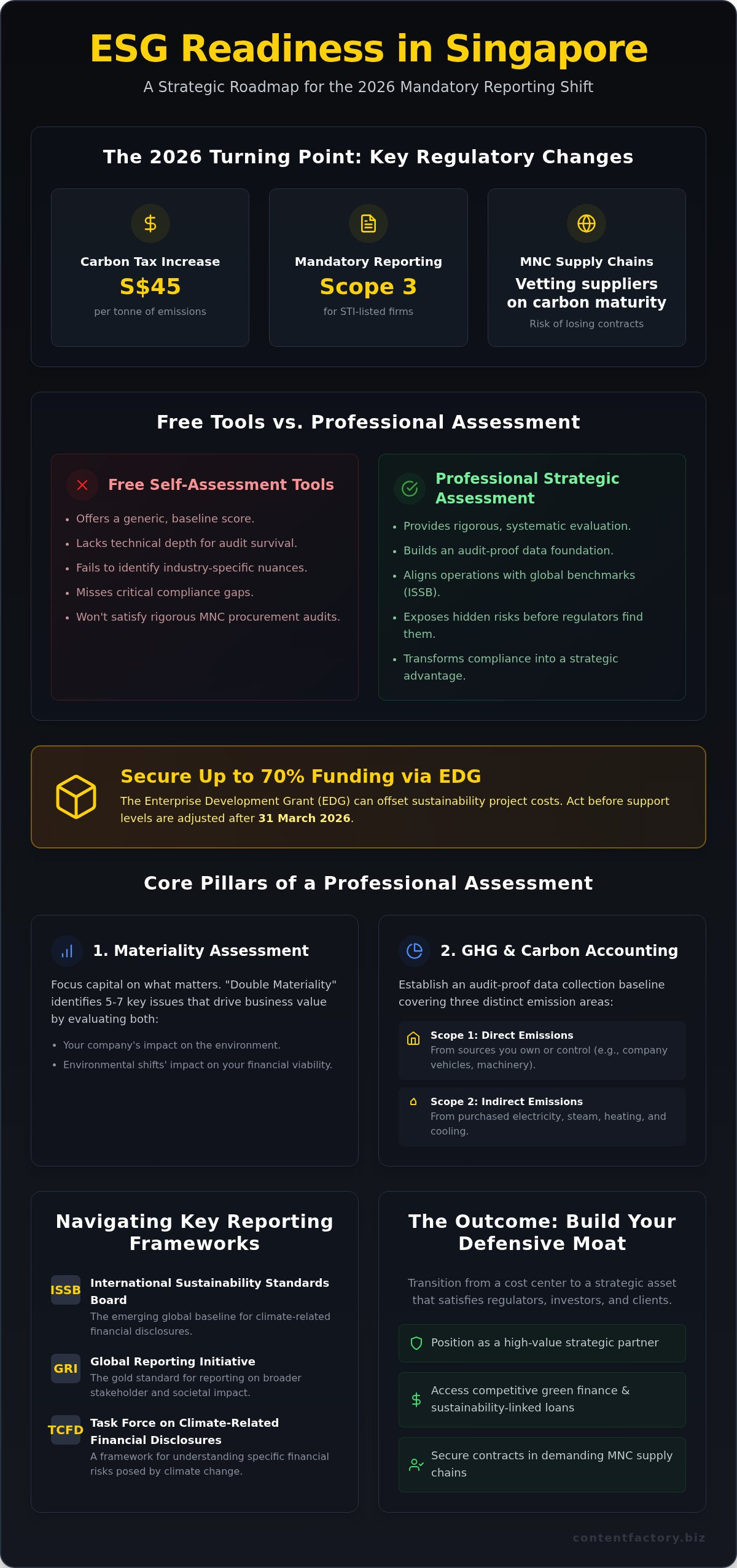
Your business doesn’t need another generic checklist; it needs a defensive moat. While a free bank-issued score offers a baseline, it lacks the technical depth required to survive a rigorous ESG readiness assessment Singapore audit from a global tier-one partner. With Singapore’s carbon tax hitting S$45 per tonne in 2026 and mandatory Scope 3 reporting now a reality for STI-listed firms, the window for “figuring it out” has closed. You’re likely feeling the pressure of choosing between ISSB and GRI frameworks while worrying about the cost of professional guidance.
We recognize the frustration of managing these shifting regulations while trying to protect your margins. This guide moves you past the anxiety of basic compliance to help you build a funded, high-impact ESG framework that secures your market position. You’ll learn how to leverage the Enterprise Development Grant (EDG) to offset up to 70% of costs before support levels drop after 31 March 2026. We’re providing a clear roadmap to transform carbon accounting and materiality from a cost center into a strategic asset that satisfies both regulators and investors.
Key Takeaways
- Understand why a professional ESG readiness assessment Singapore is essential for navigating the 2026 shift from voluntary to mandatory climate reporting.
- Discover how to secure up to 70% funding through the Enterprise Development Grant (EDG) for sustainability projects before the support level changes on 31 March 2026.
- Learn to identify the hidden compliance gaps that free self-assessment tools miss, ensuring your business meets the rigorous standards of global MNC supply chains.
- Transition from a baseline evaluation to a results-driven 90-day roadmap that integrates GHG emissions calculation into your core digital operations.
- Position your SME as a high-value strategic partner by moving beyond simple box-ticking to a framework that satisfies both regulators and institutional investors.
What is an ESG Readiness Assessment in the Singapore Context?
An What is an ESG Readiness Assessment is a rigorous, systematic evaluation of your firm’s performance across Environmental, Social, and Governance pillars. It’s the difference between guessing your impact and proving your value. In our local market, a professional ESG readiness assessment Singapore serves as a diagnostic tool to align your operations with the Singapore Green Plan 2030. It doesn’t just look at what you do; it exposes what you’re missing before a regulator or a major client finds it first.
2026 is the year the “voluntary” era officially ends. With the carbon tax set at S$45 per tonne and mandatory Scope 3 reporting hitting STI-listed companies, the regulatory environment has shifted from encouragement to enforcement. Many SMEs rely on automated bank tools for a quick score. That’s a mistake. A high score on a digital survey might help with a basic loan application, but it won’t satisfy a multinational’s procurement audit. You need a strategy that accounts for industry-specific nuances, not a generic algorithm’s output that lacks context.
The Drivers: Why SMEs are Moving Now
Supply chain pressure is the primary catalyst. Large MNCs are now vetting Singaporean suppliers based on their carbon maturity. If you can’t provide granular data on your emissions, you risk losing contracts to competitors who can. It’s not just about keeping clients, though. Regulatory alignment with ACRA and SGX requirements is becoming a prerequisite for doing business. Beyond compliance, firms that demonstrate high ESG readiness gain access to green finance. These sustainability-linked loans offer competitive rates that traditional financing simply can’t match in this high-interest environment.
Key Frameworks to Know
The landscape is cluttered with acronyms, but three matter most for Singaporean businesses. The ISSB (International Sustainability Standards Board) has emerged as the global baseline for climate-related disclosures. For companies focusing on broader stakeholder impact, the GRI (Global Reporting Initiative) remains the gold standard. Finally, TCFD provides a framework for understanding the specific financial risks climate change poses to your business. Selecting the right framework early prevents the “reporting fatigue” that plagues firms trying to satisfy every metric simultaneously without a clear focus.
The 4 Pillars of a Professional ESG Readiness Assessment
A professional ESG readiness assessment Singapore isn’t a superficial survey designed to yield a feel-good score. It’s a rigorous diagnostic that establishes your operational baseline against global benchmarks like the ISSB. While many SMEs rely on automated bank tools for a generic rating, these often fail to identify the specific regulatory gaps that could disqualify you from a major MNC’s supply chain. A true assessment moves beyond cataloging what you already do. It exposes what you’re missing for full compliance, transforming hidden risks into quantifiable market growth opportunities. This assessment serves as the immutable structural foundation upon which all future sustainability reporting and investor disclosures are built.
Materiality Assessment: Identifying What Matters
Not all ESG factors carry equal weight for your bottom line. We utilize the concept of “Double Materiality,” which evaluates both your company’s impact on the environment and how environmental shifts impact your financial viability. You can’t be everything to everyone; you must talk to your employees, customers, and investors to prioritize the 5 to 7 issues that actually drive business value. Focusing on irrelevant metrics is a waste of capital. By narrowing your scope, you ensure that your resources are funneled into areas that satisfy procurement officers and improve your resilience.
GHG Emissions and Carbon Accounting Baseline
Carbon accounting is the most technical component of the “E” in ESG, and it’s where most Singaporean SMEs stumble. With the carbon tax reaching S$45 per tonne in 2026, precision is mandatory. You must establish a data collection process that survives a third-party audit, covering three distinct areas:
- Scope 1: Direct emissions from your owned or controlled sources, such as company vehicles or machinery.
- Scope 2: Indirect emissions from the generation of purchased electricity, which is critical given Singapore’s grid-dependent energy landscape.
- Scope 3: All other indirect emissions in your value chain, including logistics and employee travel, which are now required for many STI-listed partners.
Setting this baseline is often the most resource-intensive phase of the journey. To manage the financial burden, many firms utilize the Enterprise Development Grant (EDG) to fund the expert consulting required for accurate GHG calculation. If you’re unsure where your data gaps lie, starting with a professional materiality and readiness review can prevent costly errors in your first reporting cycle. Establishing this baseline now ensures that when mandatory reporting hits your sector, your data is already audit-ready and defensible. For a deeper understanding of how to structure this process, our comprehensive guide on carbon accounting for SMEs walks you through the exact steps needed to treat emissions as a financial metric rather than an abstract obligation.
Free Self-Assessment Tools vs. Strategic ESG Advisory
Don’t let the allure of “zero-cost” snapshots derail your long-term compliance strategy. While several local banks offer free digital tools to help SMEs gauge their basic sustainability standing, these are risk-identification instruments designed for lenders, not strategic roadmaps for business owners. A high score on a bank’s automated survey doesn’t guarantee you’ll pass a rigorous multinational procurement audit. These tools often rely on generic global templates that miss the specific operational nuances of the Singaporean market. They give you a number; they don’t give you a defense.
The ESG readiness assessment Singapore landscape requires a transition from automated scores to expert interpretation. An algorithm can’t identify the subtle materiality risks inherent in your specific supply chain or help you navigate the complexities of carbon accounting. Engaging an SCMC-certified consultant ensures that your data is not just collected, but audited and verified. This level of technical weight is essential when aligning your disclosures with the SGX sustainability reporting guidelines, which serve as the benchmark for many large-scale partners in the region. You aren’t just looking for a score; you’re looking for a three-year implementation plan that survives scrutiny from regulators and investors alike.
When a Self-Assessment is Enough
Self-assessment tools are ideal for the very first step of your journey. If you’re a micro-SME with limited supply chain exposure and you simply want to build internal awareness, a free tool is a cost-effective starting point. It helps your team understand basic terminology and identifies obvious low-hanging fruit in energy consumption. However, it’s a diagnostic starting point, not a final destination for any firm seeking to protect its market share in a competitive tender environment.
When to Engage a Boutique ESG Consultant
Professional advisory becomes mandatory the moment you face external pressure. If you’re preparing for mandatory ACRA-aligned reporting or bidding for government contracts that weigh sustainability performance, a generic score is insufficient. Boutique consultants offer the nimble, execution-focused energy that larger firms often lack. They’re essential when you’re applying for the Enterprise Development Grant (EDG), as they provide the certified expertise required to structure a funded project that delivers tangible ROI. When the stakes involve multi-million dollar contracts or regulatory compliance, the “free” option becomes the most expensive mistake you can make.
Funding Your ESG Assessment via the Enterprise Development Grant (EDG)
Professional consulting shouldn’t be a financial deterrent. While most bank-led discussions focus on the “what,” they rarely address the “how” of funding. Enterprise Singapore’s Sustainability Pillar under the Enterprise Development Grant (EDG) bridges this gap. Until 31 March 2026, SMEs can access an enhanced support level of up to 70% for sustainability-related projects. After this date, the standard support level drops to 50%. This makes the timing of your ESG readiness assessment Singapore critical. By bundling your initial materiality review with GHG emissions calculation, you maximize the grant’s utility, transforming a regulatory burden into a subsidized strategic upgrade.
To qualify, your company must be registered and operating in Singapore with at least 30% local shareholding. You must also demonstrate financial viability to complete the project. It’s not enough to want to be “green”; you must prove you have the structural integrity to implement the change. The secret weapon in a successful application is the Singapore Certified Management Consultant (SCMC). Enterprise Singapore requires that consultants leading EDG projects hold this certification to ensure high standards of delivery. Working with an SCMC-certified partner isn’t just a requirement; it’s a safeguard that your project will meet the rigorous audit standards necessary for grant disbursement.
Eligible Costs Under the EDG
The grant covers more than just a final report. Eligible costs include professional advisory fees for ESG strategy and implementation, which are often the largest expense for SMEs. You can also offset the costs of third-party certifications and specialized reporting software that automates data collection. Additionally, the EDG supports training and capability building. This ensures your internal team isn’t just reading a report but gaining the skills to manage your sustainability roadmap independently once the consultancy ends.
The Grant Application Process
Efficiency is key to a successful submission. The process begins with a pre-assessment where you define a clear scope of work with your consultant. This scope must demonstrate how the project will lead to tangible business outcomes, such as improved resource efficiency or market expansion. Once the proposal is ready, you submit it via the Business Grants Portal (BGP). Post-approval, you execute the project while maintaining a meticulous audit trail. If you want to ensure your application is structured for success, you should engage our SCMC-certified experts for EDG grant advisory to navigate the portal requirements and maximize your funding potential.
Executing Your Roadmap: From Assessment to Implementation
Completing your ESG readiness assessment Singapore isn’t the finish line. It’s the starting block for a 90-day sprint where you move from identifying gaps to populating your first reporting framework with actual, defensible data. The first three months post-assessment should focus on “quick wins” that demonstrate immediate ROI, such as optimizing energy usage or formalizing employee safety protocols. For commercial food service facilities addressing operational safety and ventilation retrofits, you can discover Air Flow M&E Pte Ltd for kitchen exhaust addition and alteration solutions. You aren’t just checking boxes; you’re building a system that survives the scrutiny of a supply chain audit. This transition requires a shift in mindset from passive compliance to active operational management.
Technology is the backbone of this transition. Don’t rely on fragmented spreadsheets that are prone to human error and difficult to audit. You must integrate ESG metrics into your broader digital roadmap. By using automated tools to track sustainability KPIs, such as real-time electricity consumption or waste diversion rates, you ensure that your data is accurate and ready for reporting at a moment’s notice. This digital-first approach allows you to communicate your ESG value with confidence. For businesses looking to enhance their digital infrastructure, Elves Lab Pte Ltd offers custom web design and e-commerce solutions that help SMEs showcase their sustainability progress to the market. Whether you’re bidding for a local government tender or expanding into the wider ASEAN market, having a verified sustainability profile becomes a powerful competitive differentiator.
Building Internal Capabilities
Why ContentFactory for Your ESG Journey?
We don’t deal in the dry, detached fluff often associated with Big 4 firms. ContentFactory provides a nimble, boutique alternative that prioritizes pragmatic, execution-focused energy. We understand that for a Singaporean SME, every dollar must deliver a result. Our deep expertise in the local grant ecosystem ensures you maximize your ROI through the Enterprise Development Grant (EDG), while our SCMC-certified leadership provides the strategic weight needed to satisfy global investors. We don’t just hand you a report and walk away. We link your ESG milestones to digital transformation and market growth, ensuring your business is built to last in a low-carbon economy.
Secure your ESG future-book a consultation with ContentFactory today.
Securing Your Competitive Advantage in a Low-Carbon Economy
The era of voluntary sustainability is over. Relying on a surface-level score from a generic digital tool won’t protect your supply chain contracts or help you manage a S$45 per tonne carbon tax. A professional ESG readiness assessment Singapore is the only way to build a defensible, audit-ready framework that satisfies both global MNCs and local regulators. By acting before the 31 March 2026 EDG support deadline, you can secure the funding necessary to transform compliance from a cost center into a strategic moat. Don’t settle for a score; demand a strategy.
Success requires a partner who understands the operational floor as well as the boardroom. We provide SCMC-certified consulting expertise and a proven track record in EDG grant approvals to ensure your journey is technically sound and financially optimized. We don’t offer abstract theories. Instead, we deliver end-to-end ESG and digital transformation integration that drives real business growth. It’s time to move past the checklist and start building for the future.
Start your funded ESG journey with ContentFactory
Your business is ready for the next level of growth. Let’s build a resilient, sustainable future together.
Frequently Asked Questions
Is an ESG readiness assessment mandatory for Singapore SMEs in 2026?
Direct mandatory reporting currently targets listed companies and large non-listed entities, but SMEs face indirect mandates through supply chain requirements. As STI-listed partners must report Scope 3 emissions starting in FY2026, they require their SME suppliers to provide verified data. Conducting an ESG readiness assessment Singapore ensures you aren’t disqualified from these critical contracts due to a lack of climate disclosures.
How much does a professional ESG readiness assessment cost?
The investment for a professional assessment depends on your operational complexity, the number of sites involved, and the depth of the materiality study required. While we don’t quote fixed fees without a scoping session, most SMEs utilize the Enterprise Development Grant (EDG) to offset up to 70% of these professional advisory costs. This grant significantly lowers the financial barrier to entry for businesses seeking high-level strategic guidance.
Can I use the Enterprise Development Grant (EDG) for carbon accounting?
Yes, carbon accounting and GHG emissions calculation are eligible activities under the EDG Sustainability pillar. Enterprise Singapore provides this support to help SMEs build the technical capabilities needed to manage rising carbon costs, which hit S$45 per tonne in 2026. You must apply before 31 March 2026 to take advantage of the enhanced 70% support level before it reverts to the standard 50% for SMEs.
What is the difference between an ESG assessment and a sustainability report?
An assessment is an internal diagnostic roadmap, while a report is an external disclosure document. The ESG readiness assessment Singapore identifies your current gaps, establishes a carbon baseline, and sets your strategic priorities. A sustainability report is the final output that follows this process, presenting your verified data to investors, regulators, and the public according to frameworks like GRI or ISSB.
How long does it take to complete a full ESG readiness assessment?
A comprehensive assessment typically takes between 8 and 12 weeks to complete. This timeline includes the initial materiality workshops, stakeholder engagement sessions, and the technical data collection needed for carbon accounting. If your data is fragmented or your supply chain is complex, the process might extend further to ensure the final roadmap is audit-ready and defensible.
Why do I need an SCMC-certified consultant for my grant application?
Enterprise Singapore requires that consultants leading EDG-funded projects hold a recognized certification like the Singapore Certified Management Consultant (SCMC) status. This requirement protects your business by ensuring the advisor has the verified expertise to deliver high-quality outcomes. Applications submitted without an SCMC-certified lead are generally not considered for approval, making this certification a non-negotiable prerequisite for funded projects.
What are the specific ESG frameworks recognized by Enterprise Singapore?
Enterprise Singapore recognizes globally aligned frameworks including the ISSB (International Sustainability Standards Board), GRI, and TCFD. For SMEs looking for a more accessible starting point, the “Green 100” initiative introduced in May 2026 offers a simplified disclosure program. This initiative focuses on five key metrics: water, electricity, gas, machinery fuel, and vehicle fuel consumption to help smaller firms begin their reporting journey.
How does ESG readiness affect my ability to get a business loan in Singapore?
High ESG maturity directly improves your access to sustainable financing and green loans from major banks like DBS and OCBC. Financial institutions now use ESG scores to assess credit risk, often offering preferential interest rates to firms that can prove their resilience. Conversely, businesses that ignore ESG readiness may face higher borrowing costs or more stringent collateral requirements as banks align their portfolios with MAS environmental risk guidelines.
Article by
Mayuresh Godse
Mayuresh Godse is a Singapore Certified Management Consultant and Business Strategist specializing in Sustainability, ESG, AI-driven Digital Transformation, and business growth. Based in Singapore, he writes about Sustainability, Digital Innovation, Business Strategy, and Content Marketing for global audiences.
Disclaimer
This article is provided by ContentFactory for general information only and is not legal, tax, accounting or financial advice. Regulations and government scheme criteria change; grant eligibility and quantum are set by the relevant Singapore agencies and assessed case by case, with no outcome guaranteed. Verify current requirements before acting.