

By 2026, the traditional handshake that secured your family firm’s bank loans and supplier contracts will no longer be enough to sustain your operations. You’ve spent decades building a reputation on trust and performance, yet the sudden pressure to quantify environmental and social impact feels like a distraction from the values that built your business. It’s frustrating to face complex reporting frameworks when your focus remains on daily execution and long-term stability.
Integrating ESG for family-owned businesses in Singapore isn’t just about ticking boxes for ACRA or SGX RegCo; it’s a strategic move to institutionalise your legacy for the next generation. This guide provides a clear, execution-focused roadmap to help you navigate mandatory climate reporting and maintain a competitive edge in regional supply chains. The following sections break down how to align sustainability with family values, manage Scope 1 to 3 emissions, and ensure your firm remains resilient against shifting regulatory demands.
Key Takeaways
- Identify ACRA and SGX RegCo requirements to navigate the transition toward mandatory climate-related disclosures effectively.
- Learn how to formalise family values through ESG to ensure a resilient multi-generational legacy and smooth leadership transition.
- Evaluate the GRI and ISSB frameworks to align your reporting with both social impact goals and financial materiality.
- Implement a structured gap analysis to integrate ESG for family-owned businesses in Singapore without disrupting core operations.
- Conduct a stakeholder-led materiality assessment to secure your position in regional supply chains and maintain a competitive edge.
Navigating the ESG Mandate for Private Family Firms in Singapore
For a legacy-driven organisation, the Environmental, Social, and Governance (ESG) framework represents the formalisation of the ethical standards your founders likely practiced instinctively. In the context of a Singaporean family enterprise, this isn’t about abstract global metrics. It’s about translating inter-generational values into measurable data that banks, regulators, and international partners can verify. The shift from voluntary participation to mandatory compliance is accelerating, moving sustainability from the periphery of the boardroom to the centre of operational survival.
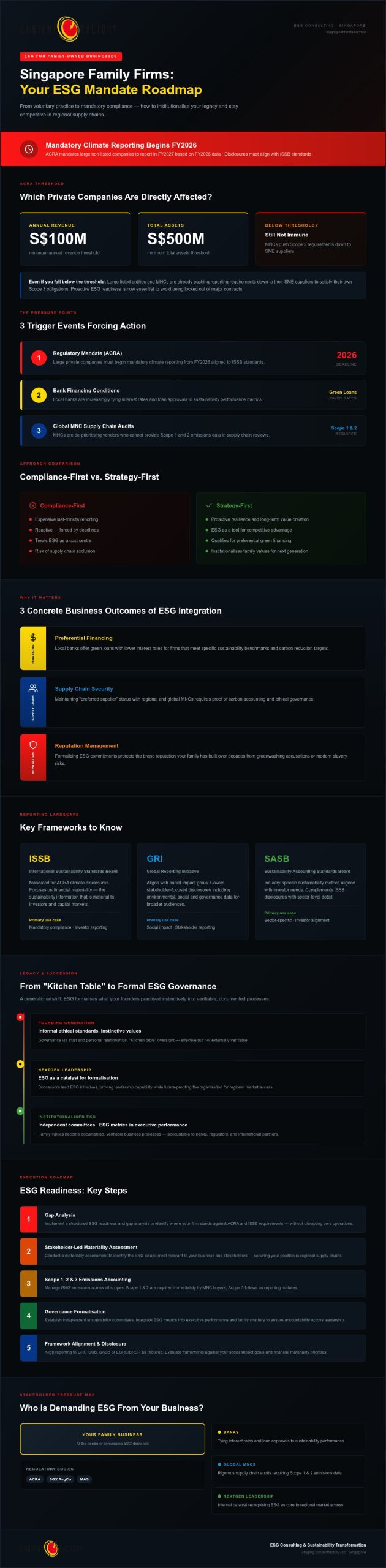
Most firms face three primary trigger events. First, ACRA mandates require large private companies to begin climate reporting from 2026. Second, local banks are increasingly tying interest rates and loan approvals to sustainability performance. Third, global MNCs are conducting rigorous supply chain audits, often de-prioritising vendors who cannot provide Scope 1 and 2 emissions data. Taking a compliance-first approach often leads to expensive, last-minute reporting. Conversely, a strategy-first approach integrates ESG for family-owned businesses in Singapore as a tool for resilience and long-term value creation.
The 2026 Regulatory Landscape: ACRA and SGX Requirements
ACRA has confirmed that large non-listed companies, defined as those with annual revenue of at least S$100 million and total assets of at least S$500 million, must begin mandatory climate reporting in FY2027 based on FY2026 data. These disclosures must align with the International Sustainability Standards Board (ISSB) standards. Even if your business falls below this threshold, you aren’t immune. Large listed entities and MNCs are already pushing these requirements down to their SME suppliers to satisfy their own Scope 3 reporting obligations. Proactive ESG readiness and gap analysis is now essential to avoid being locked out of major contracts.
Why ESG Matters to the Family Business Owner
Sustainable operations directly impact your bottom line and your ability to transfer a healthy business to the next generation. Integrating ESG for family-owned businesses in Singapore allows you to quantify your impact before a regulator or a bank forces your hand. This transition delivers three concrete business outcomes:
- Preferential Financing: Local banks offer green loans with lower interest rates for firms that meet specific sustainability benchmarks and carbon reduction targets.
- Supply Chain Security: Maintaining “preferred supplier” status with regional and global MNCs requires proof of carbon accounting and ethical governance.
- Reputation Management: Formalising your ESG commitments protects the brand reputation your family has built over decades from “greenwashing” accusations or modern slavery risks.
Aligning Sustainability with Multi-Generational Legacy and Succession
Succession planning in a family enterprise often focuses on asset distribution, yet the survival of the business depends on the resilience of its operational model. ESG for family-owned businesses in Singapore provides a structured framework to institutionalise the values that the founding generation established. It transforms informal family ethos into documented, verifiable business processes. This transition is essential for maintaining trust with external stakeholders and ensuring the firm survives the transition between generations.
The younger generation, or “NextGen”, typically acts as the primary catalyst for these changes. They recognise that sustainability is no longer a peripheral concern but a core requirement for regional market access. By leading ESG initiatives, successors can prove their leadership capabilities while future-proofing the organisation. This alignment of family values with global standards creates a powerful narrative for long-term growth. It ensures that the business remains relevant in an era where MAS Sustainable Finance initiatives are reshaping how capital is allocated in Singapore.
Professionalising Governance in Family Enterprises
Transitioning from informal “kitchen table” oversight to formal ESG governance is a hallmark of a maturing family firm. You should establish independent sustainability committees to provide objective oversight of environmental and social impacts. Integrating ESG metrics into executive performance and family charters ensures accountability across the leadership team. This professionalisation reduces the risks associated with personality-led management and builds a robust framework for conflict resolution during succession. If your current governance structure lacks these formalised triggers, you can discuss a custom governance roadmap with our strategic advisors.
Attracting and Retaining Talent through Purpose
Singapore’s talent market is highly competitive, and family firms often struggle to match the branding power of global MNCs. A clear, execution-led ESG stance levels the playing field. High-performing professionals, particularly those from younger demographics, prioritise employers who demonstrate social responsibility and environmental stewardship. By building a culture of transparency and purpose, you create a workplace that attracts talent who are invested in the firm’s long-term mission. This social capital is just as vital as financial capital for multi-generational success. It fosters employee engagement and reduces the turnover costs that can destabilise a family business during leadership changes.
Practical Frameworks: GRI, ISSB, and the Singapore Reporting Landscape
Choosing a reporting standard is the first technical hurdle in formalising ESG for family-owned businesses in Singapore. You must distinguish between impact-based reporting and financial materiality. The Global Reporting Initiative (GRI) remains the most widely adopted standard for firms focused on their impact on the economy, environment, and people. It serves as an excellent starting point for SMEs to document their sustainability journey. Conversely, the International Sustainability Standards Board (ISSB) focuses on how sustainability risks and opportunities affect a company’s financial value. This shift toward ISSB alignment is central to the SGX sustainability reporting requirements, which now set the pace for private market expectations.
For firms in manufacturing or logistics, the Sustainability Accounting Standards Board (SASB) provides industry-specific metrics that allow for direct benchmarking against global peers. These standards focus on the subset of ESG issues most relevant to your specific sector’s financial performance. Integrating these frameworks isn’t just about disclosure; it’s about building “assurance readiness,” which is the internal capability to provide verifiable, audit-grade evidence for every sustainability claim your business makes.
Choosing the Right Framework for Your Business Size
Small to mid-sized family firms should prioritise GRI because its modular structure allows for a phased implementation. As your organisation scales or prepares for a public listing, transitioning to ISSB-aligned reporting becomes a necessity to satisfy institutional investors and lenders. Implementing ESG for family-owned businesses in Singapore requires a focus on core materiality. Identify the ESG factors that truly drive your business value to avoid “framework fatigue”. This ensures your resources are spent on execution rather than just documentation. This pragmatic approach ensures that your reporting remains a tool for strategic growth rather than a mere administrative burden.
Carbon Accounting: Managing Scope 1, 2, and 3 Emissions
Accurate carbon accounting is the backbone of any credible ESG strategy. Scope 1 covers direct emissions from owned sources, while Scope 2 addresses indirect emissions from purchased energy. The real complexity lies in Scope 3, which encompasses your entire value chain. For Singapore’s export-oriented family firms, Scope 3 data is non-negotiable. International buyers now demand this information to satisfy their own regulatory requirements. Collecting this data across fragmented supply chains is difficult; however, digital tools can automate emissions tracking to ensure accuracy. Manual spreadsheets are no longer sufficient for the level of transparency required in 2026. Data automation reduces human error and provides the real-time insights needed to manage your carbon footprint effectively.
Executing an ESG Readiness and Materiality Assessment
Execution is the critical differentiator between firms that merely report and those that create tangible value. For ESG for family-owned businesses in Singapore, the journey starts with a rigorous ESG readiness and gap analysis. This process identifies the distance between your current operational state and the stringent requirements of the 2026 ACRA mandates. You shouldn’t assume your existing practices are sufficient; you must verify them against ISSB and GRI standards to ensure compliance and bankability.
A successful assessment follows a four-step methodology designed for clarity and action:
- Conduct a gap analysis to pinpoint regulatory vulnerabilities and data deficiencies.
- Engage stakeholders, including family members, key employees, and major customers, to identify their priorities.
- Define a materiality matrix to prioritise issues with the highest business impact and stakeholder interest.
- Develop an operational roadmap with measurable targets and clear timelines for implementation.
This structured approach ensures that your resources are allocated to the areas that most influence your long-term resilience and market position. It moves the conversation from abstract sustainability goals to concrete operational requirements.
Defining What Matters: The Materiality Matrix
The materiality matrix is your strategic filter. It weights stakeholder concerns against the potential impact on your business performance. For a manufacturing firm, this might prioritise waste reduction and energy efficiency, whereas a service-based firm might focus on human capital and data privacy. By identifying industry-specific issues, you prevent greenwashing and focus your limited resources on high-impact initiatives. This prioritisation is essential for maintaining transparency and building trust with the banks and MNCs that monitor your sustainability performance.
Building Internal ESG Capabilities
Reporting is only as good as the data behind it. You need to build internal capabilities by providing ESG capability building and training at both the board and management levels. Establishing a cross-functional ESG taskforce within the family firm ensures that sustainability isn’t siloed in one department. This group should include members from finance, operations, and HR to ensure comprehensive data collection. Assigning clear data ownership is the only way to ensure your sustainability reports are accurate, verifiable, and ready for mandatory assurance when the time comes.
Operationalising Sustainability with ContentFactory
ContentFactory functions as a pragmatic execution engine rather than a traditional consulting firm. We understand that ESG for family-owned businesses in Singapore involves more than just data; it requires a deep respect for the sensitive dynamics of family governance and legacy preservation. Our senior-led teams work directly with your board to formalise values into verifiable business processes that meet the scrutiny of the 2026 regulatory environment. We move beyond theoretical slide decks to deliver tangible outcomes that satisfy regulators, institutional lenders, and international partners.
Our Approach to ESG Consulting and Transformation
Our methodology starts with a comprehensive Gap Analysis and Strategy phase to identify regulatory vulnerabilities before they impact your operations. We provide precise carbon accounting services that cover Scope 1, 2, and 3 emissions, ensuring your data is ready for the mandatory reporting windows. We specialise in mandatory sustainability assurance readiness, which prepares your firm for external audits before they become a legal requirement. By tailoring capability building to the specific operational realities of family-owned SMEs, we ensure your team can manage sustainability metrics independently and accurately.
Bridging the Gap from Strategy to Funded Execution
A sustainability roadmap is only effective if it drives operational efficiency and enables regional growth. ContentFactory guides your firm through the execution phase, connecting ESG targets to measurable commercial outcomes like reduced waste and improved energy procurement. We ensure your reporting meets the high standards required to maintain “preferred supplier” status in global MNC supply chains. This focus on execution allows you to maintain a competitive edge as regional markets increasingly prioritise green credentials and ethical governance. You can learn more about our results-oriented approach in our ESG Readiness Assessment Singapore guide.
ContentFactory provides the specialised expertise needed to integrate ESG for family-owned businesses in Singapore into your core operations. We focus on readiness, materiality, and carbon accounting to protect your multi-generational legacy and ensure regulatory compliance. Our consultants act as a hands-on extension of your leadership team to drive measurable growth. Projects may be eligible for the Enterprise Development Grant (EDG) which supports up to 50% of qualifying costs for eligible Singapore SMEs.
Grant quantum, support levels and eligibility criteria are set by the relevant Singapore government agencies and are subject to change. Eligibility is assessed case by case.
Securing Your Multi-Generational Legacy Through Strategic ESG Execution
The transition toward mandatory climate reporting is an operational reality that requires immediate action. You must align your family values with global reporting frameworks like GRI and ISSB to maintain your competitive edge in regional supply chains. Formalising ESG for family-owned businesses in Singapore isn’t just about compliance; it’s a tool to professionalise governance and attract the next generation of leadership.
ContentFactory provides the execution-led expertise needed to navigate these complexities. Led by a Singapore Certified Management Consultant, we deliver pragmatic roadmaps tailored to the unique dynamics of family firms. With deep experience across the manufacturing, logistics, and retail sectors, we ensure your sustainability journey drives measurable commercial growth and long-term resilience.
Take the first step toward institutionalising your legacy today. It’s time to transform your family values into a verifiable strategic advantage that secures your business for the next generation.
Frequently Asked Questions
Is ESG reporting mandatory for private family businesses in Singapore in 2026?
Large non-listed companies in Singapore with at least S$100 million in annual revenue and S$500 million in total assets must begin mandatory climate reporting in FY2027. This means your data collection must start in FY2026. While smaller family firms aren’t legally mandated yet, they often face reporting pressures from listed MNC clients. Proactive integration of ESG for family-owned businesses in Singapore ensures you remain a preferred supplier in regional supply chains.
What is a materiality assessment and why does my business need one?
A materiality assessment is a strategic exercise used to identify and prioritise the environmental, social, and governance issues that most significantly impact your business and your stakeholders. It prevents your firm from wasting resources on irrelevant metrics. By focusing on high-impact areas, such as energy use in manufacturing or data privacy in retail, you can build a more resilient operational model. This assessment forms the foundation of any credible sustainability roadmap.
How much does it cost for a family-owned SME to start ESG reporting?
The cost of initiating ESG reporting varies significantly based on your company’s size, operational complexity, and the depth of data collection required. Factors such as the number of locations and the complexity of your supply chain influence the total investment. Rather than looking at a fixed price, you should consider the ROI of maintained market access. Eligible Singapore SMEs can also apply for government grants to co-fund these sustainability initiatives.
What is the difference between GRI and ISSB frameworks for SG firms?
The Global Reporting Initiative (GRI) focuses on your company’s impact on the economy, environment, and people for a wide range of stakeholders. In contrast, the International Sustainability Standards Board (ISSB) standards prioritise financial materiality, specifically how sustainability risks affect your firm’s enterprise value. Most Singaporean firms start with GRI for its comprehensive scope and then align with ISSB to satisfy the requirements of banks and institutional investors.
Can my family business get government funding for ESG projects?
Yes, the Singapore government provides several schemes to support sustainability transformation. The Enterprise Development Grant (EDG) can co-fund up to 70% of qualifying costs for sustainability projects, subject to eligibility criteria. This support covers areas like carbon accounting, materiality assessments, and strategy development. ContentFactory provides strategic grant advisory to help you navigate the application process and ensure your project aligns with the requirements set by EnterpriseSG.
How does ESG impact my ability to get bank loans in Singapore?
Local banks are increasingly integrating ESG performance into their credit risk assessments. Firms that demonstrate robust sustainability practices can often access preferential green financing rates or sustainability-linked loans. Conversely, businesses that fail to provide transparent ESG data may face higher borrowing costs or stricter lending conditions. Maintaining clear carbon accounting and governance records signals to lenders that your family firm is a lower-risk, future-proofed investment.
What are Scope 3 emissions and why should my family firm care?
Scope 3 emissions encompass all indirect emissions that occur in your company’s value chain, including both upstream and downstream activities. They often represent the largest portion of a family firm’s carbon footprint. You should care about these because global MNCs now require this data from their suppliers to meet their own reporting mandates. Failing to track Scope 3 emissions can result in your business being excluded from international procurement contracts.
How long does it take to complete an ESG Readiness Assessment?
A comprehensive ESG Readiness Assessment typically takes between four to eight weeks to complete, depending on the scale of your operations and data availability. This timeframe includes the initial gap analysis, stakeholder engagement, and the development of a prioritised materiality matrix. Starting this process early is essential to ensure you have sufficient time to address any identified data gaps before mandatory reporting deadlines or bank reviews take effect in 2026.
Grant quantum, support levels and eligibility criteria are set by the relevant Singapore government agencies and are subject to change. Eligibility is assessed case by case.
Article by
Mayuresh Godse
Mayuresh Godse is a Singapore Certified Management Consultant and Business Strategist specializing in Sustainability, ESG, AI-driven Digital Transformation, and business growth. Based in Singapore, he writes about Sustainability, Digital Innovation, Business Strategy, and Content Marketing for global audiences.
Disclaimer
This article is provided by ContentFactory for general information only and is not legal, tax, accounting or financial advice. Regulations and government scheme criteria change; grant eligibility and quantum are set by the relevant Singapore agencies and assessed case by case, with no outcome guaranteed. Verify current requirements before acting.
One thing worth checking on the tool side: if the disclaimer is switched on globally, the grant caveat already written into your Global Writing Instructions will appear as well, so grant articles will carry the same point twice. Remove the required-disclaimer section from the instructions file if you enable this one.