

What if your sustainability reporting was a driver of operational profit rather than an administrative drain? Many Singaporean firms currently view Environmental, Social, and Governance (ESG) requirements as a complex hurdle, primarily due to mounting pressure from supply chain partners and evolving tender requirements. It’s easy to feel paralysed by the perceived complexity of global frameworks like GRI or ISSB when you have a limited internal headcount and no dedicated sustainability department. Effective ESG capability building for SMEs is not about mimicking the exhaustive reporting of a multi-national corporation; it’s about strategic prioritisation and resource efficiency.
This guide provides a pragmatic, step-by-step roadmap to build and operationalise an ESG framework specifically tailored to the constraints of a growing enterprise. You will learn how to identify material issues, streamline data collection, and turn compliance into a competitive advantage for winning new contracts. The following sections examine how to transition from fragmented efforts to a synchronised system that improves resource management and meets regulatory expectations without distracting from your core business operations.
Key Takeaways
- Shift from exhaustive MNC-style reporting to a resource-efficient framework that focuses on high-impact data points relevant to your business size.
- Focus on ESG capability building for SMEs by conducting a materiality assessment to filter out irrelevant metrics and prioritise what matters to your supply chain partners.
- Align your strategy with global baselines like ISSB (IFRS S1 and S2) to ensure your sustainability data meets the rigorous standards required for Singaporean tenders.
- Execute a phased implementation roadmap that starts with identifying existing gaps to avoid disclosure fatigue while building operational resilience.
- Leverage sustainability as a strategic tool to improve resource efficiency and secure long-term growth within increasingly regulated regional ecosystems.
Why Generic ESG Frameworks Often Fail Small and Medium Enterprises
Global reporting standards are frequently architected for multi-national corporations with sprawling sustainability departments and deep pockets. For a mid-market firm in Singapore, attempting to track hundreds of data points leads rapidly to disclosure fatigue. This administrative burden distracts from core operations and immediate cash-flow management. Effective ESG capability building for SMEs requires a departure from these bloated, theoretical models that prioritise volume over value.
The foundational pillars of Environmental, Social, and Governance (ESG) provide a necessary baseline; yet the execution often stumbles when SMEs apply frameworks designed for firms with thousands of employees. Recent sustainability research indicates that over 80% of local SMEs have not yet allocated a specific budget for sustainability initiatives. This financial constraint makes it impossible to chase every metric found in generic global frameworks without sacrificing operational agility.
The Resource Gap in SME Sustainability
Most SMEs don’t have the luxury of a dedicated Chief Sustainability Officer. Instead, ESG responsibilities are often bolted onto the existing duties of finance managers or operations heads. These professionals frequently lack standardised data collection tools, making the tracking of Scope 1, 2, and 3 emissions a manual, error-prone process. You need a leaner, more agile approach to framework adoption. This ensures your limited headcount focuses exclusively on the materiality factors that impact your specific sector and regulatory standing.
Moving Beyond Theoretical Compliance
A compliance-only mindset creates a culture of reporting for the sake of reporting. This results in wasted effort on elaborate strategy decks that never reach the shop floor. In the local market, supply chain pressure is now a non-negotiable driver. Large listed companies are required to provide climate-related reporting from fiscal year 2025. They expect their SME partners to provide accurate, verified carbon data, not abstract promises.
Strategic ESG capability building for SMEs centres on execution over theory. It protects your position in the global supply chain by delivering the precise metrics that your partners and lenders demand. You must prioritise tangible outcomes, such as improved resource management and energy efficiency, rather than chasing every possible certification. To see how professional energy procurement can support these operational goals, find out more. This approach bridges the gap between high-level vision and the daily operational realities of your business.
A functional ESG framework for a mid-market company is not a carbon copy of a multi-national’s report. It is a lean, execution-focused system built on three specific pillars: Materiality, Baseline Data, and Governance. These components ensure that your sustainability efforts support business resilience rather than draining operational resources. Effective ESG capability building for SMEs starts by treating sustainability as a core business function rather than a peripheral compliance task.
Materiality serves as the strategic filter. It prevents your team from being overwhelmed by hundreds of irrelevant data points. By focusing only on the environmental and social factors that impact your bottom line, you ensure that every hour spent on reporting contributes to commercial value. Governance then provides the structure to keep these initiatives on track. It moves sustainability from the marketing department to the Managing Director’s desk, ensuring it remains a high-level strategic priority.
Prioritising Through Materiality Assessments
You cannot track everything at once. Identifying the factors that actually affect your business resilience is the first step toward a resource-efficient strategy. This involves engaging key stakeholders, including your primary customers, employees, and lenders, to understand which metrics influence their decision-making. You don’t need complex, expensive surveys to achieve this. A focused engagement process can reveal exactly where your ESG risks and opportunities lie.
By linking your goals to operational realities, you avoid the trap of “reporting for the sake of reporting.” This targeted approach allows you to allocate limited headcount to the areas that drive the most significant impact. For a detailed look at how local firms are identifying these priorities, refer to our guide on Materiality Assessment for SMEs.
Building an Audit-Ready Data Foundation
Strategy fails without accurate data. You must establish a “single source of truth” for your non-financial metrics to ensure reporting accuracy and build trust with supply chain partners. Prioritise Scope 1 and 2 emissions data first. These are the direct and indirect emissions from your operations and purchased energy. Once this foundation is stable, you can begin the more complex process of tackling Scope 3 data from your wider value chain.
Establishing an audit-ready foundation prepares your business for mandatory assurance requirements. It also simplifies the process of meeting tender requirements for sustainability. If you require technical depth in establishing these metrics, our Carbon Accounting Services SG provide the necessary precision. Building this data capability is a critical step in ESG capability building for SMEs, turning raw numbers into strategic assets. If you are ready to move from vision to execution, connect with our consultants to discuss your specific roadmap.
Evaluating Reporting Frameworks: ISSB, GRI, and SASB for SMEs
Framework choice is not a generic exercise. It’s a strategic decision based on your target market and specific client requirements. While some competitors suggest GRI is the only path for smaller firms, the Singapore market is shifting rapidly toward ISSB alignment. Effective ESG capability building for SMEs involves selecting a framework that matches your growth objectives rather than trying to satisfy every global standard simultaneously.
The ISSB standards, specifically IFRS S1 and S2, are now the global baseline for financial materiality. These focus on how sustainability risks affect your company’s enterprise value. GRI remains the preferred standard for firms focusing on multi-stakeholder impact, covering a broader range of social and environmental consequences. SASB provides industry-specific metrics that are highly practical for manufacturing and logistics firms. It allows you to focus on the 20% of metrics that drive 80% of your sector’s sustainability impact.
Which Framework Fits Your Business Goals?
Selecting the right framework depends on your immediate commercial triggers. You must align your reporting with the expectations of your most critical stakeholders. This targeted approach ensures that your resources are not wasted on irrelevant disclosures.
- ISSB: Prioritise this if you are seeking bank financing or preparing for mandatory reporting requirements from SGX RegCo and ACRA.
- GRI: Use this if your primary goal is enhancing brand reputation and demonstrating social impact to a wide range of community and environmental stakeholders. To learn more about how a strong organizational culture supports these social goals, expert-led workshops can help.
- SASB: Opt for this if you want a “quick win” through sector-specific KPIs that resonate with industrial supply chain partners.
The Move Toward Mandatory Sustainability Assurance
Preparing for “assurance-ready” data today is a strategic necessity. You shouldn’t wait for regulatory deadlines to establish rigorous data collection processes. Supply chain partners increasingly require verified carbon data to meet their own Scope 3 reporting obligations. Starting early prevents a last-minute scramble and ensures your non-financial data stands up to external audit.
Understanding Mandatory Sustainability Assurance Readiness is vital for navigating the requirements set by SGX RegCo and ACRA. These frameworks aren’t just reporting tools; they are navigation aids for a shifting regulatory landscape. Integrating these standards into your ESG capability building for SMEs ensures your business remains resilient and eligible for high-value tenders across the ASEAN region.
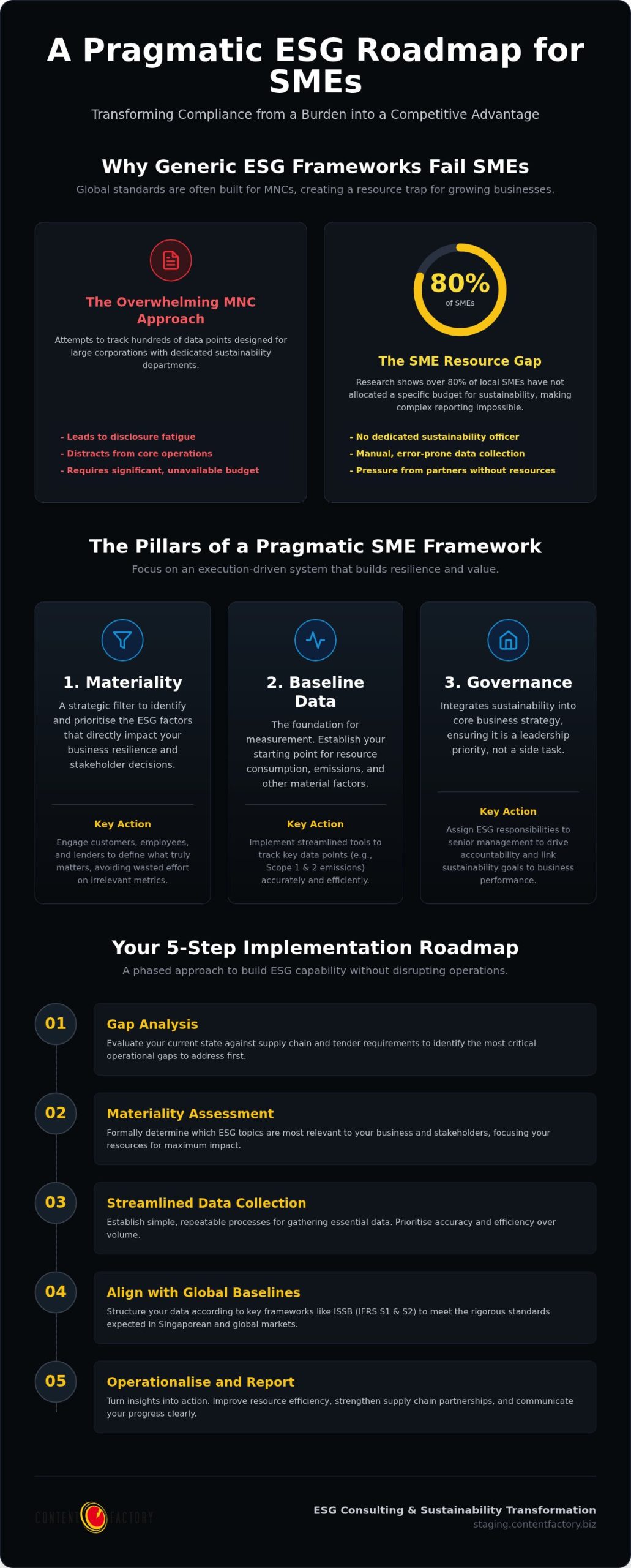
Five Steps to Implementing Your SME ESG Strategy Framework
Implementation moves from strategy to execution through five distinct phases. You must avoid the trap of purely theoretical planning and instead focus on tangible milestones that integrate with your existing business processes. ESG capability building for SMEs is a methodical journey that transforms fragmented sustainability efforts into a synchronised, audit-ready system.
- Step 1: Conduct an ESG Readiness Assessment to identify existing gaps and benchmark against industry peers.
- Step 2: Define your materiality matrix to ensure your limited resources are focused on the highest-impact areas.
- Step 3: Calculate your carbon footprint, prioritising Scope 1 and 2 emissions using verifiable utility and fuel data.
- Step 4: Build internal capability through leadership and staff training to ensure cross-departmental ownership.
- Step 5: Produce a multi-framework report that meets the specific expectations of your lenders and supply chain partners.
Executing the ESG Readiness Assessment
The first phase involves benchmarking your current performance against regional standards and global best practices. This gap analysis highlights where your business stands regarding compliance and operational efficiency. You can initiate this process by conducting an ESG Readiness Assessment Singapore to map out your initial roadmap. Identifying “low-hanging fruit,” such as immediate energy-saving initiatives or waste reduction protocols, provides immediate operational ROI and builds internal momentum for more complex projects.
Once you understand your gaps, you define your materiality matrix to filter out irrelevant data points. You then calculate your carbon footprint, focusing specifically on direct emissions and purchased energy. This creates the quantitative foundation needed for the final reporting phase. Verifiable data is essential here; estimates are no longer sufficient for supply chains governed by SGX RegCo or ACRA requirements.
Bridging the ESG Capability Gap
Sustainability cannot be managed in a vacuum or delegated solely to a single junior employee. It requires cross-departmental buy-in, from procurement and logistics to finance and HR. ESG capability building for SMEs is only successful when your operations team feels empowered to own the data collection process. This transition requires structured training to ensure everyone understands how their daily actions impact the company’s overall sustainability metrics.
Investing in ESG Capability Building Workshops provides your leadership and staff with the technical literacy required for long-term resilience. Training should focus on practical data management and regulatory compliance rather than abstract environmental concepts. This internal expertise ensures that your multi-framework reports meet the rigorous expectations of bank lenders and global partners, securing your position as a preferred supplier.
Operationalising ESG Transformation with ContentFactory
A strategy remains a theoretical exercise until it influences your daily operations. At ContentFactory, we move beyond the production of static reports to make sustainability work on the shop floor. Our focus on ESG capability building for SMEs ensures that your framework isn’t just a compliance document but a driver of operational efficiency and long-term resilience. We bridge the gap between high-level vision and the practical realities of a mid-market firm.
We provide senior-led advisory that delivers C-suite expertise without the inflated overheads associated with global consultancy firms. Led by Singapore Certified Management Consultant Mayuresh Godse, our team brings over 25 years of expertise to your transformation journey. We integrate ESG readiness with a clear roadmap for implementation, often leveraging digital ESG integration and automation to streamline data collection and ensure accuracy across your organisation.
From Theoretical Reports to Measurable Value
Compliance is a baseline; competitive advantage is the goal. We help you turn sustainability data into a strategic asset that unlocks ASEAN market access and strengthens your position in global supply chains. Our approach is rooted in Singaporean integrity, ensuring that your disclosures are compliant with international trade standards and regional regulations like those from SGX RegCo and ACRA. This gives your partners and lenders the confidence they need in your non-financial metrics.
Your ESG framework must be scalable. As your business grows, your data requirements and stakeholder expectations will evolve. We design systems that expand alongside your operations, protecting your investment in sustainability. By focusing on execution over “slide deck” strategy, we ensure your business meets mandatory assurance requirements while improving resource management and reducing waste. This pragmatism is what separates a successful transformation from a wasted administrative exercise.
Taking the First Step Toward ESG Maturity
ContentFactory helps you integrate ESG Consulting & Sustainability Transformation into your core business model. We specialise in turning complex, multi-framework requirements into funded, measurable execution. Our hands-on approach ensures that your leadership and staff are equipped to manage the ongoing demands of a modern, sustainable enterprise. We don’t just advise; we act as a dedicated extension of your leadership team.
Establishing ESG capability building for SMEs is a critical move for any firm looking to secure its future in a low-carbon economy. We guide you through the intricacies of materiality, carbon accounting, and reporting with a focus on tangible outcomes. We help you navigate Singapore government frameworks effectively, ensuring your business remains a preferred partner for global corporations. Our consultants can also advise on how the Enterprise Development Grant (EDG) can support your sustainability projects.
Grant quantum, support levels and eligibility criteria are set by the relevant Singapore government agencies and are subject to change. Eligibility is assessed case by case.
Executing Your Roadmap to ESG Maturity
Transitioning from a generic framework to a pragmatic, results-led system is the only way to avoid administrative bloat. You’ve seen how prioritising materiality and establishing an audit-ready data foundation protects your business from disclosure fatigue. By focusing on Scope 1 and 2 emissions and aligning with frameworks like ISSB, you prepare your firm for the rigorous requirements of Singapore’s financial and supply chain ecosystems.
Investing in ESG capability building for SMEs ensures your organisation remains resilient while improving resource efficiency across manufacturing, technology, and logistics sectors. ContentFactory provides the expert-led stability needed to navigate these changes. Our senior advisory, led by a Singapore Certified Management Consultant, bridges the gap between vision and execution.
The move toward mandatory sustainability reporting is a strategic opportunity to refine your operations and secure long-term growth. Your business is ready to lead this transformation.
Frequently Asked Questions
What is the best ESG framework for a small business in Singapore?
The best framework depends on your commercial objectives and stakeholder requirements. ISSB (IFRS S1 and S2) is currently the global baseline for financial materiality and aligns with SGX requirements. GRI is suitable for firms prioritising broad social impact, while SASB offers sector-specific KPIs for manufacturing and logistics. You should select a framework that matches your target market expectations to avoid wasting resources on irrelevant disclosures.
How much does it cost to implement an ESG strategy framework for an SME?
Implementation costs depend on the project scope and the complexity of your supply chain. While professional fees vary, Singaporean SMEs can leverage government support to manage the investment. The Enterprise Development Grant (EDG) provides up to 70% funding for qualifying sustainability projects until 31 March 2026. This allows you to build internal capabilities and establish data systems while maintaining operational cash flow.
Is ESG reporting mandatory for private SMEs in Singapore?
Reporting is not currently mandatory for all private companies; however, the regulatory landscape is shifting. Listed companies in Singapore must provide climate-related reporting from fiscal year 2025. This mandate forces SMEs within their supply chains to provide accurate carbon data. Proactively establishing a framework ensures you remain a preferred supplier and can meet the increasingly strict sustainability requirements of large corporate tenders.
What is the difference between a materiality assessment and an ESG strategy?
A materiality assessment is a diagnostic process used to identify which environmental and social factors impact your business resilience. It acts as a filter for your reporting efforts. In contrast, an ESG strategy is the comprehensive roadmap that operationalises these findings. It integrates baseline data collection, governance structures, and implementation steps to turn identified priorities into measurable business value and compliant disclosures.
How long does it take to build an audit-ready ESG framework?
Building an audit-ready framework typically requires six to twelve months. This timeline includes conducting an initial readiness assessment, identifying material issues, and establishing verifiable data collection for Scope 1 and 2 emissions. The speed of implementation depends on your current data maturity and the availability of internal staff. A phased approach ensures that sustainability tasks don’t overwhelm your core business operations or disrupt daily workflows.
Can an SME use the Enterprise Development Grant (EDG) for ESG projects?
Yes, SMEs can access the Enterprise Development Grant (EDG) for sustainability-related initiatives. The grant provides up to 70% support for projects like ESG readiness assessments, carbon accounting, and multi-framework reporting. This enhanced support level is part of the Enterprise Sustainability Programme and is confirmed to run until 31 March 2026. Eligibility is assessed case by case by EnterpriseSG to ensure projects deliver measurable transformation.
What are Scope 1, 2, and 3 emissions, and which should an SME track first?
Scope 1 covers direct emissions from your operations, while Scope 2 covers indirect emissions from purchased electricity and cooling. Scope 3 includes all other value chain emissions. You should track Scope 1 and 2 first. These direct metrics are easier to verify with utility bills and fuel records. Establishing this foundation is a critical part of ESG capability building for SMEs before tackling complex value chain data.
How does an ESG framework help with bank loans and financing?
Financial institutions use ESG performance as a proxy for management quality and long-term resilience. A clear strategy framework demonstrates that you are managing transition risks and operational efficiencies. This transparency can lead to favourable interest rates or access to dedicated green financing programmes. Lenders view firms with audit-ready sustainability data as lower-risk partners, especially as regional regulations around climate-related financial disclosures continue to tighten.
Grant quantum, support levels and eligibility criteria are set by the relevant Singapore government agencies and are subject to change. Eligibility is assessed case by case.
Article by
Mayuresh Godse
Mayuresh Godse is a Singapore Certified Management Consultant and Business Strategist specializing in Sustainability, ESG, AI-driven Digital Transformation, and business growth. Based in Singapore, he writes about Sustainability, Digital Innovation, Business Strategy, and Content Marketing for global audiences.
Disclaimer
This article is provided by ContentFactory for general information only and is not legal, tax, accounting or financial advice. Regulations and government scheme criteria change; grant eligibility and quantum are set by the relevant Singapore agencies and assessed case by case, with no outcome guaranteed. Verify current requirements before acting.
One thing worth checking on the tool side: if the disclaimer is switched on globally, the grant caveat already written into your Global Writing Instructions will appear as well, so grant articles will carry the same point twice. Remove the required-disclaimer section from the instructions file if you enable this one.