

Beyond the Spreadsheet: Defining Financial Modelling for Grant Applications
Many businesses treat financial projections as a simple extension of their annual budget—a spreadsheet exercise in linear forecasting. However, when applying for a government grant like the Enterprise Development Grant (EDG), this approach is insufficient. Financial modelling for a grant application is a dynamic and strategic tool. It translates your project’s objectives into a detailed financial narrative that demonstrates its viability, risks, and potential returns to grant assessors.
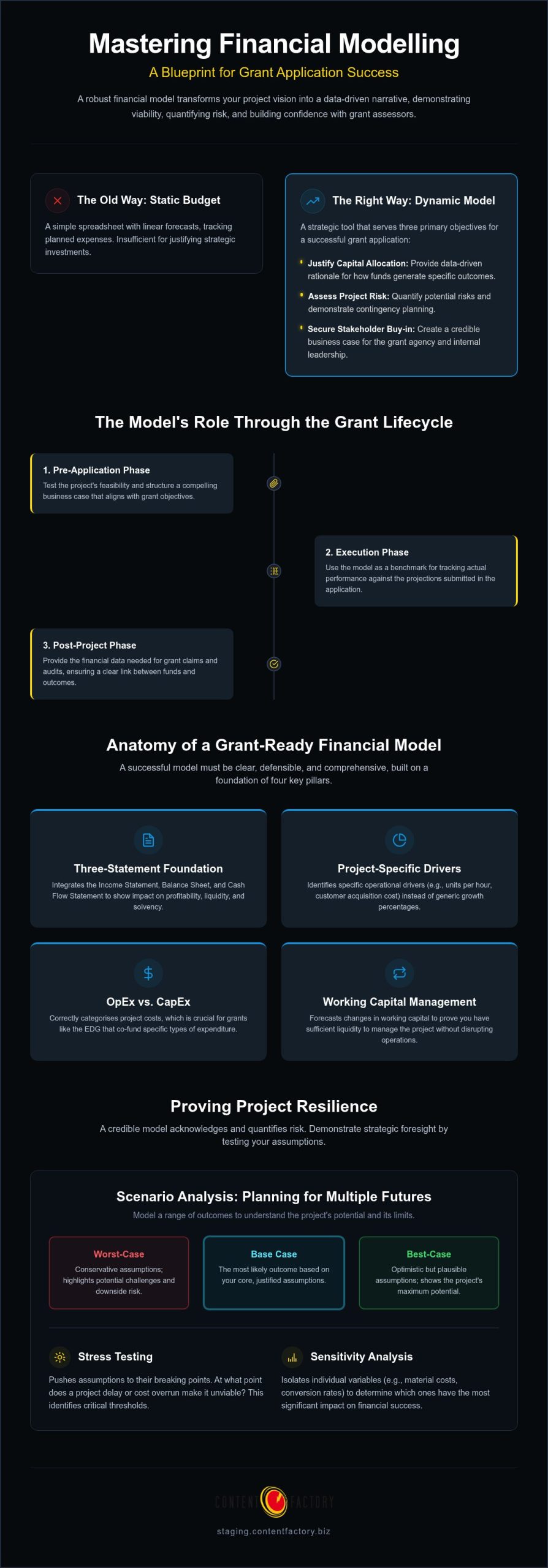
Unlike a static budget that tracks planned expenses, a robust financial model for a grant application serves three primary objectives:
- Justifying Capital Allocation: It provides a data-driven rationale for the proposed investment, showing exactly how grant funds will be utilised to generate specific, measurable outcomes.
- Assessing Project Risk: It quantifies potential risks and demonstrates that you have planned for contingencies, giving assessors confidence in your management capabilities.
- Securing Stakeholder Buy-in: It serves as a credible business case, not just for the grant agency, but for internal leadership and potential co-investors, aligning everyone on the project’s financial logic.
A well-written business plan outlines your vision, but it lacks force without the financial engine to prove its feasibility. For grant evaluators, the model is the evidence that your strategic intent is grounded in commercial reality.
The Role of Modelling in the Grant Lifecycle
A financial model is not a one-time document created solely for the application. It functions as a critical management tool throughout the project’s lifecycle.
- Pre-Application Phase: The model is used to test the project’s feasibility and structure a compelling business case that aligns with the grant’s objectives.
- Execution Phase: It becomes a benchmark for tracking actual performance against the projections submitted in your application, enabling proactive adjustments.
- Post-Project Phase: The model provides the financial data needed for grant claims and audits, ensuring a clear, documented link between the funds received and the outcomes achieved.
Why SMEs Struggle with Grant Projections
Many promising grant applications fail due to weak financial projections. Common pitfalls include linear thinking, where future growth is projected as a simple extension of the past, and overlooking hidden costs associated with the project, such as integration, training, or temporary productivity dips. The most critical failure is often the inability to directly link the grant-funded activity to a quantifiable improvement in revenue, efficiency, or market share.
Core Components of a Grant-Ready Financial Model
A financial model designed for grant assessment must be clear, defensible, and comprehensive. It should provide evaluators with a transparent view of the project’s financial mechanics and its potential impact on your business. The foundation rests on the three core financial statements.
- The Three-Statement Foundation: Your model must integrate the Income Statement, Balance Sheet, and Cash Flow Statement. This demonstrates how the project impacts not only profitability but also your company’s overall financial health, liquidity, and solvency.
- Project-Specific Drivers: Instead of generic growth percentages, identify the specific operational drivers the grant will affect. For a new piece of machinery, this could be units produced per hour. For a digital platform, it might be customer acquisition cost (CAC) or transaction capacity. Each key assumption must be clearly stated and justified.
- Working Capital Management: Grant-funded projects can strain cash flow before they deliver returns. Your model must forecast changes in working capital to prove you have sufficient liquidity to manage the project without disrupting core business operations.
*Operating Expenditure (OpEx) vs. Capital Expenditure (CapEx): The model must correctly categorise project costs. This is crucial for grants like the EDG, which often co-fund qualifying CapEx for equipment or technology and the OpEx associated with its implementation.
Data Granularity vs. Model Flexibility
The key to a successful grant model is finding the right balance between detail and clarity. Grant assessors need to see your assumptions, but an overly complex model can obscure the core business case. Structure your model to be modular, allowing for easy adjustments to key variables as you refine your project plan. This flexibility is vital, as it enables you to test different scenarios without rebuilding the entire model. Ultimately, the data presented must be clear, logical, and traceable, creating an audit-ready foundation for future funding rounds or compliance checks.
Proving Project Resilience Through Scenario and Sensitivity Analysis
A credible financial model does more than present an optimistic forecast; it acknowledges and quantifies risk. By including scenario and sensitivity analysis, you demonstrate strategic foresight to grant assessors, showing that you have considered potential challenges and have a plan to address them. This moves your application from a simple request for funds to a well-reasoned business case.
- Scenario Analysis: This involves creating multiple versions of your forecast based on different sets of assumptions. At a minimum, you should model a Base Case (most likely outcome), a Best Case (optimistic), and a Worst-Case scenario to understand the potential range of results.
- Stress Testing: This technique pushes your model’s assumptions to their breaking points. For example, at what point does a delay in project completion or a lower-than-expected market adoption rate make the project financially unviable? This identifies critical thresholds for your cash flow and profitability.
- Sensitivity Analysis: This analysis isolates individual variables (e.g., raw material costs, labour rates, customer conversion rates) to determine which ones have the most significant impact on your project’s financial success. This helps you focus risk mitigation efforts where they matter most.
Common Grant Project Scenarios to Model
When preparing a model for a grant application, certain project-specific scenarios are particularly important to consider and present to evaluators.
- The “Delayed Launch” Scenario: Model the financial impact of a 6-to-12-month delay in project implementation, whether due to supply chain issues, regulatory hurdles, or internal resource constraints.
- The “Cost Overrun” Scenario: Project the effects of a 15-20% increase in key project costs. Does the business case still hold? How will you fund the shortfall?
- The “Slow Adoption” Scenario: If the project involves a new product or technology, model the impact of slower-than-expected customer adoption or internal user uptake on revenue and ROI timelines.
Linking Your Financial Model to the Enterprise Development Grant (EDG)
For Singaporean businesses, the Enterprise Development Grant (EDG) is a primary source of funding for projects that upgrade capabilities, innovate, or expand overseas. Enterprise Singapore, the administering agency, requires a robust business case, and a detailed financial model is its centrepiece. The model is your primary tool for proving the project’s commercial viability and its alignment with national economic objectives.
A well-structured financial model helps you demonstrate the “projected outcomes” that are central to the EDG evaluation criteria. It allows you to translate the grant-funded activity into tangible metrics like productivity gains, increased revenue from new channels, or the number of skilled jobs created. Aligning your growth model with strategic grant advisory and financial modelling services ensures that your projections are presented in a format that meets the rigorous standards of grant evaluators.
Preparing Your Model for EDG Review
To prepare a financial model for an EDG application, follow a structured, four-step process to ensure it is comprehensive and defensible:
- Ensure Historical Financials Are Clean: Your projections must be built on a solid foundation. Start with at least two years of audited or management-certified historical financial statements.
- Project 3-5 Year Growth with Defensible Assumptions: Project your financials for a minimum of three years post-project completion. Every key assumption—from market growth rates to operational efficiency gains—must be clearly stated and justified with market data or internal analysis.
- Link Grant Activity to Financial Outcomes: Create a clear, direct line between the grant-funded equipment, software, or activity and its impact on the income statement or balance sheet. For example, show how a new CRM system reduces sales cycle time, directly leading to higher revenue.
- Conduct a Sensitivity Analysis: Include a summary of your sensitivity analysis to show that you have assessed the project’s resilience. This demonstrates prudent financial management and reassures assessors that the project is not built on fragile, best-case-only assumptions.
Grant quantum, support levels and eligibility criteria are set by the relevant Singapore government agencies and are subject to change. Eligibility is assessed case by case.
Executing the Project: How Advisory Support Turns Models into Reality
Securing grant approval is a milestone, not the finish line. The next challenge is executing the project and delivering the outcomes promised in your financial model. The transition from “paper projections” to operational reality requires disciplined project management and continuous financial oversight. The model that won you the grant now becomes your roadmap for implementation and a critical tool for accountability.
Financial modelling should be an ongoing process, not a one-time document. As the project unfolds, the model must be updated with actual results, allowing you to track progress, identify variances, and make informed decisions. For Australian firms seeking professional oversight, creditte provides accounting and advisory services that help translate financial models into operational reality. This is where a pragmatic guide can help you navigate the complexities of post-approval grant management, from milestone reporting to final claims and audits.
Continuous Monitoring and Model Refinement
Effective project execution relies on a tight feedback loop between your financial model and your operational activities. Start by establishing Key Performance Indicators (KPIs) that are drawn directly from your model’s core assumptions. These could include metrics like production output, system uptime, or lead conversion rates. Regular reviews—whether monthly or quarterly—are essential for comparing these KPIs against your projections. This allows you to adjust your operational roadmap in real-time, addressing challenges before they derail the project and ensuring you stay on track to meet your grant obligations.
The ContentFactory Advantage
Successfully securing and managing a grant-funded project requires a deep understanding of the local grant ecosystem and rigorous financial discipline. Led by Singapore Certified Management Consultant Mayuresh Godse, ContentFactory provides the strategic support needed to bridge the gap between your vision and its funded execution. Our results-led approach prioritises tangible commercial outcomes over abstract reports, ensuring your financial model is a practical tool for both securing funding and driving project success. We offer direct access to a senior advisor for high-level strategic guidance through every stage of the grant process.
To build a financial model that supports your grant application and guides your project to success, Book a Strategic Consultation.
Frequently Asked Questions (FAQs)
What is the difference between a budget and a financial model?
A budget is typically a static, annual plan that lists expected income and expenses. A financial model is a dynamic, multi-year tool that links your operational assumptions (like production volume or pricing) to integrated financial statements (Income Statement, Balance Sheet, Cash Flow). For a grant application, a model is required because it can simulate different outcomes and demonstrate long-term viability.
Why is financial modelling critical for a grant application?
Grant agencies like Enterprise Singapore need to see a credible, data-driven justification for funding your project. A financial model provides this by forecasting the project’s financial impact, demonstrating a positive return on investment, and proving that your business has a viable plan for execution and long-term growth.
How far into the future should a grant model project?
A standard practice for major grant applications, such as the EDG, is to project for three to five years. This timeframe is typically sufficient to show the project’s full impact, from the initial investment phase through to achieving profitability and stable cash flow.
Can financial modelling help in securing the Enterprise Development Grant (EDG)?
Yes, it is a critical component. A robust financial model is essential for demonstrating the project’s viability, which is a key assessment criterion for the EDG. It provides the evidence that your project is well-planned, commercially sound, and likely to achieve its stated objectives of capability building, innovation, or internationalisation.
What are the most common mistakes in grant application models?
The most common errors include making assumptions that are not backed by evidence, failing to link the grant-funded activity directly to revenue or cost savings, neglecting to model the impact on working capital and cash flow, and submitting a model that is just a simple, single-scenario projection without any risk analysis.
How often should a business update its financial model during a grant-funded project?
It is good practice to review and update your model on at least a quarterly basis during the project implementation. This allows you to compare your actual performance against your projections, report on milestones to the grant agency, and make timely strategic adjustments.
Do I need specialised software for financial modelling?
While there is specialised software available, most grant-ready financial models for SMEs and mid-market companies can be built effectively using Microsoft Excel. The key is not the software itself, but the logical structure, clear assumptions, and integration of the three financial statements.

Article by
Mayuresh Godse
Mayuresh Godse is a Singapore Certified Management Consultant and Business Strategist specializing in Sustainability, ESG, AI-driven Digital Transformation, and business growth. Based in Singapore, he writes about Sustainability, Digital Innovation, Business Strategy, and Content Marketing for global audiences.
Disclaimer
This article is provided by ContentFactory for general information only and is not legal, tax, accounting or financial advice. Regulations and government scheme criteria change; grant eligibility and quantum are set by the relevant Singapore agencies and assessed case by case, with no outcome guaranteed. Verify current requirements before acting.
One thing worth checking on the tool side: if the disclaimer is switched on globally, the grant caveat already written into your Global Writing Instructions will appear as well, so grant articles will carry the same point twice. Remove the required-disclaimer section from the instructions file if you enable this one.