

Technology can help address ASEAN’s ESG data challenge, but it cannot fix weak or inconsistent inputs on its own. The future of ESG reporting in ASEAN depends on reliable data, globally aligned standards and phased climate-reporting timelines, supported by digital tools. In Singapore, the central bank launched Project Greenprint to address gaps in ESG reporting and access to reliable data.
If your business is preparing for changing disclosure expectations, the pressure is real: sustainability information needs to be consistent, traceable and useful, not merely collected for a report. Requirements and timelines vary across the region, so one technology solution or template will not suit every market.
This article explains how digital tools can support ESG data collection and reporting, why data quality matters, how global standards influence local approaches, and what phased climate-reporting timelines mean for businesses in Singapore and ASEAN. The practical takeaway is to build reporting processes around dependable data and the requirements relevant to your business, rather than treating technology as a shortcut.
Key Takeaways
- Digital tools can organise ESG information, but dependable reporting still starts with consistent, traceable data.
- Understand how ISSB-aligned standards are shaping disclosure approaches while local frameworks remain relevant.
- Phased climate-reporting timelines make it important to plan for the requirements that apply to your organisation and reporting period.
- Compare Singapore’s disclosure approach with those in Malaysia, Indonesia, Thailand, Vietnam and the Philippines before relying on one regional template.
- Multi-framework reporting can help connect your ESG data and disclosures across relevant reporting requirements.
Digital tools for sustainability reporting
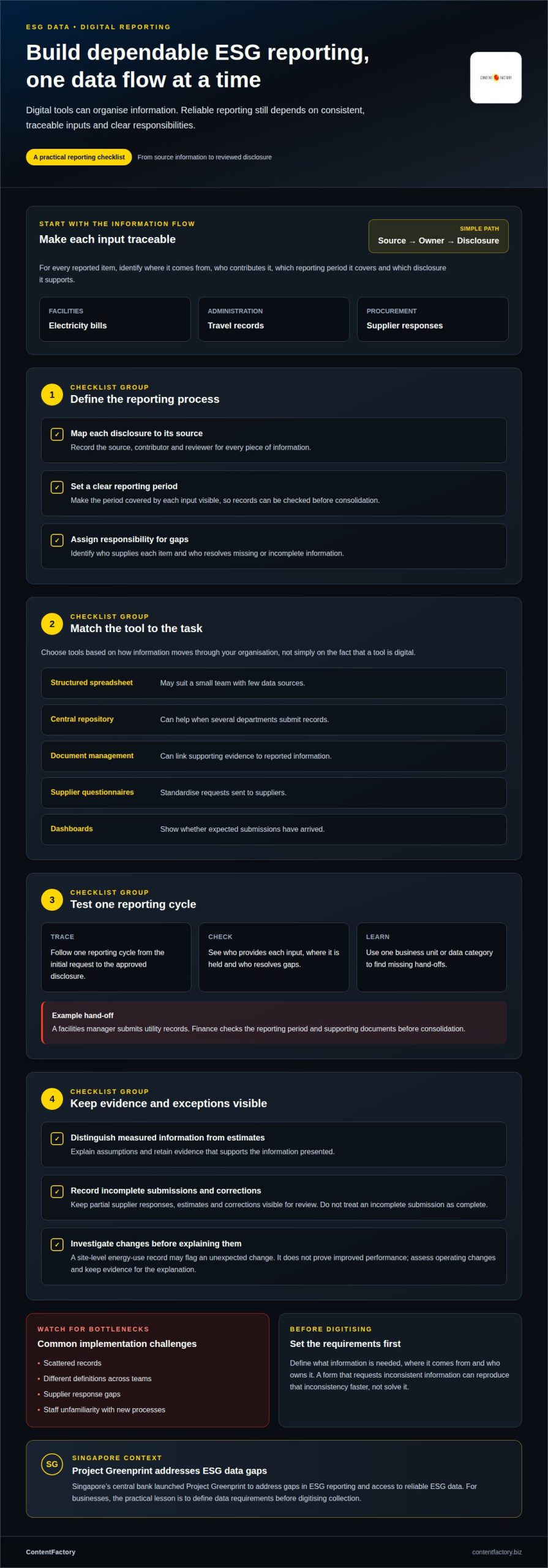
Digital reporting tools organise information from different business activities into a consistent process. A Singapore company might collect electricity bills from facilities, travel records from administration and supplier responses from procurement. The goal is not simply to move files online. Each input needs a clear reporting period, an accountable owner and a link to the disclosure it supports.
Different tools support different parts of the process. A structured spreadsheet may suit a small team with few data sources. A central repository can help when several departments submit records. Document-management tools can link supporting evidence to reported information. Supplier questionnaires standardise requests, while dashboards show whether expected submissions have arrived.
Choose tools based on how information moves through your organisation. Before selecting software, map one reporting cycle from the initial request to the approved disclosure. Identify who supplies each input, where it is held and who resolves gaps. For example, a facilities manager might submit utility records, while finance checks the reporting period and supporting documents before consolidation.
Digital monitoring can reveal changes between reporting cycles. A site-level energy-use record, for example, can help a facilities team spot an unexpected change and investigate its cause. That signal does not prove improved performance. The team still needs to assess relevant operating changes and retain evidence to support its explanation.
Transparency also depends on how figures are presented. A useful record distinguishes measured information from estimates and explains assumptions. If a supplier provides a partial response, the reporting team can record the gap and assign follow-up. That is more informative than treating an incomplete submission as complete.
Singapore’s central bank launched Project Greenprint to address gaps in ESG reporting and access to reliable ESG data. The practical lesson for businesses is to define data requirements before digitising collection. A form that asks departments for inconsistent information will reproduce that inconsistency faster, not solve it.
- Map information flows: Link each disclosure to its source, contributor and reviewer.
- Choose tools by task: Match collection, evidence storage and status tracking to actual workflow needs.
- Test a reporting cycle: Use one business unit or data category to identify missing hand-offs.
- Record exceptions: Keep estimates, incomplete submissions and corrections visible for review.
Implementation challenges include scattered records, different definitions across teams, supplier response gaps and staff unfamiliarity with new processes. Costs depend on the reporting scope, current systems, integration work and training required. For Singapore-specific support, a business can connect its reporting approach with ESG consulting services in Singapore.
Start with an inventory of the information your next report needs. Note its current source, owner and collection method, then identify a bottleneck to address. This helps distinguish where a digital tool can improve the workflow from where the underlying process first needs clearer responsibilities.
Global standardisation of ESG reporting
The ASEAN Taxonomy for Sustainable Finance helps classify activities against regional sustainability criteria. It supports a common reference for sustainable finance decisions, but it isn’t a substitute for corporate reporting standards such as IFRS S1 and IFRS S2.
The direction is towards greater comparability, not identical rules everywhere. The International Sustainability Standards Board published IFRS S1 and IFRS S2 in June 2023. IFRS S1 sets general requirements for sustainability-related financial disclosures. IFRS S2 focuses on climate-related disclosures. Together, they provide a shared baseline that jurisdictions can adopt or adapt through local regulation.
That baseline is gaining reach. As of September 2024, jurisdictions representing approximately 57% of global GDP had decided to use, or were taking steps to introduce, ISSB standards in legal or regulatory frameworks. Those jurisdictions represented over 40% of global market capitalisation and more than half of global greenhouse gas emissions. The future of ESG reporting in ASEAN will take shape through this wider alignment, alongside local rules and timelines.
For companies operating across borders, standardisation can reduce the need to rebuild disclosures for every audience. It doesn’t remove the need to map local rules, reporting periods and applicable requirements. The European Union’s Corporate Sustainability Reporting Directive, for example, uses 12 sector-agnostic European Sustainability Reporting Standards. This illustrates why companies must distinguish a shared global baseline from the detailed rules of a specific jurisdiction.
The ASEAN Taxonomy adds a regional perspective. A company can use its classification approach to explain how an activity relates to sustainable finance categories, while its disclosures follow applicable reporting standards. The distinction matters: an activity classification describes the activity, while a reporting standard structures the information a company discloses. Treating them as interchangeable risks confusing investors and internal decision-makers. The future of ESG reporting in ASEAN will partly depend on keeping these purposes clear as approaches develop.
For a Singapore business preparing disclosures, a practical framework map can separate three layers:
- Baseline: Identify whether IFRS S1 and IFRS S2 are relevant to your reporting requirements.
- Local application: Record the country-specific rules and reporting period that apply to each entity.
- Regional classification: Use the ASEAN Taxonomy where activity classification supports your sustainable finance context.
Then map each disclosure to its source data, calculation method and responsible reviewer. A framework crosswalk can show where one data point supports several requirements and where separate explanations remain necessary. For Singapore organisations handling multiple frameworks, framework selection guidance can help clarify that mapping. If you need to discuss how standards fit your reporting scope, talk through framework alignment.
Phased mandatory climate-reporting timelines
Climate-reporting rules are introduced by jurisdiction and company category, so regional groups need an entity-level view. A parent company’s reporting date may differ from the timetable for each subsidiary. Listed status, business type, financial year and local adoption determine which schedule applies to each operation.
Indonesia’s Group 1, including Main Board companies and major commercial banks, is scheduled to report for FY2026, starting 1 January 2027. Thailand’s SET50 constituents are scheduled to disclose IFRS S1 and S2 for the 2026 annual reporting period, starting in 2027. SET100 constituents are scheduled to start in 2028 for the 2027 annual reporting period. In the Philippines, large non-listed entities with revenue above PHP 15 billion must comply with PFRS S1 and S2 for fiscal years commencing on or after 1 January 2028.
How should ASEAN companies report Scope 1, 2 and 3 greenhouse gas emissions? They should identify direct emissions, emissions from purchased energy and relevant value-chain emissions, then apply the measurement and disclosure requirements relevant to their framework and jurisdiction. Scope 3 information may depend on suppliers, so companies need a consistent method for setting boundaries and recording assumptions.
What penalties or risks apply to inaccurate or incomplete ESG disclosures in ASEAN? There is no single ASEAN-wide penalty schedule; consequences depend on the jurisdiction, entity and applicable rules. Inaccurate statements can prompt stakeholder questions or corrections, while weak supporting evidence can make reported figures harder to explain.
How do ASEAN ESG reporting rules affect SMEs and supply chains? An SME may receive data requests from a larger customer even when it is not directly within that customer’s reporting scope. Suppliers can prepare by keeping records of relevant activities and defining what their data covers, rather than starting from scratch with every request.
A useful timeline register tracks more than the start date. Record the reporting entity, applicable framework, financial year, responsible executive and data-collection window. Then work backwards from the reporting period to set internal dates for gathering inputs, reviewing calculations and resolving missing information. This helps identify when supplier engagement needs to begin.
Organise emissions information by scope and source. For example, separate fuel used in company-controlled vehicles from purchased electricity, then distinguish both from relevant value-chain categories. Record the boundary, source data and method for each calculation. This makes changes in coverage easier to explain between reporting periods.
For an SME in a supply chain, a proportionate first step is to identify which customers request climate information and what activity data they need. Agree internally who owns each response and retain supporting records. This helps the business respond consistently as customer requirements and jurisdiction-specific reporting schedules develop.
Technology for ESG data reporting
Technology choices should follow the reporting process, not dictate it. Before selecting a platform, define what information needs to move between teams, how it will be transformed and who can approve changes. This prevents a tool designed for one department from becoming a disconnected reporting layer that staff must maintain manually.
Start by setting a common data structure. Give each field a consistent name, unit, organisational boundary and reporting period. For instance, if sites record energy activity differently, establish a shared format before consolidating their submissions. A clear structure makes entries easier to compare and suitable information easier to reuse across internal reports.
Next, assess how the system handles changes to reporting methods. A calculation may need updating when source information improves or a boundary changes. The technology should preserve earlier versions and show the reason for each revision. Reviewers can then understand which method produced a figure instead of seeing only the latest value.
Integration requires similar discipline. Identify existing records that can supply ESG inputs, then define what should transfer and how fields should map. A connection between two systems is useful only when both interpret information consistently. Test transfers with representative records and review failed or incomplete exchanges before relying on them for reporting.
Access design is another practical control. Contributors should be able to enter or amend relevant inputs, while designated reviewers hold approval permissions. Separating these roles creates a clearer review trail and reduces the risk of unreviewed changes appearing in a final disclosure without an accountable decision.
Technology should support review, not conceal judgement. Automated rules can flag a blank field, invalid format or value outside a defined range. These checks help staff focus their attention, but cannot determine whether an estimate is appropriate or an explanation sufficient. Set an escalation route for exceptions that need human assessment.
When evaluating a reporting system, test how well it meets these requirements:
- Data structure: Can it represent the organisation’s reporting boundaries and periods consistently?
- Change history: Can reviewers trace revisions and understand their reasons?
- Integration: Can relevant records transfer without losing meaning or context?
- Permissions: Can contribution and approval responsibilities be separated?
- Exceptions: Can unresolved issues be assigned and followed through?
A small pilot can reveal design problems before wider deployment. Select one reporting workflow, test both complete and incomplete submissions, and have contributors and reviewers perform their respective tasks. Note where manual workarounds appear. They often reveal unclear definitions or process gaps that software configuration alone cannot resolve.
For Singapore organisations planning connected ESG workflows, digital ESG data integration can help align system connections with reporting needs. The practical test is whether a reviewer can trace a disclosed value through its transformation history and see who approved it. If that path is unclear, refine the system design before expanding its use.
How do Singapore, Malaysia, Indonesia, Thailand, Vietnam, and the Philippines compare on ESG disclosure rules?
ASEAN has no single ESG disclosure rule covering all six markets. Singapore, Malaysia, Indonesia, Thailand, Vietnam and the Philippines each have local requirements, guidance or implementation pathways. Businesses operating across borders must distinguish exchange guidance from requirements that apply to each specific entity.
Singapore: The Singapore Exchange Sustainability Reporting Guide recommends that publicly listed companies report on sustainability. For Singapore businesses, it is a local reference point, but relevant reporting obligations depend on the entity and applicable rules. Record which Singapore entity is reporting and which requirements apply.
Malaysia: Malaysia launched its National Sustainability Reporting Framework in September 2024. The framework establishes mandatory adoption of ISSB-aligned disclosure standards. This gives companies a local transition path towards aligned disclosures, while the reporting entity and relevant period remain important when planning implementation.
Indonesia: Sustainability reporting requirements for listed companies are outlined in OJK Regulation No. 51/POJK.03/2017. Indonesia also scheduled Group 1, including Main Board companies and major commercial banks, to report for FY2026 starting 1 January 2027. These are distinct reference points: the regulation sets an existing framework, while the phased timeline identifies a specific cohort.
Thailand: The local SEC is expected to revise listed-company disclosure requirements to include information about human rights practices and carbon emissions. Separately, SET50 constituents are scheduled to disclose IFRS S1 and S2 for the 2026 annual reporting period, starting in 2027. SET100 constituents are scheduled to begin in 2028 for the 2027 annual reporting period.
Vietnam: Listed companies have been subject to mandated ESG reporting since 2016. In early 2024, Vietnamese companies had not integrated IFRS S1 and IFRS S2 into their reporting practices. That dated position matters when interpreting the regional picture, but it should not be mistaken for a current statement about every company’s later adoption.
Philippines: Securities and Exchange Commission Memorandum Circular No. 4, Series of 2019, requires publicly listed companies to report on sustainability. The Philippine Sustainability Reporting Committee endorsed adoption of IFRS S1 and IFRS S2 for annual reporting periods beginning on or after 1 January 2025, subject to regulators issuing a jurisdictional roadmap.
For a regional group, build a country-by-country register with each reporting entity, applicable framework, reporting period and data owner. Keep the framework name separate from the local rule that applies it. That distinction helps prevent a group template from obscuring a country-specific requirement. For support aligning disclosures across frameworks, Contact Us.
ContentFactory: Multi-Framework Sustainability Reporting
ContentFactory helps turn ESG data and applicable disclosure requirements into a structured reporting approach. Its Multi-Framework Sustainability Reporting supports businesses that need to align information across frameworks while accounting for local requirements. Where the starting point is unclear, an ESG Readiness & Materiality Assessment can identify relevant topics and information gaps. GHG Emissions Calculation and Carbon Accounting can help establish a consistent basis for emissions disclosures.
This is useful when reporting spans several entities, frameworks or data owners, or when your existing disclosures need a clearer structure. The focus is on practical alignment, defined reporting boundaries and usable information, not a one-size-fits-all template. Explore multi-framework sustainability reporting to understand the approach. To discuss your reporting needs, contact ContentFactory.
Build a reporting approach that can adapt
Make ESG reporting part of how your organisation manages information, rather than a separate exercise assembled at year-end. Define who owns each disclosure, how evidence is retained and how changes in reporting requirements will be assessed. This operating discipline gives your team a stable foundation as frameworks and timelines evolve.
The future of ESG reporting in ASEAN will depend not only on standards or software, but also on organisations’ ability to connect material priorities, emissions data and disclosures consistently. ContentFactory supports this work through ESG Readiness & Materiality Assessments, GHG Emissions Calculation and Carbon Accounting, and Multi-Framework Sustainability Reporting. The right starting point depends on where your reporting process needs structure, whether that means identifying relevant topics, establishing emissions data or aligning disclosures.
Choose one reporting gap to address first, then set a clear owner and practical next step. A focused start is more useful than adopting tools before the process is defined. If you’re ready to discuss how to make your reporting approach work for your organisation, Contact Us. Your next reporting cycle can begin with a clearer plan.
Frequently Asked Questions
Can tech be the answer for the region’s woes with ESG data reporting?
Technology can improve ESG data collection and review, but it cannot replace reliable source information or clear accountability. For example, a workflow can flag a missing supplier response or inconsistent reporting period before consolidation. Someone still needs to resolve the exception and document the decision. Singapore’s Project Greenprint addresses gaps in ESG reporting and access to reliable data, underlining the importance of data quality alongside digital tools.
What are the latest ESG reporting requirements in ASEAN countries?
Requirements vary by market and company type. Singapore Exchange’s Sustainability Reporting Guide recommends sustainability reporting for publicly listed companies. Malaysia’s National Sustainability Reporting Framework establishes mandatory adoption of ISSB-aligned disclosure standards. Indonesia’s listed-company requirements are outlined in OJK Regulation No. 51/POJK.03/2017. The Philippines’ SEC Memorandum Circular No. 4, Series of 2019 requires publicly listed companies to report on sustainability. Vietnam has mandated ESG reporting for listed companies since 2016.
What are ASEAN’s plans for adopting ISSB sustainability reporting standards?
Adoption is progressing through national pathways, rather than a single ASEAN-wide timetable. Malaysia’s National Sustainability Reporting Framework establishes mandatory adoption of ISSB-aligned standards. The Philippines’ Sustainability Reporting Committee endorsed IFRS S1 and IFRS S2 for annual periods beginning on or after 1 January 2025, subject to a jurisdictional roadmap from regulators. Thailand has scheduled phased disclosures for SET50 and SET100 constituents, while Indonesia has a defined Group 1 reporting timeline.
When will mandatory climate and ESG reporting take effect across ASEAN?
There is no single start date for all ASEAN companies. Indonesia’s Group 1 reporting for FY2026 starts 1 January 2027. Thailand’s SET50 disclosures for the 2026 annual reporting period start in 2027, followed by SET100 disclosures in 2028 for the 2027 annual period. In the Philippines, large non-listed entities above the stated revenue threshold face PFRS S1 and S2 requirements for fiscal years starting on or after 1 January 2028.
Which companies in ASEAN must report ESG information, and what are the thresholds?
Coverage depends on local rules and company category, including whether an entity is listed. The Philippines’ requirements include publicly listed companies under SEC Memorandum Circular No. 4, Series of 2019. A separate threshold applies to large non-listed Philippine entities with revenue above PHP 15 billion, which must comply with PFRS S1 and S2 for fiscal years commencing on or after 1 January 2028. Other thresholds and scopes differ by jurisdiction.
What steps should ASEAN companies take to prepare for future ESG reporting requirements?
Start by identifying each reporting entity and the countries where it operates. Assign an owner to each disclosure topic and record the data sources, reporting periods and calculation methods. Map supplier information separately, since value-chain inputs may need to be collected beyond your own operations. Finally, check that evidence supports each reported figure and retain explanations for estimates or revisions. This creates a practical readiness baseline before a new requirement applies.

Article by
Mayuresh Godse
Mayuresh Godse is a Singapore Certified Management Consultant and Business Strategist specializing in Sustainability, ESG, AI-driven Digital Transformation, and business growth. Based in Singapore, he writes about Sustainability, Digital Innovation, Business Strategy, and Content Marketing for global audiences.
Disclaimer
This article is provided by ContentFactory for general information only and is not legal, tax, accounting or financial advice. Regulations and government scheme criteria change; grant eligibility and quantum are set by the relevant Singapore agencies and assessed case by case, with no outcome guaranteed. Verify current requirements before acting.