

Your carbon footprint is no longer a marketing footnote; it’s a line item on your balance sheet that determines whether you keep your biggest contracts. For Singaporean SMEs, the era of voluntary reporting has ended. Multinational clients now demand granular Scope 3 data, and “we’re working on it” is no longer an acceptable answer. Utilizing a professional GHG Protocol carbon accounting service isn’t about paying for a report; it’s about securing your seat at the table for 2026. It’s not a cost center, but a mechanism to protect your margins and prove your operational integrity.
We understand that the technical jargon and the fear of accidental greenwashing can feel paralyzing. You’re facing pressure from every angle, from global regulations like the EU’s CBAM to local expectations for sustainability-linked financing. This guide cuts through the noise to help you master the GHG Protocol’s complexities. You’ll learn how to transform raw emissions data into a strategic asset, leverage the Enterprise Development Grant (EDG) to offset implementation costs, and position your business as a transparent, high-value partner in a decarbonizing economy.
Key Takeaways
- Learn how a professional GHG Protocol carbon accounting service transitions your business from estimation to systematic verification, ensuring your reports are audit-ready for global clients and local banks.
- Understand the strategic difference between direct Scope 1 emissions and the complex value chain requirements of Scope 3 that multinational partners now demand from their suppliers.
- Discover how standardized emissions data unlocks tangible financial advantages, including access to sustainability-linked financing and lower interest rates within the Singapore market.
- Follow a clear 5-step roadmap to implementation, including how to leverage Singapore’s Enterprise Development Grant (EDG) to significantly offset your sustainability transition costs.
- Evaluate why an agile, boutique advisory with Singapore Certified Management Consultant (SCMC) leadership provides more practical, skin-in-the-game value than the theoretical approach of global consultancies.
What is a GHG Protocol Carbon Accounting Service?
Counting is a clerical task. Accounting is a strategic discipline. For a Singaporean SME, a GHG Protocol carbon accounting service represents the difference between guessing your environmental impact and proving it to a global auditor. By 2026, the market has no patience for “approximate” figures. You need a verifiable carbon accounting framework that aligns your operations with the Greenhouse Gas Protocol, the gold standard used by 92% of Fortune 500 companies. This isn’t about filling out a spreadsheet. It’s about building a data fortress that protects your status as a preferred supplier.
Professional services move beyond the “what” of emissions and focus on the “how.” They translate raw utility bills, fuel receipts, and supply chain invoices into a structured report that banks and auditors actually trust. This systematic verification ensures that when you claim a reduction in carbon intensity, you have the documentation to back it up. It transforms your environmental data from a compliance burden into a high-value financial asset that can be used to negotiate better terms with regional partners.
The Core Principles of the GHG Protocol
The GHG Protocol isn’t just a list of rules; it’s a methodology built on rigorous standards. For SMEs, three principles are non-negotiable. First, relevance ensures your report reflects the true reality of your business operations, not just the parts that are easy to measure. Second, completeness prevents the common trap of cherry-picking “clean” data while ignoring high-emission activities, a mistake that leads to audit failures. Finally, consistency allows you to create a baseline for year-on-year growth tracking. This allows you to prove your decarbonization progress to lenders providing sustainability-linked financing in Singapore’s competitive banking sector.
Why DIY Carbon Calculation Often Fails
Free carbon calculators are the “fast food” of sustainability. They’re accessible, but they lack the depth required for regulatory health. Most DIY tools rely on outdated emission factors or generic data that doesn’t reflect Singapore’s specific energy grid or regional logistics. When a multinational client demands Scope 3 data, a generic calculator will fail to account for complex supply chain variables. Inaccurate data isn’t just a technical error, it’s a reputational liability. A professional GHG Protocol carbon accounting service eliminates the risk of unintentional greenwashing, ensuring your numbers withstand the scrutiny of high-stakes procurement audits. It’s the difference between a superficial estimate and an ironclad business case.
Decoding the Scopes: 1, 2, and the Strategic Scope 3
Understanding the three scopes defined by the GHG Protocol is not a theoretical exercise; it’s a structural necessity for surviving the 2026 procurement cycle. As global regulations like California’s SB 253 and the EU’s CSRD begin to mandate Scope 3 reporting for large entities, the pressure on Singaporean suppliers is intensifying. Engaging a professional GHG Protocol carbon accounting service helps you navigate these layers without getting lost in technical jargon. It ensures that your data is not only accurate but also strategically aligned with international expectations, moving you beyond simple compliance into a position of market strength.
Scope 1 & 2: Building Your Foundation
Scope 1 covers direct emissions from sources you own or control, such as your company’s delivery fleet or refrigerant leaks in your facility’s cooling systems. These are the most straightforward to track but require rigorous documentation for audit purposes. Scope 2 focuses on the indirect emissions from the electricity, steam, or cooling you purchase for your operations. Scope 2 is the bridge between operations and procurement. For many Singaporean firms, purchasing Renewable Energy Certificates (RECs) or switching to green energy retailers is the fastest route to a lower carbon footprint and a credible reporting foundation.
Scope 3: The New Frontier of B2B Competition
Scope 3 is the new frontier of B2B competition, representing the ‘Value Chain’ emissions that your multinational clients are now demanding to see. This includes 15 categories, from upstream activities like business travel and waste generated in operations to downstream activities like the transport of sold products. Because your Scope 1 and 2 data effectively becomes your client’s Scope 3 data, any gap in your reporting creates a gap in theirs. Mastering carbon accounting for SMEs is no longer optional; it is the primary way to stay relevant in a supply chain that prioritizes transparency.
The shift from avoiding Scope 3 to using it as a competitive differentiator is where the real ROI lies. When you provide transparent, protocol-aligned data through a GHG Protocol carbon accounting service, you remove a significant administrative burden for your global partners. This precision transforms you from a generic vendor into a strategic asset that helps your clients meet their own net-zero pledges. If you’re ready to protect your margins and secure your future, you should assess your ESG readiness to identify your most critical data gaps and start measuring what matters.
The Strategic ROI of Standardized Carbon Accounting
Data without strategy is just noise. In the context of 2026, a GHG Protocol carbon accounting service is the tool that converts that noise into financial leverage. While competitors might promise fancy dashboards, the real value lies in the doors this data opens. Standardized reporting, backed by the World Resources Institute (WRI) framework, is now a prerequisite for sustainability-linked loans in Singapore. Local banks are increasingly offering lower interest rates to SMEs that can prove their carbon performance with audit-ready data. If your numbers are verified, your capital becomes cheaper.
Beyond financing, carbon data serves as a diagnostic tool for operational waste. When you track emissions at the category level, you often find hidden energy costs that were previously buried in general overheads. This transparency creates a “Green Premium.” In the current B2B landscape, multinational corporations aren’t just looking for the lowest price; they’re looking for the lowest risk. A transparent, protocol-aligned firm wins the contract because they don’t jeopardize the client’s own net-zero targets.
Unlocking Government Grants and Funding
Singaporean SMEs have a unique advantage: significant state support. You can structure your sustainability journey to qualify for Enterprise Singapore (ESG) assistance. Specifically, the Enterprise Development Grant (EDG) can be utilized to offset a substantial portion of professional advisory fees. Success in these applications often hinges on a robust ESG readiness assessment Singapore. By proving you have a structured roadmap, you demonstrate to grant evaluators that your project is a high-value investment in long-term operational resilience rather than a one-off expense.
Risk Mitigation in a Decarbonizing Economy
Proactive reporting is your primary defense against the “sudden death” of supply chain exclusion. As Singapore’s carbon tax continues its scheduled trajectory, businesses without a clear view of their carbon intensity will face escalating costs they cannot pass on. Professional GHG Protocol carbon accounting service allows you to identify these risks before they hit the bottom line. It’s about building business resilience through transparent, third-party verified data. You aren’t just complying with a trend; you’re future-proofing your operations against a regulatory environment that is only getting tighter.
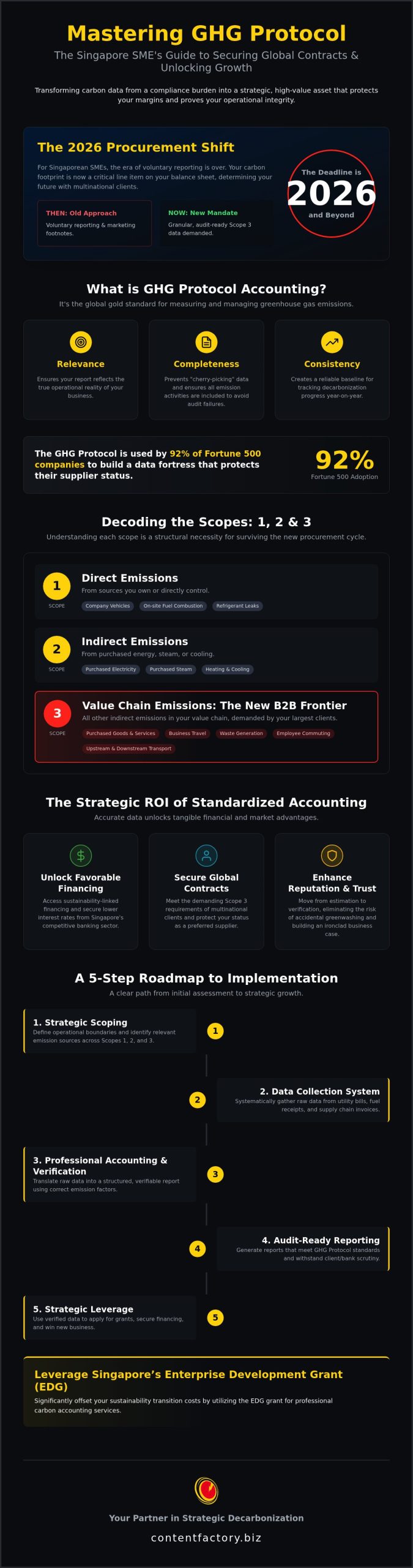
Implementing the GHG Protocol: A 5-Step Roadmap
The official GHG Protocol documentation is a dense technical manual designed for auditors, not for busy directors. To move from theory to execution, you need a streamlined “Day 1” plan that prioritizes action over academic debate. A professional GHG Protocol carbon accounting service strips away the fluff and focuses on the high-impact steps that secure your compliance and your contracts. This isn’t a one-time exercise; it’s a repeatable system designed to scale with your business.
- Step 1: Boundary Setting. Deciding which parts of your business are in or out of your footprint.
- Step 2: Data Collection. The grit-heavy work of gathering utility bills, fuel receipts, and logistics logs.
- Step 3: Emission Calculation. Applying specific emission factors for Singapore’s grid and regional transport.
- Step 4: Reporting. Creating a narrative that satisfies both global standards and your board of directors.
- Step 5: Verification. The final check that ensures your numbers hold up under the scrutiny of third-party auditors.
Setting Organizational and Operational Boundaries
Which approach fits your SME? The “Equity Share” approach tracks emissions based on your ownership percentage, while the “Control” approach focuses on where you have the power to implement operational change. For most Singaporean SMEs, the operational control approach is more practical because it aligns directly with where you can actually reduce costs. Defining clear organizational and operational boundaries is the most critical step for ensuring legal compliance and avoiding the risk of double-counting in multi-stakeholder projects. It ensures you aren’t paying for carbon you don’t own.
Data Integrity and the Verification Audit
The quality of your report depends on moving from “estimated” data to “primary” data. While estimates are acceptable for a first-year baseline, multinational clients increasingly demand primary data sourced directly from your meters and suppliers. A boutique GHG Protocol carbon accounting service provides the hands-on grit needed to prepare you for a third-party assurance audit, ensuring your data trail is ironclad. This preparation makes future reporting cycles 50% faster by establishing a repeatable, systemic process. If you want to stop guessing and start measuring with precision, you should request a digital roadmap and implementation plan to identify your most critical data gaps and start building your baseline today.
Boutique Advisory vs. Big 4: Finding Your Partner
Prestige doesn’t calculate Scope 3. While Big 4 firms offer a recognizable logo for your annual report, they often lack the agility and hands-on grit that a Singaporean SME requires to actually execute a sustainability transition. You don’t need a detached auditor who visits once a quarter; you need a pragmatic mentor with skin in the game. Engaging a boutique GHG Protocol carbon accounting service ensures that your strategy is built on operational reality, not just global theory. It’s the difference between receiving a 200-page PDF and receiving an actionable roadmap that your operations team can actually follow.
The Advantage of Hands-On Implementation
Boutique firms provide something the global giants can’t: direct, consistent access to senior consultants who have actually run businesses. Instead of being handed off to a junior associate after the contract is signed, you work with experts who understand how to integrate carbon accounting with your broader digital roadmap and regional go-to-market execution. We don’t rely on one-size-fits-all software templates that ignore the nuances of your specific industry. We build customized frameworks that align your emissions data with your growth objectives, ensuring that every reduction in carbon intensity also represents an increase in operational efficiency. This isn’t just about math; it’s about structural integrity and long-term viability.
Maximizing Your Investment Through Grants
In Singapore, the financial barrier to high-level advisory is significantly lowered by the Enterprise Development Grant (EDG). However, managing the administrative requirements of Enterprise Singapore can be a bureaucratic headache for the uninitiated. A boutique partner led by a Singapore Certified Management Consultant (SCMC) understands the specific criteria needed to secure funding for sustainability projects. We don’t just help you get the Letter of Offer; we provide the post-approval support to ensure your documentation is ironclad so that your grant claims are actually paid out. By leveraging a GHG Protocol carbon accounting service that understands local grant cycles, you ensure that every dollar spent on ESG builds long-term shareholder value rather than just adding to your overhead.
ContentFactory bridges the gap between technical accounting and business growth. We replace the Big 4 fluff with a results-oriented approach that treats carbon data as a competitive weapon. If you’re tired of theoretical exercises and ready for a partner that prioritizes tangible outcomes, it’s time to move beyond the big-box consultancies and work with a team that understands the specific pressures of the Singapore market.
Own Your Data, Secure Your Future
Carbon transparency has shifted from a corporate social responsibility initiative to a hard requirement for supply chain survival. As multinational partners tighten their Scope 3 reporting, your ability to provide verified, protocol-aligned data determines your commercial viability. We’ve explored how a professional GHG Protocol carbon accounting service transforms technical emissions data into a strategic business asset that unlocks sustainability-linked financing and lowers interest rates. By mastering the five-step roadmap and leveraging local support, you move from a position of regulatory risk to one of market leadership.
ContentFactory provides the hands-on grit and strategic authority needed to navigate this transition. Led by an SCMC-certified consultant, we specialize in building SME supply chain resilience through actionable roadmaps and have a proven track record in securing EDG grant approvals. Don’t let technical jargon or the fear of greenwashing stall your growth. It’s time to replace theoretical fluff with a results-oriented execution plan. Secure your competitive edge with a GHG-aligned carbon accounting roadmap from ContentFactory. Your baseline for 2026 starts today; make sure it’s one that your clients and your bank can trust.
Frequently Asked Questions
What is the difference between carbon accounting and a carbon footprint?
A carbon footprint is the total volume of greenhouse gases your business produces, while carbon accounting is the rigorous methodology used to calculate and verify that figure. Think of the footprint as the final balance and accounting as the ledger and audit trail. Utilizing a professional GHG Protocol carbon accounting service ensures your “ledger” follows global standards, making your final footprint figure credible to auditors, banks, and international partners.
Is the GHG Protocol mandatory for SMEs in Singapore in 2026?
Direct legal mandates currently focus on large emitters and listed entities, but the GHG Protocol is effectively mandatory for any SME within a multinational supply chain. Global regulations like the EU’s CSRD and California’s SB 253 require large firms to report their Scope 3 data, which includes your emissions. If you can’t provide protocol-aligned data, you risk being delisted by major clients who must meet their own compliance deadlines.
How much does a GHG Protocol carbon accounting service cost?
The investment varies based on your organizational complexity, the number of facilities, and the depth of Scope 3 categories required. Factors like data readiness and whether you require third-party assurance also influence the final cost. Instead of viewing this as a flat fee, businesses should consider the operational scale and the level of strategic advisory needed to ensure the report meets the bank-grade standards required for sustainability-linked financing.
Can I use the EDG grant for carbon accounting services?
Yes, the Enterprise Development Grant (EDG) supports sustainability projects that include carbon accounting and ESG strategy development. Singaporean SMEs can leverage this grant to offset a significant portion of qualifying project costs. Working with a Singapore Certified Management Consultant (SCMC) is typically a prerequisite for grant approval, ensuring the project delivers tangible improvements to your business’s environmental resilience and long-term operational efficiency.
How long does it take to complete a full GHG inventory?
A comprehensive inventory typically takes between three to six months to complete from initial boundary setting to the final report. The primary bottleneck is usually data collection from utility providers and supply chain partners. A structured GHG Protocol carbon accounting service accelerates this timeline by implementing efficient data-gathering systems that transform raw receipts into audit-ready metrics without disrupting your daily operations or requiring a small army of staff.
What happens if my business doesn’t report its carbon emissions?
Failure to report leads to “supply chain exclusion,” where multinational clients move their contracts to more transparent competitors. You also face higher capital costs, as Singaporean banks increasingly tie interest rates to ESG performance. Ignoring carbon accounting doesn’t just hurt your reputation; it creates a structural disadvantage that makes your business more expensive to run and harder to scale in a decarbonizing economy where transparency is the new currency.
Is software enough for GHG Protocol compliance, or do I need a consultant?
Software is an excellent tool for data storage, but it can’t handle the strategic nuances of boundary setting or materiality assessments. A consultant provides the “hands-on grit” required to interpret complex supply chain variables and ensure your methodology survives a third-party audit. Most SMEs find that a hybrid approach, using software for tracking and an advisor for strategic alignment, provides the most reliable and audit-proof results.
What is the difference between Scope 2 and Scope 3 emissions?
Scope 2 covers indirect emissions from the generation of purchased energy, such as the electricity powering your Singapore office or warehouse. Scope 3 is much broader, encompassing all other indirect emissions in your value chain, including business travel, waste disposal, and the production of raw materials you buy. While Scope 2 is often the easiest to reduce, Scope 3 typically represents the largest portion of an SME’s total footprint and is the most scrutinized by global partners.
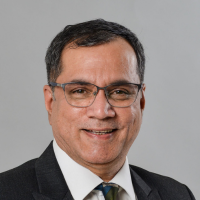
Article by
Mayuresh Godse
Mayuresh Godse is a Singapore Certified Management Consultant and Business Strategist specializing in Sustainability, ESG, AI-driven Digital Transformation, and business growth. Based in Singapore, he writes about Sustainability, Digital Innovation, Business Strategy, and Content Marketing for global audiences.
Disclaimer
This article is provided by ContentFactory for general information only and is not legal, tax, accounting or financial advice. Regulations and government scheme criteria change; grant eligibility and quantum are set by the relevant Singapore agencies and assessed case by case, with no outcome guaranteed. Verify current requirements before acting.