

The grant with the clearest ESG label may not fit the project you need to fund. The right Singapore government grant for ESG depends on your project’s purpose, your organisation’s eligibility and the programme’s current rules. Start by defining the work, then compare it with the relevant agency’s published criteria.
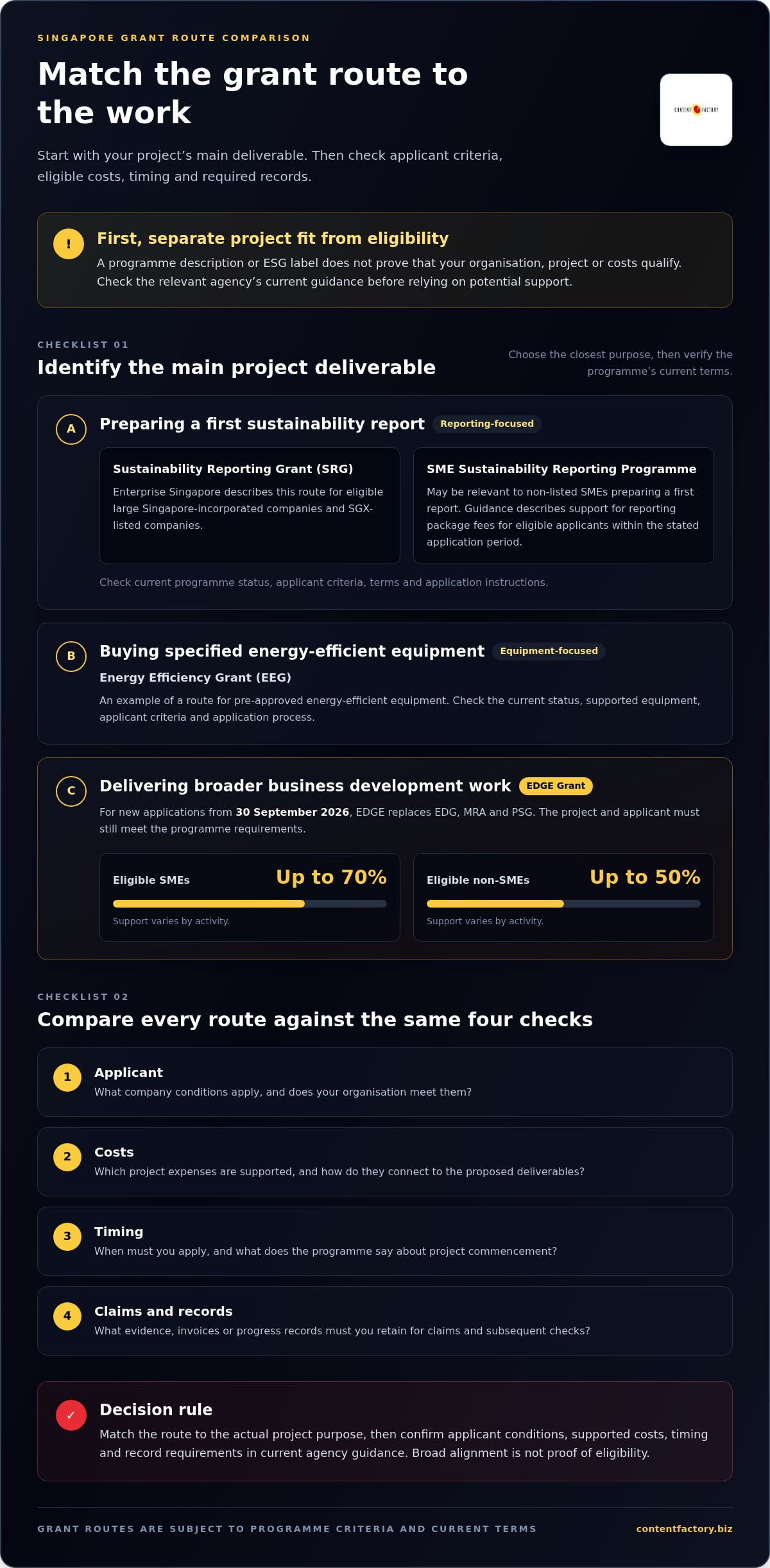
Since 30 September 2026, the EDGE Grant has replaced EDG, MRA and PSG for new applications. Enterprise Singapore says eligible SMEs may receive up to 70% support and eligible non-SMEs up to 50%, with support varying by activity. Reporting-focused grants have different purposes and applicant criteria. A programme description alone does not establish eligibility.
This guide compares potential routes and sets out practical checks for project scope, costs, application documents and post-approval records. The aim is to help you make an informed decision, not assume an application will be approved.
Key Takeaways
- Match the funding route to your project’s purpose, then compare applicant criteria, supported costs and timing.
- Treat programme fit as a starting point, not proof that your company or project qualifies for a Singapore government grant for ESG.
- Check company-level eligibility separately from project scope, costs and timing so you can identify gaps early.
- Prepare a clear project plan, financial model and supporting documents before submitting an application.
- Plan record-keeping from the outset so your team can manage claims and compliance obligations systematically.
Which Singapore government grants may support ESG-related projects?
Potential funding routes depend on what your project is designed to deliver and the relevant agency’s current criteria. Preparing a first sustainability report, buying specified equipment and undertaking broader business development are distinct use cases. A grant’s name or description does not establish that your business or proposed costs qualify.
For new applications from 30 September 2026, Enterprise Singapore’s EDGE Grant replaces EDG, MRA and PSG. Enterprise Singapore states that eligible SMEs may receive up to 70% support and eligible non-SMEs up to 50%, with support varying by activity. The specific project and applicant must still meet the programme’s requirements.
For an overview of the EDGE Grant, watch this explainer from Enterprise Singapore:
When a sustainability reporting grant may be relevant
If your project is specifically to prepare a first sustainability report, review the Sustainability Reporting Grant (SRG). Enterprise Singapore describes it as a route for eligible large Singapore-incorporated companies and SGX-listed companies. Its published guidance sets out support for qualifying costs, subject to the programme’s current applicant criteria and terms. Check those details before building the grant into your project budget.
For non-listed SMEs preparing a first report, the SME Sustainability Reporting Programme may be relevant. Enterprise Singapore’s guidance describes support for reporting package fees for eligible applicants within the stated application period. Check the programme’s current terms, status and application instructions, then compare your planned work with its stated purpose.
When equipment or broader capability routes may be relevant
If your project centres on buying equipment, Enterprise Singapore’s Energy Efficiency Grant is an example of an equipment-focused route for pre-approved energy-efficient equipment. Before treating it as an option, check the current status, supported equipment, applicant criteria and application process.
For a wider business development project, the EDGE Grant may be relevant if your project meets its scope and criteria. EDG stopped accepting new applications on 30 September 2026, when EDGE replaced it for new applications. Its requirements may still matter to qualifying applications or projects filed before that date. Compare your project’s purpose, costs and timing with current Enterprise Singapore guidance rather than relying on an old scheme page or an ESG label alone. ContentFactory provides grant advisory and financial modelling to help organise this assessment and prepare supporting materials.
How to compare Singapore grant routes for an ESG project
Start with the work your business will deliver, not the scheme name. Describe reporting preparation, equipment adoption or broader capability work as distinct project scopes. Then assess each possible route against the same factors: purpose, supported costs, applicant criteria, timing and claims documentation.
Compare programme purpose with the work you plan to deliver
Describe the project in plain operational terms. Is the main deliverable a first sustainability report, the purchase of specified equipment or a broader business capability project? These have different funding purposes, even when they relate to ESG.
Use the awarding agency’s current guidance to understand what each programme is designed to support. Enterprise Singapore’s EDGE Grant covers qualifying business development activities, while the Sustainability Reporting Grant and SME Sustainability Reporting Programme focus on reporting. The Energy Efficiency Grant is an example of an equipment-focused route. The Singapore Green Plan funding schemes page can help you find relevant programmes, but a listing does not confirm that your project or costs qualify.
EDG stopped accepting new applications on 30 September 2026, following its replacement by EDGE. EDG guidance may still be relevant to qualifying applications or projects filed before that date. ContentFactory’s strategic grant advisory and financial modelling support can help you organise a comparison against published criteria.
Compare eligibility, costs and compliance before deciding
For each route, use the latest agency guidance to answer these practical questions:
- Applicant: What company conditions apply, and does your organisation meet them?
- Costs: Which project expenses are supported, and how are they connected to the proposed deliverables?
- Timing: When must you apply, and what does the programme say about project commencement?
- Claims: What evidence, invoices or progress records must you retain for claims and subsequent checks?
Do not treat broad alignment as proof of eligibility. A reporting project still needs to meet the programme’s applicant and cost conditions. An equipment purchase must match current supported-equipment guidance. Compare your project with the published criteria before committing expenditure or relying on potential support.
ContentFactory can help define project scope, organise financial modelling and prepare application documents. Its grant advisory service supports a structured review of the project against published programme requirements.
Is your company and project ready to apply for ESG-related funding?
A project that appears to match a grant’s broad purpose is not proof that your company or costs qualify, and it does not guarantee approval. For a Singapore government grant for ESG, readiness means checking company-level conditions and project-specific requirements separately against the relevant agency’s current guidance.
Check project fit before investing in an application
Start with a short project brief. State the business need, objective, planned activities and expected deliverables. Keep the scope specific enough to distinguish the proposed work from routine operating costs or unrelated activities.
Next, map each proposed cost to the programme’s published rules. Do not assume an expense is supported just because it contributes to the project’s overall purpose. If the guidance is unclear about cost treatment, timing or required documents, note the issue and resolve it using the agency’s current instructions before making commitments.
Use this preparation checklist
This is a planning aid, not an official eligibility test. Use it to identify what you still need to confirm:
- Company conditions: Have you checked the programme’s current applicant criteria against your organisation’s details?
- Project scope: Can you explain the business need, activities, deliverables and intended outcome clearly?
- Costs: Have you mapped each proposed cost to published guidance rather than assumed it qualifies?
- Timing: Have you checked the application window and any rules about when the project or spending can begin?
- Records: Can your team retain the documents and evidence needed for the application and any later claims?
Assess the practical case for proceeding
Eligibility is only one part of readiness. Identify who will own the project, who can provide supporting information and whether your organisation can manage the work and maintain records throughout the process. A clear project scope can still be difficult to manage if responsibilities are unclear or key documents are missing.
List assumptions that need to be resolved before you proceed. These could include whether particular costs are supported, what documents are required, when to submit an application and what evidence is needed for claims. Agency guidance determines eligibility. Advisory support can help organise the project, financial model and application materials, but it cannot determine or influence the agency’s decision. For related information, see ContentFactory’s advisory service.
If important points remain unresolved, avoid making commitments based on anticipated support. ContentFactory can help structure the project scope and application materials around the programme’s published requirements.
How to prepare a grant application and manage compliance
A well-organised application starts with a project you can explain and continues with records your team can maintain. For a Singapore government grant for ESG, use these steps to prepare, then follow the selected programme’s current application and claims instructions. Agency requirements take precedence over any general checklist.
- Define the project. Set out the business need, objective, planned activities, deliverables and implementation plan. Keep the scope specific so the application, budget and project records refer to the same work.
- Build the financial case. Connect proposed costs to project activities and deliverables. Record the basis for each estimate, separate confirmed costs from assumptions and compare each item with the programme’s published cost rules. Do not treat a cost as eligible unless the programme guidance supports that interpretation.
- Assemble the documents. Identify the information and supporting records required by the selected programme. Check names, dates, project descriptions and figures across documents for consistency. The documents should support the same scope and financial case throughout.
- Submit through the stated process. Confirm the submission channel, declarations and timing in the current programme guidance. Retain a copy of what you submit and note any follow-up or reporting instructions issued through the official process.
- Prepare for claims and project close-out. Before work begins, decide how your team will capture invoices, approvals, project updates and other records specified by the programme. Follow its claims instructions and keep evidence traceable to the approved project.
Make the project and financial case consistent
Check the chain from business need to activities, deliverables, costs and timing. If the application describes one scope while estimates or later records refer to another, claims administration can become more difficult. Keep the project description and financial model aligned as the work progresses. ContentFactory provides post-approval audit and compliance support to help organise related records.
Assign owners for records from the outset
Decide who maintains the project file, gathers invoices, records approvals and updates the documentation. Keep an index of records and note where each item is stored. This gives your team a consistent way to respond to claims requirements and check that the file reflects the work carried out.
ContentFactory can help connect project scope, financial modelling and application documentation, then support post-approval compliance planning. Find details about grant preparation support.
How grant advisory can support a better-informed funding decision
Choosing a plausible programme is only the start. A Singapore government grant for ESG also requires a defined project, an explainable financial case and application materials aligned with current programme guidance. Grant advisory supports that preparation. It does not influence the agency’s assessment or determine whether an application is approved.
What grant advisory can help your team organise
Grant advisory can help you set out the business need, project activities, deliverables and proposed costs, then compare the scope with published programme purposes and conditions. Financial modelling connects the project plan to its cost assumptions, while application documentation can be organised around the selected programme’s stated process.
Mayuresh Godse is a Singapore Certified Management Consultant with 25+ years of consulting experience. He supports practical project analysis and preparation. The relevant awarding agency assesses eligibility and decides each application.
Advice can help your team identify gaps, clarify assumptions and assemble coherent materials. It cannot replace agency guidance or guarantee an outcome. ContentFactory provides Singapore government grant consulting, including strategic grant advisory and financial modelling.
What happens after a grant decision
If support is approved, manage the project in line with the award terms and agency instructions. Keep the approved scope, project updates, invoices, approvals and claim records organised. Follow the programme’s specific requirements for claims and supporting evidence.
Clear records make it easier to trace project activity and expenditure to the approved work. Incomplete or inconsistent documentation can complicate claims administration, so assign owners to maintain records and check them against the award terms. ContentFactory also provides post-approval audit and compliance support. The agency remains responsible for its assessment and decisions.
Turn grant research into a practical funding plan
The right Singapore government grant for ESG depends on your project’s purpose, your organisation’s fit and the programme’s current requirements. Compare reporting, equipment and broader capability routes against published criteria before committing. A clear scope, traceable financial case and organised records give your team a practical basis for preparing and managing an application.
ContentFactory helps SMEs prepare through strategic grant advisory, financial modelling, application documentation and post-approval compliance support. The relevant agency assesses eligibility and decides each application. Use the programme’s current guidance to check requirements as you develop your plan.
Frequently Asked Questions
Which Singapore government grant can support an ESG project?
No single grant fits every ESG-related project. The Sustainability Reporting Grant is intended for eligible reporting projects, while the Energy Efficiency Grant focuses on specified equipment. EDG stopped accepting new applications on 30 September 2026, when the EDGE Grant replaced it for new applications. Check each programme’s current status, applicant criteria, supported costs and application process. An ESG label does not establish eligibility.
Can SMEs apply for a Singapore government grant for ESG?
SMEs may explore relevant programmes, but eligibility depends on the scheme and its current published conditions. Check both company-level requirements and the proposed project’s scope, costs and timing. A general programme summary or preliminary assessment is not confirmation. The awarding agency determines eligibility and decides each application under the applicable programme requirements.
What does the Sustainability Reporting Grant support?
Enterprise Singapore describes the Sustainability Reporting Grant as support for eligible companies preparing their first sustainability report aligned with ISSB standards. That purpose does not mean every reporting activity or organisation qualifies. Check Enterprise Singapore’s current guidance for programme status, eligible applicants, supported costs and application instructions. Use current agency information rather than relying only on older summaries.
How much can an ESG project receive through the Enterprise Development Grant?
EDG stopped accepting new applications on 30 September 2026, when the EDGE Grant replaced it for new applications. EDG guidance may remain relevant to qualifying applications or projects filed before that date. For new applications, Enterprise Singapore states that eligible SMEs may receive up to 70% support through EDGE and eligible non-SMEs up to 50%, with support varying by activity. Check the current terms and eligibility criteria.
Do I need approval before starting a grant-supported project?
Application timing and project commencement rules depend on the programme. Check the awarding agency’s latest instructions before committing costs or beginning activities. Do not assume that expenses incurred before an application or decision can be claimed. Keep your project plan, proposed costs and internal approvals aligned with the selected scheme’s published requirements.
What documents should I prepare for a grant application?
Use the current agency checklist as the authority because requirements vary by scheme. As a starting point, organise a clear project scope, business rationale, planned activities, deliverables, cost assumptions and relevant supporting records. Check whether the programme requests additional documents, and keep project descriptions, dates and figures consistent across the application. A well-organised file helps your team respond accurately but does not guarantee approval.
What happens after a grant application is approved?
Follow the award terms and agency instructions for project delivery, claims and supporting records. Keep documentation organised and ensure reported work and costs align with the approved requirements. Exact obligations depend on the scheme. ContentFactory can support post-approval audit and compliance preparation by helping organise records and check documentation against programme instructions. The awarding agency remains responsible for setting requirements and making decisions.
Grant quantum, support levels and eligibility criteria are set by the relevant Singapore government agencies and are subject to change. Eligibility is assessed case by case.
Book a Strategic Consultation (30-minute discovery call).
Article by
Mayuresh Godse
Mayuresh Godse is a Singapore Certified Management Consultant and Business Strategist specializing in Sustainability, ESG, AI-driven Digital Transformation, and business growth. Based in Singapore, he writes about Sustainability, Digital Innovation, Business Strategy, and Content Marketing for global audiences.
Disclaimer
This article is provided by ContentFactory for general information only and is not legal, tax, accounting or financial advice. Regulations and government scheme criteria change; grant eligibility and quantum are set by the relevant Singapore agencies and assessed case by case, with no outcome guaranteed. Verify current requirements before acting.