

What if your sustainability report was a blueprint for operational resilience rather than just a compliance hurdle? Many Singaporean business leaders feel the pressure as SGX moves to end “comply or explain” by FY 2026, making primary components mandatory for all listed issuers. It’s common to feel that the complexity of GRI framework sustainability reporting is a barrier to progress, particularly when your team is struggling to identify material topics or lacks the internal capability to collect and verify data across the entire supply chain.
Mastering the Global Reporting Initiative (GRI) framework allows you to deliver transparent, compliant, and results-led sustainability reports that drive business value and regional market access. This guide provides a pragmatic roadmap for GRI adoption, clarifies the distinction between Universal and Topic standards, and shows how to build stakeholder trust through rigorous disclosure. It bridges the gap between high-level strategy and the operational reality of meeting international standards, ensuring your organisation is prepared for the mandatory climate reporting and assurance requirements currently being phased in by ACRA and SGX RegCo.
Key Takeaways
- Identify how the modular GRI system enables consistent and credible impact disclosure across the economy, environment, and people.
- Navigate the three pillars of GRI, including Universal, Sector, and Topic standards, to ensure your report meets specific industry requirements and global benchmarks.
- Execute a GRI-aligned materiality assessment to prioritise the sustainability impacts that determine your business’s long-term resilience.
- Apply a structured five-step roadmap to implement GRI framework sustainability reporting, moving from initial leadership training to final data verification.
- Convert reporting from a compliance obligation into a strategic asset that prepares your organisation for mandatory sustainability assurance.
Understanding the GRI Framework for Sustainability Reporting
The Global Reporting Initiative (GRI) stands as the most rigorous and widely adopted architecture for impact disclosure globally. Unlike frameworks that focus strictly on financial risk, GRI framework sustainability reporting enables an organisation to quantify its impacts on the economy, environment, and people. It’s a modular system designed for scalability, allowing businesses to maintain a consistent and credible narrative even as regulatory expectations evolve. For Singaporean firms, this isn’t just a reporting exercise; it’s the foundational language required to meet the increasingly stringent expectations of SGX RegCo and ACRA.
Adopting this framework allows your business to communicate non-financial performance to a broad spectrum of stakeholders, including investors, distributors, and regional partners. By using a standardised set of disclosures, you eliminate the ambiguity often associated with ESG data. This clarity is essential for building long-term trust and ensuring that your sustainability claims are backed by a globally recognised methodology.
Why GRI is the Baseline for Singapore Firms
SGX RegCo has signaled a decisive shift toward mandatory climate reporting aligned with ISSB standards, starting with the financial year beginning on or after 1 January 2025. While ISSB standards compliance advisory focuses on how climate change affects a company’s financial value, GRI remains the primary tool for disclosing the company’s “outward” impacts. This dual-framework approach is becoming the expected standard in Singapore. From FY 2026, the ‘comply or explain’ approach for primary components ends for all SGX-listed companies, making structured disclosure a non-negotiable requirement.
Beyond the stock exchange, large non-listed companies with annual revenue of S$1 billion and total assets of S$500 million and above must prepare for ISSB-based climate disclosures by FY 2030. Adopting GRI now provides the structural discipline needed for these future mandates. It also supports regional expansion into ASEAN and India markets, where multinational partners increasingly require GRI-aligned data for their own supplier due diligence and Scope 3 reporting requirements. Using this framework ensures your business is positioned as a resilient and transparent partner in the regional supply chain.
Key Principles of GRI Reporting
Executing a high-quality report requires more than just data collection; it demands adherence to core principles like accuracy, balance, and clarity. You must disclose both positive contributions and negative impacts to provide a fair representation of your performance. A report that only highlights successes lacks the credibility needed for mandatory sustainability assurance readiness. External auditors look for a balanced narrative that acknowledges challenges and outlines clear steps for improvement.
Stakeholder inclusiveness is equally vital. Your report content shouldn’t be decided in a vacuum; it must reflect the interests of those affected by your operations, from shareholders to employees and local communities. This ensures that the information you provide is relevant and useful for decision-making. By prioritising these principles, your business moves beyond “reporting for reporting’s sake” and begins to use ESG data to drive operational efficiency and risk management.
The Three Pillars of GRI Standards: Universal, Sector, and Topic
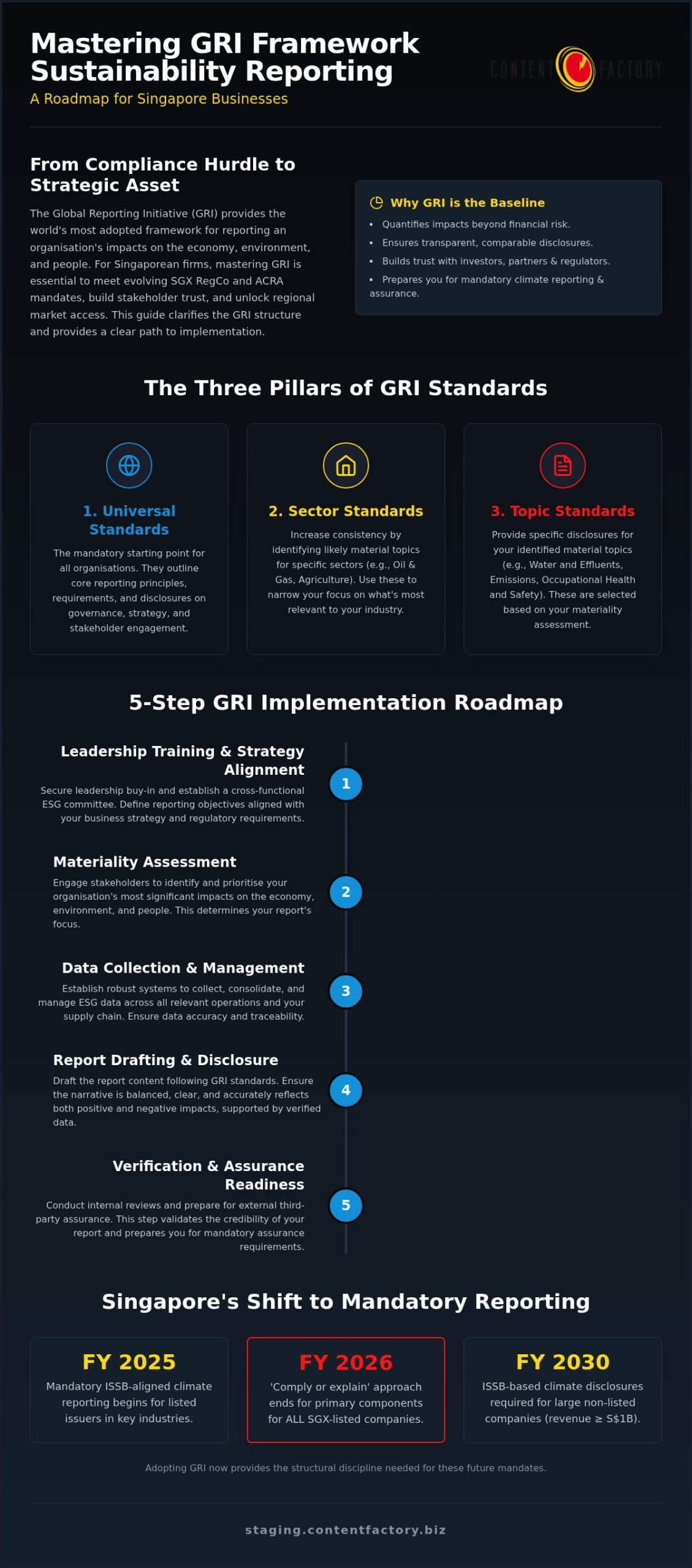
The GRI standards are structured as a modular system to ensure that disclosures remain relevant as a business grows. This architecture prevents reporting fatigue by allowing you to focus only on the impacts that truly matter to your operations and stakeholders. As the most widely used standards for sustainability reporting, this three-pillar system provides a clear hierarchy for data collection and disclosure. Understanding this structure is the first step toward efficient GRI framework sustainability reporting.
Universal Standards: The Mandatory Starting Point
Every organisation begins with the Universal Standards. These are non-negotiable and provide the foundation for all subsequent disclosures. GRI 1: Foundation introduces the requirements and principles you must follow to claim your report is “in accordance” with the standards. It sets the ground rules for transparency and data integrity. GRI 2: General Disclosures requires information about your organisation’s structure, governance, and reporting practices. This section provides the context for your sustainability performance.
GRI 3: Material Topics is perhaps the most critical component. It outlines the specific process for identifying your business’s most significant impacts. You cannot report on everything. Instead, you must use this standard to justify why certain topics were selected and others omitted. This process ensures your resources are directed toward the ESG factors that influence long-term value and stakeholder trust.
Selecting Relevant Topic and Sector Standards
Once material topics are identified, you select from the Topic Standards to provide specific data. These are divided into three series:
- GRI 200 (Economic): Covers disclosures on financial performance, anti-corruption measures, and tax transparency.
- GRI 300 (Environmental): Focuses on operational footprints, including energy use, water consumption, and Scope 1-3 GHG emissions.
- GRI 400 (Social): Addresses human rights, occupational health and safety, and labour practices.
The GRI also continues to release Sector Standards to increase reporting quality for specific industries. For example, GRI 14 for Mining became effective in early 2026, and new standards for Financial Services are expected throughout the year. These provide industry-specific lenses that ensure your disclosures are comparable with regional peers. If your team finds this hierarchy complex, you can speak with our consultants to streamline your reporting architecture. Efficiently mapping these pillars ensures your GRI framework sustainability reporting remains focused on tangible outcomes rather than just administrative volume.
Conducting a GRI-Aligned Materiality Assessment
Materiality is not just a buzzword; it is the filter that separates strategic disclosure from administrative noise. In the context of GRI framework sustainability reporting, materiality is the methodical process of identifying the most significant impacts your business has on the economy, environment, and society. This process serves as a core requirement of an ESG Readiness and Gap Analysis Strategy. By focusing on what truly matters, you ensure your report is concise, relevant, and valuable to your primary audience of investors and regulators.
A Global Reporting Initiative (GRI) aligned assessment requires you to look beyond internal assumptions. You must engage with both internal and external stakeholders to prioritise topics that influence their decisions and reflect your organisation’s outward impact. This rigorous approach prevents reporting fatigue and ensures your sustainability narrative is grounded in operational reality rather than generic disclosures.
Identifying and Assessing Impacts
The first stage of the assessment involves mapping your entire value chain to find potential environmental and social risks. You don’t just look at your direct office or factory operations; you examine the footprint of your suppliers and the downstream impact of your products. Engaging stakeholders through structured surveys, one-on-one interviews, or workshops is essential to gather diverse perspectives. You must also differentiate between actual impacts, which are currently occurring, and potential impacts that could arise from future activities. This distinction allows your reporting cycle to move from a reactive stance to a proactive risk management model.
Prioritising Topics for Disclosure
Once you have a list of impacts, you must categorise them using a materiality matrix. This tool allows you to plot topics based on their significance to the business and their influence on stakeholder assessments. Using this framework helps you determine clear thresholds for what must be included in the final report. If a topic falls below the threshold, it is omitted to keep the disclosure focused and impactful. You should review these material topics annually to reflect changes in your business operations or shifts in the Singaporean regulatory landscape. This consistent review ensures your GRI framework sustainability reporting remains a high-level strategic tool that supports long-term resilience.
Implementation Roadmap: Five Steps to Your First GRI Report
Transitioning from conceptual ESG goals to a published report is a methodical journey that requires internal capability building and structured data management. It’s not a marketing exercise; it’s a rigorous disclosure process that demands C-suite commitment and cross-departmental coordination. For Singaporean firms, the first GRI framework sustainability reporting cycle often serves as the “stress test” for their internal governance and data integrity.
Success depends on following a logical, linear progression that moves from leadership alignment to external verification. This roadmap ensures your resources are focused on high-impact areas rather than administrative volume:
- Step 1: Preparation and Training. Ensure leadership understands GRI requirements and their link to capital access. ESG capability building and training is the first hurdle to clear.
- Step 2: Materiality Assessment. Define the scope of your report by identifying the economic, environmental, and social impacts that matter most to your stakeholders.
- Step 3: Data Collection. Gather the quantitative and qualitative evidence needed for your specific Topic Standards. This is where most firms discover gaps in their current record-keeping.
- Step 4: Report Drafting. Structure your report according to the GRI Universal Standards for context and Topic Standards for performance data.
- Step 5: External Assurance. Prepare for mandatory sustainability assurance readiness. ACRA and SGX RegCo are increasingly requiring third-party verification to ensure data credibility.
Setting Up Your ESG Data Infrastructure
You can’t manage what you don’t measure. Moving from manual spreadsheets to digital ESG integration and automation is essential for maintaining a single source of truth. Manual data entry is prone to error and creates significant risk during the assurance process. You should assign ownership of specific GRI disclosures to department heads, ensuring that HR owns labour data while Operations manages waste and energy metrics.
Standardising data collection is particularly critical for GHG emissions calculation and carbon accounting. With Singapore’s carbon tax at S$45 per tonne for 2026 and 2027, accurate Scope 1 and 2 reporting is no longer optional for large emitters. Building this infrastructure early allows you to scale your reporting as requirements for Scope 3 disclosures begin to take effect for STI constituents in FY 2026.
Drafting and Communicating Your Report
A compliant report must include a GRI Content Index to help readers navigate your disclosures. This index acts as a map, linking specific GRI standards to the pages where the data resides. It’s a mandatory requirement for any report claiming to be “in accordance” with the standards. Without it, investors and regulatory bodies cannot easily verify your compliance status.
Don’t let technical data obscure your strategy. You must balance hard metrics with a narrative that explains how your sustainability performance supports your long-term business resilience. A well-drafted report shows that you aren’t just tracking numbers; you’re using those numbers to drive operational efficiency and risk mitigation. This clarity is what builds trust with investors and regional partners across ASEAN and India. Firms navigating both GRI and ISSB standards compliance advisory requirements will find that aligning these frameworks early significantly reduces duplication of effort across reporting cycles.
Operationalising Your ESG Strategy with ContentFactory
Sustainability reporting shouldn’t be an isolated annual task; it’s the visible output of a robust, daily ESG strategy. ContentFactory helps you bridge the critical gap between mere reporting compliance and tangible operational value. We don’t just deliver a one-off document. We focus on building your internal competencies so your team can manage the GRI framework sustainability reporting process independently as your business scales. This approach ensures your disclosures are audit-ready and aligned with global expectations from the start, preventing the need for costly retroactive corrections.
Capability Building for Long-Term Success
We provide customised ESG capability building and training designed for both leadership and operations teams. This training moves your organisation beyond basic compliance, allowing you to transition into advanced disclosure practices that reflect your true market impact. By integrating GRI disclosures into your broader business transformation roadmap, we ensure that ESG metrics drive efficiency rather than just administrative burden. This strategic alignment is what transforms a report into a tool for regional market access and investor confidence across ASEAN and India. Our work focuses on institutionalising these processes so that sustainability becomes a core component of your operational DNA.
Audit-Ready Disclosures and Multi-Framework Alignment
As Singapore moves toward mandatory assurance, the integrity of your data is paramount. Our approach to GRI framework sustainability reporting ensures that every data point is traceable, verifiable, and prepared for external scrutiny. We help you navigate the intersection of GRI and other requirements like ISSB, ensuring your climate-related disclosures meet the specific expectations of SGX RegCo and ACRA. By establishing a rigorous ESG readiness and gap analysis strategy, we identify data silos early and implement the governance structures needed for multi-framework alignment. This proactive stance reduces the risk of greenwashing and positions your business as a leader in corporate transparency.
Practical Takeaway: To begin your journey, map your current internal data owners against the GRI 2 General Disclosures. Identifying who holds information on governance, employee metrics, and procurement practices will immediately highlight where your data collection gaps lie and which departments require immediate training.
ContentFactory provides the strategic architecture and execution support required to transform ESG from a compliance burden into a growth driver. Led by Singapore Certified Management Consultant Mayuresh Godse, our team brings 25 years of consulting expertise to your sustainability journey. We specialise in operationalising ESG frameworks for mid-market firms, ensuring that your disclosures are both credible and scalable.
It’s time to turn your sustainability disclosures into a tangible business asset that drives growth and builds long-term stakeholder trust.
Frequently Asked Questions
Is GRI reporting mandatory for SMEs in Singapore?
Sustainability reporting is not currently mandatory for all private SMEs. However, all companies listed on the Singapore Exchange (SGX) must provide climate-related disclosures from FY 2025. Large non-listed companies with annual revenue of S$1 billion and total assets of S$500 million must also comply by FY 2030. Many SMEs choose to adopt the framework early to meet the supplier code of conduct requirements set by multinational partners and financial institutions.
How does the GRI framework differ from SASB or ISSB standards?
The GRI framework focuses on impact materiality, which measures a company’s influence on the economy, environment, and people. In contrast, SASB and ISSB standards prioritise financial materiality, focusing on how ESG factors affect a company’s financial value for investors. While Singapore mandates ISSB-aligned climate reporting, firms often use GRI to report on a broader range of social and environmental impacts that stakeholders and regional distributors demand.
What are the Universal Standards in GRI 2021?
The Universal Standards consist of GRI 1: Foundation, GRI 2: General Disclosures, and GRI 3: Material Topics. These apply to every organisation regardless of size or sector. GRI 1 sets the reporting principles; GRI 2 covers governance and structure; and GRI 3 outlines the process for identifying material impacts. Following these is a mandatory requirement for any business claiming its GRI framework sustainability reporting is “in accordance” with the standards.
Can our business get funding for GRI-aligned sustainability reporting?
Qualifying sustainability projects in Singapore may be eligible for support through the Enterprise Development Grant (EDG). This grant can provide up to 70% funding for qualifying projects that focus on core sustainability capabilities and strategy. ContentFactory provides the strategic advisory needed to ensure your project meets the rigorous criteria set by EnterpriseSG. Grant quantum, support levels and eligibility criteria are set by the relevant Singapore government agencies and are subject to change. Eligibility is assessed case by case.
How long does it take to produce a first-time GRI-compliant report?
A first-time report typically takes between four and nine months to complete. This timeline accounts for the initial materiality assessment, stakeholder engagement, and the establishment of new data collection protocols. High-quality GRI framework sustainability reporting requires sufficient lead time to ensure that quantitative data, such as carbon emissions and waste metrics, is accurate and ready for internal or external verification before the final publication date.
Do we need external assurance for our GRI sustainability report?
External assurance is not a mandatory requirement of the GRI standards themselves, but it is highly recommended for credibility. In Singapore, SGX RegCo and ACRA are phasing in mandatory assurance requirements for climate-related disclosures. Obtaining third-party assurance ensures that your data is robust and reduces the risk of greenwashing. It also provides your board of directors with the confidence that the organisation’s sustainability claims are backed by verifiable evidence.
How often should we update our materiality assessment under GRI?
You should review your material topics annually to ensure they still reflect your organisation’s most significant impacts. While a full-scale stakeholder engagement exercise may only occur every two to three years, an annual internal review is necessary to account for changes in business operations or new regulations. This keeps your reporting relevant to your audience and ensures that your ESG strategy remains aligned with the evolving expectations of the Singaporean market.
What is the GRI Content Index and why is it important?
The GRI Content Index is a mandatory navigation table that maps your report’s content to specific GRI disclosures. It allows investors, regulators, and auditors to quickly locate the information they need to verify your compliance. Without a correctly formatted index, a report cannot be considered “in accordance” with the GRI standards. It acts as a transparency tool that proves your organisation has followed the methodology required for rigorous and comparable impact disclosure.

Article by
Mayuresh Godse
Mayuresh Godse is a Singapore Certified Management Consultant and Business Strategist specializing in Sustainability, ESG, AI-driven Digital Transformation, and business growth. Based in Singapore, he writes about Sustainability, Digital Innovation, Business Strategy, and Content Marketing for global audiences.
Disclaimer
This article is provided by ContentFactory for general information only and is not legal, tax, accounting or financial advice. Regulations and government scheme criteria change; grant eligibility and quantum are set by the relevant Singapore agencies and assessed case by case, with no outcome guaranteed. Verify current requirements before acting.
One thing worth checking on the tool side: if the disclaimer is switched on globally, the grant caveat already written into your Global Writing Instructions will appear as well, so grant articles will carry the same point twice. Remove the required-disclaimer section from the instructions file if you enable this one.