

GRI reporting isn’t reserved for large companies. GRI standards for SME reporting use the same core framework as reporting by other organisations: the Universal Standards, GRI 1, GRI 2 and GRI 3, alongside relevant Sector and Topic Standards. SMEs can select disclosures based on the sustainability topics that matter to their business and impacts.
That flexibility matters when reporting feels like a choice between saying too little and taking on an unwieldy exercise. GRI provides a structure for explaining an organisation’s impacts and how it manages them. Materiality helps focus the report on relevant issues, rather than every possible indicator.
This guide explains how the GRI standards for SME reporting work, which parts may apply to Singapore SMEs, and how stakeholder engagement and impact analysis can help identify material topics. It also shows how to connect those topics to relevant indicators and make reporting more manageable by starting with information your business already tracks.
Key Takeaways
- See how the Universal, Sector and Topic Standards fit together, and how each serves a different reporting purpose.
- Identify Topic Standards that may match your business impacts, such as energy use, emissions or workplace safety.
- Understand why SMEs can use the GRI framework without treating every disclosure as relevant to their organisation.
- Use stakeholder input and impact analysis to prioritise material topics before selecting indicators.
- Explore practical ways to build a focused report around relevant issues and information your business already tracks.
Universal, Sector and Topic Standards
GRI divides its standards into Universal, Sector and Topic Standards. Together, they help an organisation identify relevant impacts and select disclosures that explain how it manages them.
Universal Standards for ESG Topics
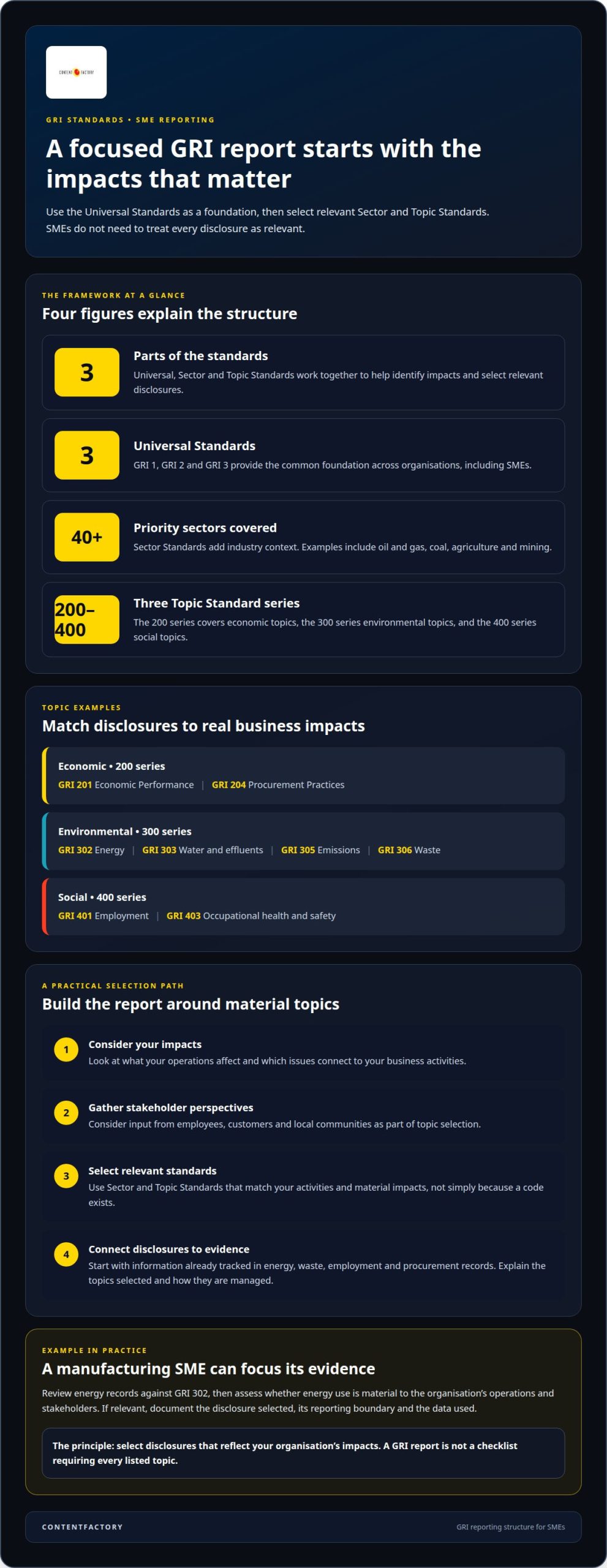
The Universal Standards set the common foundation for identifying and reporting an organisation’s material sustainability topics. GRI 1, GRI 2 and GRI 3 form this framework and apply across organisations, including SMEs.
For your business, GRI 3 connects impact analysis and stakeholder engagement to topic selection. Consider what your operations affect, then gather perspectives from employees, customers and local communities. This process helps distinguish material issues from topics that simply appear in a generic checklist. The Universal Standards also incorporate human rights and environmental due diligence in line with intergovernmental expectations.
Sector and Topic Standards
Sector Standards describe impacts relevant to particular industries, while Topic Standards set out disclosures for specific sustainability issues. They add context to the universal foundation, helping you select disclosures relevant to your activities instead of treating every issue as equally important.
GRI’s modular standards cover over 40 priority sectors. Examples include GRI 11 for oil and gas, GRI 12 for coal, GRI 13 for agriculture and GRI 14 for mining. A manufacturing SME can consider GRI 403 for occupational health and safety, or GRI 302 for energy consumption. Use the standards that match your sector and material topics; don’t select a disclosure solely because a code exists.
Environmental, Economic, and Social Topics
Topic Standards group disclosures into economic, environmental and social areas. The 200 series covers economic topics, the 300 series environmental topics, and the 400 series social topics.
This structure gives your reporting team a practical way to organise evidence. For example, GRI 305 covers emissions, GRI 306 covers waste, and GRI 303 covers water and effluents. Economic examples include GRI 201 for Economic Performance and GRI 204 for Procurement Practices. Social examples include GRI 401 for Employment and GRI 403 for occupational health and safety.
Choose topics by connecting each disclosure to a real impact, a business activity and available evidence. A manufacturing SME could review energy records against GRI 302, then assess whether energy use is material to its operations and stakeholders. If relevant, document the chosen disclosure, its reporting boundary and the data used. This keeps the report focused and makes the reasoning clear to readers and business partners.
Use the standards as a framework for selecting disclosures, not as a requirement to report every listed topic. Your report should reflect your organisation’s impacts and explain how it manages them. A concise, well-supported set of disclosures is more useful than a lengthy document covering issues unrelated to your business.
SMEs and GRI Standards: Are They Relevant?
Yes. The Global Reporting Initiative (GRI) Standards apply to organisations of all sizes. SMEs can focus their reporting on material impacts and relevant disclosures, making GRI useful when customers, business partners or other stakeholders need clear information about your sustainability practices.
Which GRI Standards are most relevant to small and medium-sized enterprises? Start with the Universal Standards, then select Sector and Topic Standards that match your operations and material impacts. For example, a manufacturer might assess energy use or occupational health and safety.
Relevance and Lighter Reporting for SMEs
A lighter approach means applying the GRI framework selectively instead of trying to report on every possible topic. This allows a smaller organisation to focus its efforts on impacts that matter to its activities and stakeholders.
Start with information already held in energy, waste, employment and procurement records. Identify gaps only for topics you consider material. GRI-based reporting can also help reveal opportunities to reduce waste and manage operational impacts. Keep the report concise, while explaining which topics you selected and how you manage them.
Comparing SME Reporting Frameworks
GRI, IFRS sustainability standards and ESRS are distinct frameworks, so the right comparison depends on your reporting purpose and obligations. GRI focuses on an organisation’s impacts. According to the European Commission, companies subject to the CSRD must report under ESRS, their required EU framework.
For a Singapore SME, first identify what customers, investors or other stakeholders request and whether a specific reporting obligation applies to your organisation. Do not treat a GRI report as a substitute for another framework when that framework is required. The frameworks may address related sustainability issues, but their reporting requirements are not interchangeable.
Preparing GRI Reports and Disclosures
GRI reporting uses the applicable Universal Standards and disclosures from relevant Topic or Sector Standards. SMEs can use the same standards as larger organisations, selecting topics based on their impacts and materiality.
What information must an SME disclose under GRI? The disclosures depend on the material topics selected and the applicable standards, not on a single fixed checklist for every SME. To report in accordance with GRI, identify impacts, select relevant topics, gather evidence, explain how each topic is managed and map disclosures to the report. These steps create a clear record of your reporting choices.
Reporting Costs, Benefits, and Challenges
Costs depend on your internal capacity, existing data, selected topics and reporting depth. There is no single price for every SME. The practical workload increases when records are fragmented or disclosures require new data collection.
What are the benefits and challenges of GRI reporting for SMEs? A focused report can clarify impacts for customers and partners, while improving visibility of waste or resource use. The challenge is gathering consistent evidence without overextending a small team. How can an SME report in accordance with the GRI Standards? Scope the report around material topics, use existing records, and document limitations and management approaches.
Are there Singapore-specific sustainability reporting requirements or support for SMEs using GRI? The GRI Standards themselves are not legally mandatory. Identify which requirements apply to your organisation and reporting context. Are there GRI Standards or guidance specifically for SMEs? The standards apply across organisation sizes, so SMEs can use their modular structure and select relevant disclosures.
Applicability of GRI Standards to organisations of all sizes
The GRI Standards apply to organisations of all sizes, including Singapore SMEs and larger companies. The framework stays consistent. Your organisation’s activities, impacts and relevant disclosures determine what it reports.
That distinction matters for a small or medium-sized business. GRI does not require you to copy a large company’s report or describe every operation at the same depth. A local manufacturer and a regional group may both use GRI, but their material impacts, available records and stakeholder concerns can differ significantly.
Start with the activities your organisation controls or influences. A food producer might examine packaging, energy use, employee safety and supplier practices. A professional services firm might focus on employment, workplace practices and business conduct. These examples are starting points, not fixed topic lists. Select topics based on your own impacts and business context.
Use a practical scope before collecting data:
- Describe the activities, locations and business relationships covered by the report.
- Identify impacts connected to your products, services, workforce and operations.
- Ask relevant stakeholders which issues affect them, then record what you heard.
- Choose disclosures that explain material topics and how your organisation manages them.
- Use available records first, then identify gaps that need better tracking.
This approach supports transparency without treating report length as a measure of quality. An SME with one operating site, for example, might explain its energy monitoring process and related impacts. A larger organisation with several locations may need to distinguish performance and management practices across those locations. Both can report clearly when their reporting boundaries and explanations reflect their operations.
GRI can also provide a common structure when a customer or business partner asks about sustainability performance. A supplier can use its report to explain selected impacts, management actions and relevant disclosures, rather than responding with disconnected claims. Stakeholder engagement helps test whether the report covers issues that matter beyond the organisation’s own priorities.
Keep the reporting process proportionate to your capacity. Assign responsibility for each disclosure to the person closest to its source records, such as facilities staff for energy data or human resources for workforce information. Document data sources, boundaries and decisions. This supports comparison in future reporting and helps readers understand how the organisation reached its conclusions.
Materiality and selecting relevant GRI indicators
Materiality helps you focus a GRI report on impacts that matter to your organisation and stakeholders. Use your assessment to select relevant disclosures and indicators, rather than treating every available indicator as necessary.
Assessing Materiality
Under GRI 3, identify material topics through impact analysis and stakeholder engagement. This gives your reporting decisions a clear basis: the topics reflect your organisation’s impacts, not simply a generic checklist or investor preference.
Start by reviewing your activities, products and business relationships. A Singapore manufacturer could consider energy use, workplace safety, waste and supplier practices. Gather input through customer surveys, employee discussions and local community feedback, then compare those perspectives with impacts identified in your operations.
For each potential topic, record:
- The activity or relationship connected to the impact.
- Who or what is affected, including relevant stakeholders.
- The evidence and feedback supporting its significance.
- How your organisation currently manages the issue.
These notes make governance decisions easier to explain. They also help your team distinguish a material impact from an issue that is visible but less relevant to your business. A focused materiality assessment for SMEs can help organise this analysis.
Selecting Relevant GRI Indicators
GRI indicators are disclosures selected from the Topic Standards to report on material topics. Choose them after your assessment, so each disclosure connects to an identified impact and a practical way to explain how it is managed.
For example, if energy consumption is material to a manufacturing SME, review the relevant energy disclosures in GRI 302. If occupational health and safety is material, consider GRI 403. The indicator should help explain the issue, the organisation’s approach and the evidence supporting its account.
Use this sequence to keep selection disciplined:
- Match each material topic to the relevant GRI Topic Standard.
- Identify which disclosures fit your organisation’s activities and impacts.
- Assign data ownership to the team member closest to each record.
- Note exclusions and explain why a disclosure does not apply.
Test proposed disclosures against stakeholder concerns and available evidence. Investors may seek comparable information, while employees may prioritise safety or employment practices. Address relevant needs without letting one audience replace impact analysis. This balance supports transparency and a credible sustainability commitment.
Review your selection when operations, products or business relationships change. A new production line, for instance, may alter energy or waste impacts and make different disclosures relevant. Record the reasons for changes to keep future reporting traceable and consistent.
What are the GRI Standards and how do they apply to SMEs?
The Global Reporting Initiative (GRI) Standards provide a framework for organisations to report their sustainability impacts. GRI has provided sustainability reporting standards for over 30 years, and SMEs can use them to prepare reports suited to their operations and reporting purpose.
The standards are maintained through a formal standard-setting process. The Global Sustainability Standards Board governs GRI’s standard-setting activities, providing a structured framework for organisations reporting on different impacts. SMEs can use defined standards and disclosures instead of creating reporting categories from scratch.
The revised GRI Universal Standards were published in October 2021 and came into effect for reporting on 1 January 2023. If your organisation is preparing a report, identify the reporting period first, then use the applicable standards and versions consistently throughout the document. Consistency helps readers understand what the report covers and how its disclosures relate to the organisation’s activities.
GRI reporting is more than a collection of sustainability statements. A report should connect an organisation’s impacts with how it manages them, using relevant disclosures and supporting information. For example, an SME describing employment impacts can explain the policies, processes or actions it uses to manage them, alongside the applicable disclosure information.
A practical reporting workflow can help your team turn scattered records into a coherent report:
- Set the reporting boundary by describing the organisation and activities covered.
- Identify the reporting period and gather relevant records from responsible teams.
- Choose applicable standards and disclosures based on the topics being reported.
- Explain how the organisation manages each reported topic and support statements with evidence.
- Prepare a GRI Content Index that maps each disclosure to its location in the report.
The Content Index is a required table that maps each disclosure to its location in the report. The report itself can be concise, while the index gives readers a direct route from a disclosure to the supporting section. Keep references accurate as you edit, especially when a section moves or a disclosure appears in more than one place.
For an SME, applying GRI means using the framework with discipline, not copying the scale of a larger organisation’s report. Keep evidence traceable, make the reporting boundary clear and ensure every included disclosure has a clear purpose. If you need support aligning your reporting approach and disclosures, Contact Us.
Applying these standards consistently ensures clarity and comparability. SMEs account for nearly 90% of global employment and 40% of GDP in many countries, making clear reporting relevant beyond large organisations. Many large companies require SMEs in their supply chains to demonstrate their sustainability commitments. SMEs may find it more manageable to focus reporting on their direct impacts and risks and use data they already collect. GRI-based sustainability reporting can also help SMEs identify ways to reduce waste and save costs, connecting documented impacts and actions with practical improvements.
ContentFactory: ESG Readiness & Materiality Assessments
ContentFactory helps SMEs turn GRI requirements into a focused reporting plan. Its ESG Readiness & Materiality Assessments identify relevant topics, assess existing information and clarify where reporting processes need development.
Turn to this support when your team is unsure which impacts to prioritise, how to select disclosures or how to organise evidence. If emissions are a material topic, GHG Emissions Calculation and Carbon Accounting can support the underlying data. Multi-Framework Sustainability Reporting can help align disclosures when your organisation reports against more than one framework.
The practical next step is to define your reporting purpose, boundary and material topics, then identify the gaps your team needs to address. Contact ContentFactory to discuss your SME’s reporting needs.
Turn your reporting priorities into an operating plan
Turn reporting priorities into decisions your organisation can act on. Assign owners for key data, establish a review process and decide how reporting choices will adapt as operations or stakeholder expectations change. This keeps sustainability information connected to business decisions instead of treating the report as a one-off document.
A practical approach to GRI standards for SME reporting should account for the work behind the disclosures. ContentFactory offers ESG Readiness & Materiality Assessments to clarify priorities, GHG Emissions Calculation and Carbon Accounting for emissions data, and Multi-Framework Sustainability Reporting when your organisation needs to report across frameworks. The right starting point depends on your reporting needs and existing processes.
Choose one action to move forward: identify the reporting decision your team needs to make next, then establish who will own it. For support shaping that next step, Contact Us. A clear plan can help your organisation build reporting practices that develop alongside the business.
Frequently Asked Questions
How do the GRI Standards work?
The GRI Standards give organisations a recognised basis for presenting sustainability information. You can publish a concise snapshot or integrate disclosures into an annual report or website. For example, a Singapore SME might publish selected information online for customers interested in its sustainability commitments. Choose a format that works for your readers, and make clear which topics and reporting period the published material covers.
What is the Global Reporting Initiative (GRI)?
The Global Reporting Initiative is the organisation that develops the GRI Standards. It has provided sustainability reporting standards for over 30 years. Organisations use those standards to prepare sustainability reports, including SMEs. In practice, GRI is the standard-setting organisation, while the standards are the reporting framework your organisation applies. Keeping that distinction clear helps readers understand whether you are referring to the organisation or the reporting requirements.
Why is GRI important for SMEs?
GRI can help an SME present its sustainability commitments in a format business stakeholders can access. A concise online disclosure, for example, gives customers one place to understand the organisation’s stated priorities. Reporting can also prompt internal discussion about resource use and operational practices. Its practical value depends on selecting information that serves your business purpose and making it easy for your intended readers to find.

Article by
Mayuresh Godse
Mayuresh Godse is a Singapore Certified Management Consultant and Business Strategist specializing in Sustainability, ESG, AI-driven Digital Transformation, and business growth. Based in Singapore, he writes about Sustainability, Digital Innovation, Business Strategy, and Content Marketing for global audiences.
Disclaimer
This article is provided by ContentFactory for general information only and is not legal, tax, accounting or financial advice. Regulations and government scheme criteria change; grant eligibility and quantum are set by the relevant Singapore agencies and assessed case by case, with no outcome guaranteed. Verify current requirements before acting.