

The TCFD reporting requirements in Singapore now sit within a climate-disclosure regime based on IFRS S1 and IFRS S2. For Singapore-listed issuers, Scope 1 and Scope 2 emissions disclosures are mandatory from financial year 2025; Scope 3 is mandatory from financial year 2026 for the specified issuer category and voluntary for the other listed category. Large non-listed companies meeting both the revenue and asset thresholds must report from FY2030 unless exempted.
There isn’t one start date or rule for every company. Your obligations depend on whether your company is listed, its size and, for some requirements, its industry.
This guide explains which companies are covered, when reporting begins and how emissions scopes apply. It also explains how Singapore’s current requirements relate to TCFD, helping you identify the rules that apply to your organisation and prepare accordingly.
Key Takeaways
- Identify your issuer category first: listing status, industry and applicable phase-in determine when climate disclosures begin.
- Separate Scope 1 and Scope 2 emissions from Scope 3, then map which disclosures apply to your organisation and reporting year.
- Singapore’s climate-related disclosure framework is based on IFRS S1 and IFRS S2, while TCFD’s four pillars help organise climate information.
- Check whether your company falls within the requirements for listed issuers or large non-listed companies, including any applicable exemption.
- Build a reporting timeline around your financial year and the sustainability report publication deadline that applies to your assurance arrangements.
When do Singapore companies need to start mandatory climate reporting?
SGX RegCo introduced climate reporting in phases for Singapore-listed issuers. From financial year 2025, SGX RegCo requires Scope 1 and Scope 2 emissions disclosures; other climate-related disclosures have separate start dates based on issuer category.
SGX RegCo’s 2022 approach was comply-or-explain. For 2023, SGX RegCo required climate reporting for issuers in financial services, agriculture, food and forest products, and energy; other issuers reported on a comply-or-explain basis. In 2024, SGX RegCo’s mandatory sector coverage also included materials and buildings, and transportation.
TCFD’s recommendations contain 11 disclosures across governance, strategy, risk management, and metrics and targets. They cover board oversight, climate-related risks and opportunities, risk processes, and measures used to assess performance. Singapore’s climate disclosure framework is based on IFRS S1 and IFRS S2, with requirements phased by financial year and issuer category.
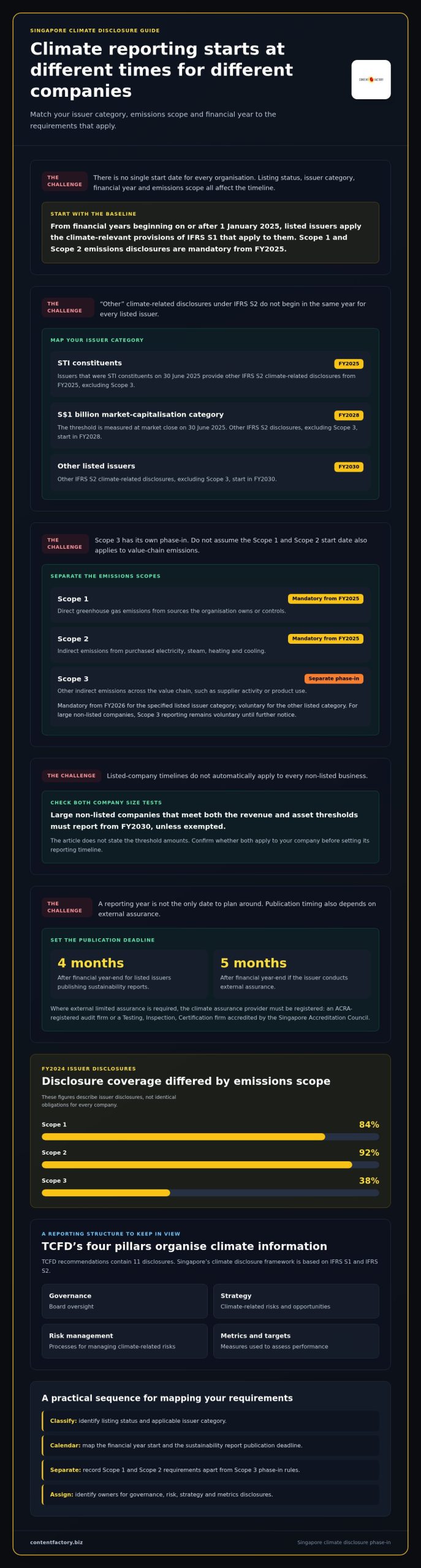
From financial years starting on or after 1 January 2025, SGX RegCo requires issuers to apply the climate-relevant provisions of IFRS S1 that apply to them. Issuers that were STI constituents on 30 June 2025 must provide other IFRS S2 climate-related disclosures, excluding Scope 3, from financial year 2025. The S$1 billion market-capitalisation category starts those other disclosures in financial year 2028; the threshold is measured at market close on 30 June 2025. Other issuers start in financial year 2030.
SGX RegCo requires listed issuers to publish sustainability reports no later than four months after financial year-end, or five months if they conduct external assurance. This sets the deadline for the sustainability report.
Where external limited assurance is required, Singapore’s framework requires a registered climate assurance provider: an ACRA-registered audit firm or a Testing, Inspection, Certification firm accredited by the Singapore Accreditation Council.
An issuer is non-compliant if it fails to meet an applicable SGX RegCo reporting obligation. Any specific consequence depends on the relevant listing rule and the circumstances of the breach, not the reporting timetable alone.
For preparation guidance, ACRA and SGX RegCo established the 15-member Sustainability Reporting Advisory Committee, an industry-led panel. A practical first step is to map your financial year and issuer category, then assign owners for governance, risk, strategy and metrics disclosures.
Between 1 January 2022 and 31 December 2022, Singapore-listed issuers had to undertake climate reporting on a comply-or-explain basis. Other Singapore-listed public companies are required to publish climate-related disclosures on a comply-or-explain basis, while SGX mandates TCFD-based climate-related disclosures for selected sectors.
Scope 1, Scope 2 and Scope 3 greenhouse gas emissions
Emissions scopes classify greenhouse gases by where they arise in a company’s operations and value chain. For Singapore-listed issuers, Scope 1 and Scope 2 disclosures are mandatory from financial year 2025. Scope 3 reporting follows a separate phase-in, so identify your issuer category before setting reporting boundaries.
Scope 1 covers direct greenhouse gas emissions from sources your organisation owns or controls. Scope 2 covers indirect emissions from purchased electricity, steam, heating and cooling. Scope 3 covers other indirect emissions across your value chain, such as supplier activity or product use.
For Singapore-listed issuers, Scope 1 and Scope 2 disclosures are mandatory from financial year 2025. Singapore reporting entities are expected to disclose both scopes from their first climate-related disclosure reporting year, with Scope 3 disclosures to follow. A clear inventory of emissions sources and relevant value-chain activities can help support emissions reporting.
Scope 3 is mandatory from financial year 2026 for Singapore-listed issuers in the category marked with footnote 1 in the requirements table. It remains voluntary for the other listed category. Large non-listed companies’ Scope 3 reporting remains voluntary until further notice. These distinctions matter: don’t treat a listed-company phase-in as applying automatically to every Singapore business.
FY 2024 disclosures show a difference in reporting coverage across the three scopes: 84% of Singapore issuers disclosed Scope 1, 92% disclosed Scope 2, and 38% disclosed Scope 3 emissions. These figures describe issuer disclosures, not a rule that every company had identical obligations. Investors use scope data to understand emissions exposure, climate-related risks and opportunities, and progress against targets.
Build a defensible emissions record by linking each reported figure to its activity data, reporting boundary and calculation method. Start with these practical checks:
- List facilities, vehicles and other controlled sources relevant to Scope 1.
- Match purchased electricity and other energy records to Scope 2 reporting periods.
- Map significant suppliers and value-chain activities to identify Scope 3 data needs.
- Record assumptions, exclusions and data owners so reviewers can trace each metric.
For example, reconcile electricity records with the reporting period, then identify which suppliers hold relevant value-chain data. This helps clarify what you can report now and where estimates or better data-collection processes may be needed.
If you’re defining reporting boundaries or organising emissions data, discuss your emissions reporting approach.
Sustainability Reporting Requirements in Singapore: What Are They?
Singapore’s rules cover annual sustainability reporting by SGX-listed issuers and phased climate disclosures. Requirements depend on listing status, industry, company size and financial year.
ESG Reporting for SGX-Listed Companies
ESG reporting is the disclosure of an issuer’s sustainability-related information, including relevant climate risks and opportunities. SGX RegCo requires SGX-listed issuers to publish annual sustainability reports under a comply-or-explain rule. SGX RegCo recommends 27 core ESG metrics as a starting point. Use relevant metrics to organise data, then explain how selected indicators relate to business activities, targets and material issues.
Listed Company Reporting Timelines
Listed company reporting timelines set when issuers publish sustainability information and meet phased climate requirements. SGX RegCo requires sustainability reports no later than four months after financial year-end, or five months when external assurance is conducted. SGX RegCo phased climate reporting by sector, beginning with comply-or-explain in 2022 and moving to mandatory reporting for specified sectors in 2023 and 2024. For financial years starting on or after 1 January 2026, SGX RegCo requires all primary components of sustainability reports on a mandatory basis.
Large Non-Listed Company Timelines
Large non-listed company reporting applies to Singapore companies meeting both stated size thresholds. A company qualifies when annual revenue is at least S$1 billion and total assets are at least S$500 million. Under Singapore’s climate disclosure framework, unless exempted, these companies must report ISSB-based climate disclosures, including Scope 1 and Scope 2 emissions, from financial years starting on or after 1 January 2030. Scope 3 reporting remains voluntary until further notice.
A subsidiary may qualify for an exemption if its parent prepares ESG disclosures under Singapore standards, or standards deemed equivalent, and includes the subsidiary’s activities in a publicly available report. Before relying on the exemption, compare the parent report’s stated coverage with the subsidiary’s activities.
Issuer-Category Climate Reporting Start Dates
Issuer-category start dates phase in IFRS S2 climate-related disclosures beyond Scope 1 and Scope 2 emissions. SGX RegCo requires issuers that were STI constituents on 30 June 2025 to provide those other disclosures, excluding Scope 3, from financial year 2025. For listed issuers with market capitalisation of S$1 billion or more, SGX RegCo sets the start at financial year 2028; the threshold is measured at market close on 30 June 2025.
SGX RegCo sets financial year 2030 as the start for all other listed issuers. For issuers subject to a post-listing phase-in, the reporting start may depend on their listing timeline. Record your issuer category, financial year and listing date, then map each disclosure to its applicable reporting period.
Companies covered by Singapore sustainability reporting requirements
Coverage depends on whether an entity is SGX-listed, operates in a prioritised industry or meets the large-company thresholds. Check each condition separately: listing status and financial profile determine which reporting rules apply.
SGX-listed issuers are public companies with securities listed on the Singapore Exchange. SGX requires annual sustainability reports under a comply-or-explain rule. Issuers in five prioritised industries must report in line with TCFD recommendations. These industries are financial services; agriculture, food and forest products; energy; materials and buildings; and transportation. Other listed issuers also face climate-related disclosure obligations, phased by financial year and issuer category.
Other Singapore-listed public companies are issuers outside the five prioritised industries. They publish sustainability reports under comply-or-explain, meaning they report against applicable requirements or explain their approach. This does not remove the need to identify relevant climate-related risks, governance arrangements and financial information. Map each applicable disclosure to its reporting year rather than assume a sector-based phase-in covers every requirement.
Large non-listed companies are Singapore companies that meet both specified size thresholds: annual revenue of at least S$1 billion and total assets of at least S$500 million. Unless exempted, they must publish ISSB-based climate-related disclosures, including Scope 1 and Scope 2 emissions, from FY2030. Scope 3 reporting remains voluntary until further notice. Use the company’s annual revenue and total assets together; meeting only one threshold does not satisfy the stated test.
A qualifying subsidiary exemption may apply when the parent prepares ESG disclosures under Singapore standards or standards deemed equivalent, and includes the subsidiary’s activities in a publicly available report. The test concerns both the parent’s reporting basis and whether the report covers the subsidiary’s activities. Map your operations against the report’s stated coverage before treating the group disclosure as relevant.
To identify the right reporting path, record these details about your organisation:
- Whether the entity is listed on SGX, and its applicable issuer category.
- Whether its industry falls within the five prioritised groups.
- For a non-listed company, annual revenue and total assets against both thresholds.
- For a subsidiary, the parent’s reporting standard and coverage of subsidiary activities.
These distinctions separate listing-based sustainability reports from requirements for large non-listed companies. They also help avoid a common scope error: assuming a parent’s report covers a subsidiary when its activities are excluded, or that an unlisted company is covered simply because it operates in a prioritised industry.
When do Singapore Exchange climate reporting requirements take effect by issuer category?
An issuer category determines when an SGX-listed company must provide phased climate disclosures. Relevant dates depend on the financial year, STI constituent status, market capitalisation and, for some issuers, listing date.
All Singapore-listed issuers must disclose Scope 1 and Scope 2 greenhouse gas emissions from financial year 2025. For financial years starting on or after 1 January 2025, issuers must also apply the climate-relevant IFRS S1 provisions that apply to them. These requirements set an initial baseline; additional IFRS S2 disclosures phase in according to category.
STI constituents: issuers that were constituents of the Straits Times Index on 30 June 2025 must provide other climate-related disclosures applying IFRS S2 requirements from financial year 2025. This category excludes Scope 3 emissions, which follow a separate transition. Check constituent status against the specified date, rather than a later index position.
Issuers with market capitalisation of S$1 billion or more: other IFRS S2 climate-related disclosures, excluding Scope 3, become mandatory from financial year 2028. The threshold is measured at market close on 30 June 2025. Use that measurement date to classify the issuer, then map the resulting category to its financial-year reporting calendar.
All other listed issuers: other IFRS S2 climate-related disclosures, excluding Scope 3, become mandatory from financial year 2030. This is the later general phase-in for issuers outside earlier categories. It does not defer Scope 1 and Scope 2 emissions disclosures, which apply from financial year 2025.
Post-listing phase-in issuers: the start date for other IFRS S2 disclosures, excluding Scope 3, is the later of financial year 2028 or the issuer’s first full financial year after listing. For example, an issuer’s first full financial year after listing may fall later than financial year 2028, making that later year the applicable start. Identify the listing date and first full financial year before assigning the reporting deadline.
Scope 3 has its own phase-in. From financial year 2026, disclosures are mandatory for Singapore-listed issuers in the category marked with footnote 1 in the requirements table; they remain voluntary for the other listed category. From financial years starting on or after 1 January 2026, all primary components of a sustainability report must be disclosed on a mandatory basis.
Build an issuer-specific calendar by recording your financial year, category, 30 June 2025 market-capitalisation measurement and listing date. Then separate Scope 1 and Scope 2, Scope 3, and other IFRS S2 disclosures. For help structuring the reporting work, Contact Us.
ContentFactory: ESG Readiness & Materiality Assessments
ContentFactory helps turn Singapore’s climate disclosure requirements into a practical reporting workplan. Its ESG Readiness & Materiality Assessments identify relevant topics, data gaps and internal responsibilities, helping you prioritise next steps.
Use this support when your issuer category and reporting year are clear, but you need to organise evidence, assess material issues or prepare emissions information. ContentFactory also provides GHG Emissions Calculation and Carbon Accounting, as well as Multi-Framework Sustainability Reporting. These services help develop reporting inputs and disclosures; they do not provide audit or assurance opinions.
For a discussion about your reporting needs, contact ContentFactory.
Turn your reporting obligations into a practical workplan
Meeting TCFD reporting requirements in Singapore means more than preparing disclosures. Establish clear ownership of climate data, document how decisions are made and connect reporting inputs to wider organisational planning. A focused workplan helps teams address gaps in sequence instead of treating every disclosure as a separate task.
ContentFactory supports this work through ESG Readiness & Materiality Assessments, GHG Emissions Calculation and Carbon Accounting, and Multi-Framework Sustainability Reporting. These services help you assess priorities, organise emissions information and prepare disclosures aligned with relevant frameworks.
If you’re ready to discuss the reporting work your organisation needs, Contact Us. A clear next step can make complex reporting requirements more manageable.
Frequently Asked Questions
What are Singapore’s TCFD reporting requirements for listed companies?
TCFD reporting requirements in Singapore depend on the issuer category and applicable financial year. For a listed company, turn the applicable disclosure requirements into an internal reporting plan. Assign owners for governance records, climate-risk analysis and supporting evidence. For example, link a risk identified by management to the decision-making process used to address it, rather than treating disclosure as a standalone narrative.
Which Singapore-listed companies must report Scope 1 and Scope 2 greenhouse gas emissions?
All Singapore-listed issuers are covered, not only those in prioritised industries. To put the requirement into practice, identify which teams hold records for facilities, fuel use and purchased energy, then agree how those records will reach the reporting team. Document data sources and responsibility for each input so reported figures can be traced to the underlying operational information.
When must Singapore companies disclose Scope 3 emissions under SGX rules?
For the specified Singapore-listed issuer category, Scope 3 disclosure is mandatory from financial year 2026; it remains voluntary for the other listed category. The practical distinction is your issuer’s category, not simply whether suppliers provide emissions information. Map relevant value-chain activities and data owners, then distinguish information collected for future readiness from disclosures required for the current reporting year.
How do Singapore TCFD requirements compare with ISSB IFRS S1 and S2 standards?
Singapore’s climate-related disclosure framework uses IFRS S1 and IFRS S2, while TCFD offers a useful structure for organising climate information. In practice, use the applicable Singapore requirements to determine what your report needs to contain. You can then use TCFD’s familiar themes to organise responsibilities and supporting evidence, while avoiding the assumption that a TCFD-style layout alone meets every disclosure requirement.
ContentFactory can help you turn reporting priorities into an actionable workplan through ESG Readiness & Materiality Assessments, GHG Emissions Calculation and Carbon Accounting, and Multi-Framework Sustainability Reporting. Book a 30-minute discovery call to discuss your reporting needs.
What climate disclosures are required under the TCFD pillars of governance, strategy, risk management, and metrics and targets?
Disclosures cover board oversight of climate issues, climate-related risks and opportunities, processes for managing those risks, and the measures used to assess performance and targets.

Article by
Mayuresh Godse
Mayuresh Godse is a Singapore Certified Management Consultant and Business Strategist specializing in Sustainability, ESG, AI-driven Digital Transformation, and business growth. Based in Singapore, he writes about Sustainability, Digital Innovation, Business Strategy, and Content Marketing for global audiences.
Disclaimer
This article is provided by ContentFactory for general information only and is not legal, tax, accounting or financial advice. Regulations and government scheme criteria change; grant eligibility and quantum are set by the relevant Singapore agencies and assessed case by case, with no outcome guaranteed. Verify current requirements before acting.