

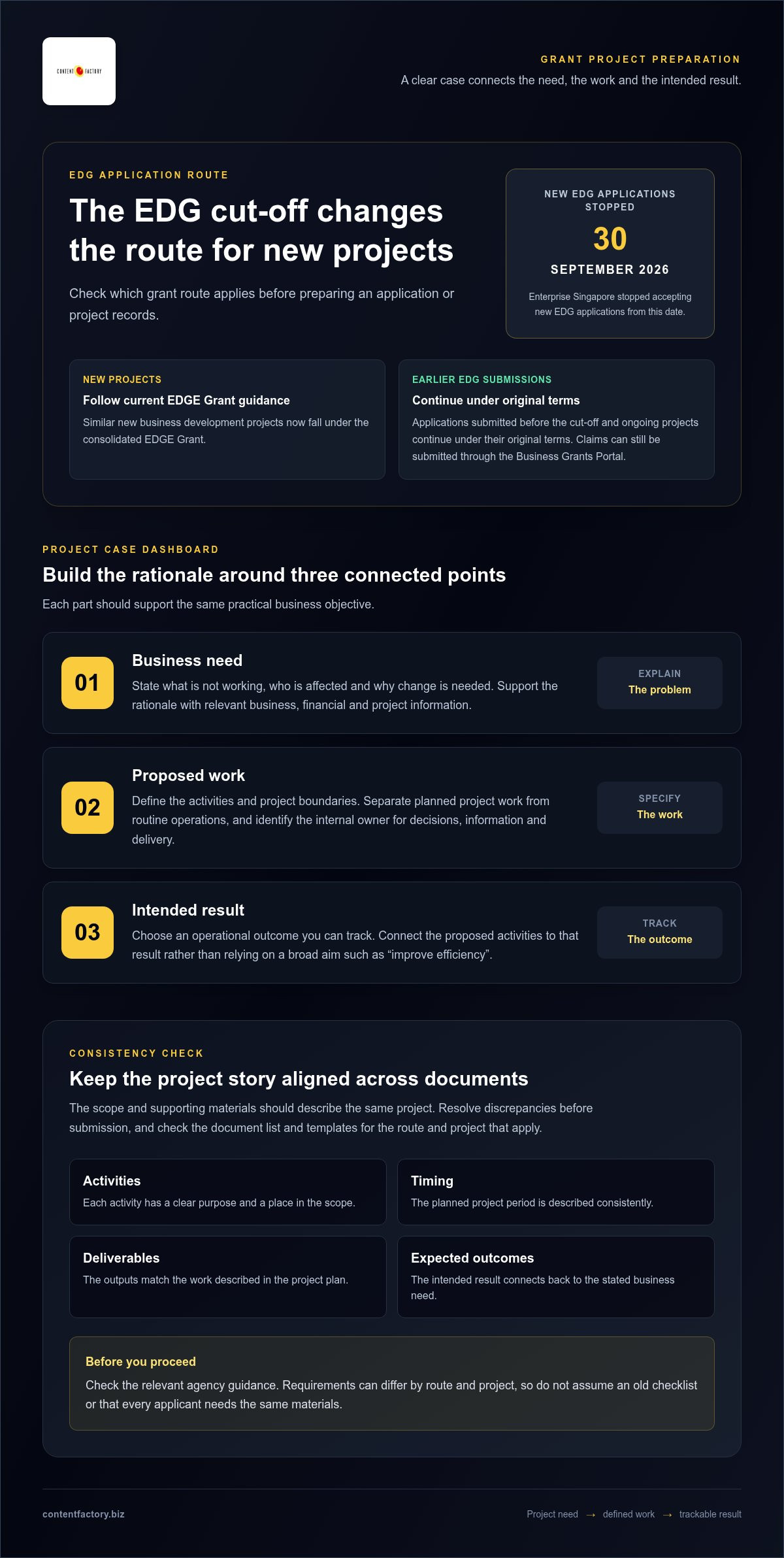
If you’re asking how to apply for EDG grant Singapore, first confirm whether EDG is still accepting applications. Enterprise Singapore stopped accepting new EDG applications from 30 September 2026. Similar new business development projects now fall under the consolidated EDGE Grant.
That change does not remove the preparation needed for a sound application. A clear business need, defined project scope and relevant supporting evidence still matter. EDG applications submitted before the cut-off, along with ongoing projects, continue under their original terms. Claims for those projects can still be submitted through the Business Grants Portal.
This guide explains how to assess project readiness, define the work and organise supporting documents. It also covers what to manage after submission and which preparation principles remain useful when planning a project under the current grant route.
Key Takeaways
- Before following EDG application steps, confirm the route that applies. Enterprise Singapore stopped accepting new EDG applications from 30 September 2026, and similar new projects moved to the EDGE Grant.
- For an EDG application submitted before the cut-off, keep the project scope, business need and supporting evidence aligned throughout delivery.
- Use this guide to understand how to apply for EDG grant Singapore, from checking readiness to preparing documents and following the relevant portal instructions.
- Manage submission, the agency’s decision, project delivery and claims as separate stages. Follow the conditions and claims instructions that apply to your project.
- Decide whether your team can manage preparation internally or would benefit from structured support with project scoping, financial modelling and documentation.
How to apply for an EDG grant in Singapore: understand the route first
Start by confirming the route that applies to your project. Enterprise Singapore stopped accepting new EDG applications from 30 September 2026. If you’re preparing a new application, follow the current EDGE Grant guidance. EDG applications submitted before the cut-off and their ongoing projects continue under their original terms.
EDG supported eligible business upgrading and transformation projects. The relevant agency assesses applications and makes the decision. This guide covers general application preparation, not legal, tax or accounting advice.
For context on the grant transition, watch this overview from SG Grant Man:
What the EDG application process is designed to assess
For an EDG application submitted before the cut-off, the proposal needed to link an eligible project to a defined business need. Explain the problem, set out the work and show how the activities support a practical business objective. Supporting evidence should substantiate the project’s scope and rationale, rather than simply add volume to the submission.
Enterprise Singapore sets the scheme requirements and assesses applications. A clear project case makes the proposal easier to understand, but it does not guarantee approval. For new applications, use current EDGE Grant guidance rather than assuming EDG requirements carry over unchanged. Refer to Enterprise Singapore’s official EDG guidance for information about the scheme.
Who should check eligibility before preparing documents
Before assembling documents, review Enterprise Singapore’s published guidance for the scheme and route that apply. Check your company’s registration and operating details, ownership information, financial position, proposed activities, project scope and timing. These checks remain relevant to EDG applications and projects submitted before the cut-off. New applicants should assess their project against EDGE criteria.
Prepare a short readiness note covering the business need, intended work, project timing and evidence available to support the proposal. It can help identify gaps before formal submission. Eligibility is assessed case by case. ContentFactory’s EDG advisory guide provides further context on grant preparation.
Grant quantum, support levels and eligibility criteria are set by the relevant Singapore government agencies and are subject to change. Eligibility is assessed case by case.
Build an EDG-ready project scope before starting the application
A grant application needs more than a list of planned purchases or activities. Begin with the business problem, define the work that addresses it and choose an operational result you can track. EDG stopped accepting new applications from 30 September 2026, so this approach applies to projects submitted before the cut-off and can also help you scope a new project under the current grant route.
EDG supported eligible business upgrading and transformation projects within the scheme’s published categories. A project’s fit with a category does not automatically make it eligible. Refer to the official Enterprise Development Grant page for EDG information, and check the current requirements for the route that applies to your project.
Turn a business need into a clear project plan
Write down what is not working, who is affected and what the project will change. For example, if a recurring process causes avoidable rework, identify the baseline measure, the proposed activities and the intended improvement. Choose an outcome you can track instead of relying on a broad aim such as “improve efficiency”.
Next, define the project boundaries. Separate planned project work from routine operations, and name the internal owner responsible for decisions, information and delivery. Keep the activities, timing, deliverables and expected outcomes consistent across the scope and supporting materials. If one document describes a short, focused project while another suggests ongoing operational work, resolve the discrepancy before submission.
Prepare evidence to support the project rationale
Build a concise evidence file to support the case for change. Gather relevant business, financial and project information, then check Enterprise Singapore’s instructions for the specific document list and templates. Requirements can differ by route and project, so do not rely on an old checklist or assume every applicant needs the same materials.
Connect three points in your rationale: the business need, the proposed work and the intended result. Financial modelling can help show how project costs relate to planned activities and outcomes. Check that figures and explanations are consistent across the scope and supporting documents, and follow the agency’s guidance for the relevant grant route and application period.
Before proceeding, make sure each activity has a clear purpose, an owner and evidence to support its place in the project scope. If you need help structuring the project case and financial documentation, review EDG advisory guidance or Contact Us to discuss grant preparation support.
Complete the EDG application in a clear sequence
If you’re preparing a new application, follow the current EDGE Grant instructions rather than submitting under EDG. The steps below describe preparation and submission for EDG applications before the cut-off. They can also help you organise records for an existing EDG application.
Gather information and prepare the application
EDG applications submitted before the cut-off followed a structured preparation process. For any current application, use Enterprise Singapore’s latest guidance. Portal steps, forms and document requirements may differ between schemes.
- Confirm the route. Establish whether you are managing an existing EDG submission or applying through a route that is currently open. Do not assume an old EDG form or checklist applies to EDGE.
- Assemble the project case. Organise the project scope, business rationale, intended outcomes, company information and supporting documents requested by the relevant agency.
- Reconcile the details. Compare project activities, timing, costs and outcomes across the application and attachments. Resolve discrepancies before entering information in the portal.
- Use current instructions. Check the latest agency guidance and templates for your application route. Avoid relying on saved forms or document lists from an earlier application.
As a final check, trace each proposed activity back to the business need and confirm that descriptions and figures are consistent. Keep a copy of the final materials for your records.
Submit through the applicable official route
For EDG applications submitted before the cut-off, the application route was the Business Grants Portal (BGP), accessed with a valid CorpPass account. Third parties could support preparation, but the applicant company was responsible for its submission. For a new application, follow Enterprise Singapore’s current EDGE Grant portal and submission instructions rather than assuming the former EDG route still applies.
Before submitting an existing EDG application, compare the entered information and attachments with your final documents. After submission, retain the application record and any acknowledgement from the portal. Submission is not confirmation of approval. The agency makes the decision and communicates the outcome and any applicable conditions.
For structured help with project scope, financial modelling and application documentation, read our EDG advisory for Singapore SMEs. You can also Contact Us to discuss grant preparation support.
After submission, manage the EDG decision and project obligations
Submission is only one stage of the grant process. The agency’s decision comes next. If Enterprise Singapore approves an EDG application, deliver the project according to its approval conditions. Claims are a separate step and must follow the instructions issued for the project. A submission confirmation is not an approval, and it does not mean planned costs or activities will be supported.
Applications submitted before the cut-off and ongoing EDG projects continue under their original terms. Claims for those projects can still be submitted through the Business Grants Portal. If you’re working out how to apply for EDG grant Singapore, keep in mind that current guidance for new projects may differ from the conditions for an existing EDG application.
Keep project delivery aligned with the approved scope
Once you have an approval, use its conditions as your reference for delivery. Keep records and evidence linked to the approved activities, deliverables and project timing. This creates a clear record of what the agency approved and what your business carried out.
Do not treat a material change to scope, deliverables or timing as an informal adjustment. Review the approval conditions and follow Enterprise Singapore’s instructions for changes. The applicable process can depend on your project’s terms, so avoid relying on guidance for a different grant or application period.
Prepare for claims and post-approval checks
A claim is separate from an application and has its own requirements and submission instructions. For an existing EDG project, check the current Business Grants Portal guidance and your approval conditions before preparing a claim. Follow the requirements stated by Enterprise Singapore for your project rather than relying on a generic checklist.
Keep project evidence and financial documentation organised as the work progresses. This is easier than reconstructing the record when it is time to claim. Check that retained materials relate to approved activities and can be understood alongside project delivery records. This also helps with administration if further information is requested.
ContentFactory provides structured post-approval grant compliance support, including help organising documentation and managing grant compliance requirements. Contact Us to discuss support for your project.
Choose the right way to prepare your EDG application
First, confirm which grant route applies. Enterprise Singapore stopped accepting new EDG applications from 30 September 2026, so new applicants should follow current EDGE Grant guidance. The options below apply if you are managing an existing EDG application or planning a project under the current route. Internal preparation and grant advisory can help organise the work, but neither determines the agency’s decision.
When your team can manage preparation internally
Your team may be able to manage preparation if one person can own the project case, access the necessary business records and coordinate input from colleagues. Assign responsibility for checking Enterprise Singapore’s current instructions, reviewing documents for consistency and retaining application and project records.
Internal preparation can work when the scope is clear, the information is available and the project owner can explain how the proposed work addresses a defined business need. Use current agency guidance as the source of truth. Do not rely on old forms or assume EDG instructions apply unchanged to another grant route.
When structured grant advisory can support the work
More coordination may be needed when a project has several activities, multiple internal owners, complex cost assumptions or documents that do not yet tell a consistent story. Grant advisory can help structure the scope, connect the business rationale to the proposed work and organise documentation. Financial modelling can also help present project assumptions and costs coherently.
ContentFactory provides strategic grant advisory, financial modelling and application documentation, as well as post-approval compliance support. This work supports preparation and record keeping. It does not influence Enterprise Singapore or determine an approval outcome. Read more about Singapore grant consulting to understand the support available.
Ask whether your team can explain the project scope, reconcile information across its documents and clearly assign responsibility for agency instructions and records. If these tasks are stretching internal capacity, structured support can help organise the work. Contact Us to discuss grant advisory and documentation support.
Confirm your grant route and prepare the next step
Confirm which grant route applies before investing more time in an application. EDG accepted new applications through 29 September 2026. From 30 September, similar business development projects moved to the EDGE Grant. If you submitted an EDG application before the cut-off, follow its approval conditions and the current claims instructions for your project.
The practical answer to how to apply for EDG grant Singapore is to build a clear project case, follow the applicable agency guidance, keep supporting records consistent and treat submission, approval, delivery and claims as separate stages. Preparation matters, but Enterprise Singapore makes the grant decision.
ContentFactory provides strategic grant advisory, financial modelling and post-approval compliance support. Mayuresh Godse is a Singapore Certified Management Consultant with 25+ years of consulting experience. The support focuses on organising your project preparation and documentation, not influencing the agency’s decision.
Frequently Asked Questions
Who is eligible to apply for the EDG in Singapore?
For EDG applications submitted before the scheme’s cut-off, the business had to be registered and operating in Singapore, have at least 30% local equity held by Singaporeans or Singapore permanent residents, and be financially viable to start and complete the project. Enterprise Singapore assessed eligibility case by case. EDG stopped accepting new applications from 30 September 2026, so businesses planning new projects should check the current EDGE Grant criteria.
Can a small business apply for an EDG grant?
A small business could apply if it met Enterprise Singapore’s eligibility criteria and proposed an eligible project. For EDG applications submitted before the cut-off, the business also had to be registered and operating in Singapore, meet the local-equity requirement and be financially viable to complete the project. EDG no longer accepts new applications. Small businesses considering a new project should follow current EDGE Grant guidance.
How do I apply for an EDG grant in Singapore?
EDG accepted new applications through 29 September 2026. For an application submitted by then, the applicant company prepared its project scope and supporting information, then submitted through the Business Grants Portal using a valid CorpPass account. Third parties could support preparation, but the applicant company was responsible for submission. For a new project, follow Enterprise Singapore’s current EDGE Grant instructions rather than outdated EDG steps.
What documents are needed for an EDG application?
The documents required depended on the application and project. Applicants needed to prepare the project scope, business rationale, company information and supporting evidence requested by Enterprise Singapore. Check the relevant agency instructions and templates for your application route before assembling materials. Keep project descriptions, costs, timing and expected outcomes consistent across documents. Do not rely on an old EDG checklist for a new EDGE Grant application.
Can I start my project before the EDG application is approved?
No. For EDG applications submitted before the cut-off, the project must not have started when the application was made, and the Letter of Offer had to be received before work began. Starting early could affect eligibility for support. EDG is closed to new applications. Before making commitments for a project under the current EDGE Grant, follow Enterprise Singapore’s specific commencement rules.
How long does an EDG application take to process?
EDG applications typically took 8 to 12 weeks to process, according to the information available for the scheme. This was a typical timeframe, not a guaranteed decision date. Processing could depend on the application and any follow-up required. EDG stopped accepting new applications from 30 September 2026, so businesses applying under the current EDGE Grant should consult Enterprise Singapore’s guidance for information about that scheme.
Is a grant consultant required to apply for the EDG?
No. A grant consultant was not generally required to prepare an application. The applicant company remained responsible for submitting through the official route, though it could engage advisory support for project scoping, financial modelling or documentation. For EDG projects involving management consultancy, a specific condition applied: the consultant had to hold SAC-accredited TR 43 or SS 680 certification. Follow current agency instructions for any new grant route.
What happens after an EDG application is approved?
Follow the conditions in the Letter of Offer and deliver the project in line with the approved scope. Keep relevant project and financial records, and follow Enterprise Singapore’s claims instructions. EDG claims were submitted through the Business Grants Portal after project completion and delivery of the required deliverables. Existing EDG projects and claims continue under their original terms after the transition to the EDGE Grant.
Grant quantum, support levels and eligibility criteria are set by the relevant Singapore government agencies and are subject to change.

Article by
Mayuresh Godse
Mayuresh Godse is a Singapore Certified Management Consultant and Business Strategist specializing in Sustainability, ESG, AI-driven Digital Transformation, and business growth. Based in Singapore, he writes about Sustainability, Digital Innovation, Business Strategy, and Content Marketing for global audiences.
Disclaimer
This article is provided by ContentFactory for general information only and is not legal, tax, accounting or financial advice. Regulations and government scheme criteria change; grant eligibility and quantum are set by the relevant Singapore agencies and assessed case by case, with no outcome guaranteed. Verify current requirements before acting.