

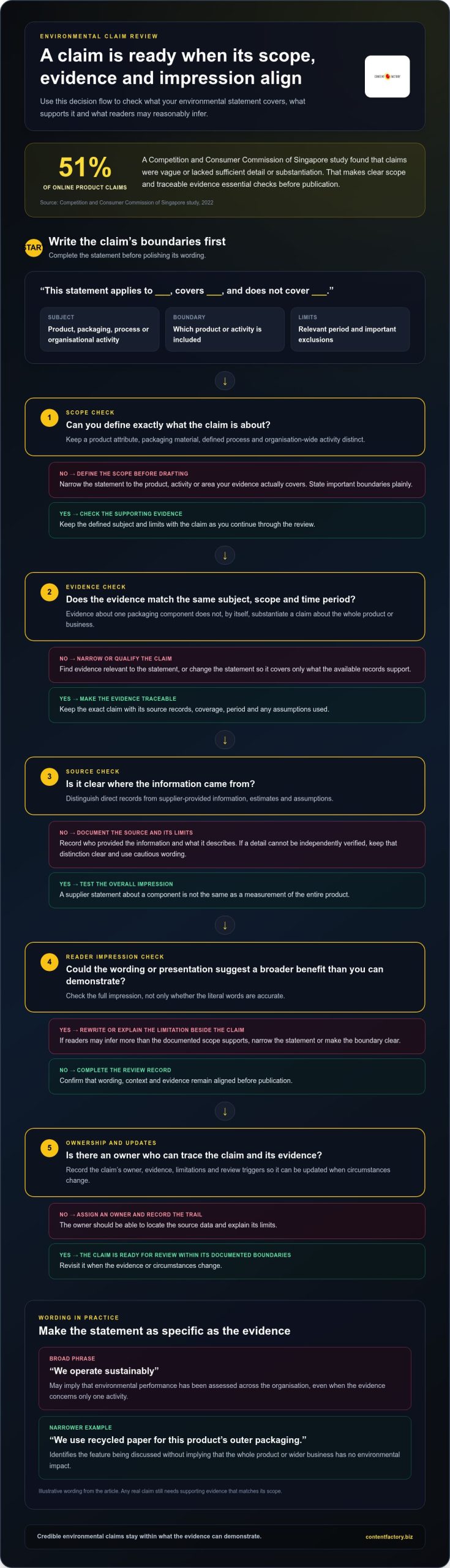
An environmental claim can mislead even when your business is taking genuine action. The Competition and Consumer Commission of Singapore found in a 2022 study that 51% of online product claims were vague or lacked sufficient detail or substantiation. If you’re asking how to avoid greenwashing in marketing, define the claim’s scope, match it to current evidence and assign someone to review it before publication.
That takes more than choosing careful wording. You need to know whether the evidence relates to a product, an operation or a supplier, and be clear about what it does and doesn’t support. This article explains how to set those boundaries, trace claims to relevant ESG data and put a practical review and update process in place. The aim is to keep environmental claims grounded in what your business can demonstrate, rather than what customers might infer.
Key Takeaways
- Define each environmental claim’s scope so it covers only the product, activity or organisational area your evidence supports.
- Match supporting records to the claim’s subject and timeframe. Be clear about estimates and supplier-provided information.
- Check whether the wording, context and presentation could lead readers to infer a broader benefit than you can demonstrate.
- Record each claim’s evidence, limitations, owner and review triggers so it can be updated when circumstances change.
- Assess gaps in ESG data and responsibilities to strengthen the basis for consistent, credible claims.
How to Avoid Greenwashing in Marketing by Defining the Claim
To understand how to avoid greenwashing in marketing, define exactly what each environmental claim says and what evidence supports it. Greenwashing is communication that creates a misleading impression about environmental performance. It can happen through a direct statement or through wording and presentation that lead people to infer a benefit beyond what the facts establish. An inaccurate claim isn’t necessarily deliberate or unlawful. The practical test is whether the overall impression is fair and supported.
A credible environmental claim has a defined scope, evidence that matches it and wording that makes its boundaries clear. The scope might cover one product, its packaging, a particular process or an organisation-wide activity. Keep these categories separate. Evidence about one packaging component, for example, cannot by itself substantiate a claim about the whole product or business.
In Singapore, the Competition and Consumer Commission of Singapore’s Guide on Quality-related Claims, published on 6 October 2025, sets out principles for environmental claims, including clarity, meaningfulness, accessible material information and credible, up-to-date evidence. The practical lesson is to define the claim before deciding how broadly to present it.
What makes an environmental claim misleading?
Broad language can leave readers to fill in the gaps. A statement such as “we operate sustainably” may imply that environmental performance has been assessed across the organisation, even if the evidence concerns only one activity. The positive wording may create an impression that goes beyond the facts.
A narrower statement is easier to assess: “We use recycled paper for this product’s outer packaging.” It identifies the relevant feature without suggesting that the product, its manufacture or the wider business has no environmental impact. The distinction is not only between true and false wording. It is also between a claim’s literal meaning and what a reasonable reader could understand it to mean.
Why claim scope must be clear
Before drafting, identify what the statement is about. Is it a product attribute, packaging material, defined process or organisation-wide activity? Then specify boundaries that affect its meaning, such as which product or activity is covered, the period the evidence describes and any important exclusions. Use plain language rather than expecting readers to infer these limits.
A limited improvement can become misleading when presented as universal. Evidence that one packaging component contains recycled material does not establish that all packaging does, or that the product as a whole is environmentally preferable. Ask: What might someone reasonably conclude from this statement, and does the evidence support that full impression? If the conclusion goes beyond the documented scope, narrow the claim or explain the limitation beside it.
Before publishing, complete this sentence: “This statement applies to ___, covers ___, and does not cover ___.” If you can’t fill in those blanks clearly, define the scope before finalising the wording.
Build Environmental Claims on Evidence, Not Vague Language
A claim is only as reliable as the records behind it. Match each statement to evidence covering the same subject, scope and time period. A current supplier declaration, for example, may support a statement about a material that supplier provides. It does not automatically support a wider claim about the finished product or your organisation.
The broader the environmental claim, the broader and more complete the evidence needed to support it. A claim about one activity may need a defined record of that activity. A statement about organisation-wide performance needs information covering the relevant parts of the organisation, not a single initiative presented as representative.
Useful evidence can include documented activities, relevant measurements and information from vendors or other business partners. Record whether information comes from direct records, supplier-provided data, estimates or assumptions. If data is incomplete or indirect, qualify the claim rather than presenting an estimate as a verified result. The University of Colorado Boulder’s guide to Identifying Greenwashing and Sustainable Choices also highlights the risks of vague wording and unsupported claims.
Match each claim to relevant supporting records
Keep the exact claim wording with its source records and boundaries. Note what the evidence covers, the period it relates to, where it came from and any assumptions used. Assign an internal owner who can locate the source data and explain its limits. That person need not create every record, but should be able to trace the claim back to its origin.
For supplier information, record who provided it and what it describes. A supplier’s statement about a component is not the same as your own measurement of the entire product. If you can’t verify a detail independently, preserve that distinction in your records and use cautious wording externally.
Replace broad phrases with precise statements
Words such as “green” and “eco-friendly” can imply a general environmental benefit without identifying the attribute. Give them clear context and support the impression they create with evidence. A label or certification may provide relevant information about a defined standard, but it doesn’t by itself prove every environmental aspect of a product or business. For example, while sustainability consultancies like Ekocentric assist projects with verified green building certifications, marketing teams must still communicate the precise scope achieved rather than asserting broad environmental superiority.
Consider the hypothetical phrase “our product is eco-friendly”. If your evidence concerns only its packaging, a more precise alternative is: “The outer packaging uses recycled material.” This wording limits the claim to the feature your records address. Don’t add an outcome, percentage or comparison unless suitable evidence supports it.
A simple claim record helps you test the match before publication:
- Claim: What exact words will readers see?
- Evidence: Which records support those words, and who supplied them?
- Boundary: What period, product or activity is covered, and what remains unverified?
If your organisation needs to identify gaps in data ownership or supporting records, an ESG readiness gap analysis can help clarify where further work is needed. You can also discuss your ESG readiness needs with ContentFactory.
Compare Claim Wording Against Scope, Evidence and Limitations
A claim can be technically accurate and still give readers the wrong impression. Compare the proposed wording with the evidence, then consider what a reasonable customer might conclude from the whole presentation, not just one sentence. The scope, evidence, limitations and likely interpretation should align.
Consider the hypothetical statement: “Our operations are powered by renewable energy.” If the records cover only one site, the wording may suggest broader coverage than the evidence supports. A more proportionate version would identify the site and period covered, then explain any material exclusions. Clear qualifiers show exactly what the claim means.
Test the claim a customer is likely to understand
Read the claim as it will appear, including its headline, nearby text and visual context. A prominent image or design can imply that an environmental benefit applies across an entire product range, even if the wording refers to one item. Ask a colleague who hasn’t seen the supporting records what they think the claim covers. If their interpretation is broader, revise the statement or make its limitation easier to see.
Check that important conditions are not buried in small print or separated from the main claim. A limitation only helps readers if they can find and understand it when they encounter the statement.
Separate progress from a broad performance claim
Describe an initiative as an action, not as proof of overall performance. For example, “We have begun measuring energy use at our Singapore office” reports a defined step. “We are an environmentally responsible organisation” makes a much wider judgement that this single activity cannot establish. Avoid unsupported comparisons such as “greener” unless you can state what is being compared and support the basis for that comparison.
Use the same comparison test for each draft:
- Scope: Does the wording identify the product, site, process or activity covered?
- Evidence: Do the records substantiate every part of the statement, including any comparison or implied outcome?
- Limitations: Are exclusions or conditions clear and close to the claim?
- Interpretation: Could a reader reasonably infer a broader benefit than you can demonstrate?
If a claim fails one of these checks, narrow it, add a clear qualification or hold it back until the evidence is stronger. Treat reporting gaps as a signal to clarify what your organisation can substantiate, not as a reason to make a broader statement. Reviewing common ESG reporting mistakes can help you spot weaknesses in the underlying information before they affect a public claim.
Keep a record of the original wording, revised wording and reason for the change. This trail helps your team apply the same standard to future claims and update them when the evidence or scope changes.
Use a Repeatable Review Process Before Publishing Claims
A reliable review process makes claim quality less dependent on individual judgement. It gives each statement a clear path from draft to evidence review, approval and future updates. This discipline is especially useful when information comes from different teams or suppliers.
Use this sequence for each environmental claim:
- Draft the statement. Write the proposed wording without broadening the benefit beyond what you intend to describe.
- Define its scope. Record which product, packaging, process, site or activity it covers, and the period it describes.
- Gather the evidence. Link the source records and note whether the information is measured, documented, estimated or supplied by another party.
- Review the wording. Check that the claim, evidence and limitations align, and that readers are unlikely to infer more than the records support.
- Record the decision. Note who reviewed and approved the wording, where the evidence is stored and when it should be checked again.
Assign an internal owner to each claim or group of related claims. The owner should be able to locate the supporting records, explain their limitations and identify when circumstances have changed. The staffing model can vary, but responsibility needs to be clear so a claim doesn’t remain in use after its evidence becomes outdated.
Create a claim record your team can maintain
Keep a concise record containing the exact wording, scope, evidence sources, limitations, responsible owner and review date. Note what could make the evidence outdated, such as a supplier change, revised product details or a change to the activity being described. Store the record where colleagues who handle the claim can access it, rather than relying on an individual’s inbox or memory.
Set review triggers as well as a planned review date. Reopen a claim when source data is corrected, a supplier changes, product specifications shift or the underlying activity is altered. If a change affects only part of the claim, check whether the wording still accurately describes the remaining evidence.
Build capability across the people handling claims
People involved in preparing, checking or approving claims need shared definitions and access to relevant evidence. They should know how to distinguish a direct record from a supplier statement or estimate, and feel able to raise uncertainty before publication. ESG capability building can clarify responsibilities and strengthen practical readiness. ESG capability building and training is one way to develop that understanding.
If your organisation needs to clarify gaps in claim evidence, ownership or review processes, an ESG readiness gap analysis can help identify where to focus. Contact Us to discuss your organisation’s ESG readiness.
Make ESG Readiness the Foundation for Credible Environmental Claims
Claim review depends on more than careful wording. Your organisation also needs to know where relevant information sits, who is responsible for it and what it can support. If data is scattered or its limitations are unclear, even a well-intentioned statement may be difficult to substantiate consistently.
An ESG readiness assessment can help you examine those foundations. It can identify gaps in data, ownership and reporting processes that affect your ability to support environmental claims. The purpose is practical preparation: understanding what your current information can substantiate and where more work is needed. An assessment does not certify or approve individual claims, and it cannot guarantee that every statement is accurate.
When an ESG readiness assessment can help
Consider an assessment if teams are unsure which records support a claim, supplier information is hard to trace, or responsibilities for collecting and reviewing ESG data are unclear. A readiness review can help distinguish claims that existing information may support from those that need narrower wording or stronger evidence. It can also surface gaps before they become embedded in reporting processes.
The assessment is a starting point, not a substitute for checking each claim. Your organisation still needs to evaluate its wording against the available evidence, boundaries and limitations. A readiness gap analysis and strategy can help clarify where information and ownership processes need attention.
Turn assessment findings into practical capability
Once gaps are visible, focus on improving how information is gathered, maintained and reviewed. Carbon Accounting (Scope 1-3) can support work on emissions data, while Multi-Framework Reporting can help organise relevant sustainability information. ESG Capability Building can clarify responsibilities and strengthen the practical understanding people need to handle evidence carefully.
These capabilities support a more consistent process, but they don’t make every claim valid by default. Keep claim owners clear, preserve the evidence trail and revisit statements when their underlying data or activity changes. This keeps external wording connected to the information your organisation can actually stand behind.
ContentFactory’s ESG Readiness & Materiality Assessments help organisations assess readiness and identify practical gaps in data, ownership and reporting processes. The focus is on building a clearer foundation for substantiated claims, not providing claim certification or approval. To discuss your organisation’s ESG readiness, Book a Strategic Consultation for a 30-minute discovery call.
Build a Stronger Foundation for Every Environmental Claim
Make claim review part of how your organisation manages ESG information, not a last-minute wording check. Start by identifying where evidence, ownership or review processes are unclear. Then prioritise the gaps that affect claims you currently rely on. This gives your team a practical way to make consistent decisions as data and activities change.
That’s the foundation for how to avoid greenwashing in marketing: keep claims connected to what your organisation can substantiate. An ESG readiness assessment can help clarify what your existing information supports and where further work is needed. It’s preparation, not claim certification or approval.
ContentFactory brings 25+ years of consulting expertise, and Mayuresh Godse is a Singapore Certified Management Consultant. To strengthen your organisation’s ESG readiness and evidence processes, Book a Strategic Consultation for a 30-minute discovery call. Clearer ownership and better-grounded information give your team a sounder basis for its claims.
Frequently Asked Questions
What is greenwashing in marketing, and how is it different from an honest mistake?
Greenwashing is communication that gives people a misleading impression of a business’s environmental performance. An honest mistake may happen when a claim relies on outdated or misunderstood information. Intent alone doesn’t determine whether the impression is misleading. In Singapore, environmental claims may fall under consumer protection rules, and the CCCS has published guidance on quality-related claims. If you find an error, correct it promptly and review how it occurred.
Can a company make an environmental claim without third-party certification?
Yes. A third-party certificate isn’t the only possible basis for an environmental claim. Your business still needs credible evidence that supports the specific statement and its boundaries. Internal records may support a factual claim about a documented activity, provided they’re relevant and current. Don’t imply that a claim has been independently verified if it hasn’t, and explain any important conditions clearly.
Does a certification alone prove that an environmental claim is accurate?
No. A certification or label relates to its own defined criteria and scope. It doesn’t automatically substantiate claims about every feature of a product, its full supply chain or your organisation’s overall performance. Check what the certification covers, which products or activities it applies to and whether it remains valid. Describe that scope accurately, and rely on separate evidence for any broader statements.
How should a business handle an environmental claim when supplier information is incomplete?
Don’t present incomplete supplier information as a verified fact. Limit the statement to what you can substantiate, or pause it while you seek clarification. If a supplier has provided details about one component but not the finished product, keep any claim specific to that component. Record what’s missing, who supplied the available information and whether it is an estimate or a direct measurement.
Can a claim about one product accurately describe an entire organisation?
Not by itself. Evidence about one product can support a statement about that product, but it doesn’t establish how the whole organisation performs. A business-wide claim needs evidence covering the activities and areas it implies. Keep the distinction clear in reports and public statements. If you’re describing a specific improvement, name the product or activity rather than presenting it as proof of organisation-wide performance.
What should a business do after finding an outdated environmental claim?
Review the underlying information and the claim’s current use. Update or remove wording that is no longer supported, including versions in product descriptions, reports and other materials. Check whether the change affects related claims, then record what was corrected, who approved the change and what evidence will support future wording. If the claim has already reached customers or other stakeholders, consider how to communicate the correction clearly.
How can a small business review environmental claims with limited internal resources?
Keep the process simple: maintain one shared record with each claim, its supporting evidence, its owner and a date or event that should trigger a review. Prioritise claims that are broad, prominent or based on information likely to change, such as supplier details. To work out how to avoid greenwashing in marketing, make sure someone can explain what each claim covers and flag uncertainty before it is used.
Book a Strategic Consultation for a 30-minute discovery call to discuss your ESG readiness and environmental claim evidence.

Article by
Mayuresh Godse
Mayuresh Godse is a Singapore Certified Management Consultant and Business Strategist specializing in Sustainability, ESG, AI-driven Digital Transformation, and business growth. Based in Singapore, he writes about Sustainability, Digital Innovation, Business Strategy, and Content Marketing for global audiences.
Disclaimer
This article is provided by ContentFactory for general information only and is not legal, tax, accounting or financial advice. Regulations and government scheme criteria change; grant eligibility and quantum are set by the relevant Singapore agencies and assessed case by case, with no outcome guaranteed. Verify current requirements before acting.