

A broad ESG pitch is easy to defer; a focused business case is harder to ignore. If you’re working out how to convince management to invest in ESG, connect your proposal to a priority leaders already recognise, such as understanding a material risk, responding to a customer’s information request or improving visibility over resource use.
Management is right to ask what the work will cost, who will own it and how progress will be assessed. ESG can feel like an open-ended commitment when a proposal covers too many issues or promises benefits it cannot substantiate. The answer is not to make bigger claims. It is to make the decision clearer.
This article explains how to build an evidence-led case around your organisation’s priorities, define a manageable first step and set practical measures for reviewing it. Materiality and an ESG readiness assessment can help narrow a broad agenda into scoped work, with clear ownership and realistic expectations. The aim is a proposal management can assess on its business merits.
Key Takeaways
- Frame ESG investment as a decision about relevant assessment, capability and action, not a commitment to adopt a label.
- Use materiality to focus your case on ESG issues connected to your organisation’s strategy, operations or stakeholder concerns.
- Separate evidence of relevance from benefits that are uncertain or long-term.
- Address cost, data availability, capability and competing priorities directly instead of treating them as objections to dismiss.
- Set out the decision requested, supporting evidence, scope, resources, owner and review measures in your proposal.
Why ESG investment becomes a management decision
Management must weigh proposed ESG work against operational demands competing for the same budget, staff time and attention. A request to “do more on ESG” gives leaders little to assess. A defined request linked to an issue the organisation needs to understand or address gives them a decision they can evaluate.
An ESG business case is a scoped request to resource assessment, capability or action on issues relevant to the organisation, supported by evidence and a clear decision. It is not simply a statement of values or an open-ended commitment to adopt an ESG label. The case depends on your organisation’s material issues, stakeholders and operating context.
For one organisation, the starting point may be a customer’s request for supplier information. Another may need a clearer view of its ESG priorities before deciding what to do. ContentFactory’s ESG consulting approach in Singapore can help frame the work around readiness and materiality, rather than assuming every organisation needs the same programme.
What management needs to decide
Be precise about the decision you need now. Approval for an initial assessment is not the same as approval for a wider programme, so do not blur the two. Identify the decision-maker, the resources requested and what those resources will enable the organisation to learn or do.
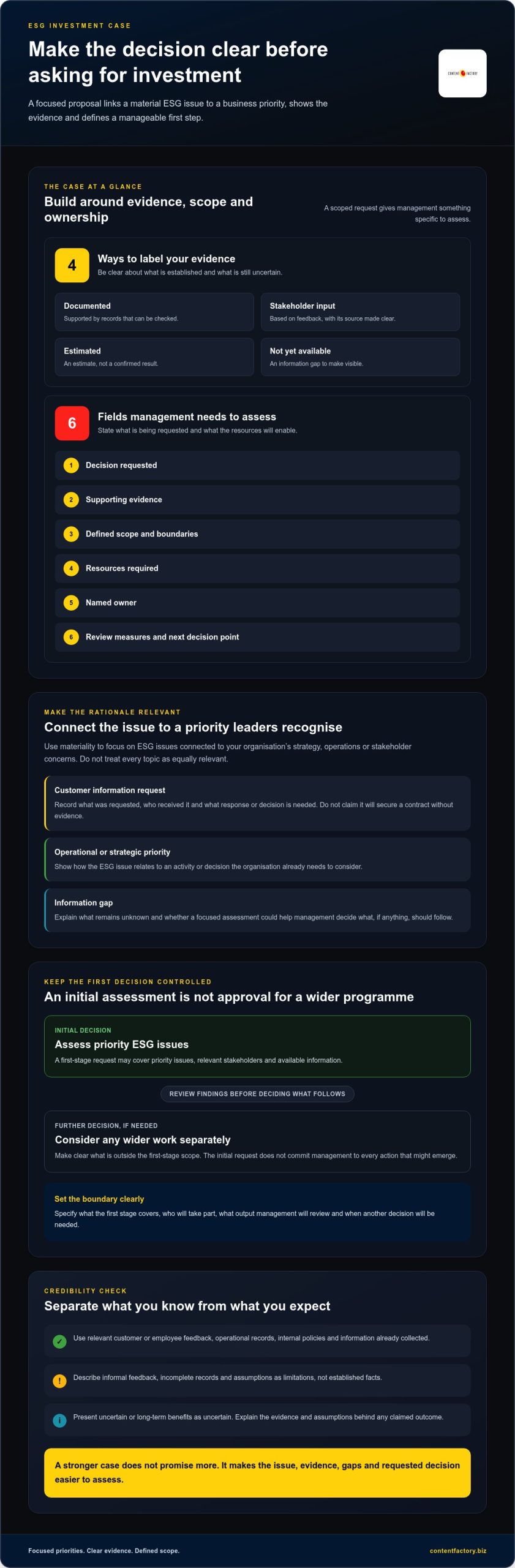
For example, an initial request could seek agreement to assess priority ESG issues, identify relevant stakeholders and review available information. That does not commit management to every action that might emerge. It gives leaders a defined scope and a basis for deciding what, if anything, should follow.
Make the boundary explicit: what the first stage covers, who will take part, what output management will review and when another decision will be needed. This turns a broad ambition into a controlled management choice.
Why a generic ESG pitch often stalls
Broad claims can obscure the question management is trying to answer: why does this matter to our organisation, and why now? General appeals to responsibility or reputation do not show which issues connect to operations, strategy or stakeholder concerns. They also make it difficult to distinguish an immediate need from a possible future benefit.
Unsupported promises weaken the case. If you claim that ESG will reduce costs, improve resilience or deliver commercial gains, explain the evidence and assumptions behind the claim. Where outcomes are uncertain or long-term, say so. Finance and operational leaders can assess a candid proposal more readily than a confident prediction without a clear basis.
Replace broad assurances with a specific rationale: identify the issue, show the evidence you have, state what remains unknown and ask for a proportionate first decision. That is a stronger foundation for discussion than asking leaders to approve an undefined programme.
Build an ESG investment case around material business priorities
An ESG issue earns a place in your proposal when you can connect it to a decision your organisation needs to make. Start with priorities management already recognises, such as operational continuity, customer requirements, workforce capability or the quality of information available to decision-makers. Then test whether the ESG issue has a clear connection, rather than assuming every topic deserves equal attention.
Materiality helps you make that choice. It focuses an ESG proposal on the issues most relevant to your organisation and its stakeholders, so management can assess a defined priority rather than an undifferentiated list. The result should reflect your organisation’s circumstances, not a generic checklist applied without context.
Make the link between each issue and a recognised business priority visible. For example, if a customer has requested information about environmental practices, record what was requested, who received it and what response or decision is required. Do not claim that meeting the request will secure a contract unless you have evidence for that conclusion.
Connect ESG priorities to organisational decisions
Map each proposed issue to a current organisational decision, operational activity or stakeholder concern. Use examples that can be substantiated through existing records or direct feedback. A customer request may warrant attention if you can point to the request and explain which team or process it concerns.
Keep the case selective. A topic may be important in general but have limited relevance to your organisation’s current decisions. State why you have prioritised certain issues and why others are outside the proposed scope. That distinction shows management the assessment is grounded in your context, not in an assumption that every ESG topic carries equal weight.
Choose evidence management can assess
Build a simple evidence trail for each priority. Useful inputs may include customer or employee feedback, operational records, internal policies and information the organisation already collects. Use them only when they are relevant and can be checked. If feedback is informal or a record is incomplete, describe that limitation instead of presenting it as established fact.
Separate what you know from what you infer. Label evidence as documented, based on stakeholder input, estimated or not yet available. Distinguish a current business need from a possible longer-term benefit. For instance, a request for data may be verified, while any future commercial effect of providing it may remain uncertain.
An ESG materiality and readiness assessment can organise relevant issues, stakeholder input and information gaps into a focused view of where further work may be useful. Before seeking approval, draft a short internal note: name the priority, cite its evidence, state what remains unknown and explain which management decision the proposal supports. If you need help framing the assessment, read about ESG assessment support.
Answer the objections behind ESG investment decisions
Management is right to ask whether an ESG proposal is relevant, what it will require and what the organisation can reasonably expect in return. Do not treat these questions as resistance to overcome. They are decision criteria your case needs to address with evidence, clear limits and honest assumptions.
ESG investment does not guarantee savings, revenue growth, improved access to capital or any other specific financial outcome. Its value must be assessed against the organisation’s relevant risks, operational indicators, stakeholder considerations and the cost and capacity required to act. Risks from inaction may matter, but they are not proof that a proposed investment will generate a particular return.
Respond when management asks about return
Separate what can be measured directly from what may be strategically relevant but difficult to quantify. If the proposed work concerns resource use, for example, you may be able to track a defined operational measure if the necessary records exist. That does not by itself prove that an ESG initiative caused a financial saving. Be clear about the baseline, measurement method and other factors that could affect the result.
Some considerations, such as responding to stakeholder expectations or understanding exposure, may matter without producing a reliable near-term financial figure. State what you can track, what remains uncertain and when management can review the evidence. Avoid unsupported ROI figures, payback periods and promises of improved access to capital. Distinguishing measurable indicators from broader considerations is more credible than relying on a return estimate built on assumptions.
Respond when management questions scope and capacity
Make the first phase manageable. Propose a defined piece of work with one accountable owner, specific deliverables and an agreed review point. Before requesting new resources, map the information and capability already available, including relevant records, existing responsibilities and gaps that could affect delivery.
This helps distinguish a genuine resource need from work the organisation can begin with existing capacity. It also gives management a clear point to decide whether further action is justified, rather than asking for approval of an undefined programme. If the proposal depends on staff input, explain whose knowledge is needed and what participation the assessment requires. Do not assume employee engagement will automatically improve retention or performance.
Where employee feedback identifies a specific workforce concern, treat it as evidence to assess, not a guaranteed benefit. Workforce considerations belong in the case only when they genuinely connect to your organisation’s circumstances. If you need help defining scope, ownership and evidence for a first-stage proposal, discuss your ESG assessment needs.
Prepare a practical ESG proposal management can evaluate
A strong ESG proposal is short enough to review and specific enough to challenge. It should tell management what decision you need, why it matters now and what the organisation will learn from the first step. Make it a decision paper, not a broad statement of intent.
Use a focused decision paper to show how to convince management to invest in ESG
Use this sequence to prepare a draft internally. Keep each point concise, and make evidence gaps or assumptions visible rather than smoothing them over.
- Decision requested: State exactly what management is being asked to approve, such as an initial ESG readiness assessment or a defined workstream. Explain why the decision is being considered now.
- Priority evidence: Name the issue and cite the relevant internal record, stakeholder input or other evidence. Identify what is documented and what remains an assumption.
- Scope: Set out what the proposed work covers and what it excludes. Describe the questions it will address, without implying that approval commits the organisation to every possible follow-on action.
- Resources: Identify the staff time, information and other inputs the work requires. Separate what is already available from any additional resource being requested.
- Ownership: Name the role responsible for coordinating the work and the people or teams whose input is needed. Make accountability clear without implying that one person can supply every answer.
- Review: Specify what management will receive, how progress will be assessed and what decision comes next. Flag unresolved questions that may affect the next step.
This structure makes the proposal easier to scrutinise. A finance leader can see the resource request; an operational leader can assess the demands on their team; and management can decide whether the evidence justifies proceeding.
Make the first step proportionate
Match the initial work to your organisation’s readiness. If priorities or available information are unclear, an assessment can identify material issues, existing capability and gaps before management considers a wider plan. If a specific issue is already supported by evidence, a tightly defined workstream may be more appropriate.
Be explicit about what the first phase will produce, such as a prioritised view of issues, a review of available information or recommendations for management to consider. These are proposed deliverables, not promised financial results. Management should be able to review the findings and decide whether further work is justified.
A structured ESG strategy framework for SMEs can help translate priorities into a sequence of practical actions. To draft your own paper, complete six lines: decision requested, reason for acting now, evidence, scope, owner and review point. Add a short note on assumptions and missing information. This gives leaders a clear basis for discussion without presenting a full transformation programme as the only option.
If you need support shaping an ESG proposal around your organisation’s readiness and priorities, explore ESG advisory support.
Turn management approval into focused ESG readiness and action
Approval should authorise a defined next step, not automatically launch a broad programme. The right starting point depends on your operations, stakeholders, available information and readiness. There is no single ESG workplan that fits every organisation, and this section does not assume a particular regulatory obligation applies to yours.
Translate the approved proposal into a clear piece of work. That could mean assessing readiness and material issues, calculating emissions where that is the identified need, or building the team’s ESG capability. Keep the purpose, owner and expected output aligned with what management agreed to resource.
Choose the right ESG starting point
Match the work to the gap behind the decision. If leaders need to understand which issues matter and what information is missing, begin with a readiness assessment and materiality work. If the priority is a defined emissions information need, consider emissions calculation. If the issue is limited internal knowledge, capability building may be the more relevant first step.
A readiness assessment can organise current practices, available information and capability gaps, helping management prioritise what to address next. It should inform the next decision, not predetermine it. The organisation can review the findings and decide whether further analysis, action or training is warranted. A scoped ESG readiness and materiality assessment gives management a structured starting point for that discussion.
Make the next management conversation concrete
Bring leaders a concise update that answers four questions: what issue are you addressing, what evidence supports its relevance, what work is proposed and what decision is required now? Include the owner, key inputs and known information gaps. If the evidence has changed or the proposed scope needs adjustment, explain that plainly rather than treating the original approval as a blank cheque.
This approach keeps management involved at meaningful decision points. It gives operational teams a clear remit and finance a defined request to evaluate. The purpose is not to promise a particular result, but to make the next action proportionate to the organisation’s needs.
For organisations deciding how to build management support for ESG, ContentFactory provides ESG readiness and materiality assessments, carbon accounting and ESG capability building. Its ESG advisory is led by Mayuresh Godse, a Singapore Certified Management Consultant with 25+ years of consulting experience. The work can help you scope the next step and plan implementation without promising a predetermined outcome.
Bring your priority, supporting evidence and proposed scope into the next conversation.
Put the next ESG decision on the agenda
Management approval is a point to reassess, not a promise to continue regardless of what the work finds. Tie the next decision to what the organisation learns, and be prepared to adjust the approach if priorities or evidence change. That discipline helps keep ESG work relevant as business needs evolve.
ContentFactory supports organisations with practical ESG readiness and action. Use the findings from your first step to define what management should consider next.
Frequently Asked Questions
Is ESG investment only relevant to large or listed companies?
No. An organisation’s size or listing status does not determine whether ESG issues affect its decisions. A smaller business can consider how its practices relate to customer expectations, workforce matters, resource use or supplier relationships. The useful test is whether an issue connects to the organisation’s activities or stakeholders. That connection may justify attention even when the business is not preparing formal public disclosures.
How do I explain the business case for ESG to a CFO?
Present the proposal in terms a CFO can evaluate: the decision requested, the resources involved, the financial assumptions and the alternatives. Distinguish the cost of the proposed work from possible future effects that cannot yet be reliably valued. If relevant, explain what the organisation would do if it deferred the decision. Avoid presenting an unverified estimate as a forecast or treating a possible benefit as a booked return.
Can an SME start investing in ESG without launching a full programme?
Yes. An SME can build ESG considerations into an existing activity rather than create a separate programme immediately. For example, a business reviewing supplier onboarding could consider whether its current questions capture the information it needs about suppliers. Keep the change relevant to that process, record who is responsible for it and review whether it provides useful information. This makes ESG part of ordinary decision-making, not a parallel initiative by default.
What evidence should I gather before presenting an ESG proposal to management?
Gather original records that relate to the issue you want management to consider. Depending on the proposal, these might include utility bills, supplier questionnaires, training records, customer correspondence or internal policies. Check the period covered, source and completeness of each item. Ask the relevant team to confirm how the record is produced and used. This helps leaders distinguish an operational fact from an assumption or an informal impression.
How can management assess ESG priorities when internal data is incomplete?
Management can first clarify why information is missing. A topic may not have been measured, records may sit across teams, or the information may not apply to the organisation’s activities. These situations call for different responses. Note the source and confidence level of any estimate, avoid presenting proxies as measured results, and identify what additional information would materially change the decision.
What happens if management approves an ESG assessment but not implementation?
The assessment should still have a clear purpose and useful outputs. Before it starts, agree what management expects to receive, such as a prioritised findings report, a summary of relevant information or options for further consideration. Make clear that implementation is a separate decision. This gives leaders room to review the findings, ask questions and decide what action, if any, should follow without leaving the assessment’s purpose undefined.
Does ESG investment guarantee cost savings or improved business performance?
No. Outcomes depend on the issue addressed, the actions taken and other conditions affecting the business. Even when a measure changes after an ESG activity, that alone does not prove the activity caused the change. Set expectations accordingly: report what was observed, explain the limits of attribution and avoid presenting a potential benefit as certain. This keeps performance discussions credible and gives management a sound basis for future decisions.
Book a Strategic Consultation, a 30-minute discovery call.

Article by
Mayuresh Godse
Mayuresh Godse is a Singapore Certified Management Consultant and Business Strategist specializing in Sustainability, ESG, AI-driven Digital Transformation, and business growth. Based in Singapore, he writes about Sustainability, Digital Innovation, Business Strategy, and Content Marketing for global audiences.
Disclaimer
This article is provided by ContentFactory for general information only and is not legal, tax, accounting or financial advice. Regulations and government scheme criteria change; grant eligibility and quantum are set by the relevant Singapore agencies and assessed case by case, with no outcome guaranteed. Verify current requirements before acting.