

A sustainability policy that sits apart from business strategy is paperwork, not direction. Creating a corporate sustainability policy means setting out your business’s commitments, measurable goals, actions and plans to monitor and report progress. For a Singapore business, the priorities should reflect its actual impacts and the way it operates, not a generic list of ambitions.
You may already know that a policy can clarify expectations for employees and suppliers. The harder part is deciding what matters most, making commitments your organisation can deliver and linking them to everyday decisions. A useful policy does more than state intent: it gives people a clear basis for action and a way to track progress.
This guide explains how to assess environmental and social impacts, identify policy priorities, involve employees and suppliers, and build sustainability into corporate strategy. You’ll also learn how to keep the document focused, set practical targets and review it as your business changes. The aim is a policy your organisation can use, not a polished statement that stays on the shelf.
Key Takeaways
- Map your business’s environmental and social impacts before choosing policy priorities, so commitments address real operational risks.
- Assign clear ownership and practical measures to turn sustainability goals into day-to-day responsibilities.
- Make supplier expectations clear and engage employees in shaping actions they can put into practice.
- Choose commitments your business can maintain, then monitor progress and review the policy as circumstances change.
- Connect sustainability priorities to business decisions so the policy supports your organisation’s broader strategy.
Assessing environmental impacts and business context
Start with evidence from your operations and value chain. Use it to distinguish current practices from material impacts, risks and opportunities.
Review Current Carbon Reduction Practices
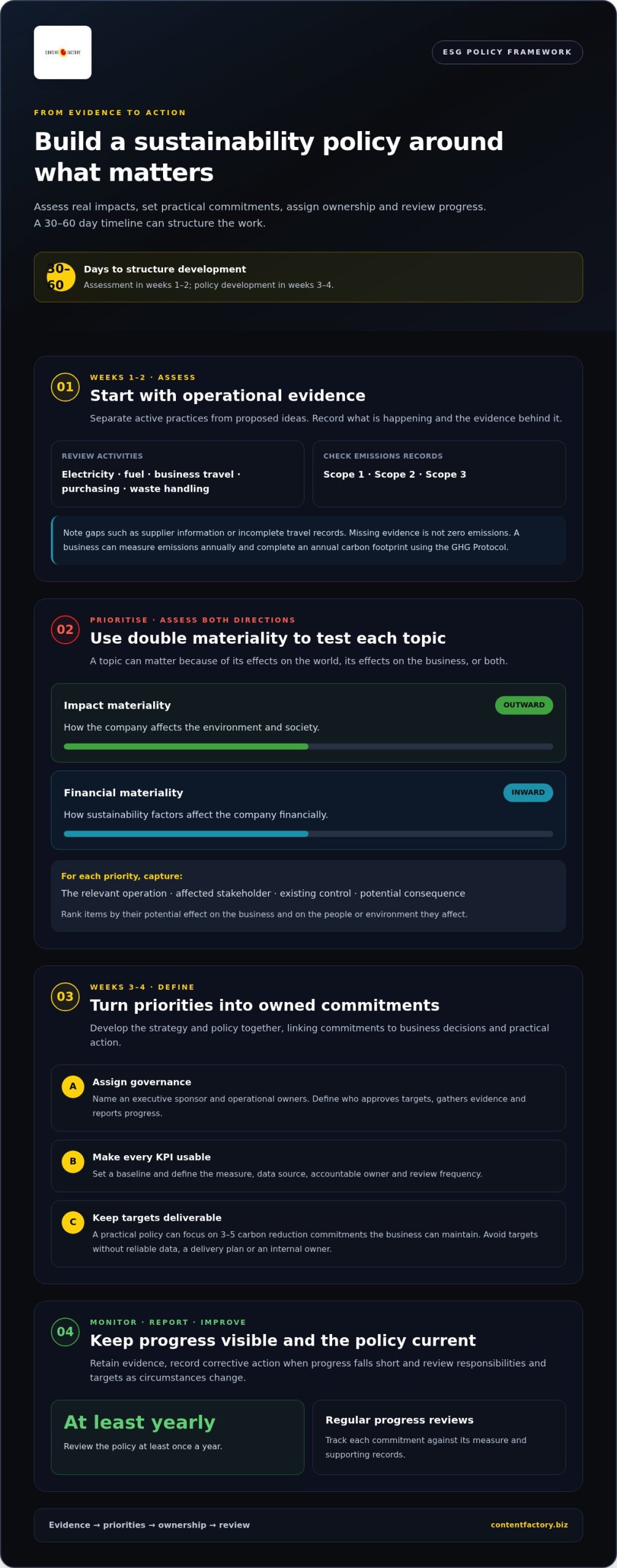
List existing actions and note the activity or evidence behind each one. Review electricity use, fuel consumption, business travel, purchasing and waste handling. For example, a paper-reduction initiative should identify the process it changes and how you will track progress. Separate active practices from proposed ideas: a policy should not present an intention as an existing result.
Check whether your records cover Scope 1, 2 and 3 emissions, including relevant operations and value-chain activities. A business can measure these annually and complete an annual carbon footprint using the GHG Protocol. Note data gaps, such as supplier information or incomplete travel records, rather than treating missing evidence as zero emissions. This gives you a defensible starting point for reducing impacts.
Assess Risks and Opportunities
Map sustainability-related risks against the activities, locations and relationships that matter to your business. Consider environmental impacts, worker safety, human rights and legal compliance. Weak controls can expose a company to fines, legal action or reputational damage. For each risk, record the relevant operation, affected stakeholder, existing control and potential consequence.
Then identify opportunities in the same business context. Reviewing energy consumption, for example, may reveal ways to reduce usage, while assessing purchasing practices may identify suppliers whose approach aligns with your priorities. Avoid broad ambitions without an operational link. Rank each item by its potential effect on the business and the people or environment it affects, then use that assessment to set policy priorities.
Conduct a Double Materiality Assessment
Assess each sustainability topic from two directions. Impact materiality asks how your company affects the environment and society. Financial materiality asks how sustainability factors affect your company financially. For example, examine both the effects of your operations on local environments and how environmental changes could affect business continuity.
Gather input from people who understand different parts of the business, such as operations, procurement and human resources. Compare their evidence with stakeholder concerns and available records. A materiality assessment should explain why a topic matters, who or what is affected, and how the finding informs decisions. ContentFactory offers ESG readiness and materiality assessments for businesses that need structured support with this work.
Why Develop a Sustainability Policy?
A policy turns sustainability priorities into assigned responsibilities, measurable targets and repeatable action. In Singapore, use it to organise commitments and controls, while treating applicable legal and reporting duties as separate requirements.
Singapore obligations depend on your business activities and reporting status, so a generic list cannot establish which rules apply to every company. Map relevant environmental, worker safety, human rights and disclosure obligations to internal controls, then use current regulator guidance to confirm their scope.
Which Singapore companies must report sustainability information depends on the rules applicable to their status. Do not assume every company has the same reporting duty. Establish whether your organisation falls within an applicable reporting regime and identify its specific scope before setting policy commitments.
The cost to develop and implement a policy depends on its scope, available data, stakeholder engagement and monitoring needs. A quote request establishes the cost based on those project factors.
Set goals against a clear baseline and define each KPI by its measure, data source, owner and review frequency. For example, track energy use against a documented baseline and assign responsibility for collecting the supporting records.
- Assign governance before drafting. Name an executive sponsor and assign operational owners to each commitment. For example, facilities can maintain energy records, while procurement can manage supplier expectations. Define who approves targets, gathers evidence and reports progress. Without clear responsibility, a policy can remain a statement of intent, with no owner able to resolve gaps or make trade-offs.
- Develop a focused strategy and policy together. Use assessment findings to choose priorities, then translate them into commitments, measurable goals, actions and plans to monitor and report progress. Keep the strategy tied to business decisions; the policy states what the organisation commits to do. A 30-60 day timeline can structure development, with assessment in weeks 1-2 and policy development in weeks 3-4.
- Set targets people can deliver. Choose a baseline, a defined measure and an accountable owner for every KPI. A practical policy can focus on 3-5 carbon reduction commitments the business can maintain. Avoid targets without reliable data, a delivery plan or an internal owner. Link each commitment to an action, such as recording energy consumption or reviewing purchasing practices, then set a regular progress review.
- Monitor, report and improve. Set a review cycle, retain evidence and record corrective action when progress falls short. Review the policy at least once a year, updating responsibilities and targets when operations or your understanding of impacts changes. Use each review to identify implementation barriers, such as inconsistent data collection or unclear approval roles, and assign an owner to address them.
Use the governance map to clarify who acts, what evidence they maintain and how progress is reviewed.
Publishing policies and engaging suppliers
Publish a policy people can find and use, then turn its commitments into practical expectations across your supply chain.
Consult employees, suppliers, customers and other stakeholders through focused discussions, questionnaires or feedback on a draft. Ask what impacts they see, what evidence they can provide and which commitments affect their work.
- Publish a clear, usable policy. Make the approved document accessible to employees and relevant external stakeholders, for example on your company website or supplier portal. State the commitments, who they apply to, expected conduct and how progress is reviewed. Avoid claims the business cannot substantiate. A short policy with clear actions is more useful than broad language that leaves staff unsure what to do.
Before publication, confirm that each commitment matches current practices and assigned responsibilities. For example, if the policy commits to reducing energy use, identify the operational action behind it. Give employees a route to raise questions or concerns, and make the policy accessible to everyone who needs to follow it.
- Translate commitments into supplier expectations. Identify which suppliers influence your environmental or social impacts, then prioritise engagement based on the goods or services they provide. Explain the relevant policy expectations directly. For example, if packaging is a priority, ask suppliers about their packaging materials and whether they can provide supporting information.
Assess suppliers’ sustainability practices regularly and work with those whose practices align with your priorities. A questionnaire can help organise responses, but it should focus on relevant practices and evidence. Avoid sending every supplier the same extensive request when the information is unrelated to your commitments.
- Review operations and supply-chain evidence. Trace a priority product or service from procurement through delivery, identifying key suppliers, processes and records at each stage. Consider whether energy use, materials, transport or worker conditions create impacts your policy should address. This review helps expose gaps between public commitments and how work is actually carried out.
Record what information suppliers can provide, where evidence is incomplete and who will follow up. Consider a supply-chain traceability programme to monitor relevant practices and support action when issues arise. Keep records proportionate to the risk and decision, rather than collecting data without a clear purpose.
- Close the feedback loop. Record stakeholder feedback, decide what changes it supports and explain the outcome. If employees say a procedure is difficult to follow, revise it or clarify ownership. If a supplier cannot meet an expectation immediately, define a practical engagement step and review progress.
At the next policy review, check whether published expectations still match operations and supplier practices. Global supply chains can involve different processes and evidence formats, so set consistent expectations while documenting relevant local differences. This keeps the policy actionable rather than merely public.
Community investment and employee wellbeing
Include community and employee priorities alongside environmental commitments. Choose initiatives connected to your business’s impacts, then assign owners and review how they work in practice.
- Identify community priorities linked to your operations. Map where your business operates, who its activities affect and which concerns stakeholders raise. For example, a site near residential areas may need a clear process for recording and responding to community feedback. A business with local suppliers could explore how its purchasing practices affect them. Avoid choosing an initiative just because it sounds appealing: explain its connection to your business context.
Consult affected groups before choosing an activity. Ask what support would be useful, who should participate and how the organisation can maintain the commitment. Record the feedback and why you selected each initiative. This gives your policy a practical basis and helps prevent a one-off contribution from being presented as a sustained programme.
- Turn employee wellbeing commitments into everyday practices. Identify workplace issues employees can influence or experience, such as workload, access to support, safety concerns or barriers to participation. Use staff discussions or an anonymous feedback channel to surface concerns. Then state what the organisation will do, who owns the action and how employees can raise problems without fear of retaliation.
For example, a policy could commit to reviewing workload practices with team leads and communicating available support channels. Make the commitment specific enough for employees to understand, but do not promise outcomes beyond the organisation’s control. A clear reporting route and responsible contact make the commitment actionable.
- Design initiatives with measurable participation and follow-through. For each community or wellbeing activity, define the intended participants, responsible owner, resources and evidence of delivery. A community partnership might record the activity completed and feedback received. An employee initiative might track participation and gather staff views on whether the practice is accessible.
Choose measures that show delivery, not just intention. Attendance may indicate reach, while employee feedback can reveal whether the initiative meets a stated need. Protect personal information appropriately and share findings in a way that supports decisions without exposing individual responses.
- Review the effects and adjust commitments. Set a review point for each initiative and compare the evidence with its original purpose. If a community activity attracts little participation, revisit its format with the people it aims to support. If employees find a wellbeing practice hard to use, identify the barrier and assign an owner to address it.
Some businesses have implemented six-hour workdays and report increased productivity and fewer sick days. Treat this as an example to assess against your organisation’s working arrangements, not a universal prescription. Record what you learn, keep commitments realistic and use the next policy review to decide whether each initiative should continue or change.
Integrating sustainability into corporate strategy
A policy has strategic value when it shapes business choices, not just public statements. Connect each sustainability priority to an operational objective, decision or risk your organisation already manages.
- Link priorities to business objectives. For each material topic, identify where it affects your organisation’s plans and decisions. An energy-use priority could inform facilities planning, while responsible sourcing could influence procurement criteria. A workforce wellbeing commitment could shape operational planning and employee support. This makes sustainability part of how teams deliver business objectives, rather than a separate list of initiatives.
Ask decision-makers to explain how each commitment affects their work. If a priority has no clear link to an activity, responsible owner or business objective, reconsider its place in the strategy. The aim is not to force every sustainability topic into every decision. It is to make relevant trade-offs visible before teams act.
- Select a framework that supports your objectives. Choose an ESG framework based on your industry, objectives and reporting priorities. ISSB, GRI and SASB are examples organisations may consider. Frameworks help organisations measure and communicate ESG performance consistently and transparently, but they are useful only when the selected approach fits your needs.
Map the information each framework requires against your existing processes. For example, if emissions are a priority, establish how operational teams will maintain the underlying information. Choose deliberately: adopting several frameworks without clear reporting ownership can create work without improving decision-useful information.
- Bring sustainability into business planning. Add relevant commitments to the plans teams already use to allocate resources, manage operations and assess performance. For example, a sustainable sourcing objective should feature in procurement planning, while an emissions-reduction objective should inform decisions affecting energy or transport.
Review proposals against both commercial objectives and sustainability impacts. Not every proposal must advance every sustainability goal. Rather, decision-makers should be able to identify material consequences, compare options and explain their choice. This discipline turns the policy into a working input for strategy.
- Align incentives and reporting with long-term objectives. Consider linking employee incentives and recognition to short-term sustainable outcomes that contribute to longer-term objectives. For instance, recognise a team that improves a defined operational practice, rather than rewarding a broad claim without supporting evidence. Check that each measure encourages responsible action and does not create pressure to misreport performance.
Use management reporting to connect progress with strategic decisions. Show the responsible owner, measure, relevant business objective and any required action. Review the information with decision-makers, then adjust plans as evidence changes. Avoid commitments your organisation cannot keep: credibility depends on delivery as well as ambition.
Need to connect policy priorities with corporate objectives and reporting? Contact Us.
ContentFactory: ESG Readiness & Materiality Assessments
ContentFactory helps Singapore businesses turn sustainability priorities into a clear, workable policy through ESG Readiness & Materiality Assessments. This support is useful when you need to identify material impacts, clarify priorities or connect commitments with business decisions.
Where your policy needs stronger emissions evidence, GHG Emissions Calculation and Carbon Accounting can help establish a basis for action. Multi-Framework Sustainability Reporting supports organisations communicating sustainability performance across relevant frameworks. These services support assessment and reporting; they do not provide legal advice or an assurance opinion.
If you’re ready to structure the next stage of your sustainability work, contact ContentFactory to discuss your requirements.
Put your sustainability commitments into practice
Your next step is to use one business decision to test the policy. Identify who will apply it, what information they need and how the decision should reflect your commitments. This practical test can reveal whether the policy is clear enough to guide action.
Creating a corporate sustainability policy is ongoing work, not a document exercise. As your organisation changes, keep the policy relevant to the decisions people make and the evidence they use. Give teams room to raise implementation issues and improve how commitments work in practice.
ContentFactory can support your sustainability work through ESG Readiness & Materiality Assessments, GHG Emissions Calculation and Carbon Accounting, and Multi-Framework Sustainability Reporting. To discuss your requirements and book a 30-minute discovery call, Contact Us.
Choose a practical first step and build from there. Clear ownership can help turn your policy into a useful guide for the business.
Frequently Asked Questions
How Long Does This Take?
The timetable depends on how quickly your organisation can gather records and make decisions. A business with established data ownership can draft more readily than one that must reconcile information across teams. For a realistic plan, identify approval steps, stakeholder availability and data gaps before setting a launch date. Allow time for review by the people expected to apply the policy, not only senior approvers.
What is Corporate Sustainability?
Corporate sustainability is how an organisation manages its effects on people and the environment while making decisions that support continued operations. It is not limited to donations or environmental projects. For example, a retailer might consider product sourcing, workplace practices and waste as part of its operating model. The key test is whether sustainability factors inform how the business creates value and manages impacts over time.
What is an ESG framework?
An ESG framework structures sustainability information and helps communicate it consistently. It differs from a company policy: a framework helps shape how performance is described, while the policy sets the organisation’s commitments and operating expectations. Before adopting one, identify who will use the information, which decisions it should inform and whether your teams can maintain the required data.
Why is a Sustainability Strategy important?
A sustainability strategy helps leaders assess business proposals against environmental and social considerations before committing resources. For instance, a planned product change can be assessed for its effects on materials, suppliers and customer needs, alongside commercial considerations. This helps decision-makers identify trade-offs early and explain their choices. A strategy is useful when it informs planning discussions, rather than sitting apart from the decisions it is meant to guide.
What should a corporate sustainability policy include?
Beyond commitments and responsibilities, make the document usable by specifying its scope, approval status, owner and review process. State which operations, subsidiaries or employee groups it covers, and explain how staff should handle questions or report concerns. Include a document date and version reference so teams can distinguish the current policy from outdated copies. These controls help prevent departments from applying inconsistent versions.
How to create a corporate sustainability policy step by step?
Once you agree the policy’s purpose, prepare a working draft and test it against realistic situations. Ask a manager to apply it to a purchasing decision and an employee how they would raise a concern. Note unclear terms, missing decision rights and steps that cannot be followed. Revise the draft, record who approved it and establish how staff can find the active version after publication.
Which international sustainability standards can guide corporate policy development?
International references include ISSB, GRI, SASB, ESRS and BRSR. Their relevance depends on your organisation’s reporting context and the information stakeholders need. Rather than treating a standard as a policy template, use it to identify disclosure topics that may inform internal commitments. Document why you selected a reference and which parts apply, so future reviews can maintain consistency when reporting needs change.
How can companies assess environmental and social risks across their operations and supply chains?
Use a traceable sample to test your risk process. Select a product or service, follow its inputs through relevant suppliers and internal activities, then compare records with operational staff observations. For example, check whether purchasing records identify the source of a material and whether the business can follow up on a concern. Record evidence gaps and prioritise follow-up by potential impact and business relevance.

Article by
Mayuresh Godse
Mayuresh Godse is a Singapore Certified Management Consultant and Business Strategist specializing in Sustainability, ESG, AI-driven Digital Transformation, and business growth. Based in Singapore, he writes about Sustainability, Digital Innovation, Business Strategy, and Content Marketing for global audiences.
Disclaimer
This article is provided by ContentFactory for general information only and is not legal, tax, accounting or financial advice. Regulations and government scheme criteria change; grant eligibility and quantum are set by the relevant Singapore agencies and assessed case by case, with no outcome guaranteed. Verify current requirements before acting.