

In 2026, a robust sustainability strategy is no longer a corporate luxury; it is a mandatory requirement for any Singaporean firm hoping to remain in the regional value chain. You likely feel the increasing weight of requests from banks and multinational clients for Scope 3 emissions data and ISSB-aligned disclosures. It’s understandable to feel overwhelmed by technical frameworks like GRI or the fear of accidental greenwashing due to fragmented data. Most small business owners want to do the right thing but lack the resources to hire a dedicated sustainability team.
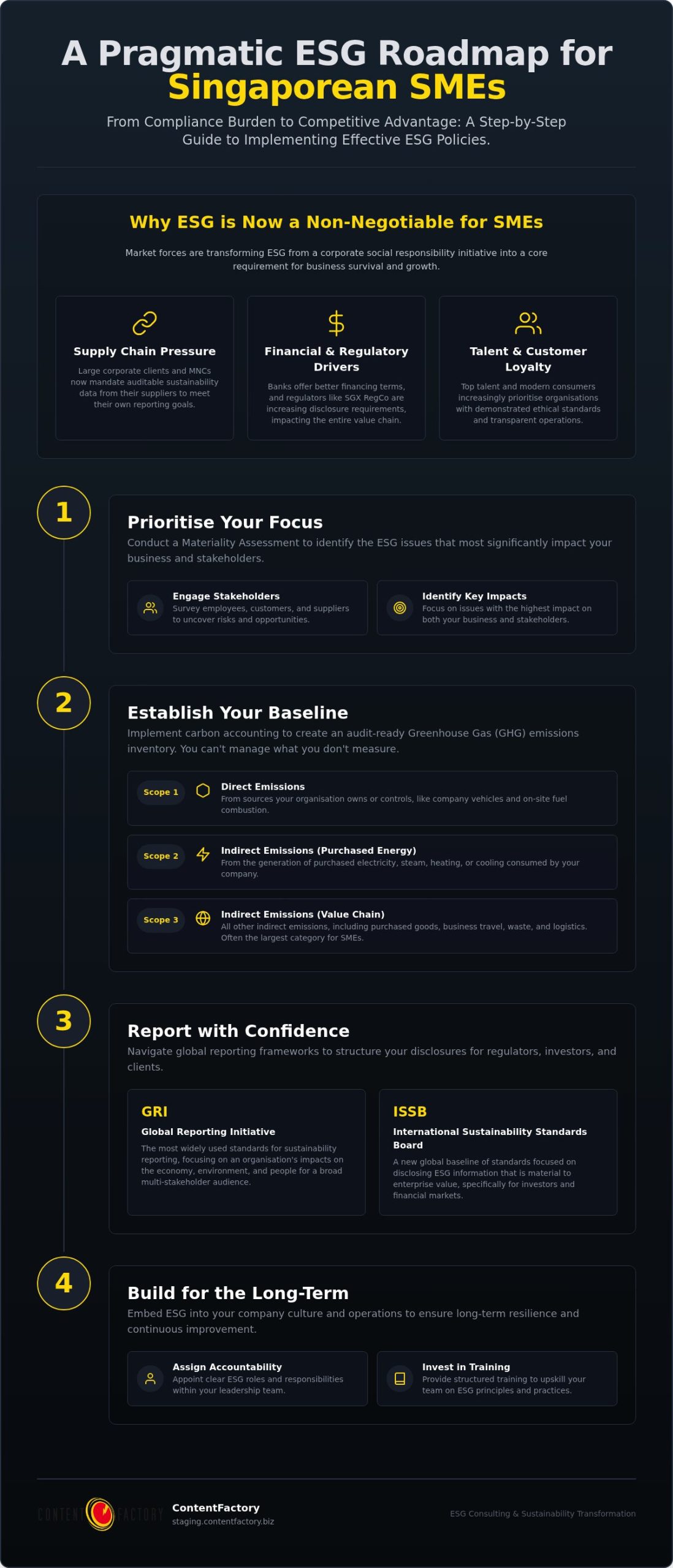
Learning how to implement ESG policies in a small business requires a focus on materiality and operational efficiency rather than complex consulting theory. To succeed, you must identify your primary environmental and social impacts, establish baseline carbon data, and integrate these metrics into existing workflows. This guide provides a clear, execution-focused roadmap to help you navigate Singapore’s specific regulatory environment, including the Green 100 disclosure programme. We’ll show you how to move from abstract goals to measurable outcomes that build brand trust and satisfy compliance demands. By the end of this article, you’ll have a structured approach to integrate ESG into your core operations, ensuring your business remains resilient and competitive in a low-carbon economy.
Key Takeaways
- Shift from viewing sustainability as a cost centre to an operational resilience tool that satisfies regional supply chain mandates.
- Conduct a materiality assessment to filter broad global concerns into a focused, high-impact business strategy for your organisation.
- Establish an audit-ready baseline for GHG emissions by accurately categorising Scope 1, 2, and 3 value chain data.
- Master how to implement ESG policies in a small business while navigating the reporting requirements of GRI and ISSB frameworks.
- Build long-term resilience by assigning clear ESG accountability to your leadership team and investing in structured internal training.
Overcoming the Complexity of ESG Implementation in Small Businesses
Triggers for sustainability readiness in Singapore are accelerating. Regulatory shifts from agencies like SGX RegCo and EnterpriseSG are creating a significant trickle-down effect. Large-cap companies now require their vendors to provide auditable sustainability data to satisfy their own reporting mandates. This investor and supply chain pressure makes Environmental, social, and governance (ESG) reporting a structural necessity rather than a marketing choice. If you don’t have the data, you don’t get the contract.
To succeed, you must stop viewing these requirements as a cost centre. Shift your focus toward operational resilience and efficiency. A well-integrated ESG strategy reduces resource waste and improves long-term stability. It also serves as a powerful differentiator for talent retention. Skilled professionals in Singapore increasingly prioritise organisations with clear values and ethical standards. Similarly, customer loyalty strengthens when you demonstrate a commitment to transparent operations. Resilience is the natural byproduct of a business that understands its impact.
The SME ESG Readiness Gap
Small firms often struggle because they attempt to copy multi-national frameworks that are too complex for their scale. This creates a “readiness gap” where daily operations remain disconnected from international standards. Attempting to track every possible metric simultaneously leads to resource exhaustion and data inaccuracies. This lack of focus is the primary reason small businesses fear accusations of greenwashing.
Effective execution begins with a localised ESG Readiness Assessment. This process identifies exactly where your current data collection falls short of requirements. You should identify quick wins first. Reducing energy consumption in your facility or implementing systematic waste management provides immediate cost savings. These tangible results prove the value of the strategy to your internal team before you tackle more complex Scope 3 reporting.
Value Chain Integration as a Growth Driver
Large companies are aggressively auditing their SME suppliers for compliance. If you cannot provide transparent data, you risk being excluded from major procurement cycles. Understanding how to implement ESG policies in a small business allows you to position your firm as a preferred supplier. Transparent policy disclosure builds trust with procurement heads who are under pressure to de-risk their own supply chains.
Beyond contract wins, ESG performance directly impacts your financial health. Banks and insurers in Singapore are refining their risk models to favour sustainable businesses. Demonstrating a clear ESG roadmap can secure better terms for trade finance and lower insurance premiums. By operationalising these policies, you convert compliance into a competitive advantage that drives measurable growth.
Conducting a Materiality Assessment to Prioritise ESG Issues
Small businesses often make the mistake of trying to address every ESG metric at once. This leads to diluted impact and wasted capital. Materiality is the concept of identifying the environmental, social, and governance issues that most significantly impact your business operations and your stakeholders. A Materiality Assessment is the process of filtering global ESG concerns into a focused business strategy. When you learn how to implement ESG policies in a small business, this assessment serves as your foundational roadmap.
Stakeholder Engagement for Small Firms
You don’t need a massive consulting budget to gather stakeholder insights. For an SME, practical methods include short, targeted surveys for employees and structured interviews with your top five customers and suppliers. These conversations often reveal hidden operational risks, such as supply chain vulnerabilities or shifting buyer preferences. Engaging your team ensures that those on the front lines identify the most pressing social or governance gaps. Once you gather this feedback, your leadership team must align on the final prioritisation to ensure the strategy is actionable and supported from the top.
Building Your SME Materiality Matrix
A Materiality Matrix is a visual tool used to prioritise your implementation roadmap. You plot each identified issue on two axes: “Impact on Business” and “Importance to Stakeholders”. Issues that fall into the top-right quadrant are your material priorities. This focus ensures resource efficiency by directing your limited capital toward areas that drive the most value. It prevents you from chasing irrelevant certifications and keeps your focus on what multinational clients actually care about.
Understanding how to implement ESG policies in a small business starts with this rigorous selection process. This prioritisation also informs your strategic ESG capability building, ensuring your staff are trained in the specific areas that matter most. If you’re unsure which metrics are material to your industry, you can speak with an ESG specialist to validate your findings. By focusing on material issues, you transform a broad compliance requirement into a lean, high-performance business strategy.
Operationalising Sustainability Through Carbon Accounting and Data Integration
Measurement converts your materiality assessment into an actionable performance baseline. For Singaporean SMEs, this specifically means quantifying Greenhouse Gas (GHG) emissions across your entire operation. You must differentiate between three distinct categories: Scope 1 (direct emissions from company-owned assets), Scope 2 (indirect emissions from purchased electricity), and Scope 3 (indirect emissions from your broader value chain). Understanding how to implement ESG policies in a small business requires this granular level of data to satisfy the reporting requirements of multinational partners.
Ensuring your data is audit-ready is critical for mandatory sustainability assurance readiness. This means your data collection process must be transparent, verifiable, and free from material errors. Without a rigorous measurement framework, your sustainability claims risk being dismissed as greenwashing by investors and regulators. Accurate carbon accounting provides the evidence needed to back your strategic commitments.
The 5-Step Carbon Accounting Process
Establishing a reliable carbon baseline follows a methodical structural approach. This ensures consistency across reporting periods and provides a clear view of your environmental impact. You should follow these steps to build a credible inventory:
- Define organisational boundaries and select a base year for future comparison.
- Identify all relevant emission sources across Scope 1, 2, and 3 specific to your sector.
- Collect activity data, such as utility bills, fuel receipts, and procurement logs.
- Apply appropriate emission factors based on recognised international standards.
- Calculate the total carbon footprint and perform internal verification for accuracy.
Digital ESG Integration and Automation
Relying on fragmented spreadsheets is a high-risk strategy that often leads to manual reporting errors. To achieve scalability, you must move toward integrated digital ESG systems. These tools automate the collection of activity data, significantly reducing the administrative burden on your existing team. Automation is particularly vital for managing Scope 3 data, where you must aggregate information from multiple external suppliers. Learning how to implement ESG policies in a small business through digital integration ensures your data remains accurate as you scale.
Digital integration allows you to link emissions data directly to your financial modelling. This connection enables a more sophisticated ROI analysis of your sustainability initiatives. When you can see the direct correlation between energy reduction and operational cost savings, ESG stops being a compliance task and becomes a tool for better business management. This data-led approach ensures your organisation remains resilient while meeting the rigorous transparency demands of the modern business landscape.
Navigating Global Reporting Frameworks: GRI and ISSB for SMEs
Selecting a reporting framework is a strategic decision that dictates your administrative workload and compliance trajectory. You don’t need to adopt every global standard simultaneously. Instead, you must identify which framework your primary stakeholders, such as multinational clients or Singaporean lenders, require for their own disclosures. Understanding how to implement ESG policies in a small business involves adopting a building block approach. You should start with core disclosures that meet immediate value chain demands and expand your reporting scope as your organisation scales.
The Singaporean landscape is increasingly aligned with international standards to ensure regional market access. For SMEs, this often means starting with the Green 100 disclosure programme launched in May 2026. This simplified programme allows you to report on essential metrics before graduating to more complex global frameworks. By aligning with recognised standards early, you avoid the need for expensive structural overhauls when mandatory requirements eventually expand to include mid-market firms.
GRI vs. ISSB: Which Should Your SME Choose?
The Global Reporting Initiative (GRI) remains the most common standard for reporting a company’s broader impact on the economy, environment, and people. It focuses on outward impact materiality, making it the preferred choice for firms answering to diverse stakeholders like local communities and employees. If your primary goal is to demonstrate corporate citizenship and social responsibility, GRI provides the most comprehensive structural foundation.
Conversely, the International Sustainability Standards Board (ISSB) focuses on financial materiality. These standards, specifically IFRS S1 and S2, are designed to show how ESG risks and opportunities impact your business’s financial value. This inward focus is what investors and banks prioritised during the 2025 mandatory reporting rollout for listed companies. The global trend is moving toward interoperability, which means data collected for one framework will increasingly satisfy the requirements of the other.
Preparing for Mandatory Assurance
Assurance-ready data is no longer optional for firms operating within global supply chains. Large non-listed companies in Singapore with significant revenue are required to report starting from financial year 2027. This creates a direct requirement for their SME suppliers to provide verified data. You must implement robust internal controls to ensure every ESG disclosure is backed by a clear evidence trail. This prevents the reputational risk of data inaccuracies and ensures your reports can withstand external scrutiny.
The foundation of any assured report is accurate carbon accounting. When your emissions data is calculated using recognised factors and verified through digital systems, the assurance process becomes a routine check rather than a crisis. Learning how to implement ESG policies in a small business with an eye toward assurance ensures your organisation remains a trusted partner in the regional ecosystem.
Developing Internal ESG Competencies for Long-Term Resilience
Assigning clear accountability is the first step toward operationalising sustainability. You must avoid the mistake of treating ESG as a side project handled by a junior staff member. Instead, delegate specific responsibilities to your existing leadership team. This ensures that environmental and social metrics are weighed alongside financial performance during every board meeting. By reviewing and updating your policies annually, you ensure the organisation remains aligned with evolving Singaporean regulations and changing value chain expectations.
Sustainability metrics must be embedded directly into your core operations. This is best achieved through systematic business process reengineering. If ESG data collection is a manual, siloed task, it will eventually fail. When you integrate these requirements into your daily workflows, they become a standard part of how you do business. This structural integration is the most efficient way to maintain long-term compliance without bloating your headcount.
Capability Building for Leadership and Staff
A significant knowledge gap often prevents effective execution. Investing in structured ESG training for management teams is essential to bridge this gap. Leadership must understand the technical nuances of materiality and carbon accounting to make informed strategic decisions. When the top level is competent, they can better guide the rest of the organisation toward sustainability goals.
Creating a culture of sustainability requires that every employee understands their specific contribution to the roadmap. Whether it is a warehouse manager tracking machinery fuel or a procurement officer vetting suppliers, everyone has a role in data integrity. You should use ESG performance as a key performance indicator (KPI) for individual business units. This incentivises the right behaviours and ensures that sustainability targets are met with the same urgency as sales quotas.
The Path Forward: From Strategy to Execution
Small businesses often fail by over-investing in slide deck strategies that never reach the shop floor. Execution is far more valuable than theoretical planning. Learning how to implement ESG policies in a small business means focusing on tangible, incremental improvements that drive resilience. You must set measurable, time-bound targets for emissions reduction and social impact to track your progress effectively.
Regularly communicating this progress to your stakeholders builds the trust necessary for long-term growth. Whether you’re reporting to a primary lender or a multinational client, transparency regarding your journey is vital. Even if you haven’t reached all your targets, showing a clear, data-backed trajectory demonstrates professional maturity. This pragmatic approach to how to implement ESG policies in a small business ensures you remain a preferred partner in the regional ecosystem.
Operationalising ESG for Long-Term Market Competitiveness
ESG is no longer a voluntary reporting exercise; it’s a fundamental requirement for Singaporean firms aiming to secure regional contracts. By prioritising materiality and establishing a robust carbon accounting baseline, you transform a compliance burden into an engine for operational resilience. You’ve learned how to implement ESG policies in a small business by focusing on data integrity and leadership accountability rather than abstract theory. This roadmap ensures your organisation remains resilient against regulatory shifts while meeting the rigorous transparency demands of global supply chains.
ContentFactory provides Singapore Certified Management Consultant led advisory to help you navigate these complexities with precision. We specialise in SME ESG readiness and materiality assessments, offering pragmatic, execution-focused solutions that bridge the gap between sustainability goals and measurable business results. Transitioning to a low-carbon economy is a significant structural shift, but with the right systems in place, your business will thrive.
The path to sustainability is a journey of continuous improvement and strategic integration. Start today to secure your position as a preferred partner in the 2026 business landscape.
Grant quantum, support levels and eligibility criteria are set by the relevant Singapore government agencies and are subject to change. Eligibility is assessed case by case.
Frequently Asked Questions
What is the first step in implementing ESG for a small business?
The first step is conducting an ESG Readiness Assessment to identify your current baseline against international standards. This diagnostic process highlights your specific data gaps and operational weaknesses before you commit to a reporting framework. By performing this initial gap analysis, you avoid wasting resources on irrelevant metrics. It ensures that your strategy is grounded in your actual business reality rather than theoretical ideals.
Do small businesses need to report on Scope 3 emissions?
Yes, small businesses are increasingly required to report Scope 3 emissions to remain in the supply chains of multinational corporations. While you may not have a direct legal mandate yet, your larger clients need this data to satisfy their own mandatory reporting requirements. Failing to provide accurate value chain emissions data can lead to your exclusion from major procurement cycles. It’s a critical factor for maintaining market access.
How much does it cost to implement an ESG policy in an SME?
The cost of learning how to implement ESG policies in a small business depends on the complexity of your operations and the depth of data required. Instead of viewing this as a fixed expense, you should treat it as an investment in operational efficiency. Reducing resource waste and energy consumption provides a direct financial return. Many firms find that the long-term savings and improved contract win rates far outweigh the initial implementation costs.
Which ESG reporting framework is best for Singapore-based small businesses?
Singapore-based SMEs should start with the Green 100 programme for simplified disclosure before moving to the GRI standard for broader impact reporting. If your primary stakeholders are banks or investors, the ISSB framework is better suited for demonstrating financial materiality. Selecting the right framework depends on which set of stakeholders you need to influence most. A modular approach allows you to scale your reporting as your business grows.
Can a small business get a government grant for ESG implementation?
Yes, eligible Singaporean SMEs can apply for the Enterprise Development Grant (EDG) to co-fund up to 70% of qualifying sustainability projects. This support helps offset the costs of consultancy and capability building required for ESG transformation. You must work with a Singapore Certified Management Consultant to qualify for certain grant components. Grant quantum, support levels and eligibility criteria are set by the relevant Singapore government agencies and are subject to change. Eligibility is assessed case by case.
What is a materiality assessment and why is it necessary?
A materiality assessment is a strategic process used to identify and prioritise the environmental, social, and governance issues that most impact your business and stakeholders. It is necessary because it prevents resource dilution by focusing your efforts on high-impact areas. Without this assessment, your ESG strategy will lack focus and fail to address the specific risks that matter to your clients and lenders. It is the filter for effective execution.
How often should a small business update its ESG policies?
You should review and update your ESG policies at least annually to ensure alignment with shifting regulations and stakeholder expectations. Frequent updates are also necessary if your business undergoes significant changes, such as entering a new market or launching a new product line. Regular reviews ensure your data remains accurate and your strategy stays relevant. This proactive approach prevents your sustainability efforts from becoming stagnant or non-compliant over time.
What is the difference between ESG and CSR for small firms?
What is the difference between ESG and CSR for small firms?
While Corporate Social Responsibility (CSR) often focuses on voluntary, qualitative philanthropic activities, ESG is a quantitative framework integrated into your core business operations. ESG involves measurable data points, such as carbon accounting and governance structures, which are used by investors to assess risk. For a small firm, CSR might be a charitable donation or a custom employee appreciation initiative—and you can read more about professional gifting options—whereas ESG is a structural commitment to reducing Scope 1 emissions. ESG is about long-term business resilience.

Article by
Mayuresh Godse
Mayuresh Godse is a Singapore Certified Management Consultant and Business Strategist specializing in Sustainability, ESG, AI-driven Digital Transformation, and business growth. Based in Singapore, he writes about Sustainability, Digital Innovation, Business Strategy, and Content Marketing for global audiences.
Disclaimer
This article is provided by ContentFactory for general information only and is not legal, tax, accounting or financial advice. Regulations and government scheme criteria change; grant eligibility and quantum are set by the relevant Singapore agencies and assessed case by case, with no outcome guaranteed. Verify current requirements before acting.
One thing worth checking on the tool side: if the disclaimer is switched on globally, the grant caveat already written into your Global Writing Instructions will appear as well, so grant articles will carry the same point twice. Remove the required-disclaimer section from the instructions file if you enable this one.