

A sustainability strategy only matters when it changes how the business operates. Integrating sustainability into business strategy means aligning leaders on priorities, assessing current maturity, setting measurable objectives and translating them into funded projects with clear owners. The work then moves beyond a central sustainability team: departments build the objectives into decisions, responsibilities and performance measures.
That shift can be difficult when accountability is unclear, sustainability data is fragmented or teams lack the skills to act. A plan on paper will not resolve these barriers. You need a practical sequence that connects business priorities to operational changes and gives leaders a way to track progress.
This guide shows you how to secure executive alignment, assess your organisation’s sustainability maturity and build a transformation roadmap. It also explains how to turn that roadmap into projects, assign ownership and define useful measures. The aim is a strategy your teams can apply in day-to-day decisions, not a set of commitments separate from the business.
Key Takeaways
- Assign clear executive and departmental ownership so sustainability priorities don’t stall between teams.
- Connect climate, human rights and fair governance priorities to your organisation’s values and business decisions.
- Use a maturity assessment to identify gaps in material issues, emissions data, capabilities and governance before setting a transformation roadmap.
- Turn strategic priorities into organisational projects with accountable owners, practical measures and objectives that teams can act on.
- Use regular communication and performance updates to keep leaders and employees aligned on progress and next steps.
How can organizations overcome challenges in integrating sustainability into their operations?
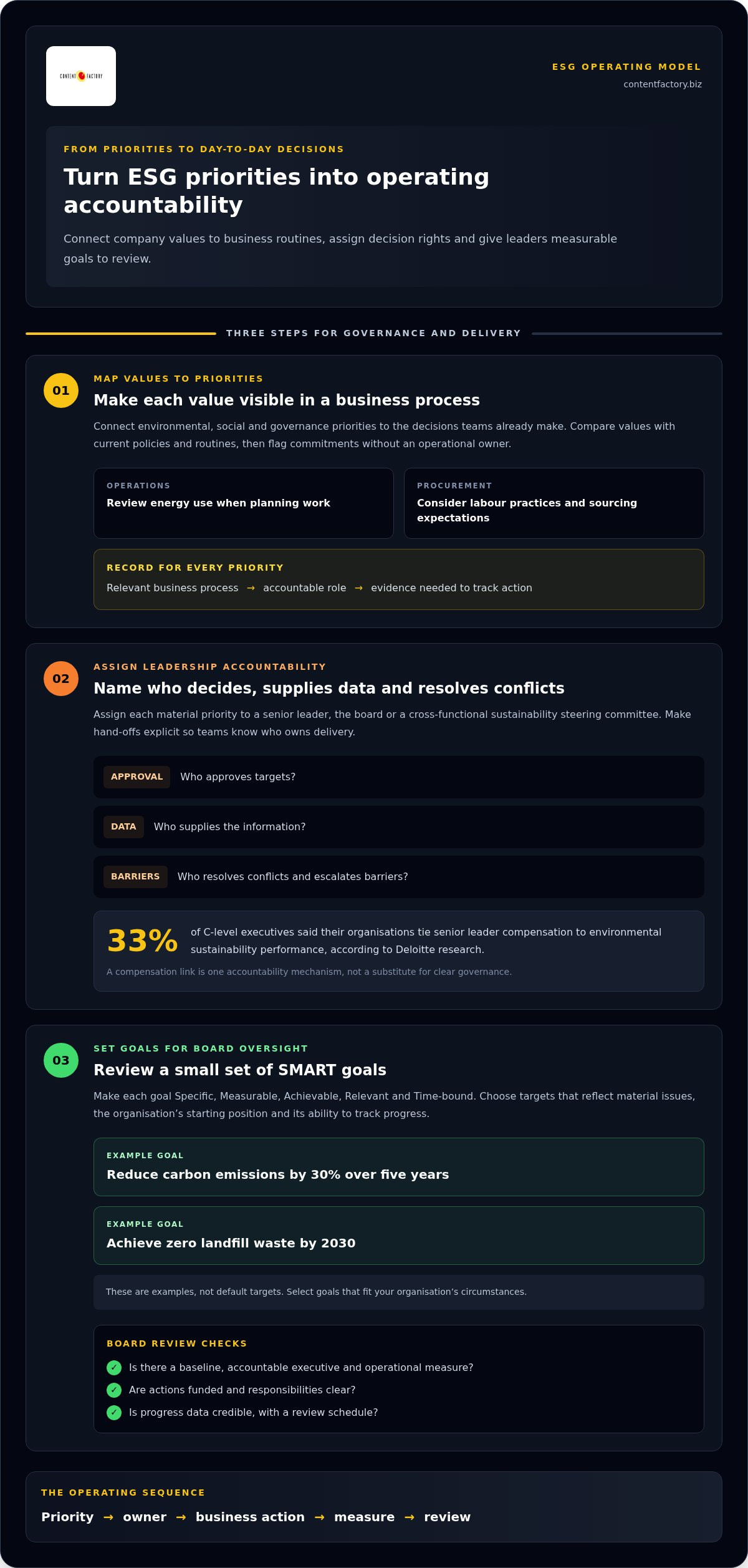
Companies can reduce fragmented efforts by linking ESG priorities to organisational values, leadership accountability and measurable goals. Assign decision rights, then translate each priority into a named owner, a business action and a review measure.
Use these steps to bring governance and delivery into the same operating approach.
Map Company Values to ESG Pillars
Map company values to environmental, social and governance priorities. If your organisation values responsible growth, connect climate action to operating decisions, human rights to workforce and supplier practices, and fair governance to transparent responsibilities. Compare each value with current policies and routines. Flag gaps where a public commitment has no operational owner or where efficiency targets conflict with social safeguards.
Then rank issues by business relevance and stakeholder impact. For example, a company with energy-intensive operations could prioritise emissions and energy use, while a labour-intensive business could examine worker conditions. Keep climate, human rights and fair governance visible together. Treating carbon as the only sustainability issue leaves social and governance risks outside the decision process.
Make the mapping useful to teams by linking each priority to a decision they already make. Operations might review energy use when planning work; procurement might consider labour practices and sourcing expectations. Record the relevant business process, accountable role and evidence needed to track action. This embeds values in everyday work instead of leaving them as broad statements.
Embed ESG in Leadership Accountability
Assign each material priority to a senior leader, the board or a cross-functional sustainability steering committee. Specify who approves targets, supplies data and resolves conflicts between financial and environmental priorities. Unclear governance can create bottlenecks, especially when departments assume another team owns delivery. A responsibility map makes these hand-offs explicit, and engaging strategic advisory from Robin Lohmann can help executive teams navigate complex structural changes and establish clear management accountability.
Build ESG measures into performance discussions, not just annual statements. Leaders can link relevant team objectives and incentives to progress, while retaining oversight of financial performance and data quality. Deloitte research found that 33% of C-level executives said their organisations tie senior leader compensation to environmental sustainability performance. Treat compensation links as one accountability mechanism, not a substitute for clear governance.
Give the accountable leader authority to bring together the teams that control relevant information and actions. A climate target, for example, may require input from facilities, finance and procurement. Set a clear route for escalating barriers, and document decisions so teams know what changed, who owns the next action and how progress will be reviewed.
Set Sustainability Goals for Board Oversight
Ask the board to review a small set of SMART goals: Specific, Measurable, Achievable, Relevant and Time-bound. One example is reducing carbon emissions by 30% over five years; another is achieving zero landfill waste by 2030. These are examples, not default targets. Select goals that reflect your company’s material issues, starting position and ability to track progress.
Give each goal a baseline, accountable executive, operational measure and review schedule. Board oversight should examine whether actions are funded, responsibilities are clear and progress data is credible. If a target is off track, identify the barrier and adjust the delivery plan rather than hiding the gap. This makes sustainability goals part of governance decisions and keeps accountability tied to operational results.
Use board reviews to distinguish changes in performance from changes in measurement. If a team revises its data collection method, explain how this affects comparisons with earlier reporting. This context helps directors assess progress fairly and decide whether the response should address delivery, data quality or the goal itself.
What does it mean to embed sustainability into corporate strategy?
It means incorporating environmental and social priorities into decisions about products, suppliers, investment and growth. Use these steps to connect sustainability objectives with customer value and business resilience.
Identify Strategic Value and Resilience
Start by identifying where sustainability can support customer value, innovation or continuity. Examine which products, services and operating choices could deliver clear environmental or social benefits. In Singapore, about 65% of consumers consider sustainability practices important when making buying decisions. Treat this as a reason to understand customer priorities, not a promise that every initiative will increase sales.
Invest in Long-Term Continuity
- Review critical dependencies across your operations and supply chain. Identify materials, services or locations where disruption could affect your ability to serve customers. Then assess suppliers’ environmental and social practices, including relevant labour conditions and sourcing processes. Ethical sourcing can help reduce supply-chain risk, but it requires clear criteria and consistent follow-up, not a one-off supplier declaration.
Use that review to prioritise practical actions. You might work with suppliers to improve resource efficiency, clarify expectations for labour practices or consider alternative inputs. For each action, record the business risk addressed, the responsible team and how progress will be assessed. This connects resilience planning with everyday purchasing decisions instead of keeping sustainability separate from procurement.
- Connect long-term stakeholder value with investment decisions. Consider how a proposal affects customers, employees, suppliers, communities and the environment alongside its financial case. A new product, for instance, can be assessed for resource use across its lifecycle, customer relevance and operational feasibility. This broader view can reveal product-development opportunities while helping leaders weigh trade-offs openly.
Set a review point for each initiative and compare actual progress with its original objectives. If you need to clarify how sustainability priorities fit your business model, discuss your strategic priorities. Keep the resulting actions specific: name an owner, identify the dependency or opportunity, and decide what evidence will show whether the project supports continuity and stakeholder value.
Executive understanding and communication of sustainability strategy
Executives need a shared understanding of priorities, evidence and responsibilities before sustainability initiatives can guide decisions. Set a consistent reporting rhythm so leaders can act on progress, gaps and emerging regulatory expectations.
Build Executive Understanding
Brief executives on how each sustainability priority connects to business decisions, risks and performance. Use a concise reporting pack that distinguishes measured results, estimates and unresolved data gaps. The CFO can coordinate sustainability information with finance controls, helping leaders use consistent figures in reporting and decision-making.
Companies comparing GRI, ISSB and TCFD should consider each framework’s purpose and intended audience. GRI focuses on an organisation’s impacts, ISSB on sustainability-related information useful to investors, and TCFD on climate-related financial disclosures.
Track metrics that reflect material impacts and strategic objectives. Climate measures can include Scope 1, 2 and 3 emissions; other useful indicators may cover energy, waste, workforce conditions and governance actions. Define each KPI’s scope, owner, source and review frequency so reported changes remain interpretable.
Use multi-framework sustainability reporting to organise disclosures around relevant frameworks and stakeholder needs. Treat frameworks as tools for structuring information, not substitutes for understanding which impacts matter to your organisation.
Engage Stakeholders and Avoid Greenwashing
Build a communication plan for employees, suppliers and customers. Give each group relevant information and a clear way to contribute: employees can share operational ideas, suppliers can discuss sourcing practices, and customers can respond to product information. Regular cross-department channels help teams exchange practical solutions and flag delivery barriers.
Businesses can share sustainability results with employees monthly or quarterly. Use those updates to explain progress, setbacks and next actions, rather than presenting only favourable results. Executives can communicate the strategic direction, while team leaders explain how specific responsibilities connect to daily work.
Greenwashing risks arise when claims are broad, unsupported or inconsistent with actual performance. Reduce these risks by defining claim boundaries, retaining evidence for reported results and explaining material limitations in plain language. If information is uncertain, present ranges, scenarios or confidence intervals with explanatory context rather than implying precision.
Engage suppliers and customers with specific, verifiable information. For example, describe the product attribute being measured and the boundary used, then distinguish completed actions from future objectives. This helps stakeholders assess sustainability initiatives without confusing ambition with achieved results.
Maturity assessments and transformation roadmaps
Assess your current data, governance and delivery capabilities before choosing sustainability initiatives. A maturity assessment identifies gaps; a transformation roadmap turns those findings into sequenced work.
To measure Scope 1, 2 and 3 emissions, establish organisational boundaries, gather activity data and apply suitable emissions factors. Separate direct emissions, purchased energy and value-chain sources so you can see where estimates, data gaps and improvement opportunities sit.
Measure Environmental and Social Impacts
Map material environmental and social impacts across your operations and value chain. For climate, review Scope 1, 2 and 3 emissions, recording data sources, calculation methods and uncertainty. Assess other relevant impacts, such as waste, resource use, workforce conditions and supplier practices, against your business activities and stakeholder concerns.
Assess how consistently your organisation can measure and manage each issue. Check whether teams use defined methods, responsibilities are clear and leaders receive usable information. A maturity assessment should distinguish established processes from isolated initiatives, and reliable data from estimates that need improvement.
Prioritise issues by their potential effect on people, the environment and business performance. One interviewee suggested using 20 metrics considered material for a sector as a proxy for performance on important sector dimensions. Treat that as a starting point, not a universal checklist: select measures relevant to your sector and impacts.
Include climate risk assessment and scenario planning to identify vulnerabilities in operations, supply chains and business positioning. Consider how different climate conditions could affect critical resources, facilities or suppliers. Record the assumptions behind each scenario, then connect identified risks to existing risk-management and decision-making processes.
Develop a Transformation Roadmap
Translate assessment findings into a prioritised roadmap with defined workstreams, owners and measures. Start with gaps that block reliable decisions, such as incomplete emissions data or unclear accountability. Then sequence operational initiatives according to dependencies, expected impact and the people or systems needed to deliver them.
For each initiative, state the issue addressed, the action required, the accountable team and the evidence used to track progress. Include a compliance solution where relevant, and integrate the work across the organisation rather than treating it as a standalone sustainability workstream. This structure connects environmental and social objectives with established planning and oversight.
Test the roadmap against climate scenarios and business priorities. If a scenario exposes dependence on a vulnerable input, assign a team to assess alternatives and report its findings. Integrate material ESG risks into enterprise risk management so leaders can consider climate threats, regulatory changes and resource constraints alongside other business risks.
Set review points to compare planned milestones with actual progress. When data quality or capability limits delivery, make that gap a defined work item with an owner and next action. This keeps the roadmap responsive, supports a clearer view of success and protects reputation through evidence-led decisions.
Applying sustainability strategy through organizational projects
Make each sustainability project change a defined business activity, not just produce a report. The practical test is whether the new approach becomes part of routine operating decisions.
- Define the operational change before choosing a project solution. For a packaging initiative, specify which product lines, packaging materials and handling processes are in scope. Record the intended environmental outcome alongside constraints such as product protection, storage and customer use. A clearly defined scope helps teams compare proposals consistently.
Map the decision points the project will affect. Product design, purchasing specifications and warehouse handling may each influence the final result. Identify where teams need revised instructions or approval criteria. Without this step, a project can meet its delivery milestones while leaving the underlying business practice unchanged.
- Sequence projects around dependencies, not just visibility. A waste-reduction initiative may depend on changes to product specifications, supplier arrangements and staff procedures. Map these links before setting delivery dates, then decide which changes must happen first. This makes the project portfolio more coherent and reduces the risk of teams working from conflicting assumptions.
Where a proposed change is unfamiliar, test it in a controlled part of the operation before extending it. For example, trial a revised material-handling method in one process area and document operational issues alongside environmental effects. Use the findings to refine instructions and requirements before applying the approach more widely.
- Specify how the new practice will be maintained after implementation. Update relevant operating procedures, purchasing criteria or product specifications, and assign responsibility for keeping them current. If you introduce reusable packaging, for instance, clarify how it is returned, inspected and put back into use. These details determine whether the initiative becomes a lasting operating practice.
Plan the handover while designing the project. Identify the team that will own the process, the information it needs and the decisions it can make. Include training where the new method changes daily work. A clear handover ensures responsibility continues after the project team completes its delivery tasks.
- Assess outcomes against the project’s original scope and operating conditions. Separate changes caused by the initiative from other changes, such as shifts in production volume or product mix. If a packaging trial reduces material use per unit, record the measurement method and any effects on product handling. This makes the evidence more useful for future decisions.
Use the review to decide whether to adapt, extend or stop the initiative. Capture practical lessons, including supplier constraints, staff feedback and maintenance requirements, then apply them to the next relevant project. If you need support connecting sustainability priorities with operational delivery, Contact Us.
ContentFactory: ESG Readiness & Materiality Assessments
ContentFactory helps you assess your organisation’s ESG maturity and material issues, then turn sustainability priorities into a basis for action. Use an ESG Readiness & Materiality Assessment to identify gaps, prioritise impacts and establish a practical starting point.
Where emissions data is a key gap, GHG Emissions Calculation and Carbon Accounting can help assess your footprint. Multi-Framework Sustainability Reporting can organise disclosures around frameworks relevant to your reporting needs. These services support a structured approach, from understanding current performance to preparing sustainability information.
If you’re ready to discuss the next step for your organisation, contact ContentFactory.
Make sustainability part of your next planning cycle
Choose an upcoming business decision where sustainability should carry real weight. It could shape a product review, supplier discussion or investment proposal. Put relevant evidence in front of decision-makers before they commit, and record how sustainability influenced the choice. This creates a practical reference point for future planning.
Integrating sustainability into business strategy is ongoing work, not a one-off exercise. As your organisation learns from implementation, refine priorities and strengthen how sustainability informs decisions. Focus on actions that fit your operating context and can be reviewed alongside other business objectives.
If you’re deciding how to move from current plans to the next practical step, Contact Us to discuss your organisation’s needs. A clear starting point can help your team build momentum at a pace that suits the business.
Frequently Asked Questions
Why Is Sustainability Critical for Business Success?
Sustainability matters because business success depends partly on how well you manage resource use, stakeholder expectations and exposure to disruption. A manufacturer tracking material waste, for example, can identify process inefficiencies while considering environmental impact. Addressing relevant issues can also help protect relationships with customers, employees and suppliers. Focus on sustainability risks and opportunities that could affect your organisation’s ability to operate and deliver value.
What does integrating sustainability into business strategy mean?
Integrating sustainability into business strategy means factoring relevant environmental and social considerations into routine business choices, rather than treating them as separate projects. A product team might include material use and product lifespan in design reviews, while procurement considers supplier practices alongside quality and delivery. The aim is to make these considerations part of planning, investment and operational decisions, with responsibilities suited to your organisation’s structure.
What are the business benefits and ROI of sustainability initiatives?
The business case depends on the initiative and how you measure its effects. A project that reduces energy or material use may lower operating requirements; a product redesign may respond to customer preferences or reduce waste. To assess return on investment, compare the project’s resources and implementation costs with measured operational changes and relevant commercial outcomes. Set a baseline first, then track financial effects and sustainability performance.
How to develop a sustainability strategy aligned with business goals?
Start with your organisation’s current objectives, such as improving operational efficiency, protecting supply continuity or developing products. Identify which sustainability issues could affect those objectives, then choose priorities your teams can influence. For each priority, define a measurable outcome, accountable owner, required resources and review method. Finally, test the plan against competing operational demands so sustainability actions support business priorities rather than sit outside them.
What are the steps to embed sustainability across operations and supply chains?
Map the activities and supplier relationships connected to your material sustainability impacts. Identify where operational decisions influence resource use, emissions or working conditions, then set expectations for relevant teams and suppliers. Build those expectations into existing processes, such as purchasing reviews or product checks, and assign owners to monitor evidence. Use supplier discussions to understand practical constraints and identify improvements that support responsible sourcing and operational continuity.

Article by
Mayuresh Godse
Mayuresh Godse is a Singapore Certified Management Consultant and Business Strategist specializing in Sustainability, ESG, AI-driven Digital Transformation, and business growth. Based in Singapore, he writes about Sustainability, Digital Innovation, Business Strategy, and Content Marketing for global audiences.
Disclaimer
This article is provided by ContentFactory for general information only and is not legal, tax, accounting or financial advice. Regulations and government scheme criteria change; grant eligibility and quantum are set by the relevant Singapore agencies and assessed case by case, with no outcome guaranteed. Verify current requirements before acting.