

An approved EDG scope can look clear on paper, yet your team may still be unsure how to put it into practice. Without a shared plan, ownership and evidence can become unclear, and a delivery change may raise questions about alignment with the approved project. Managing EDG grant project milestones means turning the approved scope into a practical working plan, not simply tracking dates.
Responsibilities and progress updates can become scattered across people and files. An internal plan helps your team coordinate work and retain relevant records as the project moves forward. It also distinguishes your own checkpoints from formal grant conditions.
This article explains how to build the plan, assign ownership, maintain records, respond to delays and proposed changes, and prepare for close-out. The aim is to give your team a practical way to manage delivery while keeping project decisions aligned with the applicable grant terms.
Key Takeaways
- Keep your milestone plan anchored to the approved scope and the grant conditions that apply to your project.
- Break approved deliverables into observable progress points, then assign an internal owner to each one.
- Use clear progress statuses and a review cadence suited to your project’s complexity to identify risks early.
- Treat delays and proposed scope changes as triggers for review, not as changes with an assumed grant outcome.
- Before close-out, reconcile completed work with the approved scope, organise supporting evidence and check current Enterprise Singapore guidance.
Why managing EDG grant project milestones matters after approval
Starting delivery without translating the approved scope into clear work and ownership leaves room for confusion. Team members may have different views of what must be delivered, who is responsible and what records to keep. Use your approval documents and applicable grant conditions as the shared reference point when work begins.
Managing EDG grant project milestones is an internal control practice, not a substitute for checking formal requirements. Your team can set its own checkpoints to monitor progress, but don’t assume they are official EDG milestones or reporting duties. Review current Enterprise Singapore guidance and your approval documents to establish what applies to your project.
Consistent tracking helps you identify slippage, clarify decisions and maintain a record of delivery. Internal records support project management, but they do not determine whether a claim will be approved or grant support disbursed. Formal assessment depends on the applicable grant conditions and requirements.
What a project milestone means in EDG delivery
A milestone is a meaningful, verifiable point in delivering the approved project. It marks progress towards a deliverable, rather than every routine task or a broad intention such as “make progress”. It should help your team see what has been completed and what remains, with evidence relevant to that point.
Illustrative example: If a project includes developing a new internal procedure, an internal checkpoint might be completion of a draft for review. This is a planning example, not an official EDG requirement. Set checkpoints to make delivery visible without presenting your chosen dates or wording as prescribed by Enterprise Singapore.
Start with the approved project, not a generic template
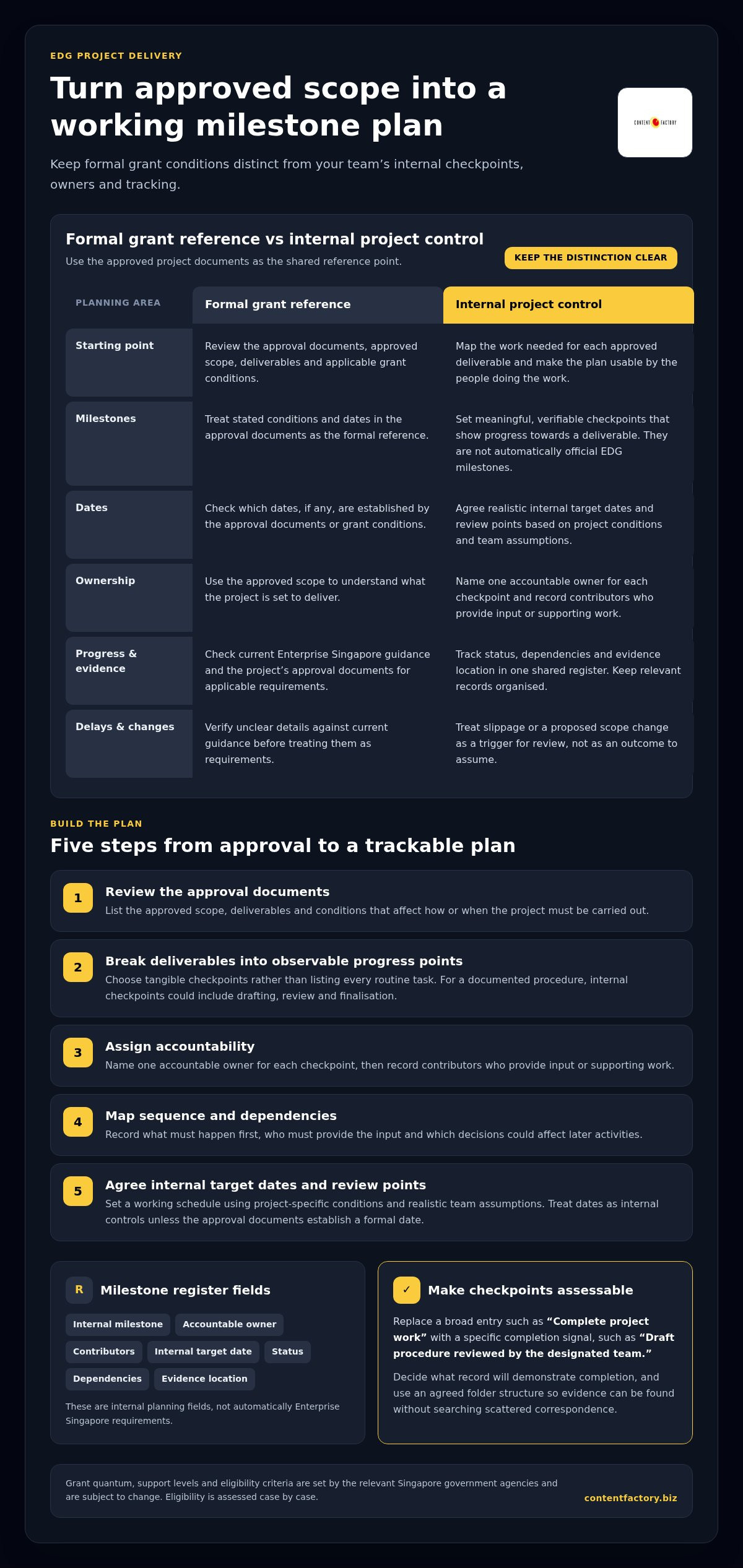
Before setting checkpoints, review your approval documents and applicable grant conditions. Identify the approved scope, deliverables and any stated conditions that affect delivery. Then map the work needed for each deliverable and assign an internal owner. A template can organise the plan, but it cannot determine what your project is required to deliver.
For context on Singapore grant support and application considerations, see the Enterprise Singapore grants guide. For milestone planning, use the approved project documents as your working reference. Record which checkpoints are internal controls and note any formal requirements separately. If a detail is unclear, verify it against current Enterprise Singapore guidance before treating it as a requirement.
As a practical first step, create a short scope register. List each approved deliverable, the document or condition it relates to, its internal owner and the evidence your team expects to retain. This turns the approval into a usable delivery reference and helps prevent internal planning decisions from being mistaken for formal grant rules.
How to turn an approved EDG scope into a milestone plan
Build the plan from what was approved, then make delivery manageable for the people doing the work. A clear sequence shows how deliverables connect, who is accountable and what will demonstrate that each checkpoint is complete. This gives your team a practical structure without confusing internal planning choices with formal grant requirements.
Use this workflow to translate the approved project into internal controls:
- Review the approval documents. List the approved scope, deliverables and any conditions that affect how or when the project must be carried out.
- Break deliverables into observable progress points. Choose checkpoints that show tangible progress towards a deliverable, rather than listing every routine task. For example, a team preparing a documented procedure might track drafting, internal review and finalisation as separate internal checkpoints.
- Assign accountability. Name one accountable owner for each checkpoint and record contributors who will provide input or complete supporting work. Shared effort is useful; unclear accountability is not.
- Map sequence and dependencies. Note what must happen first, such as receiving an agreed input before a review can begin. Flag decisions that could affect later activities.
- Agree internal target dates and review points. Base the working schedule on project-specific grant conditions and realistic team assumptions. Treat these dates as planning controls unless the approval documents establish a formal date.
Build a milestone register your team can maintain
Keep one shared register as the working source of truth. Useful fields include the internal milestone, accountable owner, contributors, internal target date, status, dependencies and evidence location. These are internal planning fields, not automatically Enterprise Singapore requirements. Name someone to maintain the register, update it after reviews and flag overdue or at-risk items to the project lead.
Make each entry specific enough to guide action. “Complete project work” is hard to assess. “Draft procedure reviewed by the designated team” identifies a checkpoint and a completion signal. Add a link or file path for relevant evidence, using an agreed folder structure so the owner can find it without searching through scattered correspondence.
Connect dependencies, owners and evidence
A checkpoint rarely stands alone. Show which earlier activity it depends on and who must provide the input. Decide before work begins what record will demonstrate completion, based on the approved scope. For example, a dated deliverable or recorded review may serve as an internal completion signal when relevant to the work. The record should be specific enough for another team member to understand why the checkpoint was marked complete.
Where the approved scope or conditions are complex, ContentFactory provides strategic grant advisory and financial modelling to help translate grant terms into practical controls. You can discuss grant project planning support with the team.
How to track EDG milestone progress and keep useful evidence
A milestone plan only helps if the team keeps it current. Use a consistent status system and review progress often enough to spot issues while there is still time to respond. Set the review cadence to suit the project’s complexity and pace. This is an internal management choice, not a prescribed Enterprise Singapore reporting frequency.
Use status labels that prompt clear decisions:
- Planned: Work has not started, or the checkpoint is waiting for a dependency.
- In progress: Work is under way, and the owner can describe the next step.
- Completed: The checkpoint is finished and its supporting evidence is saved in the agreed location.
- At risk: A delay, dependency or unresolved decision may affect the target date or delivery of an approved deliverable.
Record more than a status label. At each review, note the update date, accountable owner, concise progress summary, decisions made, delays or blockers, next action and evidence location. If a date changes, preserve the earlier target and record why the plan was revised. This gives the team a usable history rather than an unexplained moving deadline.
A useful milestone record brings together its current status, accountable owner and supporting evidence. Keep those details linked in one register or record system, and use consistent naming so another team member can follow the trail without relying on verbal explanations.
Choose evidence that demonstrates progress against approved scope
Evidence should help show what happened and how it relates to the approved work. Depending on the project, relevant records might include a completed deliverable, meeting decisions, review notes or supplier documents. These are examples, not documents that Enterprise Singapore universally requires for every EDG project. Check the applicable grant conditions and current guidance for formal requirements.
Make records accurate and traceable. Where appropriate, retain dates, identify the related milestone and store each file in the agreed location. A note such as “draft reviewed” is more useful when accompanied by the dated draft or a record of the review decision. Capture relevant records as delivery progresses instead of trying to reconstruct the evidence trail at close-out.
Run a review that turns status into action
Compare actual progress with your internal plan, then identify the cause of any material variance. Is a dependency outstanding, has an input changed, or does the owner need a decision? Record the issue, name the person responsible for the next action and set an internal follow-up point. A status entry without an action can document a problem while leaving it unresolved.
Keep decisions alongside the records that support them. For example, link a meeting note about a revised internal sequence to the affected milestone and record who agreed the action. If a change may affect approved scope or grant conditions, treat that as a separate compliance question. Check the applicable terms rather than assuming an internal plan update settles it.
How to manage EDG delays and scope changes without losing control
A delay or proposed change should trigger a review, not an assumption about how Enterprise Singapore will treat it. First establish whether you are adjusting your internal delivery sequence or changing something that may affect the approved scope or grant conditions. An internal recovery plan may help the team get delivery back on track, but it does not determine whether a grant-related change is acceptable.
Record the issue and its implications before deciding what to do. Use a simple change note to capture:
- What has changed or is delayed, and when the issue was identified.
- Which internal milestones, deliverables or dependencies may be affected.
- Whether the approved scope or a stated grant condition could be affected.
- Who owns the decision, what action is proposed and when it will be reviewed.
Respond to delays with a documented recovery decision
Identify the cause of the delay, the milestones it affects and any dependent work that may also move. Then assess whether the recovery plan changes only your internal schedule or could alter an approved deliverable or condition. Assign a decision owner, record the chosen action and update the internal plan. Keep the original target and the reason for any revision visible, rather than replacing the date without explanation.
A schedule recovery might involve resequencing internal activities or resolving an outstanding decision. Treat these as planning options, not assurances about grant treatment. If the proposed response could affect what was approved, pause before committing to it and check the relevant terms and current project-specific guidance.
Check scope changes before committing to them
Compare the proposed change with the approved scope and the conditions in your project documents. A different approach, deliverable or supplier may raise questions that cannot be settled by the internal register alone. Don’t assume a change is either permitted or prohibited. Verify whether notification or a formal variation is required under your specific grant terms, using current Enterprise Singapore guidance.
Until you have clarified the applicable requirements, keep the issue, decision and supporting records together. Note what is known, what remains unresolved and who is responsible for obtaining clarification. This gives the project team a controlled next step without presenting an unverified interpretation as a rule.
After a decision, update affected internal checkpoints and preserve the decision record alongside relevant correspondence or project documents. Make clear whether the approved deliverables remain unchanged or whether the matter needs further formal review. Disciplined records support a clearer review of how the team responded, but do not determine claim approval or disbursement.
ContentFactory provides post-approval grant audit and compliance support to help businesses organise grant records and review project controls. The team can also help if a delay or proposed change has left your project documentation difficult to manage. Find the contact details here.
How to close EDG milestones and prepare for post-approval review
Close-out should confirm what the project delivered, how that work maps to the approved scope and which records support the account. Completing the milestones means reconciling the project, not simply marking every internal checkpoint “done”. Formal submission requirements depend on the applicable grant terms and current Enterprise Singapore guidance.
Reconcile completed work with the approved project
Start with the approved scope and compare each deliverable with the milestone register. For each completed item, confirm that its supporting evidence is present and identifiable. Then list incomplete work, open decisions and records that need clarification. This helps surface gaps while the team can still investigate them, rather than leaving questions buried in a folder at submission time.
- Match deliverables to scope. Note what was completed against each approved deliverable, and flag any difference for review.
- Check milestone evidence. Confirm that the relevant files are accessible, clearly named and linked to the work they support.
- Record open items. Identify outstanding actions, unresolved decisions and the person responsible for following up.
- Organise the project file. Keep approval documents, the milestone register, decision records and supporting evidence in a traceable structure.
Keep internal completion checks separate from formal claim or disbursement requirements. Your close-out list is a management tool; it does not replace the documents, submission process or conditions set for the specific project. Before preparing a formal submission, check current guidance and your project’s approval documents. The EDG advisory strategic guide provides further context on grant considerations for Singapore SMEs.
Prepare records for a clear post-approval review
Build the file so someone unfamiliar with day-to-day delivery can follow the project’s progress. Use a consistent folder structure and keep a simple index that identifies each file, the related deliverable or milestone, and its location. Retain relevant versions and decision records so changes in the project history are understandable, not just visible as a series of updated files.
Before treating the file as ready, check for missing evidence, unclear links between documents and unexplained differences from the approved scope. Where a record is incomplete, note what is missing and who will resolve it. Verify formal documentation or submission requirements against current Enterprise Singapore guidance rather than assuming an internal close-out checklist is sufficient.
ContentFactory supports businesses with grant advisory and post-approval compliance preparation, focusing on disciplined project records and review. For help organising your close-out process, use the contact page.
Make your next project decision with clarity
Make milestone controls part of how the project is managed day to day. Set a time to review the register, confirm who owns outstanding actions and identify any decision that needs checking against your project’s grant conditions. This keeps the approved scope connected to delivery as the work moves forward.
ContentFactory provides strategic grant advisory and post-approval audit and compliance support. Mayuresh Godse is a Singapore Certified Management Consultant with 25+ years of consulting experience. The team can help you approach managing EDG grant project milestones with a disciplined plan and clearer records, while keeping internal controls separate from formal grant requirements.
If you need support reviewing project controls or preparing records, start with a clear view of your responsibilities and the actions that remain. Contact the team.
Frequently Asked Questions
What are project milestones in an EDG grant project?
Project milestones are internal checkpoints that help you see whether work is progressing towards an approved deliverable. For example, a team could track a draft, its review and the handover of a completed output as separate points. These checkpoints help managers identify where follow-up is needed. They do not automatically represent official EDG stages, required reporting points or a prescribed milestone count.
How do I create a milestone plan after EDG approval?
Start by listing the approved deliverables and any conditions that affect your project. For each deliverable, define meaningful checkpoints, assign an accountable owner and identify what will show that each checkpoint is complete. Add internal target dates only after checking project-specific conditions and team dependencies. A good plan gives staff clear actions while keeping internal planning separate from formal grant requirements.
What records should a business keep for EDG project milestones?
Keep records that help explain what was done, when it happened and how it relates to the approved work. Depending on the project, these may include versions of deliverables, review notes, meeting decisions or relevant supplier documents. Maintain a simple index or register that points to each file. These are practical examples, not a universal list of documents required by Enterprise Singapore; check your project terms and current guidance.
How often should an SME review EDG project progress?
Choose a review rhythm that fits the project’s complexity, pace and dependencies. Work involving several contributors or decisions that affect later activities may need closer internal attention than a straightforward phase. Review promptly when a key dependency slips or a decision remains unresolved. There is no single internal review frequency that suits every project, and your meeting schedule should not be treated as an Enterprise Singapore reporting requirement.
What should I do if an EDG project milestone is delayed?
Record what caused the delay and which parts of delivery may be affected. Then decide whether the response involves only internal sequencing or could affect an approved deliverable or grant condition. Assign someone to own the next action, such as resolving a dependency or checking the applicable terms. If the impact may extend beyond your internal schedule, verify the project-specific requirements before acting on an assumption.
Can an EDG project scope or schedule change after approval?
Don’t assume a proposed change is automatically acceptable or prohibited. Compare it with the approved scope and the conditions for your project, then verify with current Enterprise Singapore guidance whether notification or a formal variation is needed. A revised internal target date and a change to an approved deliverable are not necessarily the same issue. Keep a record of the proposed change, its likely impact and the decision taken.
Does completing an EDG milestone mean grant funding will be disbursed?
No. Completing an internal milestone does not by itself establish that funding will be disbursed. A milestone is a project-control checkpoint; formal claims and disbursement are governed by the grant terms and applicable assessment requirements. Check the conditions in your Letter of Offer and current Enterprise Singapore guidance to understand what applies to your project. Keep evidence organised, but do not treat a completed checkpoint as a guarantee of a claim outcome.
Grant quantum, support levels and eligibility criteria are set by the relevant Singapore government agencies and are subject to change. Eligibility is assessed case by case.

Article by
Mayuresh Godse
Mayuresh Godse is a Singapore Certified Management Consultant and Business Strategist specializing in Sustainability, ESG, AI-driven Digital Transformation, and business growth. Based in Singapore, he writes about Sustainability, Digital Innovation, Business Strategy, and Content Marketing for global audiences.
Disclaimer
This article is provided by ContentFactory for general information only and is not legal, tax, accounting or financial advice. Regulations and government scheme criteria change; grant eligibility and quantum are set by the relevant Singapore agencies and assessed case by case, with no outcome guaranteed. Verify current requirements before acting.